
Tokyo vs Kyoto 2026: Which Japanese City Should You Visit?
Tokyo vs Kyoto is the most debated Japan travel question, and for good reason. Both cities are extraordinary. Tokyo is the world’s largest metro area (38 million people), holding more Michelin stars than any city on earth. Kyoto preserves 17 UNESCO World Heritage properties and more than 1,600 Shinto shrines. Most first-timers feel they have to pick one. They don’t. But if your itinerary forces a choice, or you want to know which deserves more of your days, this honest comparison lays out every difference: cost, culture, food, nightlife, transport, and the specific traveler types each city suits best.
Key Takeaways
– Tokyo holds 170 Michelin stars (2026) and a 38-million-person metro – unmatched scale and variety (MICHELIN Guide Tokyo 2026)
– Kyoto protects 17 UNESCO World Heritage sites and 1,600+ Shinto shrines – Japan’s cultural heart (UNESCO)
– Kyoto hotels run 15-25% pricier than Tokyo equivalents; ryokan add USD 200-500/person/night (Booking.com, 2026)
– The Shinkansen connects both cities in 2h15min for ~USD 95 one way – making a dual-city trip easy
– Best approach for most first-timers: 4 nights Tokyo + 3 nights Kyoto on the same tripAffiliate Disclosure: Some links in this article are affiliate links. If you book through them, we may earn a small commission at no extra cost to you. We only recommend services we’d use ourselves.
Tokyo vs Kyoto: Quick Verdict
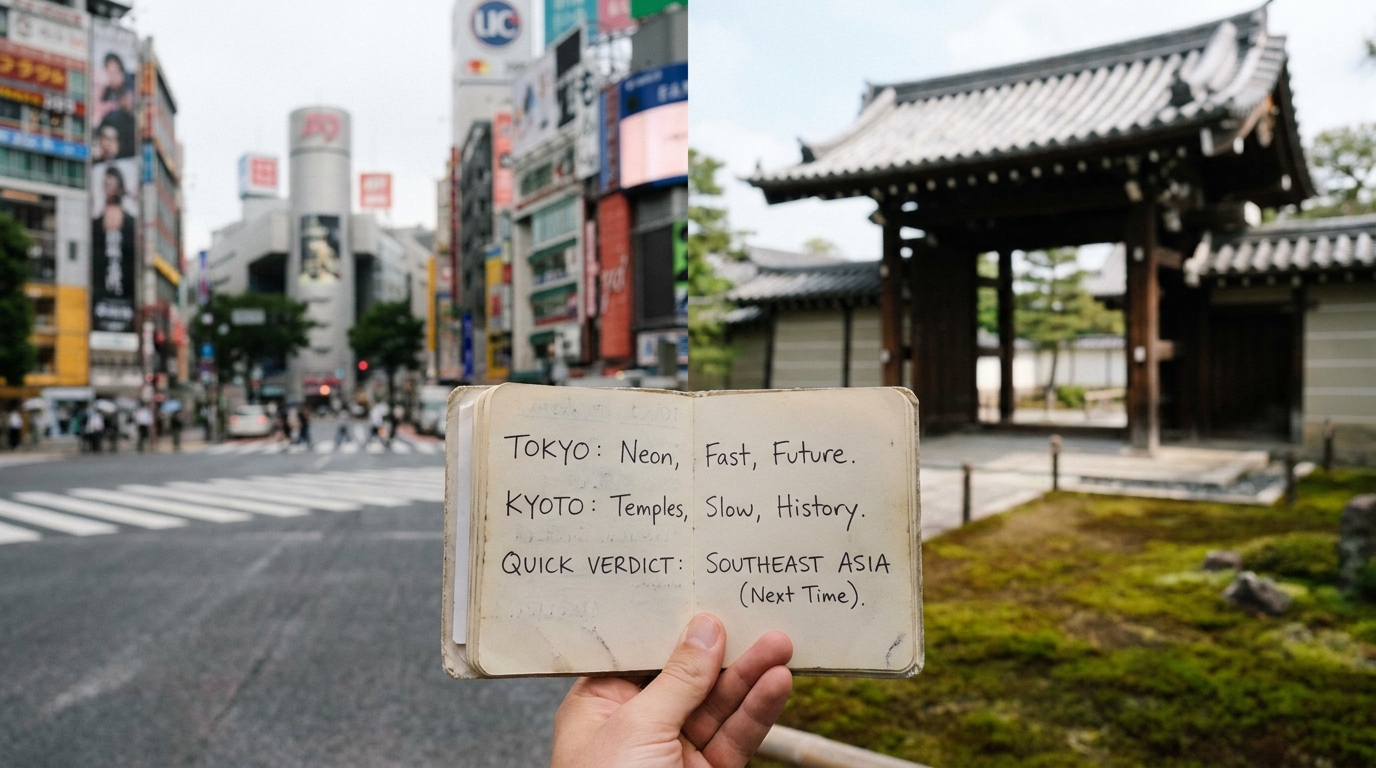
Japan’s two most visited cities serve completely different traveler needs. Tokyo wins on food diversity, nightlife, shopping, and sheer scale. Kyoto wins on temples, traditional culture, seasonal scenery, and a slower travel pace. According to the Japan National Tourism Organization (JNTO, 2025), both cities rank in Japan’s top three most-visited destinations, though they attract different types of travelers.
| Category | Tokyo | Kyoto | Winner |
|---|---|---|---|
| Michelin stars | 170 (world #1) | ~90 | Tokyo |
| UNESCO sites | 0 in city | 17 | Kyoto |
| Temples/shrines | Notable but spread | 400+ temples, 1,600+ shrines | Kyoto |
| Nightlife | Bars open until 5am | Most close by 23:00 | Tokyo |
| Hotel cost (avg) | USD 120-180/night | USD 140-200/night | Tokyo |
| Metro/transport | 13 Metro lines | Buses + 2 subway lines | Tokyo |
| Geisha culture | Nearly extinct | 200 active geiko/maiko | Kyoto |
| Budget food | USD 7 ramen, standing sushi | USD 10-15 avg lunch | Tokyo |
| First-timer verdict | Do both – 4 nights Tokyo + 3 nights Kyoto | Both | |
Sources: MICHELIN Guide Tokyo 2026; UNESCO World Heritage Sites Japan; JNTO 2025; Booking.com 2026
Location and How to Get Between Them
Tokyo sits on Honshu’s eastern Pacific coast, about 450 kilometers northeast of Kyoto. The Tokaido Shinkansen makes the journey fast and comfortable. A Hikari bullet train covers the distance in 2 hours 15 minutes for approximately JPY 14,000-14,870 (around USD 95) one way (JR East Shinkansen pricing, 2026). If you hold a Japan Rail Pass, Hikari trains are fully covered – Nozomi and Mizuho are not.
Budget travelers can take an overnight highway bus for JPY 4,000-7,000 (roughly USD 27-47), arriving in 6-8 hours. You save on a night’s accommodation, but you lose a day of sightseeing energy. For most travelers, the Shinkansen is worth every yen.
The practical takeaway: these cities are not a “pick one” situation logistically. The rail connection is so reliable that a 7-10 day Japan trip can comfortably include both. The harder question is how to split your nights.
day trips from Tokyo including Kyoto context
What’s the Atmosphere Like in Each City?
Tokyo and Kyoto feel like different countries, not just different cities. Tokyo is relentless forward motion. Shibuya Crossing processes 150,000 pedestrians per hour at peak. Akihabara glows with neon at midnight. Harajuku and Shimokitazawa generate subcultures that export globally. The city is an endless experiment in what urban life can become. Visitors describe it as overwhelming in the best way.
Kyoto runs on an older rhythm. Mornings in the Higashiyama district carry the sound of temple bells, not delivery trucks. Narrow machiya townhouse lanes called “roji” haven’t changed much since the Edo period. The city served as Japan’s imperial capital from 794 to 1869, and that history shows in the pace of daily life.
Here’s something most comparison articles miss: Kyoto’s “traditional” atmosphere is partly managed. The city has strict building height limits (45 meters maximum in most zones), advertising restrictions, and zoning laws that ban certain industries from historic districts. The serenity you feel walking Philosopher’s Path isn’t accidental. It’s actively maintained policy. Tokyo has no equivalent controls, which explains why both cities’ characters diverge so sharply despite being 450 km apart.
For travelers who want a sensory challenge that rewards curiosity, Tokyo delivers. For those seeking a city that feels like a living history lesson, Kyoto is without equal.
Cost Comparison: Hotels, Food, Transport
Tokyo runs slightly cheaper overall, which surprises many visitors who assume a smaller city means lower prices. Business hotels in Tokyo average USD 120-180 per night for decent quality in central locations (Booking.com Tokyo averages, 2026). Kyoto’s equivalent tier runs USD 140-200 per night – a 15-25% premium driven partly by tourism demand in a smaller city with fewer hotel rooms.
The real cost divergence comes from ryokan. Kyoto’s traditional Japanese inns, which include a private room, yukata robe, communal hot springs (onsen), and a multi-course kaiseki dinner plus breakfast, run USD 200-500 per person per night. They’re not required, but they’re one of the best experiences Japan offers. Tokyo has no equivalent pressure to stay in a premium traditional property.
Food costs tell a similar story. Tokyo’s street-level food culture is exceptional value. A bowl of ramen at a counter shop costs USD 7-10. Standing sushi bars (“tachinomi sushi”) near Tsukiji Outer Market charge USD 2-4 per piece for premium fish. A full kaiseki dinner at a Michelin-starred Tokyo restaurant can reach USD 500 per person, but the range between floor and ceiling is enormous. Kyoto’s food is excellent but skews pricier at the mid-range, partly because tourist demand inflates set lunch prices around temple districts.
Transport costs are lower in Tokyo thanks to the metro’s flat-zone pricing and the IC card (Suica or Pasmo) system. A typical Tokyo day of transit costs USD 5-8. Kyoto’s bus network charges a flat fare of JPY 230 (roughly USD 1.55) per ride, which sounds cheap until you realize you might take 6-8 buses in a temple-heavy day.
Tokyo accommodation options and pricing
Temples, Shrines, and Cultural Sites
Kyoto wins this category decisively. The city holds 17 UNESCO World Heritage properties – the most per city in Japan – along with more than 400 Buddhist temples and 1,600 Shinto shrines (UNESCO World Heritage Sites Japan). The Fushimi Inari Taisha, with its 10,000 vermillion torii gates climbing Mount Inari, is one of the most photographed sites in all of Asia. The Golden Pavilion (Kinkaku-ji), Arashiyama Bamboo Grove, Ginkaku-ji, Ryoan-ji’s rock garden, and the Nishiki Market temple district are all within a half-day of each other.
Tokyo has significant cultural sites but they’re embedded in a modern megalopolis. Senso-ji temple in Asakusa dates to 628 CE and remains impressive. Meiji Jingu in Harajuku is a serene Shinto forest shrine. The Imperial Palace East Gardens are worth a morning. But these are islands of history in an ocean of modernity. In Kyoto, the temples are the city.
One detail most comparison guides skip: Kyoto’s geisha culture is genuinely rare and still living. Gion district has approximately 200 active geiko (senior geisha) and maiko (apprentices) working today. Tokyo’s Shimbashi okiya, once the capital’s geisha district, has dwindled to near extinction. If watching a real geiko walk to an evening appointment along stone-paved Hanamikoji Street is on your list, only Kyoto delivers that.
The cultural density in Kyoto also means you can build an excellent itinerary on foot. The Higashiyama walking route connects Kiyomizu-dera, Sannenzaka, Ninenzaka, Kodai-ji, and Yasaka Shrine in a single 3-4 hour walk. No other Japanese city offers this kind of compact historic layering.
Food and Restaurants
Tokyo wins food by an enormous margin, and the data backs it. The MICHELIN Guide Tokyo 2026 awards the city 170 Michelin stars, making it the world’s most decorated culinary city (MICHELIN Guide Tokyo 2026). No other city on earth comes close. That total spans Japanese cuisine (ramen, sushi, tempura, yakitori, tonkatsu, soba, udon), but also world-class French, Italian, Chinese, Korean, and Indian restaurants.
The price range is what makes Tokyo’s food scene genuinely democratic. At the low end, a 7-Eleven onigiri costs under USD 1.50. A bowl of shoyu ramen at a standing counter costs USD 7-9. Conveyor-belt sushi (kaiten-zushi) chains like Sushiro serve individual plates from USD 1.20. At the high end, an omakase tasting menu at a three-Michelin-star sushi counter costs USD 400-600. Both exist in the same city without contradiction.
Tokyo’s standing sushi bars deserve special mention. Near Tsukiji Outer Market and in Yurakucho under the train tracks, hole-in-the-wall counter shops serve premium bluefin tuna, sea urchin, and fatty salmon at USD 2-4 per piece standing up. These places buy from the same Toyosu wholesale market as the starred restaurants. The product is nearly identical. The experience is the opposite. We’ve found no equivalent anywhere else in the world.
Kyoto food is not inferior, just different. The city specializes in kaiseki (multi-course traditional cuisine), tofu dishes (yudofu and dengaku), Kyoto-style pickles (tsukemono), and matcha desserts. Nishiki Market is excellent for grazing. But Kyoto’s strength is one specific, refined tradition. Tokyo’s strength is every food tradition on earth, at every price point, open until late.
Nightlife and Entertainment
Tokyo is one of the great nightlife cities in the world. Shinjuku’s Golden Gai district packs more than 200 tiny bars – each seating 6-10 people maximum – into a block-sized warren of wooden buildings. These places open at 20:00 and serve until 5am or later. Roppongi caters to the international crowd with clubs and rooftop bars. Shibuya’s bar strip beneath the JR tracks runs shoulder-to-shoulder on weekends. Shimokitazawa and Nakameguro attract the music and arts crowd. Night in Tokyo is genuinely a different city.
Kyoto at night is pleasant and calm. Pontocho alley, a narrow lantern-lit lane running parallel to the Kamo River, has excellent izakayas and yakitori spots with riverside seating. Gion Shijo has bars with tatami seating and sake lists worth exploring. But most establishments close between 22:00 and 23:00. Kyoto is not a city that rewards people who want to stay out until dawn.
This is not a criticism of Kyoto. The early-closing culture means Kyoto is better rested for early-morning temple visits, when light is golden and crowds are thin. The tradeoff is intentional. But if nightlife matters to you, Tokyo wins without contest.
Getting Around Each City
Tokyo has 13 Metro lines plus JR lines, private railways, and buses, creating the most complex urban transit network in the world (Japan National Tourism Organization, JNTO 2025). It sounds daunting. In practice, it’s highly legible. Signs are in English and Japanese at every station. The Suica IC card works on every operator. Google Maps gives accurate real-time directions for every line. The average first-timer navigates Tokyo metro confidently within 24 hours.
Kyoto’s transit is the opposite of Tokyo’s: simple but slow. The city has two subway lines (Karasuma and Tozai) and a dense bus network. The flat bus fare of JPY 230 sounds cheap, but Kyoto buses run notoriously crowded during peak tourist seasons (cherry blossom, autumn foliage). Bus routes near major temples can involve 20-minute waits and standing-room-only rides.
The practical solution in Kyoto is renting a bicycle. The city is largely flat, cycling infrastructure is solid, and a rental costs JPY 800-1,500 (USD 5-10) per day from shops near Kyoto Station. On a bike, you can reach Fushimi Inari from Gion in 20 minutes. The same trip by bus takes 35-45 minutes. For first-timers arriving in Kyoto from Tokyo, the transport downgrade is the most common adjustment complaint.
getting around Tokyo by metro and IC card
Best Seasons and Timing
Japan’s two peak travel seasons – cherry blossom (sakura) in spring and autumn foliage (koyo) in fall – affect both cities deeply. For cherry blossom, Tokyo’s peak typically falls around March 30 to April 5, with Ueno Park, Shinjuku Gyoen, and Meguro River offering outstanding viewing. Kyoto’s peak is slightly earlier, around March 25 to April 5, with Maruyama Park, Arashiyama, and Philosopher’s Path as the top spots (JNTO Sakura Forecast, 2025).
Autumn foliage (mid-October to late November) arguably favors Kyoto more strongly. Arashiyama’s maple-draped hillsides, Eikan-do temple’s crimson garden, and Tofuku-ji’s famous maple valley turn Kyoto into something that looks constructed for photography. Tokyo has excellent autumn viewing at Rikugien and Hamarikyu gardens and on Mount Takao, but the urban backdrop dilutes the effect. Kyoto’s foliage, framed by historic temples and moss-covered stone walls, is among the finest seasonal spectacles in East Asia.
Summer (July-August) is hot, humid, and crowded in both cities. If visiting then, Kyoto is marginally worse – it sits in a basin that traps heat. Winter (December-February) is quiet and cold, with occasional snow dusting Kyoto’s temple rooftops into postcard perfection. Both cities are genuinely beautiful year-round, but avoid Golden Week (late April to early May) and Obon (mid-August) if you dislike crowds.
Who Should Choose Tokyo vs Kyoto?
The honest answer is that your travel style determines your city, not your nationality or budget. According to JNTO 2025 visitor data, travelers who prioritize cultural heritage and traditional Japanese experiences overwhelmingly cite Kyoto as the highlight of their Japan trip. Travelers who rank food, nightlife, and urban energy consistently prefer Tokyo.
Choose Tokyo if you:
– Want the world’s best concentration of restaurants and food markets
– Plan to stay out late and explore nightlife neighborhoods
– Travel with a non-Japan-focused companion who needs variety and stimulation
– Are on a tighter budget and want to maximize cheap food options
– Have 5 days or fewer in Japan (Tokyo alone is more than enough for a short trip)
– Are interested in contemporary art, fashion, technology, or pop culture
Choose Kyoto if you:
– Are visiting Japan primarily for its history and spiritual culture
– Want to stay in a traditional ryokan with onsen and kaiseki dinner
– Are planning a slower trip with time to explore at walking pace
– Travel with photographers who want Japan’s “classic” imagery
– Visit during cherry blossom or autumn foliage seasons when Kyoto’s scenery peaks
– Are a return visitor who’s already done Tokyo’s highlights
Most first-timers fit neither category cleanly. That’s why the dual-city approach exists.
planning a 4-day Tokyo itinerary
Can You Visit Both? (The Honest Answer: Yes)
This is the section most comparison articles bury. The answer is yes, almost always. The Shinkansen makes a Tokyo-Kyoto combination the default Japan first-timer itinerary, not a luxury option. Japan Rail Pass holders travel between cities for free once the pass is active. Even without a pass, the JPY 14,000 Shinkansen ticket is reasonable for a 2h15min journey.
The standard recommendation from most experienced Japan travelers is 4 nights Tokyo plus 3 nights Kyoto, totaling a 7-night trip from arrival to departure. This gives you two full days in each city plus buffer time for arrival, transit, and the Shinkansen connection. With 10 nights total, you can add 2-3 nights in Nara (30 minutes from Kyoto by train) or Osaka (15 minutes).
Here’s the thing about the “pick one” framing: it’s mostly a budget or time constraint conversation, not a quality question. Both cities are worth it. The Shinkansen handles the logistics. Your job is deciding how many nights each deserves.
best things to do in Tokyo during your visit
Final Verdict
Tokyo vs Kyoto is not a fair fight on most individual metrics. Tokyo is bigger, cheaper, more diverse in food and nightlife, and easier to navigate. Kyoto is richer in cultural heritage, more beautiful in traditional scenery, and more emotionally resonant for travelers who came to Japan specifically for its history.
What makes Japan special is that both exist within the same country, connected by one of the world’s great train rides. If you have 7+ days, do both. If you have 4-5 days and must choose, Tokyo for first-timers covers more ground and offers more variety. If you’re a return visitor or came specifically for Japan’s ancient culture, Kyoto earns every night.
The Japan National Tourism Organization reports that travelers who visit both Tokyo and Kyoto report significantly higher overall trip satisfaction than those who visit only one city (JNTO, 2025). That data point tells you everything the debate doesn’t.
Start with Tokyo. Add Kyoto. Don’t skip either.
Frequently Asked Questions
Is Tokyo or Kyoto better for first-time visitors?
Tokyo is the better starting point for first-timers. It’s the world’s largest metro area (38 million people), holds 170 Michelin stars, and has the world’s most navigable metro system with English signage throughout. Most first-timers then add 3 nights in Kyoto for cultural contrast. Together, they form the backbone of Japan’s most popular itinerary (JNTO, 2025).
Is Kyoto more expensive than Tokyo?
Yes, Kyoto is 15-25% pricier for equivalent hotels, with business hotels averaging USD 140-200 per night versus Tokyo’s USD 120-180 (Booking.com, 2026). Ryokan push costs to USD 200-500 per person per night. Tokyo’s budget food options (USD 7 ramen, USD 1.50 convenience store meals) also give it a lower daily cost floor than Kyoto.
How long does it take to get from Tokyo to Kyoto?
The Hikari Shinkansen takes 2 hours 15 minutes and costs approximately JPY 14,000-14,870 (USD 90-95) one way (JR East, 2026). Japan Rail Pass holders ride for free. Budget travelers can take overnight highway buses for JPY 4,000-7,000 in 6-8 hours, saving on a night’s accommodation at the cost of travel comfort.
Can you see Kyoto as a day trip from Tokyo?
Technically yes, but it’s not recommended. The round-trip Shinkansen eats nearly 5 hours of your day before you even step off the train. Kyoto’s best experiences – ryokan onsen, early morning temple visits, golden hour at Fushimi Inari – require staying overnight. If your Tokyo base forces a day trip, it works as a sampler but misses what makes Kyoto special.
Which city is better for cherry blossom season?
Both cities are exceptional. Kyoto’s cherry blossom peaks slightly earlier (around March 25 to April 5) and its historic temple backdrops create more photogenic compositions. Tokyo’s peak falls around March 30 to April 5, with Shinjuku Gyoen and Meguro River Canal among the finest urban sakura spots in Japan. For pure scenery, Kyoto wins. For variety and celebration atmosphere, Tokyo matches it (JNTO Sakura Forecast, 2025).
Plan your Japan trip with confidence: read our Tokyo travel guide for complete destination details, or explore the best things to do in Tokyo for a full activity list. When you’re ready to book, compare Tokyo hotel options across every budget tier.