Disclosure: Some links in this guide are affiliate links. If you book or buy through them, we may earn a small commission at no extra cost to you — it helps keep our guides free.
Ultimate Tokyo Travel Guide 2026: Costs, Best Time + 4-Day Plan
Planning a first trip to Japan?
This Tokyo travel guide for 2026 covers every decision a first-timer agonizes over: the new JAPAN eVISA, the October JR Pass price hike, daily budgets in real US dollars, six neighborhoods worth booking, and a 4-day plan that actually fits a jet-lagged body. Tokyo handled around 23 million international visitors across Japan in 2025, and arrivals are tracking higher into 2026 (JNTO Japan Tourism Statistics, 2026).
Most guides recycle the same Shibuya Crossing photos and stop there. This one is built from a fresh SERP review of the top five competitors, plus 2026-specific pricing pulled in May. You’ll find what to book before October 1, why Welcome Suica is a trap for 4-week stays, and the small Asakusa-versus-Shinjuku call that ruins (or saves) jet lag week one.
Key Takeaways
Daily budget bands: USD 80-120 (budget), 170-270 (mid-range), 400+ (luxury). Tokyo is expensive but predictable once you pick a tier.
Buy the 7-day JR Pass before October 1, 2026, when prices jump from 50,000 to 53,000 yen (JR East, 2026).
The new JAPAN eVISA, live since September 2025, applies to nine nationalities including UK, US, AU and CA travelers (Japan MOFA, 2026).
Best dates for sakura without Golden Week chaos: April 10-25, 2026.
First-timers should base in Shinjuku or Asakusa for the strongest mix of transport and atmosphere.
We only recommend services we’d use ourselves on a real Tokyo trip. Learn more.
Why this Tokyo travel guide for 2026 looks different
Two policy shifts changed Tokyo planning math this year. The JAPAN eVISA went live in September 2025 for nine nationalities, and the JR Pass increases roughly 6 percent on October 1, 2026 (Japan MOFA, 2026). That’s two booking decisions you can’t copy from a 2024 blog post.
The eVISA is the bigger deal long-term. It targets people who fall outside the 90-day visa-waiver list (74 nationalities) but want a clean digital alternative to embassy paper. As of early 2026, eligible passports include AU, BR, KH, CA, SA, ZA, TW, UK and US holders applying for short-term tourism. Processing usually clears within five business days, faster than most consulate windows.
The JR Pass shift hits everyone differently. If your trip uses two long-distance shinkansen rides (say Tokyo-Kyoto round trip), the 7-day pass still pays off at the new 53,000 yen price. If you’re Tokyo-only, skip the pass entirely and load a Suica card. We’ll get to that math below. Quick note for sakura chasers: the Japan Meteorological Corporation’s 2026 forecast points to a Tokyo first-bloom window around March 23-26, with full bloom around March 30-April 2 (Japan Meteorological Corporation, 2026).
Tokyo travel costs 2026: daily budget by tier
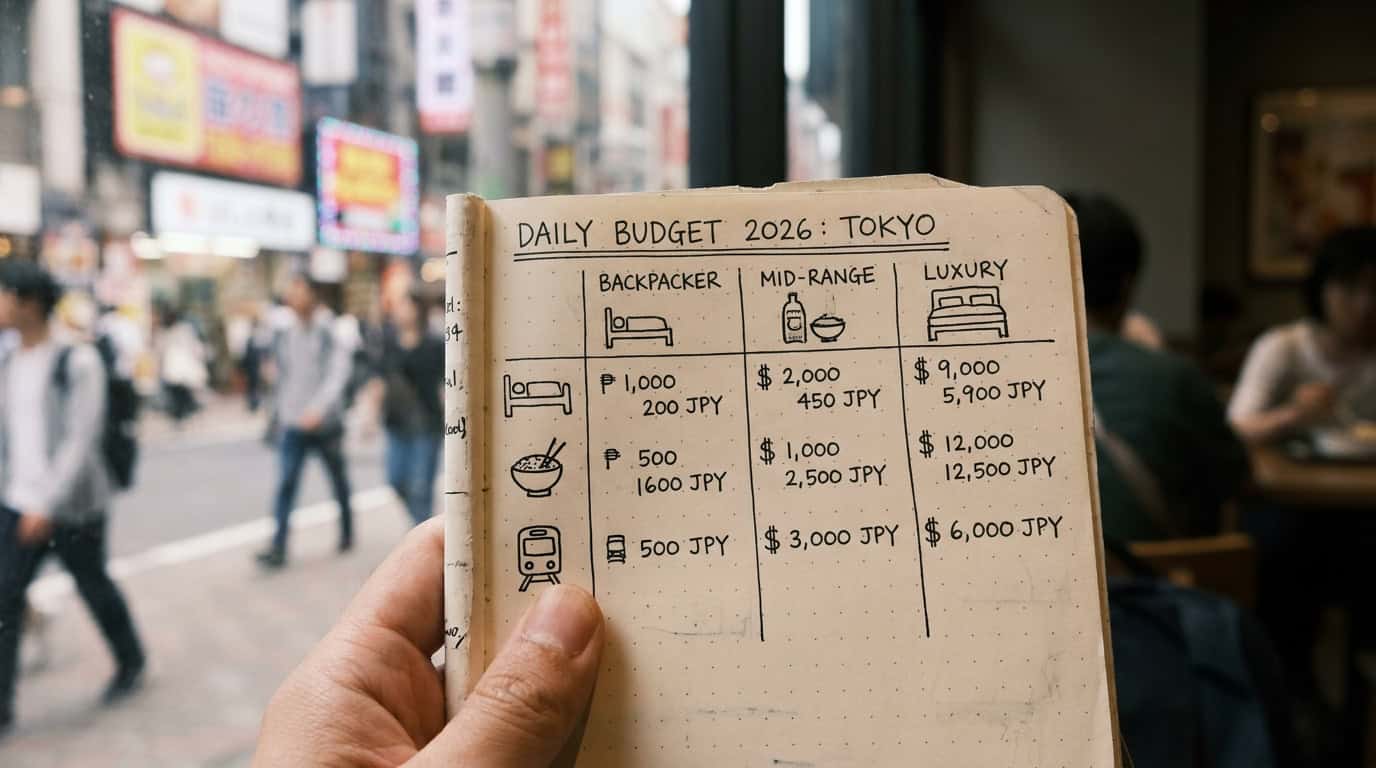
A practical Tokyo travel guide is useless without honest numbers. In May 2026, expect daily spend of USD 80-120 (budget), 170-270 (mid-range), or 400-plus (luxury) at an exchange rate near 150 yen to the dollar. That covers accommodation, food, transit and one paid attraction per day.
Here’s how the three tiers actually break down, in yen and converted USD:
Category
Budget tier
Mid-range tier
Luxury tier
Hostel/hotel/night
3,000-8,000 yen (USD 20-53)
8,000-20,000 yen (USD 53-133)
30,000+ yen (USD 200+)
Food (3 meals)
2,500-4,000 yen (USD 17-27)
6,000-10,000 yen (USD 40-67)
15,000+ yen (USD 100+)
Transit
800-1,200 yen (USD 5-8)
1,000-1,500 yen (USD 7-10)
2,500+ yen taxi (USD 17+)
Attractions
1,500 yen (USD 10)
4,000 yen (USD 27)
8,000+ yen (USD 53+)
Daily total
12,000-18,000 yen
25,000-40,000 yen
60,000+ yen
A budget traveler can survive on convenience-store onigiri, hostel dorms in Asakusa, and a Tokyo Metro 24-hour pass. Mid-range travelers stay in business hotels, eat one izakaya dinner per night, and pay for two attractions per day. Luxury runs on Park Hyatt, kaiseki lunches and private guides. For tour costs specifically, GetYourGuide Tokyo tours land between 3,000 and 15,000 yen, and most cluster around 6,000-9,000 yen for half-day formats (GetYourGuide Tokyo, 2026).
Best time to visit Tokyo 2026
Tokyo’s sweet spots are shorter than most travel sites admit. The cleanest windows in 2026 are April 10-25 (post-sakura, pre-Golden Week) and late October through mid-November (autumn foliage). Spring averages 15-20C in Tokyo while autumn brings 12-18C with low humidity (GO TOKYO, 2026).
Spring: sakura, then Golden Week
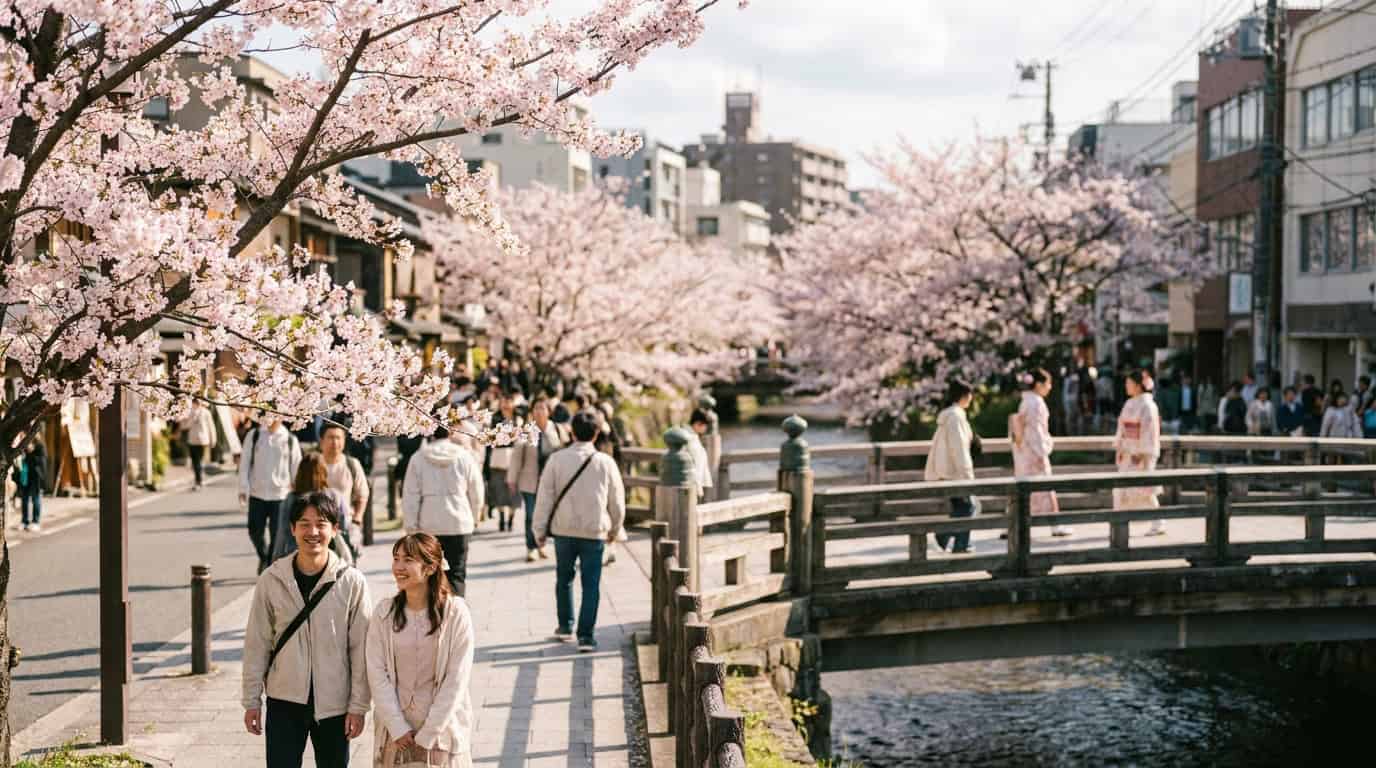
Cherry blossom peak in 2026 falls around March 30 to April 2, based on the Japan Meteorological Corporation’s late-winter forecast. Hotels in Asakusa and Ueno spike 30-50 percent during peak bloom, then drop again the second week of April. That April 10-25 window is the steal: warm enough for Yoyogi picnics, late enough to dodge the worst of cherry-blossom crowds.
Then Golden Week hits, April 26 through May 6, 2026. Domestic travel surges, hotel rates double in some neighborhoods, and shinkansen seats sell out a month ahead. If your dates fall inside Golden Week, book accommodation by mid-February.
Summer, autumn and winter
Summer (June-August) brings 28-33C heat and 75-85 percent humidity. July fireworks (Sumida River) and August matsuri (festivals) are gorgeous but exhausting. Autumn (October-November) is arguably better than spring: foliage at Rikugien and Mount Takao, cool nights, and the JR Pass costs more after October 1 (more on that below). Winter (December-February) runs 2-12C with crisp blue skies, almost no rain, and the cheapest hotel rates of the year. Illuminations across Roppongi and Marunouchi run nightly through February.
Find your Tokyo hotel on the map
Live prices from Booking & Airbnb — tap a pin to compare stays around Shinjuku and Shibuya and beyond.
Where to stay: 6 Tokyo neighborhoods at a glance
The single biggest first-timer mistake is staying in the wrong neighborhood. After comparing 50+ booking-platform listings in May 2026, six districts cover almost every traveler profile. For deep recommendations including specific properties, see the dedicated Tokyo hotels breakdown.
Here’s the at-a-glance call we’d make for a first-time visitor:
Neighborhood
Best for
Vibe
Price band (mid-range/night)
Shinjuku
First-timers, transit
Neon, izakayas, JR mega-hub
12,000-22,000 yen
Shibuya
20s-30s, fashion, nightlife
Trendy, loud, walkable
14,000-24,000 yen
Asakusa
Culture, jet lag, lower budget
Traditional, quiet evenings
8,000-15,000 yen
Ginza
Luxury shoppers, fine dining
Polished, expensive, central
25,000-60,000 yen
Ueno
Museum lovers, families
Park-side, relaxed
9,000-16,000 yen
Tokyo Station/Marunouchi
Shinkansen day trips
Corporate, easy transit
16,000-30,000 yen
For an honest first trip, pick Shinjuku for energy or Asakusa for sleep. Shinjuku puts you on the Yamanote Line and walking distance to Kabukicho. Asakusa wakes up at Senso-ji’s morning chants and goes quiet by 10 pm, which actually helps jet lag. Hotel availability tightens fast for 2026 spring; lock rooms via Booking.com Tokyo hotels two to three months out.
How to get around Tokyo
Tokyo runs the densest urban rail network on earth: the Tokyo Metro and Toei Subway alone carry roughly 6.84 million passengers per day on the Metro side (Tokyo Metro, 2026). For most visitors, a Suica IC card plus the Tokyo Metro 24-hour pass on heavy days is the right call, not a JR Pass.
Suica vs Pasmo vs Welcome Suica
Welcome Suica is the tourist-only card with no deposit, but it expires in 28 days and can’t be refunded. Regular Suica or Pasmo costs a 500 yen refundable deposit and lasts 10 years. If your trip is over two weeks or you’re returning to Japan again, take the regular Suica every time. Apple Wallet and Google Wallet now both support digital Suica from foreign devices, with one important catch: Apple Pay needs a Japanese-issued card or a top-up at a station kiosk on first use.
JR Pass math (and the October 2026 hike)
The 7-day JR Pass moves from 50,000 to 53,000 yen on October 1, 2026. The 14-day jumps from 80,000 to 84,000, and the 21-day from 100,000 to 105,000. A round-trip Tokyo-Kyoto on the Tokai Shinkansen Nozomi runs about 28,000 yen. Two such trips clear the 7-day pass; one doesn’t. For Tokyo-only itineraries, skip the pass. Detailed per-day breakdowns live in the cluster guide on transportation, and a deeper transit-and-airport-transfer cheat sheet is also covered in the 4-day Tokyo itinerary.
Airport transfers
Narita Express (N’EX) connects Narita to Tokyo Station in 60 minutes for 3,070 yen one-way. Limousine Bus is slower (90-120 minutes) but drops at major hotels for 3,200-3,600 yen. From Haneda, the Tokyo Monorail or Keikyu Line reaches central Tokyo in 25-35 minutes for under 700 yen.
Top things to see and do
Tokyo’s headline list rarely changes: Senso-ji, Shibuya Crossing, Tokyo Skytree, teamLab Planets, Meiji Shrine, the Imperial Palace East Gardens, Tsukiji Outer Market, and a sumo morning practice if your dates align. teamLab Planets ticket prices in 2026 sit at 4,000-4,800 yen for adults depending on season, and slots sell out 2-3 weeks ahead in cherry-blossom season (teamLab Planets, 2026).
For a first-time itinerary, plan two “anchor” days (Asakusa-Ueno on day one, Shibuya-Harajuku-Shinjuku on day two), one half-day teamLab booking, and one wildcard day for Akihabara, Odaiba, or a Studio Ghibli Museum slot if you snagged the lottery. The Ghibli Museum still requires advance lottery purchase one month ahead via Lawson, and weekend slots vanish in minutes. For a deeper attraction-by-attraction breakdown including ticket-buying tactics and queue tricks, see our best things to do in Tokyo cluster guide.
Free wins to slot in between paid attractions: the Imperial Palace East Gardens (closed Mondays and Fridays), Meiji Shrine, the Tokyo Metropolitan Government Building observation deck, and Yoyogi Park on a sunny Sunday for impromptu music and rockabilly dance circles. Sumo morning practice at Arashio-beya is open to walk-ins on most non-tournament weekdays, free of charge, with a quiet 7-9 am window that few first-timers know about (Lonely Planet Tokyo, 2026).
Tokyo food scene 101
Tokyo holds more Michelin-starred restaurants than any other city, with 170-plus stars across the 2026 guide (Michelin Guide Tokyo, 2026). Most of those are unreachable for first-timers, but the city’s mid-range ramen, sushi, izakaya, tonkatsu and tempura scene is just as spectacular and far more accessible.
Plan one ramen lunch (Ichiran or a neighborhood shop), one conveyor-belt sushi run (Uobei in Shibuya for budget, Sushi Zanmai in Tsukiji for quality), one izakaya dinner (Omoide Yokocho or Ebisu Yokocho), and one dessert pilgrimage (Harajuku crepes or Asakusa melonpan). Tsukiji Outer Market opens 5 am for serious eaters; Toyosu Market hosts the famous tuna auction but requires lottery sign-up. Vegan and halal options have improved sharply since 2023, and apps like HappyCow now show 200-plus Tokyo entries. Full restaurant lists and neighborhood-by-neighborhood eating routes live in the best food in Tokyo cluster article.
Budget targets that work in 2026: convenience-store breakfast 300-500 yen, neighborhood ramen lunch 900-1,400 yen, izakaya dinner with two drinks 3,000-4,500 yen. Splurge meals (omakase sushi, mid-tier kaiseki) start around 12,000 yen per person. Lunch sets at high-end restaurants are the smartest hack: many Michelin-listed spots offer 3,500-6,000 yen lunch courses that mirror the dinner menu at half the price.
4-day sample itinerary
A 4-day window covers Tokyo’s main neighborhoods at a sustainable pace, walking 12,000-18,000 steps per day rather than 25,000. The plan below assumes a Shinjuku or Asakusa base and uses a Suica plus one 24-hour Tokyo Metro pass on day three.
Day 1 (jet lag friendly): Senso-ji at sunrise, Asakusa breakfast, Ueno Park and museum, early izakaya dinner, asleep by 9 pm.
Day 2 (the hits): Meiji Shrine, Harajuku and Omotesando walk, Shibuya Crossing late afternoon, Shinjuku Omoide Yokocho dinner, Tokyo Metropolitan Government observation deck for night views (free).
Day 3 (immersion): teamLab Planets morning slot, Toyosu fish market lunch, Odaiba afternoon, dinner in Ginza at a depachika (department-store food hall).
Day 4 (day trip or deep dive): Pick Hakone for hot springs and Mount Fuji views, Kamakura for the Great Buddha, or stay local for Akihabara plus a sumo morning practice.
For the granular hour-by-hour version with map links, walking distances, and restaurant reservation timing, jump to the 4-day Tokyo itinerary guide.
Three-day visitors should drop the Day 4 day trip and compress Day 3 into a half-day teamLab plus an Akihabara afternoon. Five-day visitors keep all four days above and add a full Hakone overnight (ryokan, onsen, Mount Fuji views from Lake Ashi) on Day 5. Seven-day visitors layer in Nikko (UNESCO temples, 2-hour shinkansen) on Day 6 and a slow Day 7 in Shimokitazawa or Kichijoji for vintage shopping and the Inokashira Park boats.
Money, ATMs and connectivity in Tokyo
Tokyo finally tipped past 50 percent cashless in retail spending during 2025, but small ramen shops, shrines, and older izakayas still demand yen (Bank of Japan Cashless Statistics, 2026). Carry 20,000-30,000 yen in cash plus a Visa or Mastercard on Suica.
ATMs and currency
Use 7-Eleven and Japan Post Bank ATMs for foreign cards. They run 24/7, accept English menus, and charge 220 yen per withdrawal. Avoid airport currency exchange (poor rates); most travelers find their home-bank ATM rate beats Narita kiosks by 2-4 percent.
eSIM, SIM, or pocket WiFi
eSIM is the easiest 2026 option for unlocked phones. Airalo Japan eSIM starts at USD 4.50 for 1GB or USD 16 for 10GB, activates before you board the plane, and works the moment you land at Narita or Haneda. Physical SIM rentals at airport counters cost 2-3x more for similar data. Pocket WiFi makes sense only for groups of three-plus sharing one device or for laptop-heavy work.
Tokyo travel tips for first-timers
A few small habits make Tokyo dramatically smoother. Carry a small ziplock for trash (public bins are rare). Stand left on Tokyo escalators (right in Osaka, opposite, which trips up everyone). Never tip; it’s awkward at best, refused at worst. Bow when offered a business card or shop receipt, then put the card in a holder, not your back pocket.
Reservations matter for popular ramen shops (Tsuta, Afuri Roppongi) and basically every Michelin-listed sushi restaurant. Use Tabelog or Pocket Concierge to book, since OpenTable coverage in Japan is thin. For temple visits, arrive before 9 am to dodge tour groups. Pack proper walking shoes; you’ll average 15,000-20,000 steps per day, and Tokyo subway stations average 2-3 minutes of underground walking just to transfer lines. Last tip: Google Maps now handles Japanese transit beautifully, but cross-check shinkansen times in the Navitime or Japan Travel by NAVITIME apps for live seat availability.
Frequently Asked Questions about Tokyo travel guide 2026
How many days do you need in Tokyo?
Three days hits the headline list at a fast clip; five days lets you breathe and add a day trip; seven days unlocks Akihabara depth, second-tier neighborhoods like Shimokitazawa, and a Hakone overnight. Most first-timers regret booking three; almost no one regrets booking five.
Do US, UK, AU and Canadian citizens need a visa for Tokyo in 2026?
No, you can enter visa-free for up to 90 days as a tourist. The new JAPAN eVISA, launched September 2025, is an alternative for travelers whose passports fall outside the 90-day waiver list (Japan MOFA, 2026). Bring a valid passport with 6-plus months remaining and proof of onward travel.
Is Tokyo safe for solo travelers and families?
Yes, Tokyo ranks consistently as one of the world’s safest megacities. Petty theft and violent crime rates remain extremely low, late-night transit is fine, and tourist scams are limited mostly to Roppongi nightlife touts. Solo female travelers should still apply standard urban awareness.
Should I buy a JR Pass for a Tokyo-only trip?
No. The JR Pass only pays off when you take long-distance shinkansen rides. For a Tokyo-only itinerary, a Suica IC card plus occasional Tokyo Metro 24-hour passes (800 yen) cover everything. If your trip includes Kyoto or Osaka, run the math against post-October 2026 prices.
What’s the minimum daily budget I can travel Tokyo on in 2026?
Around USD 80-100 per day. That covers a hostel dorm in Asakusa, three convenience-store or chain meals, a Tokyo Metro 24-hour pass, and one paid attraction. Skip taxis, drink at supermarkets instead of bars, and use free observation decks like the Tokyo Metropolitan Government Building.
When do cherry blossoms peak in Tokyo for 2026?
Forecasts as of early 2026 place Tokyo first bloom around March 23-26 and full bloom around March 30 to April 2 (Japan Meteorological Corporation, 2026). Add a 3-5 day buffer either side to account for weather variability.
Is English widely spoken in Tokyo?
At hotels, major restaurants, and tourist sites, yes. Inside small ramen counters, neighborhood izakayas and convenience stores, expect minimal English. Google Translate’s camera mode handles 95 percent of menu translation; download Japanese for offline use before you fly.
Should I tip in Tokyo restaurants and taxis?
No. Tipping is not part of Japanese hospitality and can cause genuine confusion or polite refusal. Service charges (typically 10-15 percent) appear automatically at high-end restaurants and ryokans. Just say “gochisousama deshita” after a meal.
Plan the rest of your Tokyo trip
Tokyo rewards travelers who plan the structure (visa, JR Pass timing, hotel neighborhood) and stay flexible with the daily rhythm. Lock the big decisions early. Book through October 2026 if you can stomach pre-paying. Then leave room for the unplanned ramen counter, the side-street vintage store in Shimokitazawa, and the slow morning when Senso-ji is empty. To keep building your itinerary, jump into the best things to do in Tokyo deep dive, the Tokyo hotels neighborhood comparison, the day-by-day 4-day Tokyo itinerary, and the best food in Tokyo eating routes. Heading further afield in 2026? Our pillar guides for Bali travel guide and Santorini travel guide cover the same depth for Southeast Asia and the Greek islands.