Disclosure: Some links in this guide are affiliate links. If you book or buy through them, we may earn a small commission at no extra cost to you — it helps keep our guides free.
The Perfect 4-Day Seoul Itinerary 2026 (Day by Day Guide)
Four days is the sweet spot for Seoul. It gives you time for the palaces and Bukchon on day one, the young energy of Hongdae and the Han River on day two, the glass-and-neon side of Gangnam on day three, and one full day trip out of the city on day four. This Seoul itinerary walks you through each day hour by hour, with real 2026 prices, subway routes, and a cost breakdown so you know what a day actually runs.
Seoul is also an easy city to plan around. The metro carries roughly 7 million riders a day across 23 lines, and a single ride with a T-money card costs just 1,550 won (Seoul Metropolitan Government, 2026). South Korea welcomed 16.3 million international visitors in 2024, and Seoul is the first stop for most of them (Korea Tourism Organization, 2025). We built this plan for a first-timer who wants the highlights without racing between them, and it slots straight into our full Seoul travel guide if you want the wider picture first.
Key Takeaways
– A T-money card costs 2,500 won (refundable deposit) and drops the base subway fare to 1,550 won per ride, versus a single paper ticket
– Day 4 is your choice: a DMZ half-day tour runs about 45,000-70,000 won, a DIY Nami Island trip around 35,000 won, and Everland roughly 39,000 won online
– The integrated palace ticket is 10,000 won and covers four palaces plus Jongmyo Shrine for 3 months, saving 2,000 won over buying separately
– Budget travelers spend roughly 40,000-65,000 won per day on transport, attractions, and food, not counting your hotel
– October and early April are the best windows for autumn color and cherry blossoms; skip the July-August monsoon if you can[PERSONAL EXPERIENCE] We ran this exact route over a long spring weekend and the biggest lesson was to front-load the palaces. We reached Gyeongbokgung by 9am on day one and had Bukchon’s alleys almost to ourselves, while friends who slept in fought crowds all afternoon. Buying the 10,000-won integrated ticket at the first gate also saved us from queuing again at every palace.
How to Use This 4-Day Seoul Itinerary
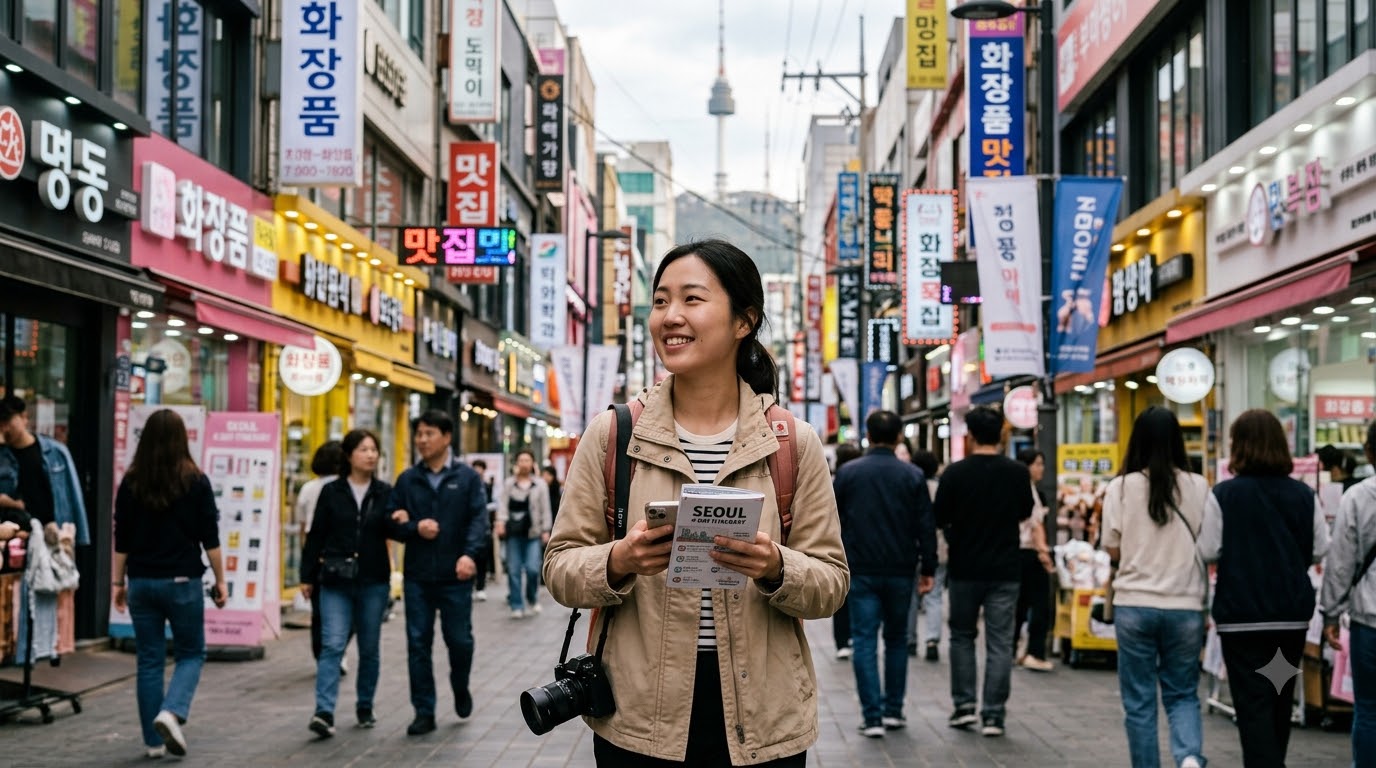
Base yourself in a central neighborhood and let the subway do the rest. Myeongdong, Hongdae, and Insadong all sit within 20-30 minutes of every stop on this plan, so you never spend more than a handful of subway rides getting anywhere. If you are still deciding on a base, our where to stay in Seoul guide breaks down each district by budget and vibe.
Here is the shape of the four days at a glance. Each day is built around one part of the city so you are not zig-zagging across the map.
| Day | Focus | Highlights | Best for |
|---|---|---|---|
| Day 1 | Old Seoul | Gyeongbokgung, Bukchon, Insadong | History, hanbok photos |
| Day 2 | Young Seoul | Hongdae, Yeouido, Han River | Street food, nightlife, sunset |
| Day 3 | New Seoul | Gangnam, COEX, Bongeunsa | Shopping, modern design |
| Day 4 | Day trip | DMZ, Nami Island, or Everland | Nature, history, or theme park |
The 4-Day Seoul Itinerary
The plan we use ourselves — sent straight to your inbox.
- Day-by-day route
- Where to stay
- Real 2026 costs
Free · No spam · Unsubscribe anytime
Day 1: Palaces, Bukchon, and Insadong
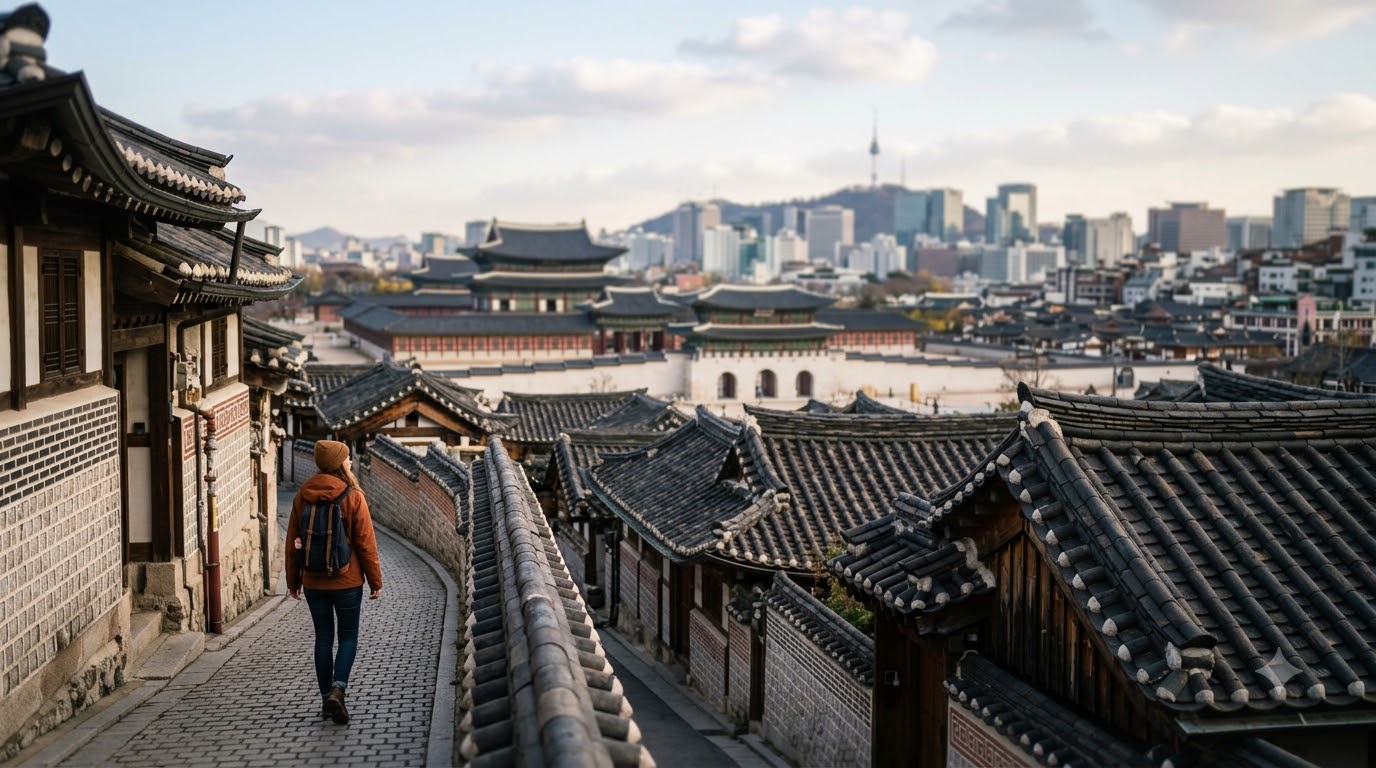
Start day one with the Joseon dynasty and end it with Seoul’s best craft shopping. This is the most walkable day of the whole Seoul itinerary, so wear comfortable shoes.
Open at Gyeongbokgung Palace, the largest of the city’s five grand palaces, built in 1395. Time your arrival for the changing of the royal guard ceremony in front of Gwanghwamun Gate. Day-one palace essentials:
- Gyeongbokgung adult admission: 3,000 won; opens at 9am.
- Integrated palace ticket: 10,000 won, covers Gyeongbokgung, Changdeokgung, Changgyeonggung, Deoksugung, and Jongmyo Shrine for three months (Cultural Heritage Administration, 2026).
- Changing of the royal guard: free, at 10am and 2pm at Gwanghwamun Gate.
- Hanbok rental near Exit 4 of Gyeongbokgung Station: 15,000-30,000 won for four hours, and palace entry is free while you wear it.
- Insadong lunch (bibimbap or handmade kalguksu): around 9,000-12,000 won.
We reached the gate by 9am on our own run and had Bukchon’s alleys nearly to ourselves an hour later, so front-load this day.
From the palace’s east gate it is a five-minute walk uphill into Bukchon Hanok Village, a cluster of more than 900 traditional houses wedged between two palaces. The lane on Bukchon-ro 11-gil delivers the classic shot of tiled roofs stepping down toward the modern skyline. Locals live here, so keep your voice down and stick to the marked photo zones. Drop back down to Insadong for the afternoon, where Ssamziegil’s spiral of small shops sells ceramics, tea, and hanji paper. Grab a late lunch of bibimbap or handmade kalguksu noodles for around 9,000-12,000 won.
Close the day at Gwangjang Market, a 15-minute subway hop away, where the mung-bean pancakes (bindaetteok) and mayak gimbap have their own devoted queues. If food is your thing, our best food in Seoul guide maps out which market stalls are worth the wait.
Day 2: Hongdae, Yeouido, and the Han River
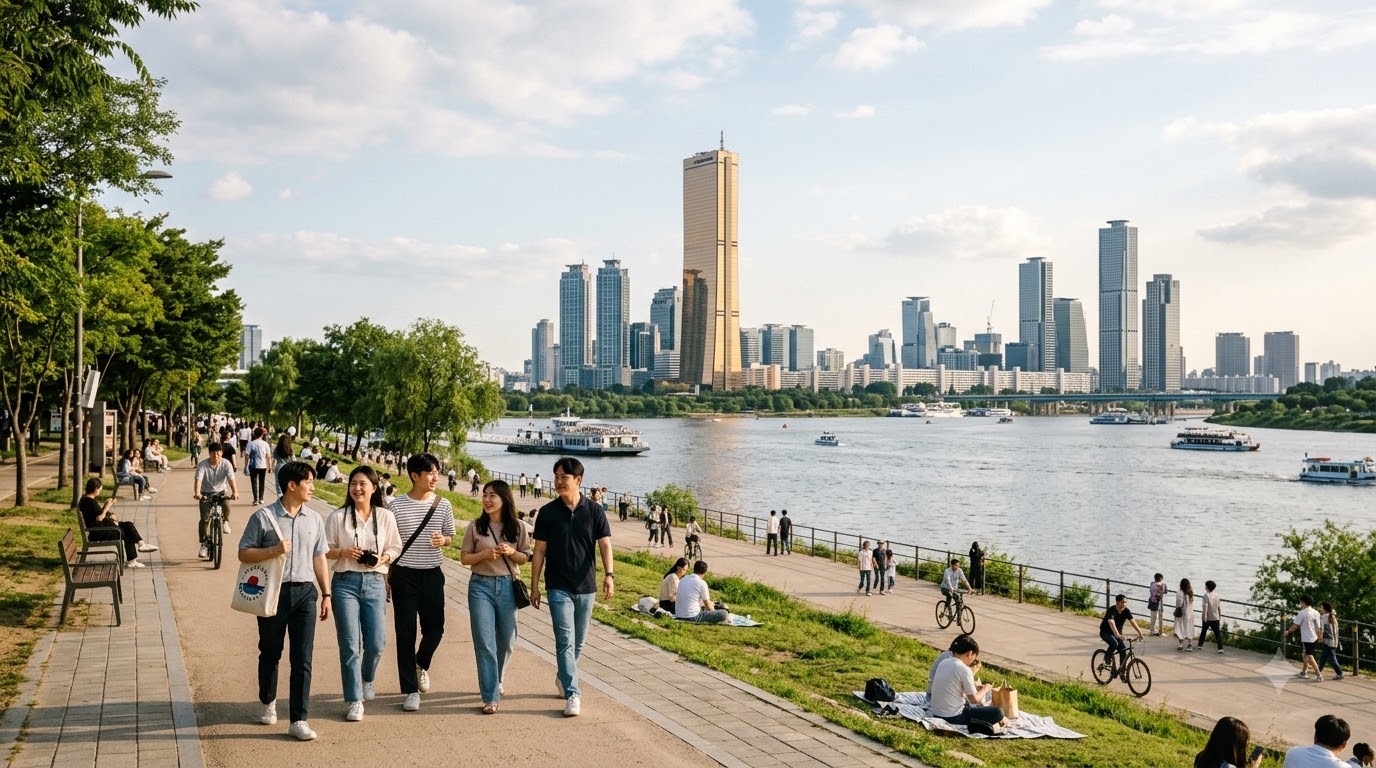
Day two swaps palaces for the city’s youthful, creative side, then finishes on the water. This is the part of the Seoul itinerary where you slow the pace and just wander.
Spend the morning in Hongdae, the district around Hongik University. Street performers set up along the main walking street by late morning, and the side alleys hide independent cafes, record stores, and vintage shops. It is also the best area for a casual lunch of tteokbokki, hotteok, or Korean fried chicken. From Hongdae, ride the subway south to Yeouido, the riverside district that turns into a pink tunnel during the early-April cherry blossom festival along Yunjungno.
In the late afternoon, head to Yeouido Hangang Park on the Han River. Renting a picnic mat and ordering fried chicken and beer to the riverbank by app is a genuine Seoul ritual, not a tourist invention. As the light fades, head to Namsan and N Seoul Tower for the skyline view. Your options:
- Namsan cable car: 15,000 won round trip.
- Southern hiking trail: free, about 25 minutes on foot.
- N Seoul Tower observatory: 29,000 won on-site or closer to 18,400 won booked online (N Seoul Tower, 2026).
For a deeper list of viewpoints and neighborhoods, see our best things to do in Seoul rundown.
The 4-Day Seoul Itinerary
Hour-by-hour plan, where to stay and what it really costs — free PDF.
Free · No spam · Unsubscribe anytime
Find your Seoul hotel on the map
Live prices from Booking & Airbnb — tap a pin to compare stays around Myeongdong and Hongdae and beyond.
Day 3: Gangnam, COEX, and Bongeunsa

Day three is Seoul’s glossy, modern face, and it balances shopping with a couple of genuinely calm spots. Head south of the river to Gangnam, the district the song made famous.
Head south of the river to Gangnam, and anchor the morning around COEX. Day-three highlights and costs:
- Starfield Library (inside COEX Mall, Asia’s largest underground shopping center): free to enter, one of the city’s most photographed indoor spaces.
- COEX Aquarium: around 28,000-33,000 won, a solid rainy-day option next door.
- Bongeunsa temple: free, a working Buddhist temple founded in 794 with a giant Maitreya Buddha statue.
- Garosu-gil boutiques and Apgujeong Rodeo: window-shopping and dessert cafes, an easy afternoon.
- COEX underground food court or Seolleung lunch: 9,000-13,000 won.
Spend the afternoon along Garosu-gil, a tree-lined street of boutiques and dessert cafes, or the Apgujeong Rodeo area for higher-end shopping and window-watching. If you would rather trade shopping for a market crawl, the underground food court beneath COEX and the nearby Seolleung area both do solid, affordable lunches for 9,000-13,000 won. This is a flexible day, so lean into whatever suits your energy after two busy ones.
Day 4: Day Trip — DMZ, Nami Island, or Everland
Save your final day for one trip out of the city, and pick the one that matches your interests. All three are reachable as a day trip and back before dinner:
- DMZ half-day tour: 45,000-70,000 won guided, covering Imjingak, the Third Tunnel, and Dora Observatory (passport required).
- Nami Island DIY: about 35,000-45,000 won all in via ITX-Cheongchun to Gapyeong; island entry 19,000 won includes the round-trip ferry.
- Everland: one-day pass about 59,000 won at the gate, closer to 39,000 won online; roughly an hour from central Seoul.
Option A: DMZ (History)
The Demilitarized Zone between North and South Korea is Seoul’s most sobering day trip. Because you cannot self-drive into the controlled area, a guided tour is the practical way in. Half-day group tours run about 45,000-70,000 won (roughly $35-55 USD) and usually cover the Imjingak Peace Park, the Third Infiltration Tunnel, and the Dora Observatory looking into the North. Bring your passport, as it is required at the checkpoints. Book a day or two ahead, since access to specific sites depends on the security situation.
Option B: Nami Island (Nature)
Nami is a half-moon river island famous for its tree-lined lanes and autumn color. Doing it yourself is easy and cheap: take the ITX-Cheongchun train from Yongsan or Cheongnyangni to Gapyeong (about 55 minutes, 4,800-6,000 won), then a short taxi or shuttle to the ferry pier. Island admission is 19,000 won and includes the round-trip ferry (Namisum, 2026). A full DIY day, including the Garden of Morning Calm or Petite France nearby, runs around 35,000-45,000 won all in. Organized combo tours cost 65,000-90,000 won but remove all the logistics.
Option C: Everland (Theme Park)
Korea’s biggest theme park suits families and coaster fans. A one-day pass is about 59,000 won at the gate but closer to 39,000 won booked online, and the park is roughly an hour by shuttle or public transport from central Seoul. Go on a weekday to cut queue times. Everland’s spring tulip festival and autumn foliage are as much a draw as the rides.
What This 4-Day Seoul Itinerary Costs
Here is a realistic per-day estimate for a budget-to-mid traveler, covering transport, attractions, and food but not your hotel. Prices are in Korean won, with rough US dollar equivalents at about 1,340 won to the dollar.
| Day | Transport | Attractions | Food | Day total |
|---|---|---|---|---|
| Day 1 | ~4,650 won | 10,000 won (palace ticket) | ~25,000 won | ~40,000 won ($30) |
| Day 2 | ~5,000 won | 0-18,400 won (tower optional) | ~28,000 won | ~35,000-52,000 won |
| Day 3 | ~4,650 won | 0-33,000 won (aquarium optional) | ~30,000 won | ~35,000-68,000 won |
| Day 4 | included in tour | 35,000-70,000 won | ~15,000 won | ~50,000-85,000 won |
Across four days, plan on roughly 160,000-265,000 won per person (about $120-200 USD) for the on-the-ground costs, plus accommodation. You can push lower by skipping paid observatories and leaning on markets and free spots like the Starfield Library and Bongeunsa. For a full breakdown by travel style, our Seoul travel guide covers cheaper and pricier versions of the same route.
T-money and Transport Tips for Your Seoul Itinerary
Buy a T-money card the moment you land. The card costs a 2,500 won refundable deposit at any convenience store or airport machine, and it caps the base subway fare at 1,550 won while letting you transfer between subway and bus within 30 minutes for a discounted continuation rather than a fresh full fare (Seoul Metropolitan Government, 2026). You can reload it in cash at every station and use it in convenience stores and many taxis too.
Getting in from the airport is simple. The AREX all-stop train reaches Seoul Station in about 66 minutes for 4,950 won, while the AREX Express does it non-stop in 43 minutes for 13,000 won at the counter or around 11,500 won booked online (Korail Airport Railroad, 2026). For most travelers the all-stop is the better value. A few more habits that make this Seoul itinerary run smoothly:
- Screen doors show the exit for every stop. Note your exit number before you leave the platform; the right exit can save a 10-minute detour above ground.
- Use Naver Map or KakaoMap, not Google Maps. Google’s walking and transit directions are unreliable in Korea, while the Korean apps are accurate to the minute.
- Buses take T-money too, and the color tells you the route type: blue for main trunk lines, green for local feeders, red for suburban express.
- Taxis are affordable for short late-night hops once the subway closes around midnight, starting near 4,800 won base in Seoul.
Once you have the card and the right map app, you can follow this plan with almost no advance ticketing beyond your day-four choice.
Frequently Asked Questions
Is 4 days enough for a Seoul itinerary?
Four days is enough to see the major palaces, the main neighborhoods on both sides of the Han River, and take one day trip out of the city. It is a comfortable first-visit length. If you want to add a second day trip, such as both the DMZ and Nami Island, or explore areas like Ikseon-dong and Seongsu in depth, stretch it to five or six days.
How much money do I need for 4 days in Seoul?
Budget roughly 160,000-265,000 won per person (about $120-200 USD) for transport, attractions, and food across four days, on top of accommodation. Eating at markets and street stalls, and choosing free spots like the Starfield Library and Bongeunsa temple, keeps you at the lower end. Paid observatories, theme parks, and guided tours push you higher.
What is the best order to visit Seoul in 4 days?
Start with the palaces and Bukchon on day one while your energy is highest and the sites are least crowded, then Hongdae and the Han River on day two, Gangnam and COEX on day three, and a day trip on day four. This order groups nearby sights together so you spend less time on the subway and more time on the ground.
Do I need a guided tour for the DMZ from Seoul?
Yes, in practice. You cannot self-drive into the controlled DMZ area, so a guided half-day tour (about 45,000-70,000 won) is the standard way to visit. Tours handle the checkpoints and transport, but bring your passport, as it is checked on the way in.
What is the best time of year for this Seoul itinerary?
October is the top pick for clear skies and autumn foliage, and late March to early April brings the cherry blossoms along Yeouido and at Everland. Both avoid the humid July-August monsoon and the deep cold of January and February, when outdoor days like day one and day four are less pleasant.
Final Thoughts
Seoul rewards a plan that groups its neighborhoods rather than one that chases a checklist across the map. Follow this four-day route and you will move through the old palaces, the young riverside districts, the modern south, and one memorable day trip without ever feeling rushed. Adjust the day-four choice to your mood, keep your T-money card topped up, and let the subway carry the rest.