
Rome Travel Guide 2026: Ancient Sites & Hidden Gems Beyond the Colosseum
Rome has been dealing with tourists for 2,000 years. Over 35 million visitors poured into the Eternal City in 2025 (Roma Capitale Tourism Office, 2026), and the Colosseum alone swallowed roughly 7 million of them. The city wears its age casually, like a coat it has owned forever. A Renaissance palazzo sits on Roman foundations. A medieval church occupies a pagan temple. A modern espresso bar operates behind a 1,700-year-old column.
This Rome travel guide is not going to list every monument. There are hundreds. Instead, it covers how to navigate the Colosseum without spending two hours in line, which ancient sites get overlooked, the Trastevere streets where you actually want to eat dinner, and the practical tips that save your feet, your wallet, and your patience.
Key Takeaways
– Colosseum tickets sell out 3-4 weeks ahead in peak season. The Full Experience Arena Floor ticket (24 EUR) is the one worth getting. Book at coopculture.it. The standard entry only lets you walk the upper ring.
– The Roman Forum and Palatine Hill share the same ticket as the Colosseum and are valid for 24 hours. Most visitors spend 30 minutes in the Forum and miss half the site. Budget 2-3 hours.
– The Pantheon is no longer free. Entry costs 5 EUR since 2023. Go before 10:00 AM on weekdays. The line moves fast because the building is deceptively large inside.
– Trastevere looks charming but has become tourist-heavy after 7:00 PM. Eat dinner slightly early (6:30 PM) or cross the river to Testaccio for Roman food at Roman prices.
– Rome’s cobblestones eat shoes. You will walk 15,000-25,000 steps per day. Bring two pairs of broken-in walking shoes. Your feet will thank you.Affiliate Disclosure: Some links in this guide are affiliate links. If you book through them, we earn a small commission at no extra cost to you. We only recommend services we genuinely trust. Learn more.
Visiting the Colosseum: What to Know
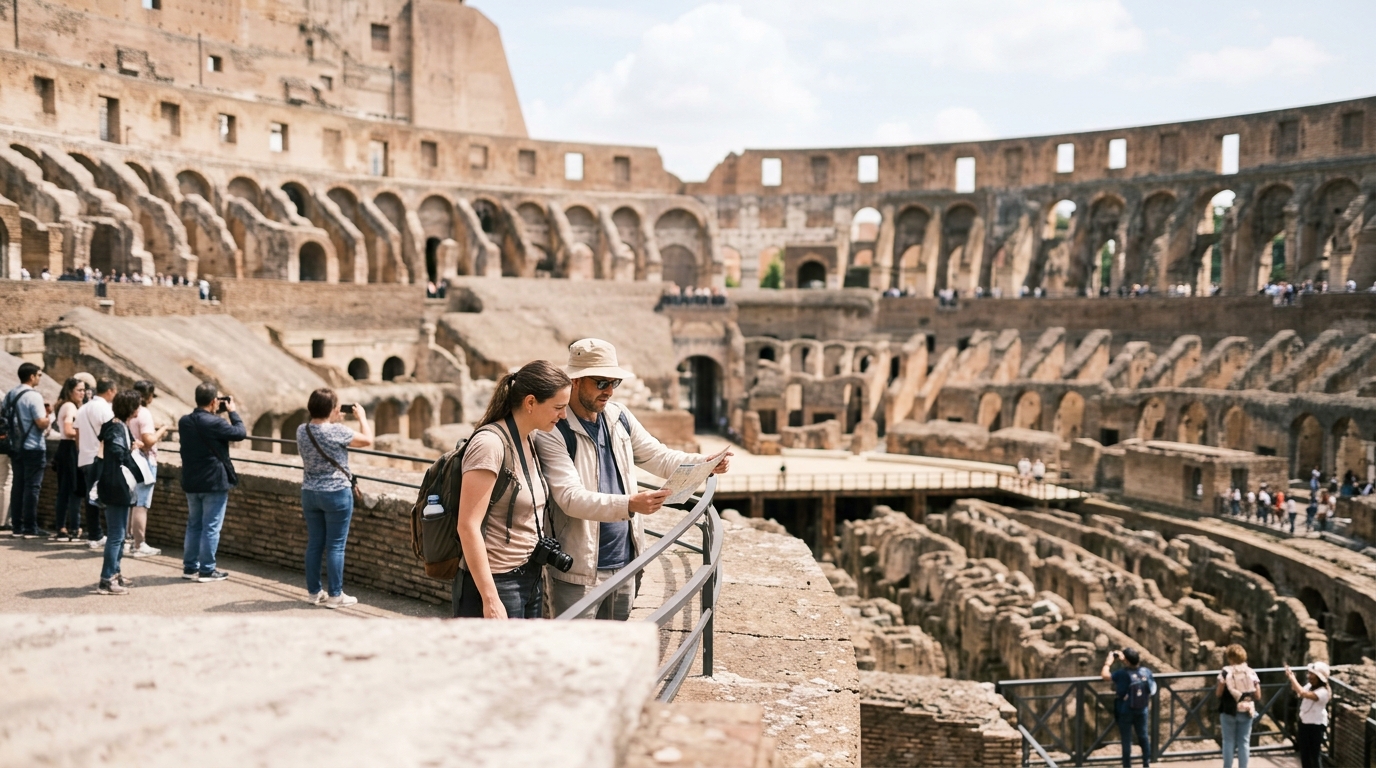
The Colosseum opened in 80 AD with 100 days of games that killed roughly 9,000 animals. Today, it kills time, not beasts, but the logistics still require planning.
Ticket Types and What You Actually Get
The Standard Entry (18 EUR) gives access to the upper two rings. You see the interior from above, which is impressive but feels like looking at a bowl from the rim.
The Full Experience Arena Floor (24 EUR) adds access to the reconstructed wooden arena floor, standing where gladiators stood, looking up at 50,000 imaginary spectators. This is the ticket minh recommends. The perspective shift from looking up at the walls instead of down at the floor changes the entire experience.
The Full Experience Underground (32 EUR) adds the hypogeum, the labyrinth of tunnels beneath the arena where animals and gladiators waited. Fascinating, but the group size is tiny and this ticket vanishes within minutes of release. Book 3-4 months ahead.
All tickets include the Roman Forum and Palatine Hill. They share the same entrance ticket and are valid for 24 hours from your Colosseum time slot. This is the single most important logistical fact about visiting ancient Rome, and the official website mentions it in a single sentence at the bottom of the booking page.
[PERSONAL EXPERIENCE] Minh booked the 8:30 AM Arena Floor ticket for a Thursday in late September. The line at 8:15 AM was already 200 people deep at the main entrance, but the Arena Floor entrance is a separate gate on the north side. Walked straight in. By 10:00 AM, the standard entry line wrapped halfway around the building.
Book at: coopculture.it. Do not use third-party resellers unless you are desperate. The official site charges face value. Reseller markups range from 5-15 EUR per ticket for the same product. If sold out, GetYourGuide offers guided tours with priority entry starting at 50 EUR that include the arena floor.
Ancient Rome Beyond the Colosseum
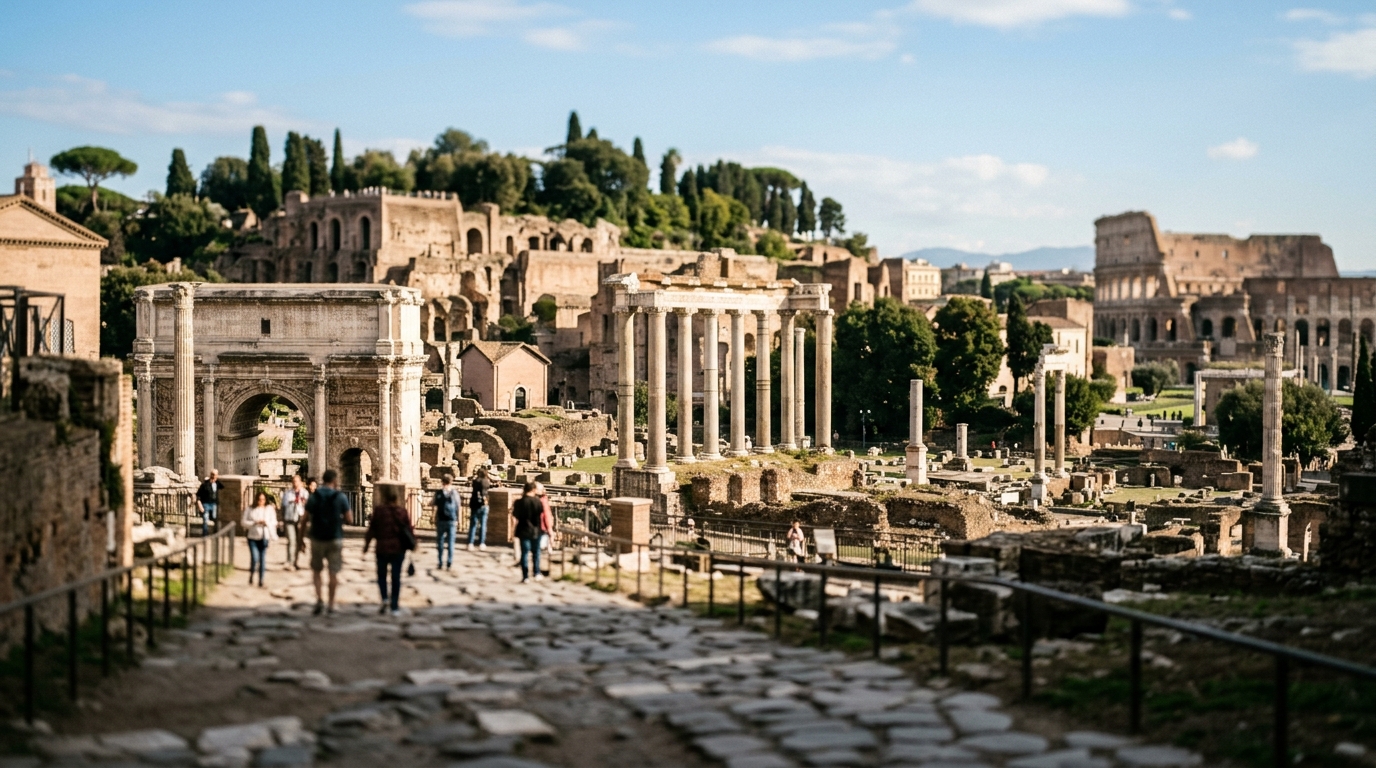
The Colosseum is the star. These are the supporting actors that, in many ways, put on a better show.
The Roman Forum
The Forum was downtown ancient Rome: temples, markets, law courts, and political rallies, all packed into a valley between two hills. Today, it is a sprawling field of marble fragments, standing columns, and the occasional intact arch. The Temple of Saturn (eight columns at the western end) is the oldest surviving structure, dating to 497 BC. The Curia Julia, where the Senate met, has been restored and is one of the few Forum buildings you can enter without a special ticket.
The House of the Vestal Virgins sits in the southeastern corner, a courtyard of statues and reflecting pools where the priestesses of Vesta lived. Each statue bears a name and a inscribed summary of virtues. The best-preserved ones date to the 3rd and 4th centuries AD.
Budget 2 hours minimum. The Forum rewards slow wandering. Download the free Parco Colosseo app before entering, which has an audio guide that identifies 40+ structures as you walk.
The Palatine Hill
The Palatine Hill rises directly above the Forum, and this is where Rome began. According to legend, Romulus founded the city here in 753 BC. By the imperial era, the Palatine had become the Beverly Hills of ancient Rome. The Domus Augustana (Emperor Domitian’s palace, 92 AD) sprawls across the hilltop with courtyards, fountains, and rooms that once had underfloor heating.
The Palatine is the quietest part of the Forum-Colosseum complex. Most visitors climb up for the view (which is spectacular, covering the Forum on one side and the Circus Maximus on the other), snap a photo, and leave. Stay longer. The Farnese Gardens at the summit are among the oldest botanical gardens in Europe, planted in the 16th century on top of Tiberius’s palace.
Beyond the Big Three
The Baths of Caracalla (8 EUR) sit 15 minutes south of the Colosseum on foot. Completed in 216 AD, these public baths could hold 1,600 bathers at once across pools of varying temperatures. The surviving brick walls tower 37 meters, and the mosaic floors in the changing rooms are largely intact. Far fewer visitors, no time slots, and you can wander for an hour without seeing more than 20 people.
The Appian Way (Via Appia Antica) runs southeast from the Aurelian Walls, a 2,300-year-old Roman road lined with cypress trees, catacombs, and crumbling tombs. The first 5 kilometers out from the city make for one of the best walks in Rome. Rent a bike at the Appia Antica Regional Park visitor center (10 EUR for 3 hours). The road is closed to non-resident cars on Sundays, making it a cyclist’s paradise.
The best things to do in Rome guide has more detail on the Baths, the Appian Way, and the catacombs.
Hidden Gems Away from the Crowds
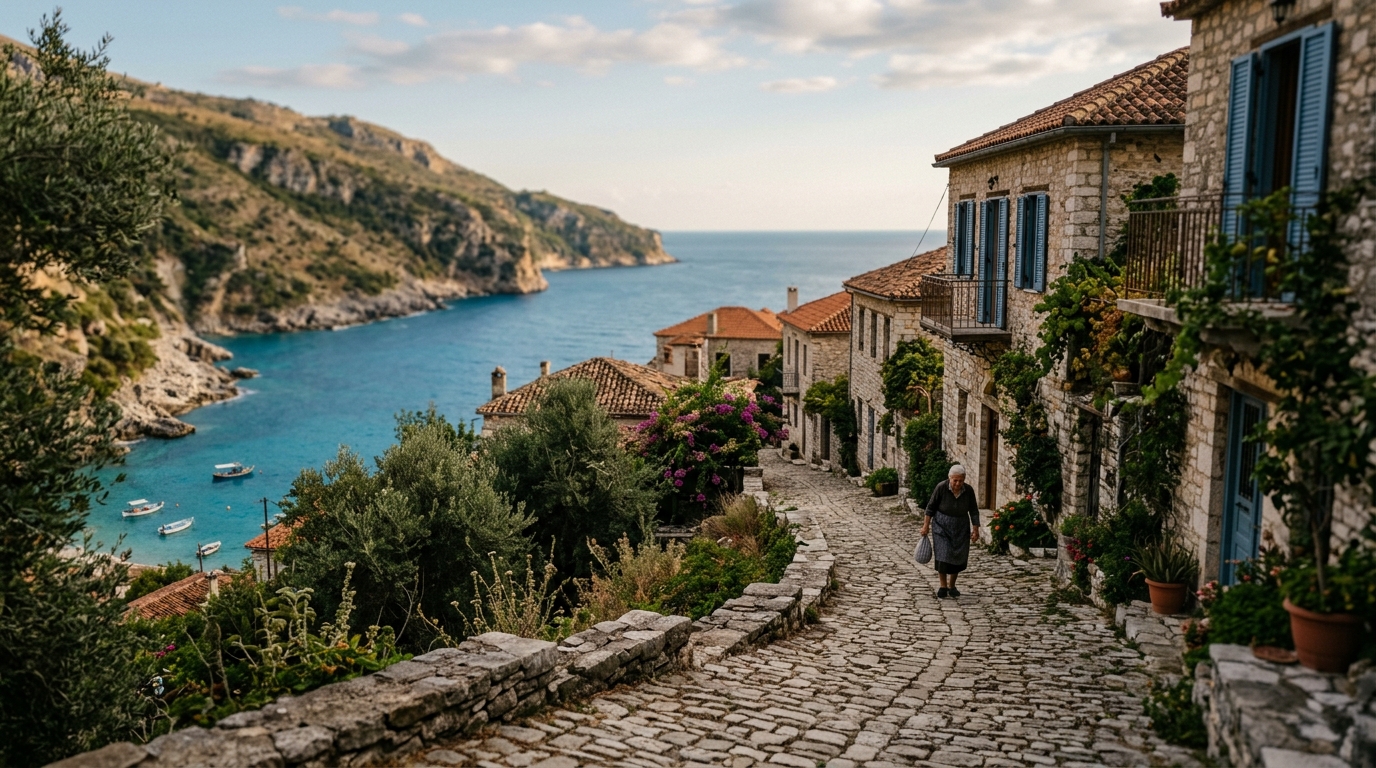
Rome has 2,000 churches, roughly 300 fountains, and more hidden corners than any human can catalog in a lifetime. These are the ones worth your afternoon.
Trastevere Beyond the Postcard
Trastevere, the neighborhood across the Tiber from the historic center, gets written up as “authentic” in every guidebook published since 1995. The authenticity is fading on the main streets. Piazza di Santa Maria in Trastevere at 9:00 PM is a human traffic jam of outdoor tables, selfie sticks, and guitar-strumming buskers.
Walk five minutes deeper. The streets west of Viale di Trastevere still feel like a Roman neighborhood. Via della Lungaretta narrows into alleyways where old men sit on folding chairs outside their doorways and the only sound is the clatter of pots from an unseen kitchen.
The Basilica of Santa Cecilia (free entry) sits on a quiet piazza three blocks off the tourist track. Under the church, excavations revealed a 2nd-century Roman house with intact frescoes and a crypt that makes you forget what century you are standing in. The excavated area costs 3 EUR and takes 20 minutes. Go in the late afternoon when the light through the courtyard palms hits the church facade.
Testaccio: Rome’s Food Neighborhood
Testaccio sits south of the Aventine Hill, and it has exactly zero famous monuments. What it has is Rome’s best traditional food at prices that have not caught up with inflation. Testaccio was home to Rome’s slaughterhouse district from 1890 to 1975, and Roman cucina povera (poor kitchen) was born here. Dishes like coda alla vaccinara (oxtail stew), rigatoni con la pajata (pasta with calf intestines), and trippa alla romana (tripe in tomato sauce) originated in this neighborhood.
The Mercato Testaccio (open Monday-Saturday 7:00 AM-3:30 PM) is the indoor market where Roman chefs shop. Mordi e Vai stall serves panini made with the market’s fresh ingredients. The bollito (boiled beef with salsa verde, 6 EUR) is the signature.
Flavio al Velavevodetto sits literally built into the Monte dei Cocci, an artificial hill made from 53 million discarded amphorae (ancient Roman oil jars). The cacio e pepe (12 EUR) is the benchmark version that other Roman restaurants are measured against.
Quartiere Coppede
The smallest, strangest neighborhood in Rome occupies just a few blocks north of the city center, designed by architect Gino Coppede in the 1920s. He mixed Art Nouveau, Gothic, Baroque, and medieval elements into a fever dream of frescoed facades, wrought iron, and mythological figures. The Fountain of the Frogs at Piazza Mincio features 12 frogs spouting water around a central basin. The Beatles waded in it after a 1965 concert. The frog fountain in Paul McCartney’s “Frog Chorus” video is this one.
Quartiere Coppede takes 30 minutes to walk through and costs nothing. Almost no tourists find it.
First Time in Rome? Smart Tips
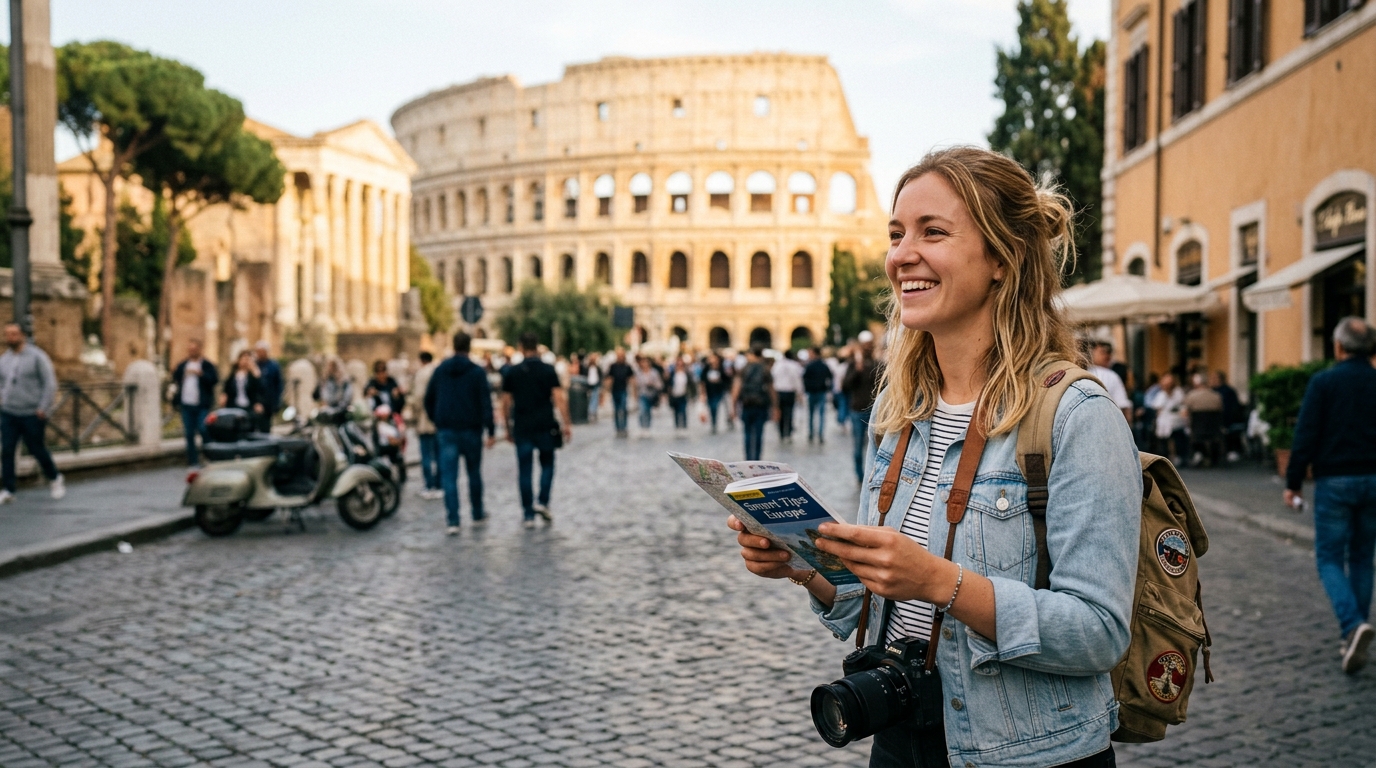
Getting Around
Rome’s metro has three lines (A, B, C) that serve roughly 30% of the places you want to go. The rest requires walking or buses. The 100-minute integrated ticket costs 1.50 EUR and covers one metro ride plus unlimited buses within the window. A 48-hour pass costs 12.50 EUR.
Rome is not a city for taxis. The streets twist, the traffic is legendary, and the metro, where it runs, is twice as fast. Walking is the default transport mode. Most major sights sit within a 25-minute walk of each other in the historic center. Accept that you will average 20,000 steps per day.
[PERSONAL EXPERIENCE] Skip the Roma Pass. At 32 EUR for 48 hours with one free attraction and transport, the math worked better five years ago when the Colosseum was cheaper. Today, buying the Colosseum Full Experience ticket separately (24 EUR) plus a 48-hour transport pass (12.50 EUR) totals 36.50 EUR, and you get the Arena Floor instead of basic Colosseum entry.
Timing and Lines
Book every major attraction in advance. The Vatican Museums (separate from this guide but essential) sell out a month ahead. The Colosseum sells out 3-4 weeks ahead. The Borghese Gallery (13 EUR, which houses Bernini’s greatest sculptures) sells out a week ahead. Rome in 2026 does not accommodate spontaneous monument visits.
Free entry day at state museums falls on the first Sunday of every month. The Colosseum, Forum, Palatine, and all state sites are free. And the lines are biblical. Skip it unless you arrive before 8:00 AM with a plan.
The Water System
Rome has over 2,500 nasoni, the small cast-iron drinking fountains scattered across the city. The water is cold, clean, and free. Bring a refillable bottle. You will save 10-15 EUR per day in bottled water costs.
Stay connected with Airalo Italy eSIM from $6 for 3GB. Coverage is solid everywhere in the city. For more Italy travel, read our Amalfi Coast guide and Venice guide.
Must-Visit Places in the Eternal City
The Pantheon
The Pantheon has stood since 125 AD, and its dome remains the world’s largest unreinforced concrete dome. The oculus, the 9-meter hole in the center of the ceiling, is the building’s only light source. When it rains, the rain falls through the hole and drains through 22 hidden holes in the marble floor.
Entry costs 5 EUR (as of 2023, previously free). Go before 10:00 AM on a weekday. The building is larger inside than the entry queue suggests, because the facade is deceptively small relative to the interior volume. Stand in the exact center, under the oculus, look up, and understand why this building has been studied by architects for 1,900 years.
Trevi Fountain
The Trevi Fountain is mobbed from 9:00 AM to 11:00 PM, and still worth seeing. The Baroque sculptures, the cascade of water, the sheer drama of the thing work even through the crowds. Go at 6:30 AM. You will share the fountain with maybe 20 other people, mostly photographers with tripods. At 10:00 AM, you will share it with 2,000.
Toss one coin over your left shoulder with your right hand to ensure a return to Rome (roughly 3,000 EUR in coins are collected daily, donated to charity). Do not toss two coins unless you are looking for a new Italian romance. Do not toss three unless you are also looking for marriage.
Villa Borghese and the Borghese Gallery
Villa Borghese is Rome’s Central Park, an 80-hectare expanse of gardens, fountains, and trails on the Pincian Hill. You can rent a rowboat on the lake (4 EUR for 20 minutes), bike the perimeter, or simply walk for an hour without hearing a car.
The Borghese Gallery inside the park holds what might be the best small art collection on the planet. Bernini’s Apollo and Daphne captures the exact moment of transformation: Daphne’s fingers becoming leaves, her toes rooting into the ground, her mouth frozen mid-scream. For many visitors, this single sculpture justifies the entire gallery. Book at galleriaborghese.it. The 13 EUR entry requires a reservation, even on free Sundays.
For more Italy inspiration, check our best things to do in Rome guide and Venice guide.
Where to Stay in Rome
Hotel de Russie — Luxury Near Piazza del Popolo
Location: Via del Babuino, between Piazza del Popolo and Spanish Steps | From 600 EUR ($640 USD) | Rating 4.8/5
Rome’s most famous luxury hotel wraps around a tiered courtyard garden. The Valadier-designed building dates to 1816. The garden bar serves negronis under palm trees.
Best for: Honeymooners and travelers who want to feel like a 1950s movie star. The location puts you 10 minutes on foot from the Pantheon and 15 from the Trevi Fountain.
Hotel Lunetta — Mid-Range Campo de’ Fiori
Location: Piazza del Paradiso, near Campo de’ Fiori | From 180 EUR ($192 USD) | Rating 4.6/5
A converted 14th-century building with 30 rooms, a small rooftop terrace, and an indoor spa built on Roman-era foundations. The campo location means you walk to everything in the historic center.
Best for: First-timers who want a central base without the five-star price tag. The breakfast spread includes fresh ricotta and honey from the Roman countryside.
The Beehive — Budget Near Termini
Location: Via Marghera, near Termini Station | From 30 EUR ($32 USD) dorm, 80 EUR private | Rating 4.5/5
A vegetarian, eco-conscious hostel run by an American couple who have lived in Rome for 20 years. The garden is an oasis after a day of walking. Communal dinners (12 EUR) bring guests together around a long table.
Best for: Solo travelers and anyone who values a good night’s sleep. The location near Termini is not Rome’s prettiest neighborhood, but the hostel itself is a sanctuary.
Book all properties on Booking.com. Rome hotels fill up 2-3 months ahead for May-June and September-October. Book early or pay the last-room premium.
Frequently Asked Questions
How many days do I need in Rome?
Budget four days minimum for the historic center. Five days allows a day trip to Tivoli or Ostia Antica. Three days covers the Colosseum, Forum, Pantheon, and Trevi Fountain, but you will skip entire neighborhoods. Rome is a 4-day city at minimum.
Is the Roma Pass worth it in 2026?
For most travelers, no. At 32 EUR for 48 hours with one free attraction, the math only works if that attraction is the Colosseum Full Experience (24 EUR), but the Roma Pass covers only basic Colosseum entry (18 EUR). Buy separate tickets and a transport pass instead.
What is the best month to visit Rome?
April, May, October, and early November are ideal. Temperatures range from 15-24 degrees C (59-75 F). Hotel prices are 20-30% below the June-September peak. July and August bring 32-38 degree C (90-100 F) heat, and many small family restaurants close for at least two weeks in August.
Is Rome’s tap water safe to drink?
Yes. Rome’s tap water is clean and tastes good. The 2,500+ nasoni fountains across the city provide free, cold drinking water 24/7. Bring a refillable bottle. You will save 10-15 EUR per day versus buying bottled water.
Do I need to book the Vatican in advance?
Yes. Vatican Museums tickets sell out 3-4 weeks ahead. Book at museivaticani.va. The 8:00 AM early-entry ticket (42 EUR including breakfast) is worth the premium. The Sistine Chapel is empty for about 30 minutes before the general entry crowd arrives at 9:00 AM.
Is Rome walkable?
Rome is extremely walkable. Most historic-center sights sit within 25 minutes of each other on foot. The metro connects the outliers. Expect to walk 15,000-25,000 steps per day. Bring two pairs of broken-in walking shoes and rotate them.
Your Roman Holiday Starts Here
Rome demands patience and rewards it. The Colosseum line, the Trevi Fountain crowd, the midday heat in July, the restaurant that tells you the kitchen closed at the precise moment you sat down. None of it matters when the sun sets behind St. Peter’s dome and the cobblestones turn gold.
Book your tickets before you fly. Walk everywhere. Eat dinner at 9:00 PM like Romans do. And when in doubt, duck into the nearest church. In Rome, there is always a Caravaggio hiding behind an unmarked wooden door.
Now, go toss a coin in the Trevi Fountain. And if Italy is just one stop on your journey, our Barcelona guide and Amalfi Coast guide are waiting.
For more European city guides, browse our Istanbul travel guide, Swiss Alps guide, and Lake Como guide.