Sicily Itinerary: 7 and 10 Days (2026)
Disclosure: Some links in this guide are affiliate links. If you book or buy through them, we may earn a small commission at no extra cost to you — it helps keep our guides free.
- The 7-day east coast loop uses two bases, Taormina and Siracusa, with no single drive over 1 hour 22 minutes.
- The 10-day version adds Agrigento and Palermo and about 715 km of driving.
- A hire car is needed; lodging and food cost about USD 860 for 7 days and USD 1,290 for 10 days per person.
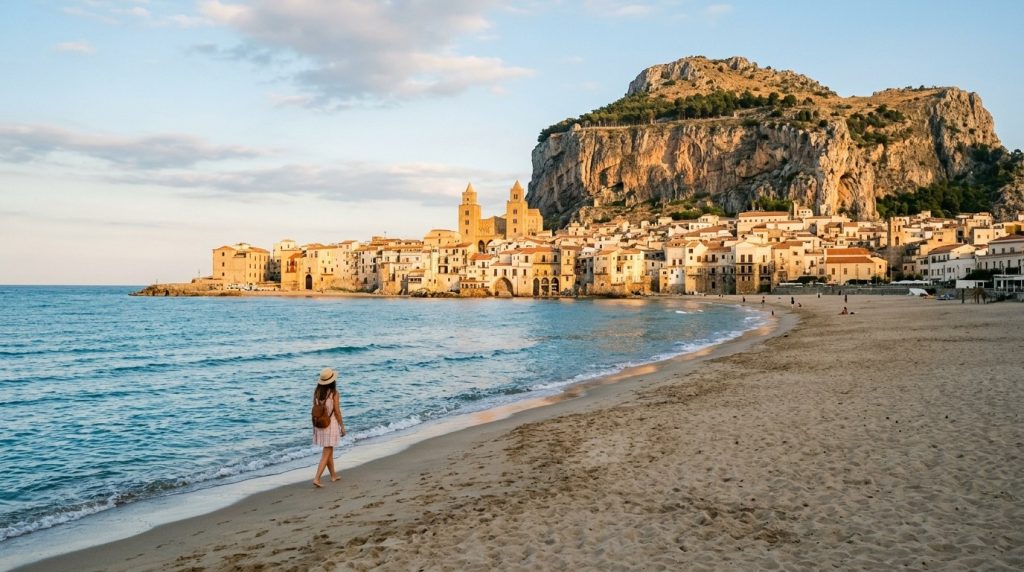
A Sicily itinerary covers roughly 715 km of driving on the 10-day version that adds the west, or as little as 118 km between bases on the tighter 7-day east coast loop. The 7-day route suits first-time visitors flying into Catania with limited time, while the 10-day route suits travelers who want to add Agrigento’s temples and Palermo’s markets without rushing the drives.
| Days | Route | Bases | Approx cost/person (USD) |
|---|---|---|---|
| 7 | Catania to Taormina to Siracusa to Catania | Taormina (3 nights), Siracusa (3 nights) | USD 860 (EUR 738) |
| 10 | Catania to Taormina to Siracusa to Agrigento to Palermo | Taormina (3), Siracusa (2), Agrigento (1), Palermo (3) | USD 1,290 (EUR 1,109) |
These figures cover lodging and food only, for one person sharing a double room, based on Sicily’s mid-range daily average of EUR 123 per person (BudgetYourTrip, 2026), converted at USD 1 is approximately EUR 0.86. Car rental, flights, and site admissions are extra. To price those extras, our guide to whether Sicily is expensive by Italian standards prices hostel beds at USD 34-56 and flags Taormina as the costly exception.
7-day Sicily itinerary: the east coast loop
The 7-day Sicily itinerary works best as a two-base loop, splitting nights between Taormina and Siracusa so no single drive exceeds 1 hour 22 minutes. Land in Catania, collect a rental car at the airport, and drive to Taormina first since the town’s ZTL and hillside parking are easier to handle on arrival than at the end of a trip.
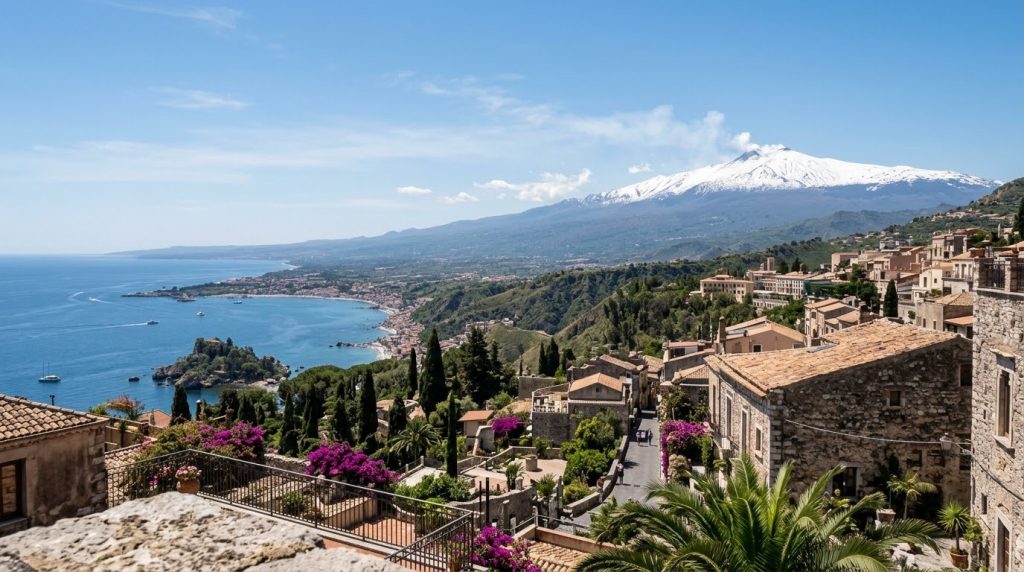
– Day 1: Catania Airport to Taormina, about 50 minutes over 58 km. Check in, walk Corso Umberto I before dinner. – Day 2 to 3: Taormina old town, Teatro Antico, Isola Bella, and a half-day trip up Mount Etna. – Day 4: Drive Taormina to Siracusa, 1 hour 22 minutes over roughly 118 km.
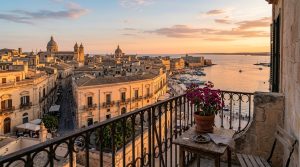
Settle into Ortigia, the old island core of the city. – Day 5: Siracusa’s Neapolis Archaeological Park in the morning, then a half-day in Noto to see the baroque center. – Day 6: Slower day around Ortigia, or a trip south to the Vendicari nature reserve for the coastline. – Day 7: Drive back to Catania Airport, roughly 1 hour on the A18/A19, for the flight out.
This loop keeps every transfer under 90 minutes, which matters more in Sicily than the map suggests, since most of the island’s roads outside the motorways are single-carriageway. Splitting the week evenly between two bases also means the car sits parked for two or three days at a stretch, so hotel valet or a nearby garage matters more than the daily rental rate when picking where to stay.
10-day Sicily itinerary: adding the west
The 10-day Sicily itinerary keeps the same east coast loop and tacks on Agrigento and Palermo, adding two of the longer drives on the island. After Siracusa, the route pushes further west than most short trips attempt, so the extra three days go almost entirely into driving and one new base per stop.
– Day 1 to 6: Same as the 7-day plan through Siracusa and Noto. – Day 7: Siracusa to Agrigento, about 2 hours 40 minutes over roughly 220 km on the SS115 coastal road, which is not a motorway.
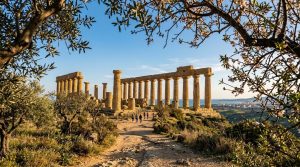
Visit the Valley of the Temples in the late afternoon light. – Day 8: Agrigento to Palermo, about 2 hours 8 minutes over 127 km, arriving in time to walk the Ballaro market before dinner. – Day 9: Palermo Cathedral, the Norman Palace, and a half-day trip to Monreale. – Day 10: Fly out of Palermo, or drive back to Catania Airport on the A19, about 2 hours 40 minutes over 191.6 km, if the return flight is fixed there.
Booking an open-jaw flight into Catania and out of Palermo removes that last long drive and is worth pricing against a round trip before committing to the route. The two extra bases also mean two extra check-ins, so travelers who dislike repacking every day or two should treat the 10-day version as the upper limit for this itinerary rather than a starting point to add on to.
Why you need a hire car in Sicily
A hire car is close to mandatory for this Sicily itinerary, because train and bus links between Taormina, Siracusa, Agrigento, and Palermo are slow, infrequent, and usually require a change in Catania or Palermo. Sicily is also bigger than its shape on a map suggests, and several of the key legs run on two-lane roads rather than motorways.
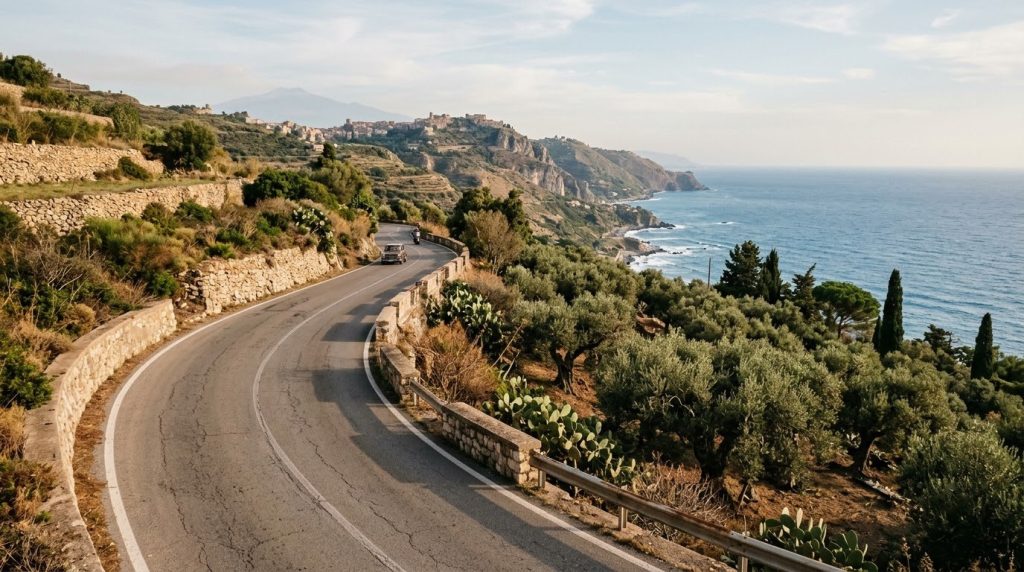
The Siracusa to Agrigento leg is the clearest example. The SS115 hugs the south coast rather than cutting inland on a motorway, so the roughly 2 hour 40 minute estimate holds only in light traffic, and it is worth budgeting extra time in July and August. Two towns on this route also restrict cars in their historic centers. Before you collect the keys, see Sicily’s real safety risks: aggressive city driving and rental-car break-ins matter far more than the Mafia, which is not a tourist threat.
Taormina’s Corso Umberto I is a ZTL, with entry cameras and fines from EUR 83 to EUR 160 for driving in without a permit, so cars go into the Lumbi or Porta Catania car parks and visitors walk or shuttle in.
Palermo’s centro storico works the same way, with a day pass costing around EUR 5 and fines from EUR 80 to EUR 165 for unauthorized entry, so parking on the edge of the ZTL near Teatro Massimo is the simpler option. Picking up the car at Catania Airport rather than in a city center avoids both restrictions on day one.
The upside of driving is the A19 between Palermo and Catania, which is toll-free with a 130 km/h limit and covers the 191.6 km stretch in around 2 hours 40 minutes when traffic is light, so the fastest leg of the whole trip is also the one that costs nothing extra in tolls.
When a shorter Sicily trip is the right answer
A shorter Sicily trip is the right answer when the visit is 4 days or less, when driving stress is something to avoid, or when Sicily is one stop inside a longer Italy trip rather than the whole trip. In that case, one base beats a loop. For a full rundown of neighborhoods, sights, and logistics, see our complete travel guide to Valletta.
Basing in Taormina for 4 nights and day-tripping to Siracusa (a round trip of roughly 2 hours 44 minutes) and Mount Etna covers the east coast highlights without packing and unpacking a car every two days.
Travelers who are combining Sicily with the mainland often route it against destinations like the Amalfi Coast, which shares the same one-base, day-trip structure. Anyone who would rather skip driving altogether tends to prefer a train-based region such as the Cinque Terre itinerary, where the towns connect by rail instead of a rental car.
How to decide – quick cheat sheet
– 7 days or fewer, flying into and out of Catania: the 7-day east coast loop. – 10 days, want the temples and Palermo too: the 10-day loop with the west added. – 4 days or fewer: one base in Taormina or Siracusa, day trips only, no full loop. – Sicily is one leg of a bigger trip: pair it with a Rome itinerary rather than squeezing in the full loop. – Traveling in July or August: add 20 to 30 minutes to every drive time listed above.
Getting around this itinerary without a car
A car-free version of this trip is possible, but only for a scaled-back take on the 7-day east coast loop, not the 10-day version with Agrigento and Palermo added.
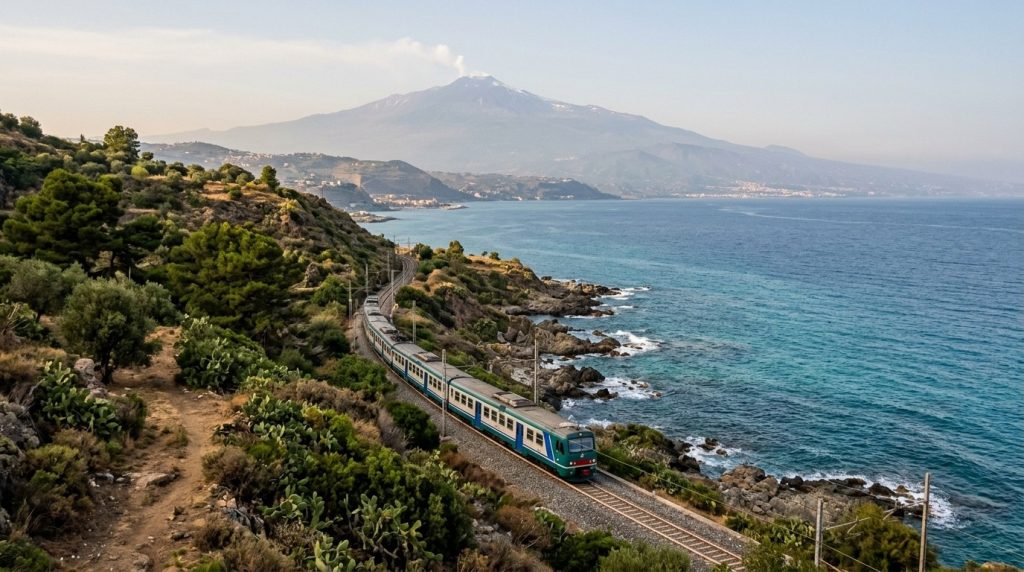
Catania to Taormina runs by train in about 56 minutes for roughly USD 6-11 (EUR 5-10), or by Interbus coach in a similar time for about USD 8-10 (EUR 7-9), both far faster than the drive once airport car-rental pickup is factored in.
Taormina to Siracusa is the leg where the car’s advantage shows clearly: the train takes about 2 hours, more than the 1 hour 22 minutes quoted for driving earlier, and tickets run roughly USD 14-32 (EUR 13-29). Interbus coaches cover the same route in a comparable time and tend to run cheaper, though schedules are sparser than the train’s.
Agrigento and Palermo are where the car-free version breaks down. Both towns sit well off the main rail corridor along the east and north coasts, and train connections from Siracusa typically require a change in Catania or Palermo with long waits between services, turning a 2 hour 40 minute drive into most of a travel day.
Travelers set on avoiding a rental car entirely should treat Agrigento and Palermo as a separate, train-based trip out of Palermo rather than an add-on to the Taormina-Siracusa loop.
For travelers who do go car-free, the trade-off is accepting a slower pace rather than a cheaper one: bus and train fares undercut a rental plus fuel and ZTL parking, but journey times roughly double on every leg, and the flexibility to stop at Etna, Noto or Vendicari along the way disappears.
That makes the car-free approach better suited to a shorter trip that sticks to Taormina and Siracusa than to the full loop described above.
What a rental car and fuel add to the budget
The lodging-and-food figures above explicitly leave out the rental car, and it is a real add to the total rather than a rounding error.
An economy car for this itinerary typically runs USD 25-30 (EUR 23-27) a day booked through a comparison site, rising toward USD 60 (EUR 55) a day for a mid-size car with more boot space for luggage; a week-long economy rental for the 7-day loop lands in the USD 160-190 (EUR 146-173) range before insurance add-ons.
Fuel in Italy runs roughly EUR 2.10-2.20 a liter (about USD 2.30-2.40) as of late 2026, and motorway stretches such as the toll-free A19 between Palermo and Catania tend to sit at the higher end of that range since fewer stations compete for passing traffic.
Across the 7-day loop’s roughly 118 km between bases, fuel itself adds relatively little; the 10-day version’s extra legs to Agrigento and Palermo, covering most of the 715 km total quoted at the top of this guide, push the fuel cost closer to USD 70-90 (EUR 64-82) for the full trip in a standard economy car.
Add the ZTL fines risk and parking fees covered earlier, and a realistic per-person total for the car itself, fuel, and parking on the 7-day loop lands around USD 150-220 (EUR 137-200) split between two travelers sharing the car, on top of the lodging-and-food figures in the table above.
Best time of year for this itinerary
April through June and late September into October are the strongest windows for this route, since both bracket the summer heat without losing reliably dry, driving-friendly weather. October specifically tends to run mild, with daytime temperatures commonly in the upper 60s to upper 70s Fahrenheit (roughly 20-26 degrees Celsius), comfortable for walking Ortigia or climbing around the Valley of the Temples without the midday heat that July and August bring.
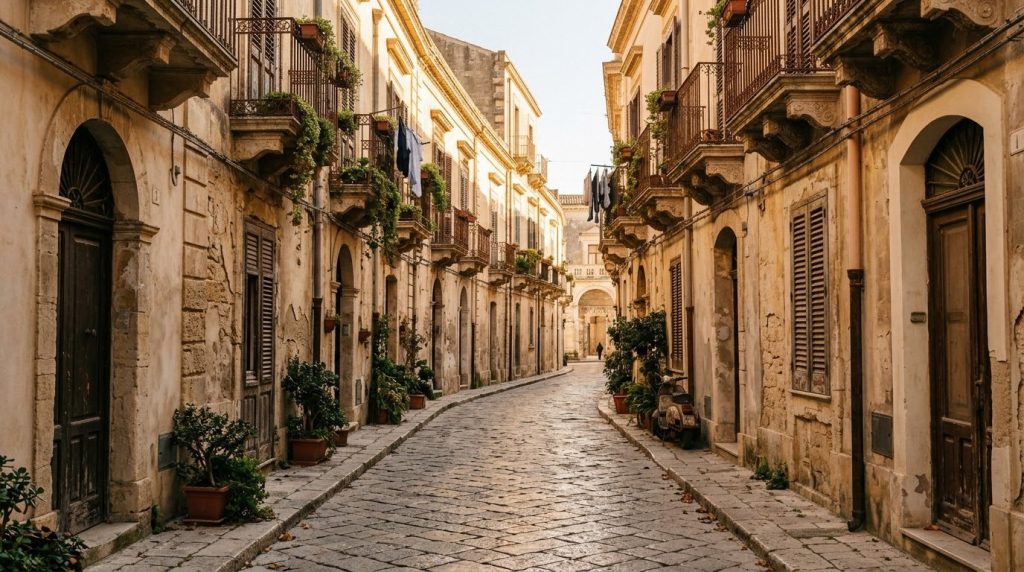
July and August push well into the 90s Fahrenheit on the coast and hotter inland around Agrigento and Palermo, which is also why the itinerary above already recommends adding 20 to 30 minutes to every drive time during those two months: heat, holiday traffic and a higher crash risk on single-carriageway roads all compound in peak summer.
Early June still runs comfortable for most of the route, with late June starting to feel more like summer than spring, particularly on the exposed drive down the SS115 toward Agrigento.
Shoulder-season travel also eases the two ZTL towns on this route. Taormina’s Corso Umberto I and Palermo’s centro storico, both covered above, see noticeably lighter day-tripper crowds outside July and August, which matters when the plan already depends on parking once and walking rather than moving the car daily.
Food to try along the route
Each base on this itinerary has a dish worth building a meal around rather than treating food as an afterthought between drives.
Taormina and the wider Catania side of the island are the home of granita with a brioche col tuppo for breakfast, almond or pistachio flavors especially, eaten at a café table rather than on the move; Catania itself, a short detour from the Day 1 airport run, is also where pasta alla Norma, tossed with fried eggplant, tomato and salted ricotta, originates.
Siracusa and Ortigia lean seafood, since the old island core sits surrounded by water on three sides and its morning market sells the catch the restaurants cook that same day.
Arancini, Sicily’s fried, stuffed rice balls, turn up everywhere on this route as a lunch-on-the-move option, but the fillings shift region to region, so trying one in each base is a reasonable way to taste the differences without a sit-down meal every time.
Palermo’s Ballaro and Vucciria markets, already on the Day 8 and 9 plan above, are built around street food rather than restaurants: panino con la milza, a spleen sandwich, and sfincione, a thick Palermo-style focaccia topped with tomato, onion and breadcrumbs instead of cheese, are the two dishes locals specifically travel into the market for.
Cannoli, filled to order with sweetened ricotta rather than pre-filled and left to soften, is worth seeking out at a proper pastry counter in any of the three cities rather than a tourist-strip bakery near the sights.
Where to stay along the route
Where to stay along a Sicily itinerary comes down to three bases: Taormina for the east coast and Etna, Siracusa’s Ortigia island for the baroque south, and Palermo for the west. Each base sits within walking distance of the sights that matter for that leg of the trip, which is what keeps the car parked rather than needed twice a day.
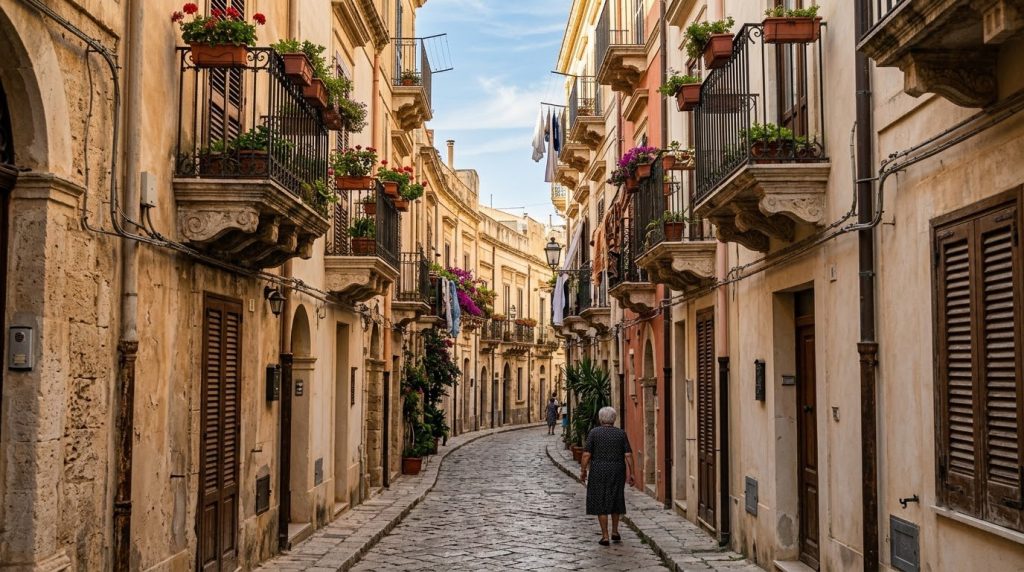
Taormina rewards paying more for a hotel inside or right at the edge of the ZTL, since every extra block outside it turns into a walk up a hill with luggage. Ortigia in Siracusa is flat and compact enough that almost any address works, and it puts Noto within the half-day trip described above.
Palermo is the largest of the three bases, so staying near Teatro Massimo or the Kalsa district keeps the cathedral, the Norman Palace, and Ballaro market within walking range without crossing the ZTL boundary. Travelers stacking a Rome stopover onto the same trip can check where to stay in Rome for that connecting leg.
Find your Sicily hotel on the map
Live prices from Booking, Airbnb and more — move the map or change dates to compare stays around Sicily.
Planning the whole trip? Start with our Sicily travel guide for the overview, then use this page for the details.