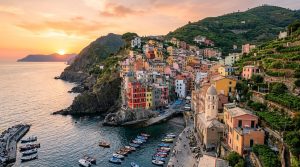
Amalfi Coast Itinerary: 3, 5 and 7 Days (2026)
Disclosure: Some links in this guide are affiliate links. If you book or buy through them, we may earn a small commission at no extra cost to you — it helps keep our guides free.
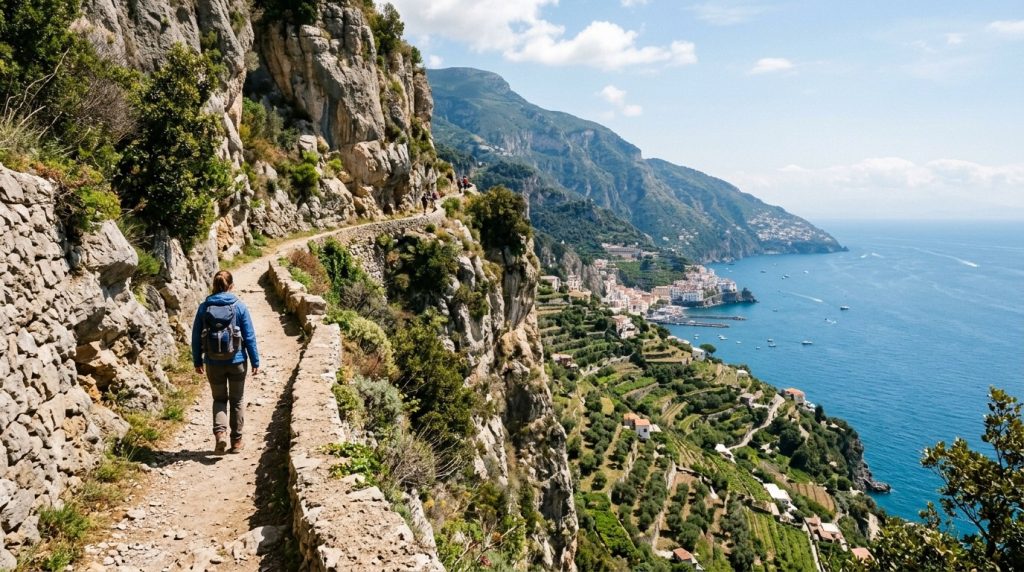
A 5-day Amalfi Coast itinerary linking Positano, Amalfi and Ravello runs USD 1,050 to USD 1,450 per person, built on a mid-range daily budget of USD 209 to USD 290 (EUR 180 to EUR 250) at the September 2026 rate of roughly EUR 1 to USD 1.16.
The 3-day version suits a first look at Positano and Amalfi, the 5-day version suits travelers who want to add Ravello and a coastal hike, and the 7-day version suits travelers looping in Sorrento and a Capri day trip.
| Days | Towns | Where to sleep | Approx cost/person (USD) |
|---|---|---|---|
| 3 | Positano, Amalfi | Positano, 2 nights | USD 630-870 |
| 5 | Positano, Amalfi, Ravello | Positano and Amalfi, 4 nights | USD 1,050-1,450 |
| 7 | Sorrento, Positano, Amalfi, Ravello, Capri | Sorrento, Positano and Amalfi, 6 nights | USD 1,460-2,030 |
3-day Amalfi Coast itinerary
Three days works best for travelers who want Positano and Amalfi without the drive time to farther towns. Base in Positano for two nights and check the Amalfi Coast travel guide for which beach or trail fits each day. Day 1 covers arrival and the town center.
Walk down to Spiaggia Grande, then work back up through Via dei Mulini past the shops and the Church of Santa Maria Assunta. Day 2 is a ferry day.
The Positano-Amalfi crossing takes 25 minutes door-to-door and costs USD 10 to USD 12 (EUR 9 to EUR 10), so spend the morning in Amalfi’s Duomo and old town before catching the afternoon ferry back.
Day 3 is for the Path of the Gods, a 7.6-kilometer trail that takes 2.5 to 4 hours one way and rewards the climb with the clearest coastal views on the route. Check the Positano itinerary for trailhead timing before setting out.
Skip Ravello and Capri on this pace, since fitting a fourth town into three days turns every stop into a rush.
5-day Amalfi Coast itinerary
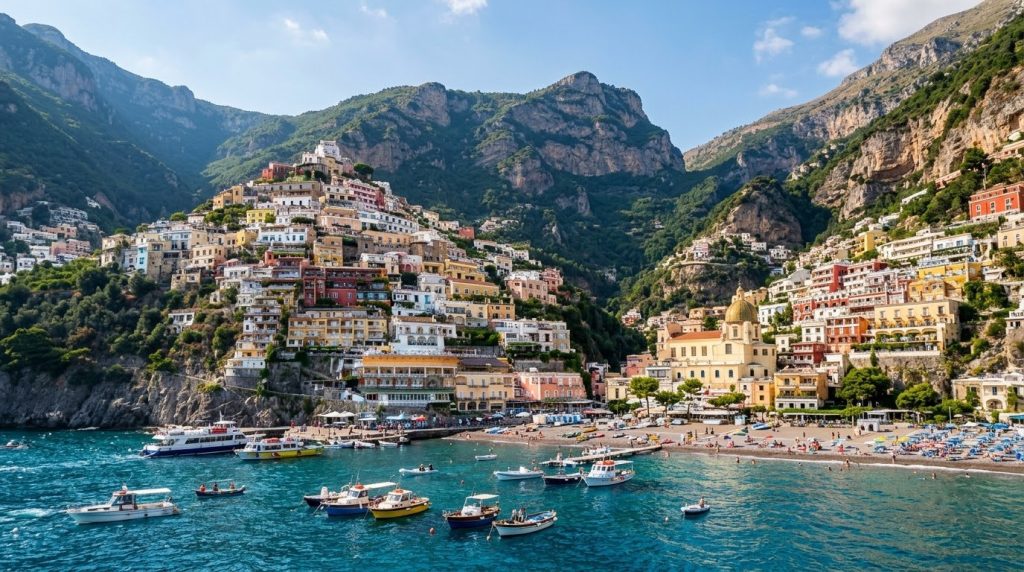
Five days is the itinerary most travelers land on because it adds Ravello without cutting time in Positano or Amalfi. Spend nights 1 and 2 in Positano covering the same beach-and-town routine as the 3-day plan, then move to Amalfi for nights 3 and 4.
Budget hotels in Amalfi average USD 151 (EUR 130) a night, noticeably less than Positano’s USD 212 (EUR 183) average for the same tier. Use day 3 for the ferry to Amalfi and an afternoon SITA bus up to Ravello, USD 3 (EUR 2.60) each way, to see the hillside piazza before the light fades.
Day 4 goes to the Path of the Gods hike described above, since Amalfi sits closer to several trail access points than Positano does. Day 5 allows a slower morning in Amalfi’s old town before departure, with time built in to check the Positano hotels guide if the next stay still needs booking.
This pace keeps each town to two full nights, so no day starts with a rushed transfer.
7-day Amalfi Coast itinerary
Seven days is the itinerary for travelers who want Sorrento and Capri added to the Positano-Amalfi-Ravello core. Start with two nights in Sorrento, using the SITA bus or a ferry to reach Positano and Amalfi on day trips before relocating. Move to Positano for two nights, then Amalfi for two nights, following the same routine as the 5-day plan above. Travelers starting in Rome can read our Naples versus Rome verdict, which recommends Rome first and Naples as the southern base for a one-week trip.
Day 6 is a Capri side trip from Positano. The ferry runs about 30 minutes each way and costs USD 28 to USD 34 (EUR 24 to EUR 29), and the chairlift to Monte Solaro adds USD 16 (EUR 14) one-way or USD 23 (EUR 20) return. Day 7 closes the loop back through Sorrento for departure.
The 7-day plan is the only length of the three where a full Capri day trip fits without compressing the coastal towns, since the extra two days absorb the ferry transfers.
Getting to the Amalfi Coast from Naples airport
Naples International Airport (NAP) is the usual gateway to the coast, and there is no direct train or metro link, so every option involves a bus, a transfer in Sorrento, or a private car.
The Curreri Viaggi shuttle bus runs directly from the airport to Sorrento, costs roughly USD 11 to USD 14 (EUR 10 to EUR 13) per person, and takes about 1 to 1.5 hours depending on traffic; from Sorrento, a SITA bus or ferry covers the final leg to Positano or Amalfi.
A private transfer is the simplest door-to-door option and typically costs around USD 130 to USD 210 (EUR 120 to EUR 190) per car for up to about eight passengers, which can work out cheaper than several individual bus and ferry tickets for a group.
Budget travelers heading to Sorrento first can also take a taxi or bus into Naples Centrale and catch the Circumvesuviana train to Sorrento, a slower but noticeably cheaper route.
However you travel, build in buffer time: between the shuttle, the connecting bus or ferry, and any queue at the port, reaching Positano or Amalfi from the airport realistically takes 2 to 2.5 hours door-to-door, not the 45 minutes a map’s straight-line distance suggests.
Booking the Curreri shuttle or a private transfer in advance for a midday or evening arrival avoids the worst of the queue at the airport taxi rank.
Some travelers instead fly into Rome Fiumicino and take a high-speed train down to Naples, roughly 70 minutes by the fastest services, before picking up one of the same onward options above; this adds a leg but can work out cheaper or more convenient depending on which city has better flight availability from home.
Whichever airport you start from, pack light for the first and last legs of the trip: narrow hotel staircases and the lack of elevators in many Positano and Amalfi properties make rolling a large suitcase up a hillside lane a genuinely unpleasant start to a holiday.
Best time of year to visit the coast
May through June and September through October are consistently the best-balanced months on the Amalfi Coast, with daytime temperatures typically in the low-to-mid 20s Celsius, most restaurants and hotels open, and noticeably thinner crowds than the peak of summer.
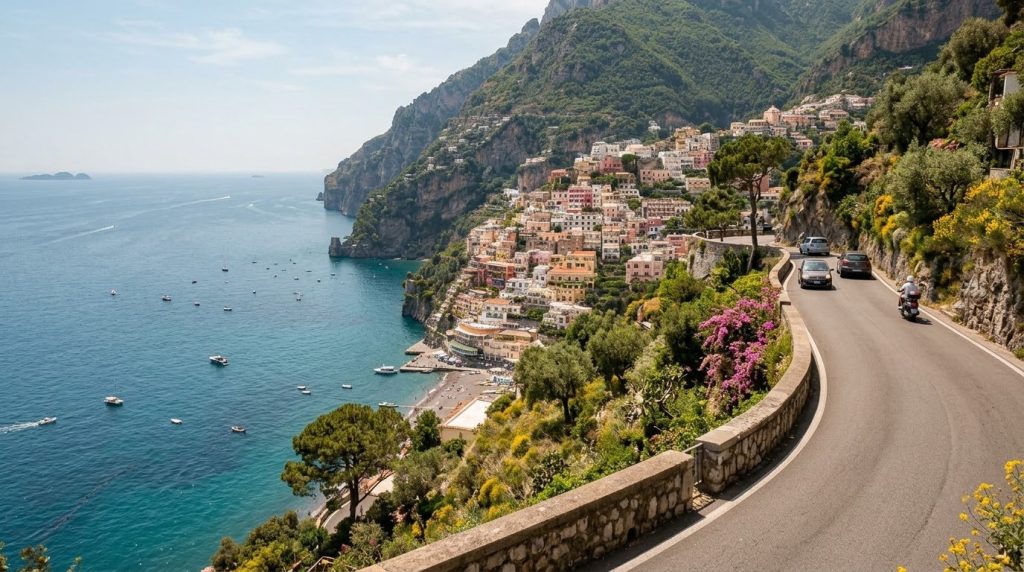
July and August are the busiest and hottest months, when the SS163 road traffic described above is at its worst, ferry queues are longest, and Path of the Gods trailheads can feel crowded rather than peaceful.
Since ferries between Salerno, Amalfi, Positano and Sorrento only run from April through October, as covered above, a trip planned for November through March needs to lean entirely on SITA buses or private transfers between towns, and some hotels and restaurants close for the winter season entirely, which thins out dining and lodging options considerably.
Early April and late October sit right at the edge of the ferry schedule and can work well for a quieter trip, though it is worth confirming which specific sailings are running that week before locking in an itinerary built around a ferry connection. Honest trade-offs and highlights are weighed in our piece on whether the Amalfi Coast is worth visiting.
For most travelers choosing between the 3, 5 and 7-day plans above, aiming for late May, June or September gets the best combination of open ferries, comfortable walking weather for the Path of the Gods, and manageable crowds at the main sights.
One date worth planning around rather than into is Ferragosto, Italy’s mid-August public holiday on the 15th, when the whole country effectively goes on vacation at once and the coast’s roads, ferries and restaurants see a domestic crowd layered on top of the usual international one; a trip that can be shifted a week either side of that date will feel noticeably calmer.
Ravello, sitting higher up the hillside than Positano or Amalfi, also runs a few degrees cooler in the height of summer, which is worth remembering if a July or August trip cannot be avoided.
Why the ferry beats the SS163 road
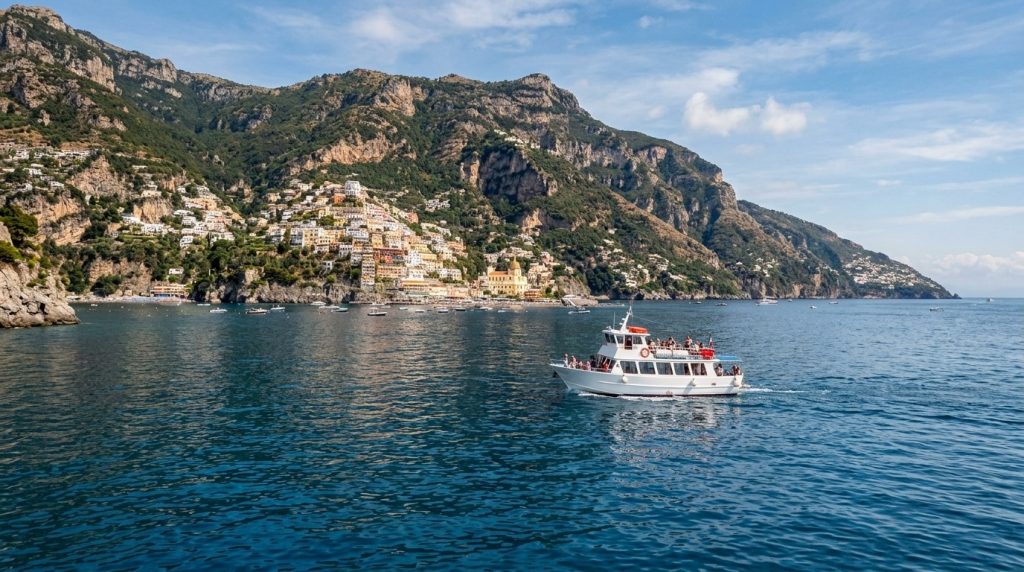
Ferries beat the SS163 coast road on speed, predictability and stress for a short itinerary. The Positano-Amalfi ferry takes 25 minutes door-to-door, while the same 12-kilometer drive on the SS163 can take 40 to 55 minutes in July and August traffic and longer on summer weekends between May and early October. Rough seas are only one of the coast’s physical risks, and our Amalfi Coast safety guide also covers rockfalls, the cliff road and hot trails. If cost matters more than speed, our Amalfi Coast budget breakdown compares the USD 11 Amalfi-Positano ferry with SITA bus rides from USD 1.70.
The road itself runs a single lane in each direction with roughly 350 hairpin turns along the full 50-kilometer coastline, which is why SITA buses and rental cars both slow to a crawl once the towns fill with day-trippers.
Ferries only run from April through October, connecting Salerno, Amalfi, Positano and Sorrento with fares of USD 10 to USD 17 (EUR 9 to EUR 15) per crossing, so travelers visiting outside that window need the SITA bus or a private transfer instead.
Book ferry tickets a day ahead in July and August, since boats fill up and sea conditions can cancel a route with little notice.
When a shorter Amalfi Coast trip is the right answer
A 3-day Amalfi Coast trip is the right length when the budget or the calendar cannot stretch past a long weekend. Two nights is the minimum that still makes the trip worthwhile, since one night leaves barely enough time to see the Duomo, walk the old town and reach a beach before checking out.
A shorter trip also suits travelers connecting from Naples or Rome, where the ride down and back already uses a half day on each end. Naples to Positano runs USD 31 to USD 35 (EUR 27 to EUR 30) by ferry and takes about 1.5 hours, while the drive from Rome takes roughly 4 hours.
Cutting the trip to three days lowers cost the most directly, since two fewer hotel nights at USD 212 (EUR 183) in Positano save more than any single activity choice. Choose the 3-day itinerary over the 5-day or 7-day version whenever the goal is simply to see Positano and Amalfi, not to add Ravello or Capri.
How to decide – quick cheat sheet
– Have 3 days and a fixed budget. Base in Positano, ferry to Amalfi once, and hike the Path of the Gods. – Have 5 days and want variety. Add Amalfi and Ravello as separate bases instead of day trips. – Have 7 days and want Capri.
Only this length leaves room for the ferry and chairlift without cutting another town. – Traveling outside April through October. Skip ferries entirely and plan around the SITA bus, since boats stop running for winter. – Traveling in July or August. Book ferries and Path of the Gods slots in advance, since both fill up on weekends.
What a day of meals costs
Food is one of the more predictable costs on this itinerary once you know the rough bands. A casual lunch of pizza or pasta at an ordinary trattoria in Positano or Amalfi runs about USD 15 to USD 26 (EUR 13 to EUR 23) per main, with seafood and more elaborate pasta dishes sitting toward the top of that range.
A multi-course set menu at a sit-down dinner restaurant, typically a starter, pasta, main and dessert, commonly runs around USD 38 (EUR 33) per person before drinks, and restaurants with a prime sea view over Positano’s beach or Amalfi’s harbor charge a premium on top of that for the location alone.
Bakeries and small alimentari (grocery shops) sell sandwiches, pastries and pre-made pasta salads for a fraction of restaurant prices, and putting together a simple picnic lunch from one of these for a hiking day on the Path of the Gods is both cheaper and more practical than trying to find a sit-down lunch along the trail itself.
Bottled water and soft drinks cost more near the main piazzas and beaches than a block or two back, the same tourist-pricing pattern that applies to souvenirs.
Budgeting roughly USD 60 to USD 90 (EUR 52 to EUR 78) per person per day for food, mixing one restaurant meal with simpler lunches, fits comfortably inside the mid-range daily budget already set out at the top of this guide.
Many sit-down restaurants in Italy, including along this coast, add a small per-person cover charge (coperto) and sometimes a separate service charge to the bill, so check the menu’s fine print before assuming the listed prices are the full cost; tipping beyond that is appreciated but not expected the way it is in the US, and rounding up or leaving a few euros for good service is the norm rather than a fixed percentage.
Path of the Gods: what to bring
The Path of the Gods rewards preparation more than fitness alone. Proper hiking shoes or trail runners with real grip matter, since several stretches are uneven stone and loose gravel rather than a maintained path, and sandals or city sneakers make the descent into Nocelle or Positano at the end noticeably harder on tired legs.
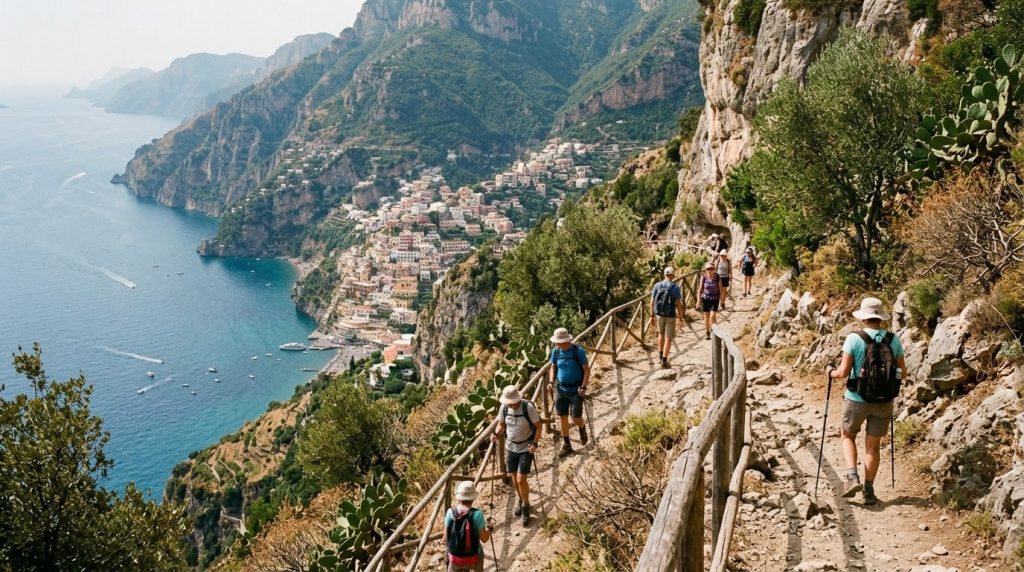
Carry more water than feels necessary, since there are few reliable refill points directly on the trail and the exposed sections offer little shade in the middle of the day, which is also why starting early in the morning is worth doing even outside peak summer.
Mobile signal drops in and out along parts of the route, so downloading an offline map of the trail beforehand is a sensible backup to the trail markers, which are generally clear but not constant.
The trailhead at Bomerano is reached by SITA bus from Amalfi, while the Nocelle end finishes with a long staircase down into Positano, so deciding which direction to walk is really a question of whether you would rather climb or descend that staircase, since the elevation change happens somewhere on the route regardless of direction.
Where to stay along the coast
Positano centers on Via dei Mulini, five to ten minutes from the main beach, where properties like Hotel Savoia run from USD 270 to USD 313 a night. The Fornillo side of town sits further from the center but has its own smaller beach, with Hotel Marincanto priced from USD 328 a night for a quieter base.
Praiano, one town over, runs 30 to 50 percent cheaper than Positano for similar sea views, which is worth checking for a 5-day or 7-day itinerary that does not need to stay inside Positano itself. For the ferry and bus connections that link Amalfi and Ravello back to Positano, check the Positano travel guide.
Find your Amalfi Coast hotel on the map
Live prices from Booking, Airbnb and more — move the map or change dates to compare stays along the Amalfi Coast.