Is Amalfi Coast Safe? Roads, Hikes and Crime Risks (2026)
Disclosure: Some links in this guide are affiliate links. If you book or buy through them, we may earn a small commission at no extra cost to you — it helps keep our guides free.
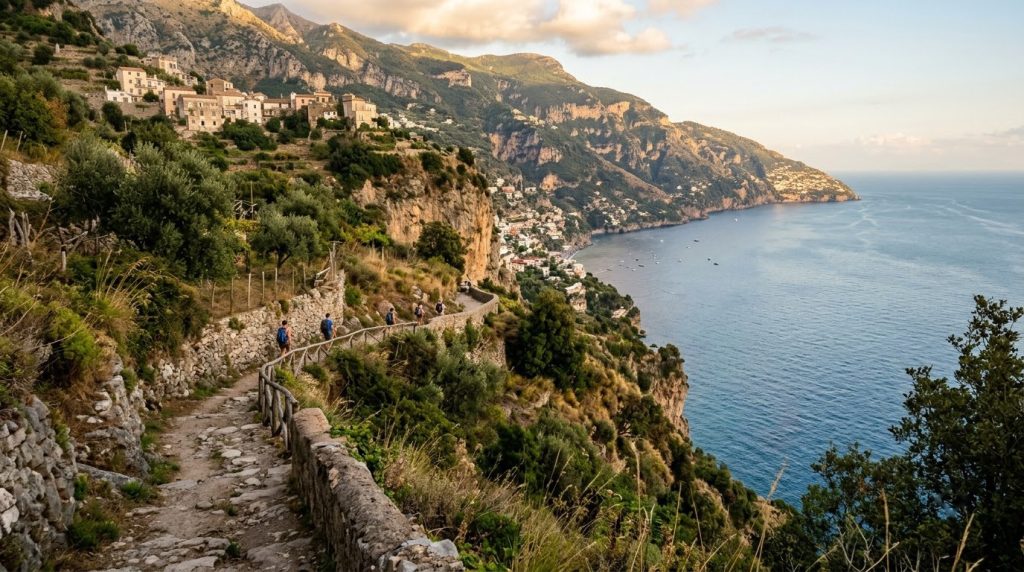
Yes, the Amalfi Coast is safe for most travelers: Italy sits at US State Department Level 2 (“Exercise Increased Caution,” last updated 23 May 2025) because of a nationwide terrorism risk, not crime on the coast. Violent crime against tourists is rare in Positano, Amalfi and Ravello. What actually hurts visitors is physical: the cliff road, rockfalls, steep stairs, hot trails and rough seas.
| Risk | Reality | What to do |
|---|---|---|
| Violent crime | Rare in the coastal towns | Normal big-city habits in Naples only |
| Pickpockets | Crowded buses, ferry piers, Naples station | Crossbody bag, phone in front pocket |
| SS163 road | Narrow, blind curves, buses and scooters | Skip driving; use buses, ferries or a driver |
| Rockfalls | Several SS163 closures in 2026 | Check road news, keep plans flexible |
| Path of the Gods | Exposed edges, heat, slippery rock | Start early, hiking shoes, 1.5 liters of water |
| Sea | Undertow on windy days, ferries canceled | Swim where others swim, carry a backup plan |
The honest answer: crime is low, terrain is the risk
The US advisory for Italy covers terrorism across all of Italy and names no special concern for the Amalfi Coast. The realistic crime problem is petty theft in crowds: a wallet lifted on a packed SITA bus, a bag left on a beach lounger, a phone grabbed at Naples station.
The serious incidents involve gravity. In 2026 alone, the SS163 Amalfitana road closed after a landslide at Vietri sul Mare in February, a rockfall at Tordigliano that cut Positano off from the Sorrento side in July, and a fire-triggered landslide at Laurito, just outside Positano, in September. Nobody was reported hurt, but the coast changes fast.
If you are still deciding whether the hassle pays off, read our take on whether the Amalfi Coast is worth visiting.
How to get to the Amalfi Coast
There is no direct bus, train or ferry from Naples Airport (Capodichino) straight to any Amalfi Coast town; every route involves at least one change. The most common path is a shuttle bus to Sorrento, which takes roughly 75 to 90 minutes, followed by the local SITA bus onward to Positano or Amalfi.
An alternative is the train: a taxi or bus into Naples to catch the Circumvesuviana line to Sorrento, then the same SITA connection onward.
From Rome, the fastest option is a high-speed Frecciarossa or Italo train to Salerno, roughly 2.5 to 3 hours depending on the service, then a bus or, from spring through autumn, a ferry onward along the coast; door to door, plan on 2.5 to 4.5 hours from Rome depending on which connection you catch.
Salerno sits closer to the coast than Naples does, so travelers coming from Rome often find it the simpler gateway.
A private transfer removes the connections at a price: door-to-door cars from Naples Airport typically quote around 75 to 90 minutes to Positano and a little less to Amalfi town, useful if you are arriving late, traveling with young kids, or simply do not want to manage luggage through two bus changes.
Whichever route you take, build in slack. SITA buses run standing-room only in summer and occasionally skip a packed stop altogether, and the one road in and out of most towns is the same SS163 covered below, so a landslide or accident elsewhere on the route can delay your last leg by hours.
Do not book a same-day onward flight or a tight cruise departure. Cruise passengers docking at Naples or Salerno face the same choices in reverse, so confirm your ship’s last boarding time before planning a full day on the coast.
Luggage is the other practical snag: SITA buses and small ferries have limited space for large suitcases, so travelers moving between towns with more than a carry-on often find a private transfer or a taxi between hotels less stressful than wrestling bags through a crowded bus door.
Transport safety: why you should skip driving the SS163
The Amalfitana is a two-lane cliff road with hairpins, little shoulder and full-size buses squeezing past tour coaches while scooters weave through the gaps. For a first-time American driver it is stressful at best.
There is also a legal trap. From 10:00 to 18:00, an alternate license-plate rule limits which cars may use the SS163: weekends and holidays in June and July, daily in August and September, weekends in October. Rental cars and foreign plates are included. Sources disagree on which digit is banned on which date, so check locally.
Safer options:
– SITA buses. A COSTIERASITA 24-hour pass costs USD 11 (EUR 10), or USD 13.50 (EUR 12) including Positano’s local buses, converted at USD 1 = EUR 0.89. Buy tickets at a tabaccheria, never on board (current timetables). Summer buses run standing-room only and often reach Positano already full.
Keep valuables zipped in front of you. – Ferries (roughly April to October) skip the road, but swells can cancel them even on sunny days. – A private driver removes both the stress and the plate rule.
Our Amalfi Coast itinerary sequences towns to minimize road time.
Path of the Gods and the stairs
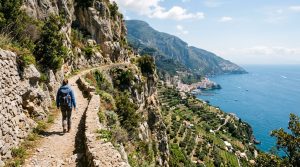
The Path of the Gods (Sentiero degli Dei) runs about 5.6 km (3.5 miles) from Bomerano to Nocelle, typically 1.5 to 3 hours. It is rated easy to moderate, but parts run along an exposed cliff edge, and Positano’s tourism site calls it unsuitable for people with vertigo. The real dangers are heat and footing: polished rock gets slippery, and shade is scarce.
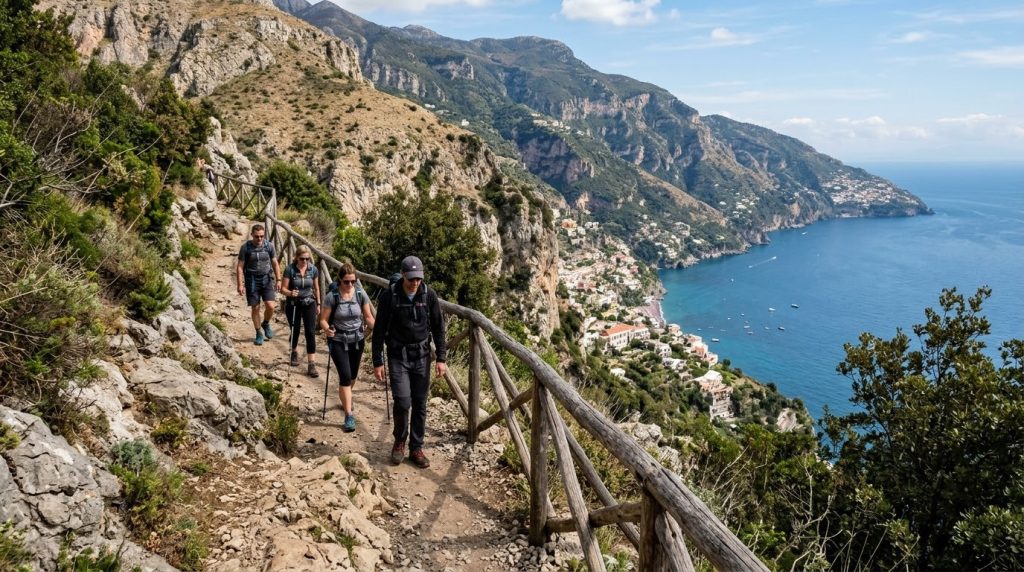
Start by 10 a.m., wear hiking shoes, and carry at least 1.5 liters of water per person. Ending in Nocelle means about 1,792 steps down to the coast road. Positano itself is stairs everywhere, so a sprained ankle is a likelier souvenir than a mugging.
Sea swimming and ferries
The water is clear and usually calm, with no dangerous marine life beyond occasional jellyfish. Beaches are pebble, so bring water shoes. The exception is windy days, especially in May and September, when westerly winds bring strong waves and undertow. Do not swim alone off rocks, and keep kids close.
Ferries strand rather than sink: a canceled afternoon boat can leave you scrambling for a bus, so never book a tight flight connection on a ferry day. Our best time to visit the Amalfi Coast guide covers the calmer months.
Scams and tourist traps that actually happen
– Unpriced menus and “fish by weight.” Ask the price before you order seafood priced per hundred grams. – Unofficial parking helpers who wave you into a spot and expect cash. Use marked lots only. – Boat-tour touts near Positano’s beach.
Book with a company that lists prices and states its bad-weather refund policy. – Distraction tricks at Naples station: someone “helping” with your bag while a partner works your pockets.
Neighborhoods to avoid after dark
No coastal town has a no-go district. The night risk is walking the SS163 itself, unlit and without sidewalk on many stretches, so take a taxi between towns after dinner. In Naples, the area around Napoli Centrale and Piazza Garibaldi deserves extra alertness at night; move straight to your onward transport.
Solo and female travelers
Positano, Amalfi and Praiano are comfortable for solo women: well lit in the centers, busy into the evening in summer. The usual rules apply: watch your drink, use a licensed taxi late at night, and share your route if you hike alone, ideally when other walkers are on the trail.
Family travel and accessibility
The Amalfi Coast is beautiful and genuinely hard going for strollers, wheelchairs or anyone with limited mobility. Positano alone has roughly 1,792 steps down from the upper town to the beach, and most towns stack similarly steep lanes and staircases between the bus stop, your hotel and the water. If accessibility is a concern, Amalfi town and Sorrento are the flattest realistic bases, and even then, expect some stairs.
Traveling with young kids changes a few of the calculations already covered above. SITA buses rarely have room for a full-size stroller once they fill up in summer, so a compact, foldable one travels far better than a full-size model, and a baby carrier is more useful than either on the Path of the Gods or the stepped lanes of Positano.
Ferries are generally the easiest way to move a family between towns, since they skip both the bus crowds and the cliff road, though the same weather cancellations covered above still apply.
For swimming with kids, stick to calmer, more sheltered beaches such as Marina Grande in Positano or Amalfi’s own small beach, and watch them closely on the pebble shoreline, which drops off faster than it looks in clear water. Sunscreen and a hat matter more here than on a typical beach trip, since much of the day is spent walking exposed stone lanes and staircases with little shade.
None of this rules out a family trip. It just means building in more time between stops than the distances on a map suggest, and accepting that a toddler’s pace, not the ferry timetable, will set the day.
Pack a basic first-aid kit with blister plasters and rehydration salts; between the heat, the stairs and the walking, minor scrapes and dehydration are far more likely to interrupt a family trip here than anything covered under crime or scams.
Who should think twice about this trip
Rethink the coast if you have serious mobility problems (stairs are unavoidable), strong vertigo, or a heart condition that makes summer heat risky, or if you insist on driving yourself. Weighing alternatives? See our Amalfi Coast vs Cinque Terre comparison.
What to do in an emergency
Call 112, Italy’s single emergency number; 118 also reaches an ambulance. Save your hotel’s address in Italian, and buy travel insurance with medical evacuation, since a cliff-path injury can mean a helicopter. ETIAS pre-authorization has not launched yet for US passport holders, so check its status before you fly.
Choosing a base beyond Amalfi, Positano and Sorrento
The three towns covered below are not the only options, and a couple of others solve specific problems better.
Ravello sits high above the coast road, reached by a dedicated bus up from Amalfi town, and its hilltop piazza is largely car-free, which makes it one of the calmer bases if SS163 traffic and crowds are your main worry. The tradeoff is a longer, winding trip down to the water each time you want to swim.
Praiano, between Positano and Amalfi, is smaller and quieter than both, with fewer crowds at its viewpoints and the same cliffside scenery at a lower key. It suits travelers who want the views without Positano’s stairs-and-selfie-stick crowding.
Minori and Maiori, past Amalfi town toward Salerno, sit on some of the coast’s flattest ground, with Maiori in particular having a longer sand-and-pebble beach rather than the rocky coves common elsewhere. Families managing a stroller, or anyone who struggles with stairs, often find these towns easier going than Positano.
Whichever base you choose, the safety basics from this guide carry over everywhere: skip driving yourself on the SS163, book boat tours with a company that states a weather policy, and take a taxi rather than walk the coast road between towns after dark.
None of these five towns is objectively safer than the others in a crime sense; the real differences are about terrain, noise and how far you are from a pharmacy or a doctor if something goes wrong. Amalfi town, as the coast’s transport hub, is the easiest place to reach help quickly, which matters more than most guidebooks mention if you are traveling with small children or an older relative.
Where to stay
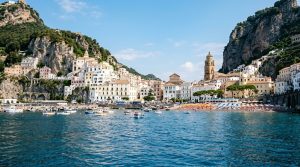
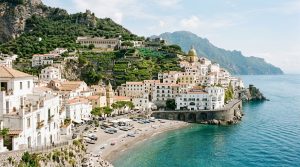
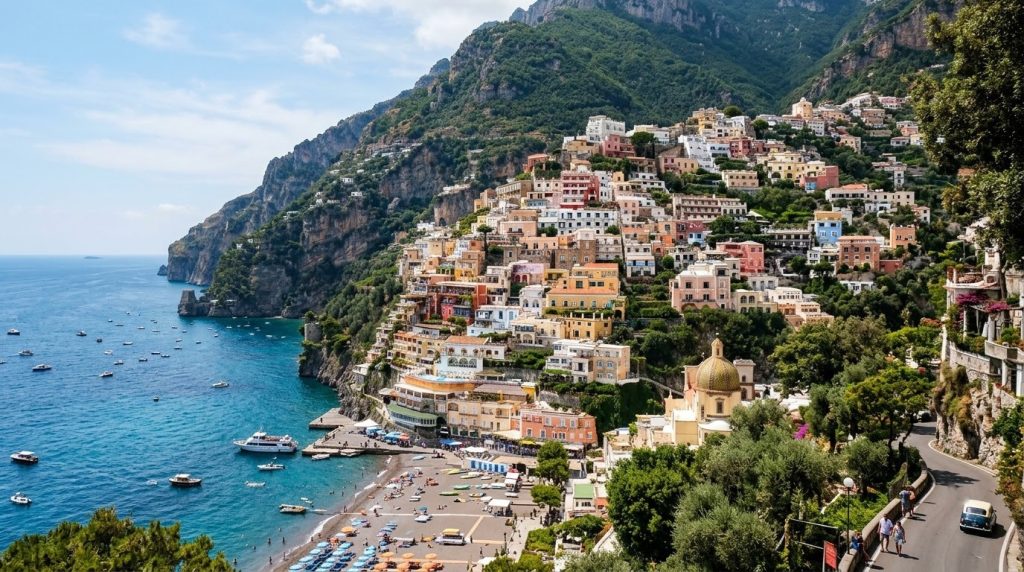
– Amalfi town: the transport hub for buses and ferries, flat center, easiest for first-timers. – Positano: the postcard, but steep. Stay near Spiaggia Grande or Fornillo beach to limit climbing. – Sorrento: off the Amalfi side, flatter, with a train to Naples. Good for families and anyone avoiding stairs.
For specific picks by budget, see our Amalfi Coast travel guide.
Find your Amalfi Coast hotel on the map
Live prices from Booking, Airbnb and more — move the map or change dates to compare stays across Amalfi Coast.
Frequently Asked Questions
Is the Amalfi Coast safe for American tourists?
Yes. The State Department rates all of Italy at Level 2 (Exercise Increased Caution) because of a nationwide terrorism risk, and the coast has no specific warning. Americans mostly face pickpocketing in crowds and the physical risks of cliff roads, stairs and hiking trails rather than violent crime.
What is the odd-even rule on the Amalfi Coast?
It is an alternate license-plate restriction on the SS163 coastal road from 10:00 to 18:00 during peak periods: weekends in June, July and October, and daily in August and September. The last digit of your plate decides whether you may drive that date. Rental cars are not exempt.
Is Positano safe at night?
Positano’s center is safe at night, with restaurants busy until late in summer. The risk is footing, not crime: steep, dim stairways after a few glasses of wine. Avoid walking the SS163 between towns after dark, since many stretches lack a sidewalk; take a taxi.
Is the Path of the Gods dangerous?
For fit hikers it is easy to moderate, about 5.6 km from Bomerano to Nocelle. Danger comes from heat, slippery polished rock and exposed cliff edges, which make it unsuitable for people with vertigo. Start early, wear proper shoes and carry at least 1.5 liters of water each.
When should you not go to the Amalfi Coast?
Avoid winter if you want reliable ferries, since boats run roughly April to October, and avoid August if you hate crowds and full buses. May and September are pleasant but can bring windy days with rough seas and undertow, so plan swimming and boat trips flexibly.