Japan Solo Travel: The Honest 2026 Guide
Disclosure: Some links in this guide are affiliate links. If you book or buy through them, we may earn a small commission at no extra cost to you — it helps keep our guides free.
- Japan is among the best places to travel solo: Numbeo Safety Index of 77.2, second-highest in the world.
- Tokyo hostel beds start at USD 20 a night.
- The catch is price: a single hotel room costs nearly as much as a double.
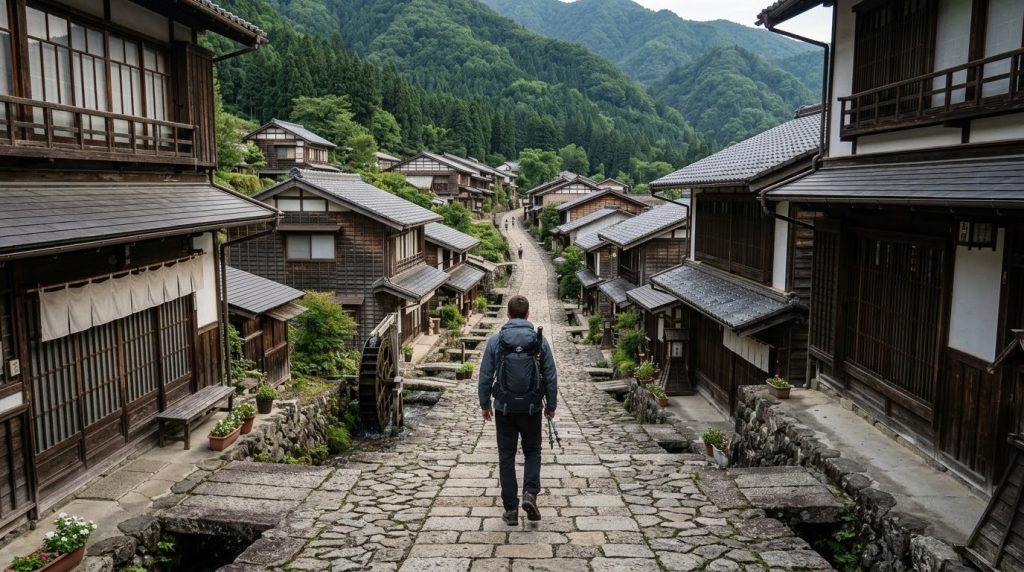
Solo travel in Japan works better than almost anywhere else on the planet, backed by a Numbeo Safety Index of 77.2, the world’s second-highest, and hostel beds in Tokyo from USD 20 a night. The one place the country doesn’t go easy on solo travelers is the price of sleeping alone, where a single room routinely costs nearly as much as a double.
| Concern | The reality | What to do |
|---|---|---|
| Personal safety | Numbeo Safety Index of 77.2 in 2026, second-highest of any country tracked | Walk, ride trains, and explore after dark without extra precautions |
| Eating alone | Counter seats and ticket machines (shokken-ki) are the standard setup, not a workaround | Order ramen or donburi solo with zero spoken Japanese |
| A single hotel room | Business hotel singles run USD 46-98 (JPY 7,000-15,000), close to twin rates of USD 52-130 (JPY 8,000-20,000) | Book capsule pods or hostel dorms at USD 20-42 (JPY 3,000-6,500) to actually cut costs |
| Getting around | A 7-day JR Pass costs USD 326 (JPY 50,000), the price set after the October 2023 increase | Price it against point-to-point Shinkansen tickets before buying |
| Language outside the cities | English signage and menus thin out past Tokyo, Kyoto, and Osaka | Load an offline translation app before leaving the JR corridor |
Why Japan is the easiest place to travel alone
Japan removes the two obstacles that make solo travel exhausting elsewhere, physical danger and the constant need to ask strangers for help. The country’s Numbeo Safety Index sits at 77.2 for 2026, trailing only the United Arab Emirates worldwide.
A solo traveler can ride the last train at midnight, walk back to a hostel through an unlit side street, or nap on a station bench without the vigilance that other major destinations demand. Our Japan safety guide for Americans confirms the Level 1 rating and flags the few real risks: nightlife bar scams, train groping and natural hazards.
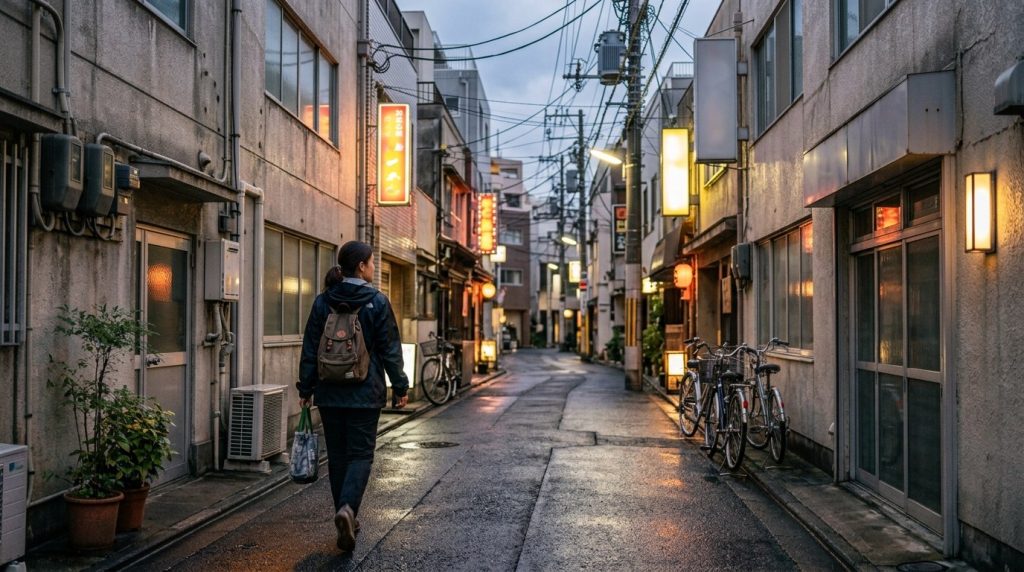
Every JR and subway line displays station names in Roman letters, and ticket machines default to English with a single tap. A Suica or Pasmo IC card removes the need to buy individual tickets, so a solo traveler taps in and out of trains, buses, and convenience stores on the same card for two straight weeks without asking anyone for directions.
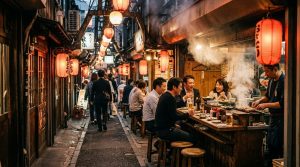
Eating alone is the default in Japan, not an accommodation for tourists. Ramen shops seat customers at a counter, and a shokken-ki ticket machine by the door lets a solo diner pick a bowl, pay in cash, and hand over a printed ticket without exchanging a single word with staff. Sushi bars, yakiniku counters, and standing soba stalls follow the same pattern, built around single seats rather than group tables.
The friction nobody warns you about
The one part of Japan that penalizes going solo is the bill for a bed. A business hotel single room costs USD 46-98 (JPY 7,000-15,000) a night, while a twin room built for two runs USD 52-130 (JPY 8,000-20,000).
Two people splitting that twin pay roughly half the per-person cost that a solo traveler pays for a single, so the usual math of group travel being cheaper per person flips against the solo traveler in Japan.
Traditional ryokan add a direct penalty on top of that. Most quote a hitori-domari single-occupancy surcharge of 20 to 30 percent above the per-person rate charged to a couple, sometimes USD 33 (JPY 5,000) or more per night, because the kaiseki dinner and room turnover are priced for two guests, not one. A handful of inns, mostly in smaller onsen towns, waive the surcharge, but they remain the exception.
The language barrier is real once a traveler leaves the JR corridor. Tokyo, Kyoto, and Osaka run on heavy English signage, but a countryside ryokan, a rural bus timetable, or a family-run izakaya in a smaller town often carries none, and a solo traveler has no companion to lean on when a menu or schedule is Japanese-only.
Timing a trip around the best time to visit Japan helps here too, since shoulder-season travel cuts both the single-room premium and the crowd at the ticket machine.
Getting around: IC cards versus the JR Pass
A prepaid IC card is the default way to move through Japan solo, and the tourist-oriented Welcome Suica removes the one friction a regular card carries. A standard Suica or Pasmo requires a refundable JPY 500 deposit on top of an initial charge, typically JPY 1,500, both loaded onto the same card.
The Welcome Suica waives that JPY 500 deposit entirely and comes preloaded with JPY 1,500, or about USD 9.80, ready to tap onto trains, buses and convenience-store registers the moment it is issued; the trade-off is that it is valid for up to six months and the balance is not refundable at the end of the trip, unlike a standard card’s deposit.
Whether a rail pass beats paying per ride depends entirely on the route. The 7-day JR Pass covered elsewhere in this guide only pays for itself once several long-distance Shinkansen legs are stacked together, so a solo traveler staying inside Tokyo, or splitting time between just two nearby cities, often comes out ahead topping up an IC card and buying point-to-point tickets instead.
Reloading an IC card at any station machine takes seconds and avoids the upfront commitment of a multi-day pass that only makes sense with a fuller, multi-city itinerary planned in advance.
Welcome Suica cards are sold at IC card vending machines and ticket counters inside the major airports and central Tokyo stations, which makes picking one up on arrival straightforward rather than something that needs sourcing in advance.
Beyond train and bus fares, the same card taps onto convenience-store registers, vending machines and coin lockers at major stations, which matters for a solo traveler juggling luggage between a check-out and a late train, since a locker paid for with the same card already in hand is one less thing to fumble for with a bag in the other hand.
What a solo Japan trip actually costs
A two-week solo trip through Japan runs on three line items, in order of size: a rail pass, a bed, and food. At today’s rate of roughly JPY 153.5 to USD 1, a 7-day JR Pass costs USD 326 (JPY 50,000), the price it has held since the October 2023 increase raised it from JPY 29,650.
A traveler covering Tokyo, Kyoto, and Osaka in one loop typically breaks even on the pass around the fourth or fifth Shinkansen leg.
| Line item | Typical range |
|---|---|
| 7-day JR Pass | USD 326 (JPY 50,000 flat) |
| Hostel dorm bed | USD 20-42 (JPY 3,000-6,500) per night |
| Capsule hotel pod | USD 26-42 (JPY 4,000-6,500) per night |
| Business hotel single | USD 46-98 (JPY 7,000-15,000) per night |
| Meals, budget pace | USD 20-29 (JPY 3,000-4,500) per day |
Lodging swings the total more than anything else, since a hostel dorm bed at USD 20-42 (JPY 3,000-6,500) a night costs less than half of a business hotel single at USD 46-98 (JPY 7,000-15,000). A full Tokyo budget guide breaks the day-to-day numbers down further for travelers staying inside the city rather than moving between regions.
Where a first solo trip should go
A first Japan solo trip should stay inside the Tokyo-Kyoto-Osaka triangle, where transport, food, and English support are all at their strongest.
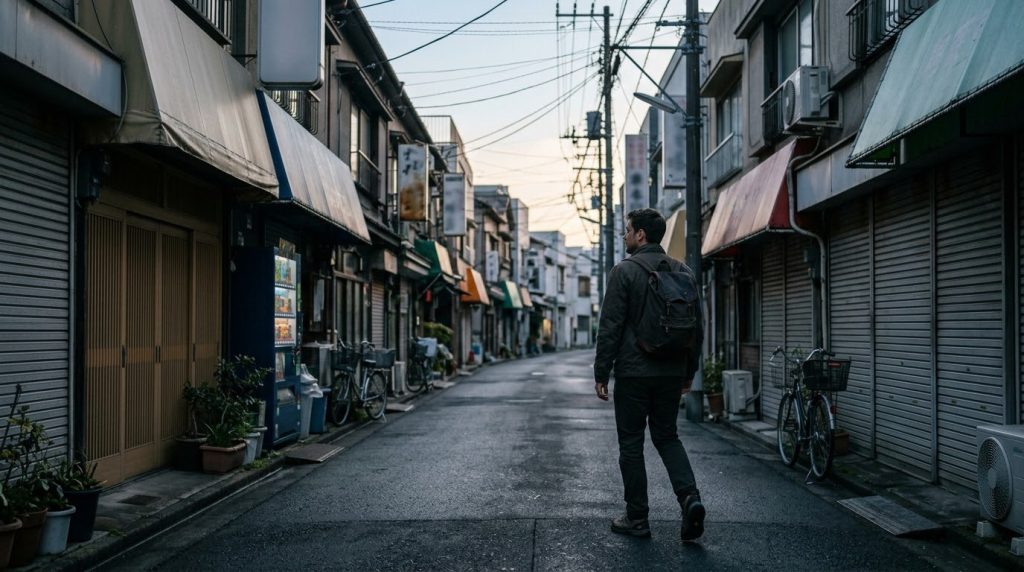
Tokyo works as a landing pad because Narita and Haneda both connect directly to the city by train, and a structured four-day Tokyo itinerary gives a solo traveler a route to follow instead of a blank map on day one.
From there, the Tokaido Shinkansen reaches Kyoto in under two and a half hours, and Kyoto’s grid of temples and machiya streets suits solo pacing better than Tokyo’s scale, since there is no group to coordinate around opening hours or ticket slots.
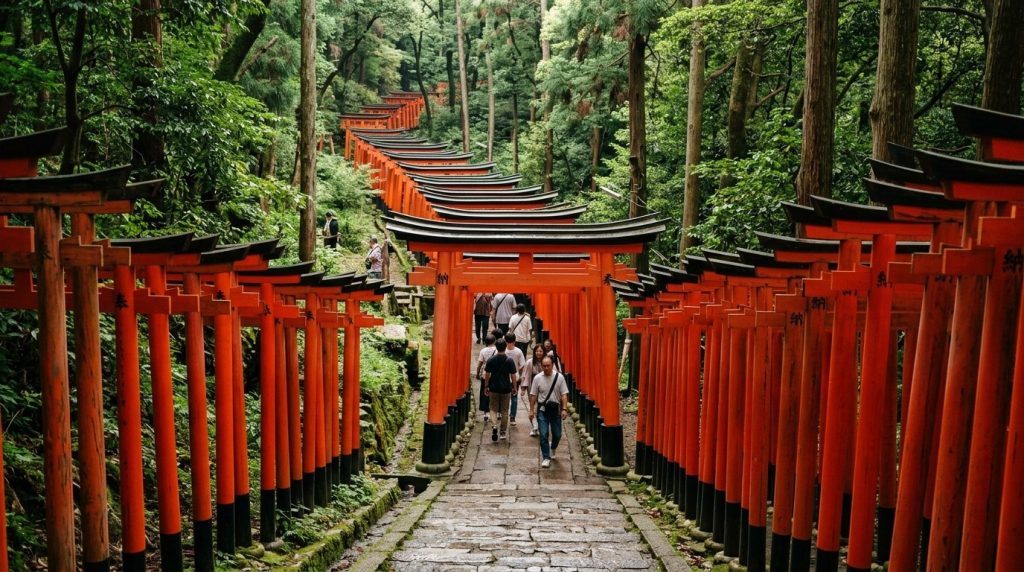
The choice between the two cities is less about which is better and more about what a solo traveler wants from the trip, a question Tokyo versus Kyoto for a solo traveler answers in more detail. Osaka adds a third stop for travelers with more than seven days, mainly for solo-friendly street food at Dotonbori’s standing counters.
Solo and female-specific safety notes
Japan’s low-crime reputation, already backed by the Numbeo Safety Index figure cited earlier in this guide, does not mean every safety consideration disappears for a solo traveler, and female travelers in particular ask about one feature that is specific to Japan: women-only train cars.
Many commuter and metro lines, operated by JR East and other companies, designate one car as women-only during weekday morning rush hour, commonly from around 7am to 9:30am, with some lines extending the policy into the evening rush as well.
The cars exist specifically to reduce groping and harassment on crowded commuter trains, are marked with pink signage on the platform and the car itself, and are optional, not mandatory, for any woman riding during those hours; outside the designated hours the same car operates as a normal one.
Beyond the trains themselves, the practical advice that comes up consistently for solo and female travelers in Japan is less about avoiding specific places and more about ordinary precautions: keeping a phone charged and a hotel’s address saved offline, staying aware in nightlife districts late at night the same way a solo traveler would anywhere, and not assuming a quiet countryside town has the same English-language signage or convenience-store density as Tokyo, Kyoto or Osaka, a gap this guide already covers under language.
None of this changes the core picture that Japan remains unusually comfortable for traveling alone; it simply means the specific precautions worth knowing are different from the ones a solo traveler might default to elsewhere.
One safety feature that specifically benefits a solo traveler without a companion to help track down a lost bag or phone is Japan’s koban system, a network of small neighborhood police boxes where found items are routinely handed in rather than kept.
Tokyo’s police lost-and-found center alone took in roughly JPY 4 billion in lost cash in a recent year and returned close to three-quarters of it to its owners, a return rate that reflects a broader social norm around turning in found property rather than an isolated statistic.
Filing a report at the nearest koban is the first step after losing anything in a city, and it is worth doing even for a lower-value item, since the system is built to handle exactly that kind of claim.
Who should not do Japan solo
Japan solo travel is not the right fit for every traveler, and three groups in particular run into more friction than the safety numbers suggest. Travelers who rely on constant conversation to enjoy a meal will find long stretches of solo, silent counter dining draining rather than freeing across a two- or three-week trip.
Anyone planning to spend most of their time in rural prefectures rather than the Tokyo-Kyoto-Osaka corridor should expect real friction, since a countryside bus schedule or a family-run inn with no English menu leaves a solo traveler without the fallback a companion would provide.
Budget travelers who cannot absorb the single-room premium, a 20 to 30 percent ryokan surcharge or a business hotel single priced close to a twin, will find their per-night costs closer to a couple’s per-person rate than the discount solo backpackers expect elsewhere in Asia.
Eating alone: how it actually works
Solo dining in Japan is not a workaround travelers figure out once they arrive; it is how the restaurant infrastructure is built in the first place.
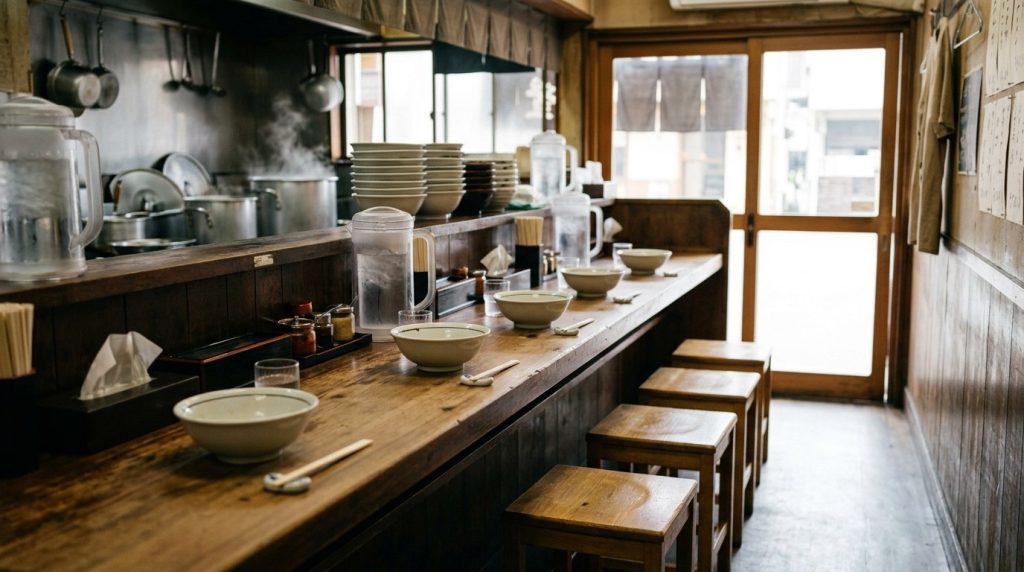
Ramen counters, standing soba stalls, sushi bars and yakiniku grills are designed around single seats at a counter rather than tables built for groups, and a shokken-ki ticket machine by the entrance of many ramen shops lets a solo diner choose a bowl, pay in cash, and hand the printed ticket to staff without exchanging a word.
That setup removes the two things that make solo dining awkward in many countries, waiting to be seated and explaining an order verbally, and it works identically whether or not the diner speaks any Japanese.
The etiquette is simple and consistent across formats: order at the machine or counter, eat without lingering too long once the kitchen is busy, and expect to be seated quickly precisely because a single diner is easy to fit in.
Convenience stores and standing bars add a second tier of solo-friendly eating for a quick meal between trains, and neither carries any social expectation of conversation the way a shared table might elsewhere.
The one adjustment worth making is pace: counter seating turns over quickly during peak meal hours, so a solo traveler who wants to linger over a bowl is better off eating slightly outside the main lunch or dinner rush than fighting a queue that is really there for turnover, not for seating capacity.
Standing bars, or tachinomi, add a similar solo-friendly option for a drink and a small plate after dinner, built around a counter with no stools and no expectation of staying long, which suits a solo traveler who wants a quick, low-commitment stop between a train and a hotel rather than a full sit-down evening out.
Cash still gets accepted everywhere this style of eating happens, so carrying enough of it matters more at a ramen counter or a standing bar than it does at a hotel or a department store, where card payment is the norm.
Where to stay travelling solo
Solo travelers in Japan generally do better in capsule hotels and hostel dorms than in hotels built for couples, both on price and on the odds of meeting other travelers.
Capsule hotels and hostel dorms cluster around major stations in Tokyo, Kyoto, and Osaka, which keeps a solo traveler within walking distance of the JR line instead of a taxi ride into unfamiliar streets. The map below pulls live prices across booking platforms so a solo trip can be planned stay by stay rather than city by city.
Find your Japan hotel on the map
Live prices from Booking, Airbnb and more — move the map or change dates to compare stays across Japan.