Best Time to Visit Osaka (2026)
Disclosure: Some links in this guide are affiliate links. If you book or buy through them, we may earn a small commission at no extra cost to you — it helps keep our guides free.
- The best time to visit Osaka is late October to mid-November, with monthly rainfall around 75 mm.
- Osaka's headline attractions run indoors and after dark, so cheap, wet months cost less than in Kyoto or Tokyo.
- April is the priciest month, with Golden Week (April 29-May 6) adding a second spike.
The best time to visit Osaka is late October to mid-November, when highs average 18-24°C (64-75°F) and monthly rainfall drops to around 75 mm, the driest stretch outside deep winter. That answer flips for anyone chasing Universal Studios Japan or Dotonbori’s food scene, because Osaka’s headline attractions run indoors and after dark, so the cheap, wet months cost far less here than they do in Kyoto or Tokyo.
| Month | Temp | Rain | Crowds and prices | Verdict |
|---|---|---|---|---|
| January | 3-10°C (37-50°F) | 45 mm | Low, except New Year week | Cold, dry, cheap |
| February | 3-11°C (37-52°F) | 60 mm | Low | Quiet, budget-friendly |
| March | 6-14°C (43-57°F) | 105 mm | Rising fast once sakura opens near March 23 | Book hotels early |
| April | 11-20°C (52-68°F) | 100 mm | Peak; Golden Week (April 29-May 6) adds a second spike | Priciest month of the year |
| May | 16-25°C (61-77°F) | 135 mm | High into early May, easing after | Warm once Golden Week clears |
| June | 20-28°C (68-82°F) | 185 mm, wettest month | Moderate; tsuyu begins around June 6-7 | Cheapest shoulder window |
| July | 25-32°C (77-90°F) | 175 mm | Tsuyu ends near July 19; Tenjin Matsuri (July 24-25) spikes one weekend | Humid, one big festival |
| August | 26-34°C (79-93°F) | 115 mm | Obon (August 13-15) is the year’s most crowded week | Hottest month, plan indoors |
| September | 22-30°C (72-86°F) | 155 mm | Typhoon risk peaks; Silver Week can add a mid-month spike | Still hot, watch the forecast |
| October | 16-24°C (61-75°F) | 135 mm | Rising through the month | Comfortable, USJ Halloween events |
| November | 10-18°C (50-64°F) | 75 mm | Peak for autumn foliage late in the month | Best all-round window |
| December | 5-12°C (41-54°F) | 55 mm | Low outside Christmas and New Year | Cheap, illuminations |
Spring and autumn – the two obvious windows
Spring (late March into April) and autumn (late October into November) are Osaka’s two reliable windows for comfortable temperatures without heavy rain, and neither is a secret.
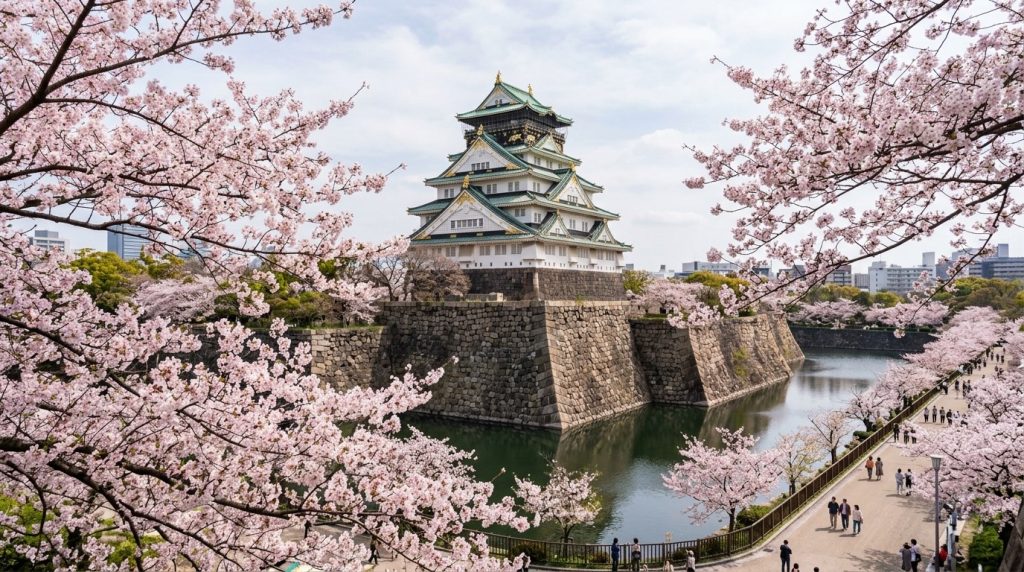
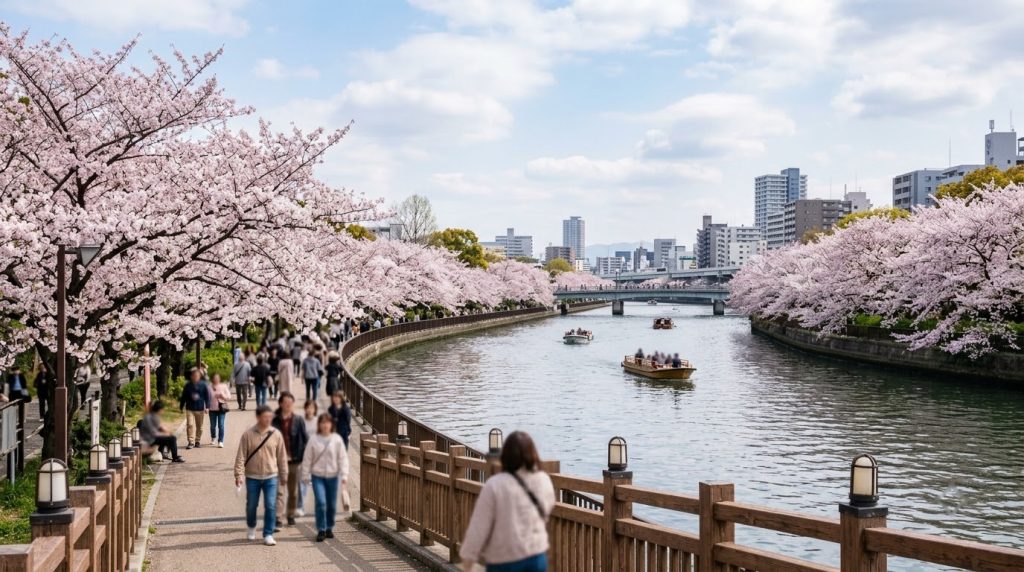
Sakura is forecast to first open around March 23-24, 2026, and reach full bloom around March 30-31, a timeline close enough to Kyoto’s own 2026 window of March 30 to April 5 that a multi-city trip can treat the two as one bloom, not two.
Golden Week (April 29-May 6, 2026) sits inside this same spring stretch and is worth avoiding on value grounds, since hotel rates spike and Osaka Castle Park and Dotonbori both get uncomfortably dense. Autumn arrives calmer: foliage peaks in late November, a few days behind Kyoto’s basin-trapped maples, while highs still sit near 18°C.
For a full day-by-day route through either season, the Osaka itinerary lays out how to sequence neighborhoods without doubling back across town.
Why Osaka handles bad weather better than Kyoto or Tokyo
Rain and heat cost an Osaka trip less than they cost a Kyoto or Tokyo trip, because Osaka’s signature experiences run indoors or after dark. Conveyor-belt sushi counters, the Dotonbori canal walk lit up at night, izakaya-hopping in Shinsekai, covered arcades like Shinsaibashi, and Universal Studios Japan itself are barely touched by a passing shower. On drier days, easy train trips from Osaka to Kyoto, Nara or Kobe take 20 to 60 minutes, so a sunny forecast is easy to use.
Kyoto’s temples and gardens are outdoor by design, and the city sits in a basin ringed by mountains that traps heat and humidity, which is why Kyoto summers feel noticeably worse than Osaka’s even on days with similar highs. Tokyo’s marquee draws, from Shibuya crossing to day trips out to Kamakura, lean outdoor too.
That is the practical case for booking Osaka in June or early September, when flights and hotels undercut spring and autumn rates by a wide margin and a shower just moves the day indoors instead of ruining it.
Universal Studios Japan changes the calculation
USJ now prices tickets by demand, which makes the calendar a bigger lever than the weather for anyone visiting mainly for the park.
Adult 1-Day Studio Passes run from roughly JPY 8,400 to JPY 11,900 depending on the date, about USD 55 to USD 77 at today’s rate of JPY 154 to the dollar, with the cheapest tickets on quiet weekdays and the highest on peak dates such as Golden Week, most October weekends, and Halloween weekend itself.
Crowd patterns follow a similar rhythm: November, October, and March are the park’s busiest months, while July, late August, and January-February weekdays run quieter, and Tuesday-Wednesday visits beat weekends year-round.
Since January 5, 2026, Super Nintendo World has required a free Area Timed Entry Ticket booked through the USJ app, so arriving early in the day still matters even on a cheap-ticket date.
Stacking a low-price weekday with the shoulder months of June or early September is the single best lever for cutting a USJ day’s cost without touching the park’s actual opening hours.
Summer, the rainy season and Tenjin Matsuri
Late June through mid-July is Osaka’s wettest stretch, but it is also one of the city’s best-value windows for travelers who plan around indoor time. Kansai’s tsuyu, the rainy season, typically starts around June 6-7 and ends near July 19, with June logging Osaka’s highest average rainfall at 185 mm; showers tend to be short and heavy rather than day-long.
Once tsuyu ends, humidity climbs into August, when highs average 26-34°C and Obon, running August 13-15 in 2026, brings the year’s heaviest domestic travel as Japanese families move between cities, tightening hotel availability even though foreign tourist numbers stay lower than spring.
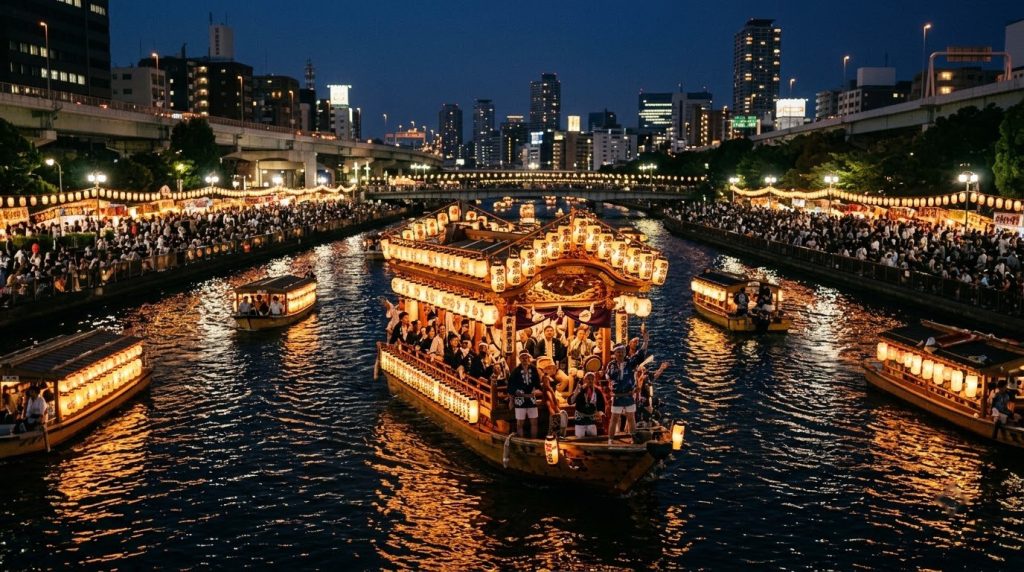
Tenjin Matsuri, ranked alongside Kyoto’s Gion Matsuri and Tokyo’s Kanda Matsuri as one of Japan’s three great festivals, runs July 24-25, 2026, with a boat procession on the Okawa River and fireworks the night of the 25th, worth timing a humid July trip around.
When NOT to visit Osaka
Skip Golden Week (April 29-May 6) and the days around Obon, roughly August 8-16, unless the crowds themselves are the draw, since both stack peak prices onto the year’s tightest hotel and transport availability. Early August through September also compounds heat, humidity, and typhoon risk, which peaks across the Kansai region in August and September.
Late December through early January adds a third crowd spike around New Year, when many restaurants close for several days straight. Outside those specific windows, Osaka’s weather punishes far less than its reputation suggests, and anyone still undecided on the city itself should read is Osaka worth visiting for the fuller case.
Plan your Osaka trip
Once the season is set, the two remaining decisions are how long to stay and where to sleep, and both depend on which window above got picked. A spring or autumn trip usually needs one extra buffer day for crowds, and the how many days in Osaka guide breaks down trip length by pace.
For where to sleep, best hotels in Osaka covers neighborhoods by budget and train access, and the map below pulls live prices across the city.
Find your Osaka hotel on the map
Live prices from Booking, Airbnb and more — move the map or change dates to compare stays across Osaka.
Planning the whole trip? Start with our Osaka travel guide for the overview, then use this page for the details.