Best Hotels in Kanazawa (2026)
Disclosure: Some links in this guide are affiliate links. If you book or buy through them, we may earn a small commission at no extra cost to you — it helps keep our guides free.
- Kanazawa hotels span USD 19 a night at a canal-side hostel to USD 152 at a station-front Hyatt.
- The mid-range tier near Kanazawa Station is best for families and first-time visitors.
- Korinbo suits design-focused travelers; the canal-side hostel suits solo budget bookers.
8 hotels by budget
| Hotel | Area | Tier | Price/night (USD · JPY) | Best for | Book |
|---|---|---|---|---|---|
| Hyatt Centric Kanazawa | Kanazawa Station | Luxury | USD 91–152 (JPY 14,200–23,700) | Modern rooms steps from the Shinkansen platform | Check rates |
| Kanazawa Tokyu Hotel | Korinbo | Luxury | USD 67 avg (JPY 10,450) | An 8-minute walk to Kenrokuen Garden | Check rates |
| KUMU Kanazawa by THE SHARE HOTELS | Korinbo, near Nagamachi | Mid-range | USD 62–96 (JPY 9,650–15,000) | Design-forward tatami rooms near the samurai district | Check rates |
| Dormy Inn Kanazawa | Kanazawa Station | Mid-range | USD 65–90 (JPY 10,150–14,050) | A rooftop onsen floor after a day of walking | Check rates |
| Daiwa Roynet Hotel Kanazawa Eki Nishiguchi | Kanazawa Station | Mid-range | USD 56–78 (JPY 8,750–12,150) | Dependable comfort two minutes from the platform | Check rates |
| APA Hotel Kanazawa Chuo | Katamachi | Mid-range | USD 45–52 (JPY 7,000–8,100) | A rooftop hot-spring bath on a tight budget | Check rates |
| Hotel Route-Inn Kanazawa Ekimae | Kanazawa Station | Budget | USD 59–92 (JPY 9,200–14,350) | Free breakfast and a public bath | Check rates |
| Guest House Pongyi | Kanazawa Station, canal-side | Budget | USD 19–26 (JPY 3,000–4,000) | Solo travelers in a converted kimono shop | Check rates |
The best hotels in Kanazawa span USD 19 a night at a canal-side hostel to USD 152 at a station-front Hyatt overlooking the Shinkansen platforms. Families and first-time visitors do best in the mid-range tier near Kanazawa Station, while design-focused travelers head to Korinbo and solo budget bookers land at the canal-side hostel near Omicho Market.
Quick answer: Hotels in Kanazawa span USD 19 a night at a canal-side hostel to USD 152 at a station-front Hyatt, with the mid-range tier near Kanazawa Station best for families and first-timers and Korinbo best for design lovers.
Where to book, at a glance
Kanazawa’s hotel map clusters into three pockets: the glass-domed station district, the Korinbo shopping and samurai-quarter core, and the lantern-lit lanes of Higashi Chaya. Move the pins below to compare live rates before locking in an area.
Find your Kanazawa hotel on the map
Live prices from Booking, Airbnb and more — move the map or change dates to compare stays around Kanazawa.
Best luxury hotels and ryokan in Kanazawa
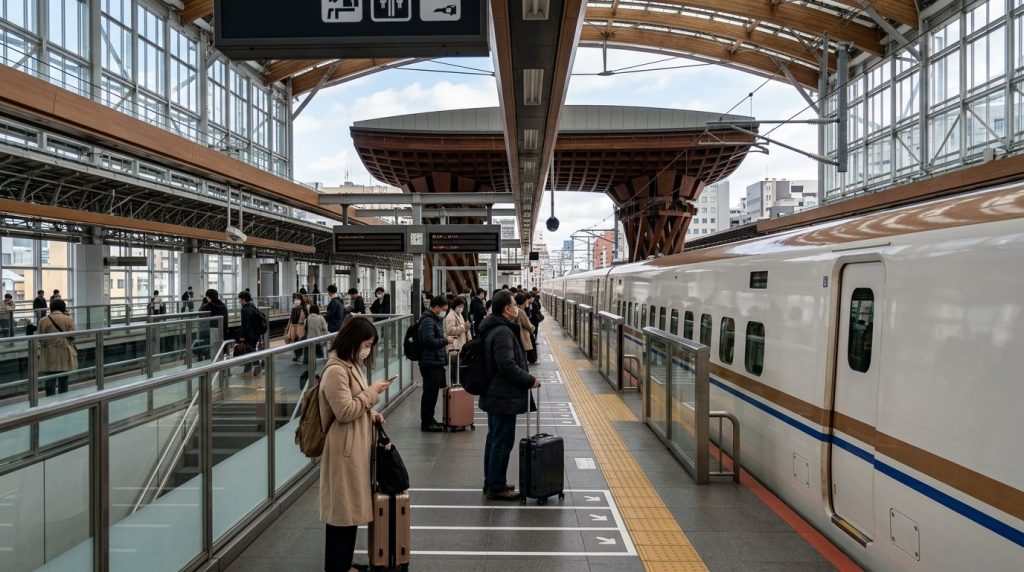
Hyatt Centric Kanazawa sits directly inside the Kanazawa Station complex, with upper-floor rooms looking down on the station’s glass Motenashi Dome and the wooden Tsuzumi-mon gate lit up at night.
Check rates: Hyatt Centric Kanazawa →
Rooms run USD 91 to 152 a night (JPY 14,200–23,700 at the September 2026 rate of USD 1 = JPY 156), and the hotel holds a 4-of-5 TripAdvisor score, ranked 5th of 80 Kanazawa hotels. Guests step off the Hokuriku Shinkansen, ride an elevator, and are in their room within minutes, with no taxi or bus required.
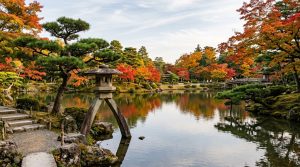
Kanazawa Tokyu Hotel trades that instant convenience for an 8-minute walk to Kenrokuen Garden, one of Japan’s three great landscape gardens, with tiered pine trees and stone lanterns that anchor most postcard shots of the city. Rooms average USD 67 a night (JPY 10,450), and the 233-room property carries a 4.0 “Very Good” rating across more than 2,200 reviews.
Check rates: Kanazawa Tokyu Hotel →
Book here to walk into Kenrokuen near opening time rather than riding a bus in from the station.
Best mid-range hotels in Kanazawa
KUMU Kanazawa by THE SHARE HOTELS occupies a design-forward building near Nagamachi, Kanazawa’s preserved samurai district of mud-walled lanes and canal-fed gardens. Tatami-floored Japanese-style rooms sit alongside western-style rooms, rates run USD 62 to 96 a night (JPY 9,650–15,000), and the property holds an 8.9-of-10 guest score, ranked 6th of 49 Kanazawa bed and breakfasts.
Check rates: KUMU Kanazawa by THE SHARE HOTELS →
It is a 4-minute walk to Oyama Shrine and 6 minutes to Omicho Market, close enough to skip the hotel breakfast and eat fresh seafood at the market stalls instead. Honest trade-offs and highlights are weighed in our piece on whether Kanazawa is worth visiting.
Dormy Inn Kanazawa keeps its guests near the station but adds a rooftop onsen floor with indoor and outdoor hot-spring baths and a sauna, plus free ramen served from 9:30 to 11pm. Nightly rates land between USD 65 and 90 (JPY 10,150–14,050). Reviewers single out the bath and the free evening snacks as the reasons to pick this hotel over a plainer business chain at a similar price.
Check rates: Dormy Inn Kanazawa →
Daiwa Roynet Hotel Kanazawa Eki Nishiguchi sits two minutes on foot from Kanazawa Station’s west exit, with soundproofed rooms, an in-house Italian restaurant, and a breakfast buffet guests describe as well above what the price suggests. Rates run USD 56 to 78 a night (JPY 8,750–12,150), making it one of the better value-for-money picks directly at the station.
Check rates: Daiwa Roynet Hotel Kanazawa Eki Nishiguchi →
APA Hotel Kanazawa Chuo undercuts that group at USD 45 to 52 a night (JPY 7,000–8,100), with a rooftop natural hot-spring bath split by gender plus a sauna. Rooms run small and the building shows its age, which is why it sits at 3.5 of 5 on TripAdvisor, but travelers consistently call the onsen and breakfast buffet worth the trade-off.
Check rates: APA Hotel Kanazawa Chuo →
Best budget hotels in Kanazawa
Hotel Route-Inn Kanazawa Ekimae sits about 500 meters from Kanazawa Station and pairs a free buffet breakfast with a public bath and massage chairs overlooking the city. Rates run USD 59 to 92 a night (JPY 9,200–14,350), and the hotel holds an 8.0 “Very Good” score across more than 1,000 reviews, ranked ahead of several pricier competitors nearby.
Check rates: Hotel Route-Inn Kanazawa Ekimae →
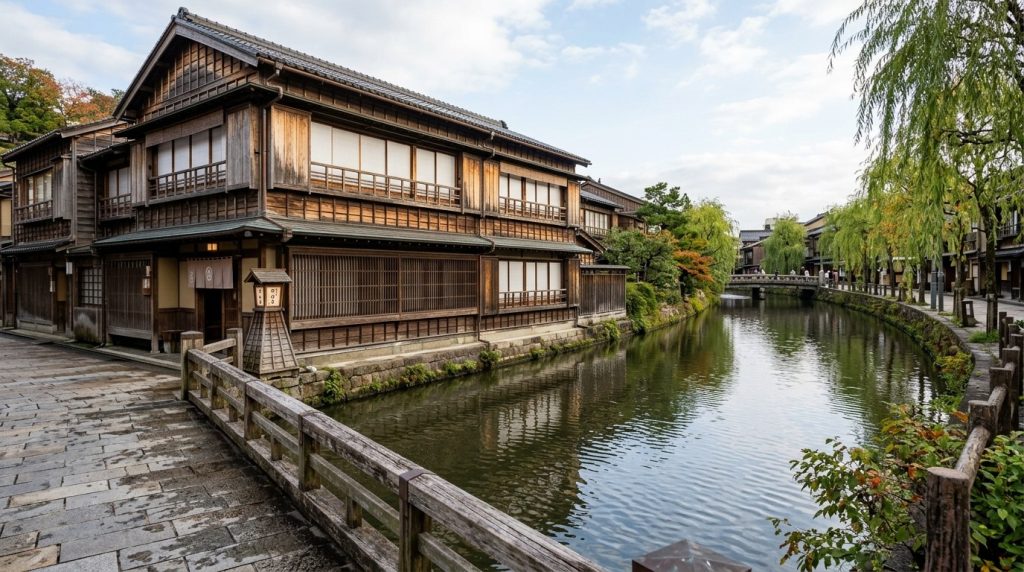
Guest House Pongyi occupies a converted 100-year-old kimono shop along the Kuratsuki canal, a 7-minute walk from the station, with a shared kitchen and communal hot showers. Beds run JPY 3,000 to 4,000 a night (USD 19–26), among the cheapest confirmed rates in this guide, and guests repeatedly mention the owners teaching kimono-wearing and local history in the evenings.
Check rates: Guest House Pongyi →
A ryokan stay in Kanazawa
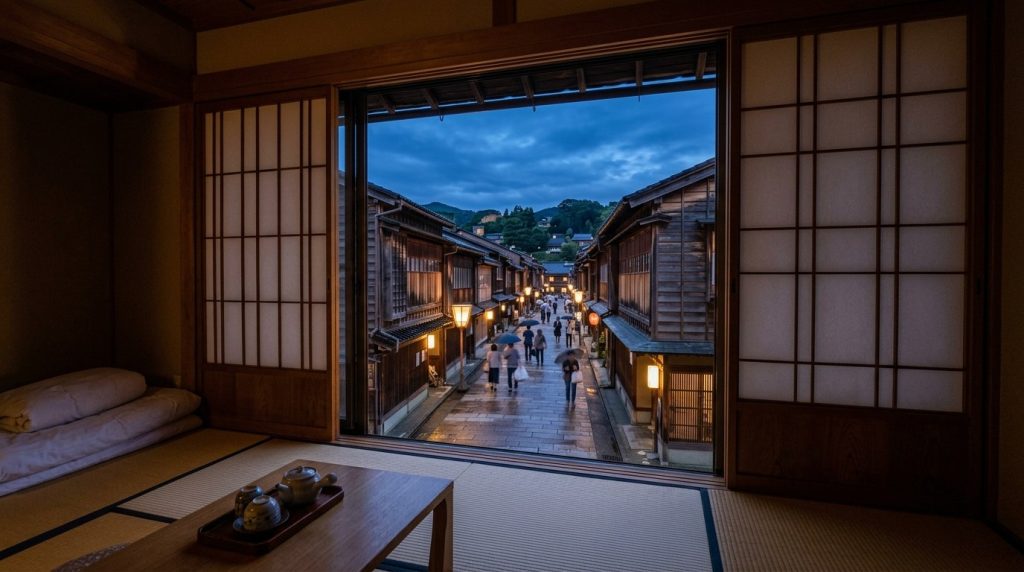
Hotels cover most of what this guide needs, but a ryokan is worth considering for at least one night if seeing a different side of Kanazawa matters more than streamlined convenience.
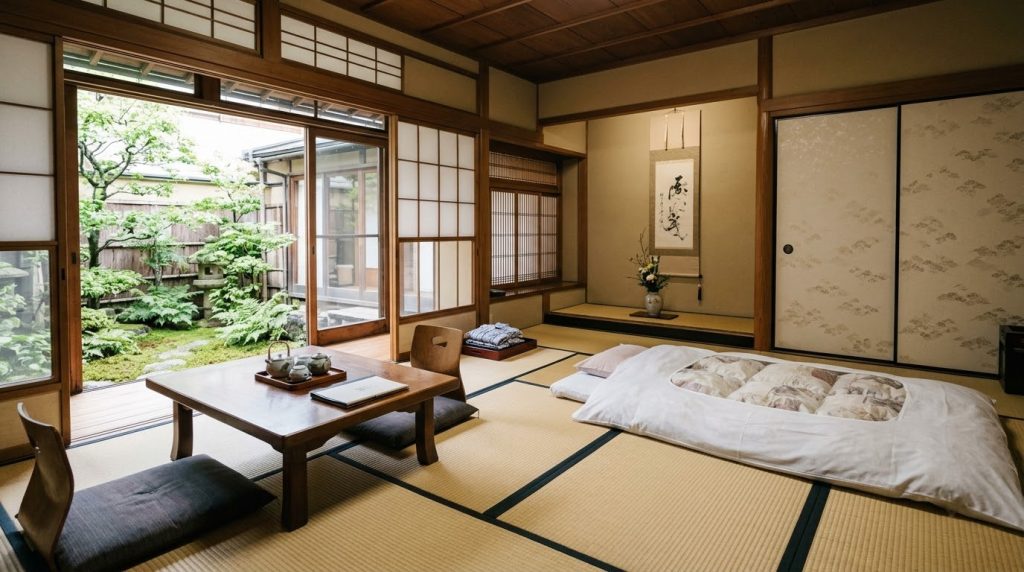
A ryokan swaps a hotel bed for a tatami-floored room with a futon laid out in the evening, and most properties fold a multi-course kaiseki dinner and breakfast into the room rate rather than charging for meals separately.
Baths are usually communal, either an indoor onsen-style tub or a smaller shared bathroom down the hall, and guests change into a yukata robe provided by the house for the evening.
Kanazawa’s ryokan tend to cluster away from the station, inside the narrow lanes of Higashi Chaya and Katamachi where converted machiya townhouses and older inns still operate alongside the samurai-era canal network.
One well-reviewed example, Nakayasu Ryokan, lists an average room rate of about USD 104 a night with a guest score of 8.9 out of 10, positioning it as a mid-range option rather than the ultra-high-end ryokan found elsewhere in Japan.
Expect rates to run higher than an equivalent hotel room once the kaiseki dinner is factored in, since that meal alone can cost close to what a night at one of the budget hotels above runs.
A ryokan suits travelers spending two nights or more in Kanazawa better than a one-night stopover, since the slower pace of a kaiseki dinner and an evening soak does not pair well with an early Shinkansen departure the next morning.
Anyone catching a morning train is usually better served by a station hotel from the list above, where checkout and luggage logistics are simpler.
For a first Kanazawa stay built around Kenrokuen Garden and the samurai district, pairing one ryokan night with a hotel night elsewhere in the trip is a reasonable middle ground between atmosphere and convenience, and most ryokan owners are used to guests staying only a single night this way.
Omicho Market: a fourth place to stay
Omicho Market, Kanazawa’s roughly 280-year-old covered seafood market, sits midway between the station and Korinbo, and a handful of mid-range hotels cluster around its covered arcades rather than inside the station complex or the Korinbo shopping core covered above.
Basing here means walking distance to market stalls selling fresh crab, oysters and sushi for breakfast, something neither the station cluster nor Korinbo offers at the same proximity, since both sit a 10 to 15 minute walk from the market gates.
The area trades some of the station’s transit convenience and some of Korinbo’s garden proximity for direct access to the city’s best breakfast option. Kenrokuen Garden is about a 15-minute walk or a short loop bus ride from most Omicho-area hotels, roughly the same distance as from a Korinbo base, while Kanazawa Station runs closer to 20 minutes on foot.
Evenings around the market are quieter than Korinbo’s restaurant streets, since most stalls close by early evening, so travelers wanting a livelier night out after dinner are better served by Korinbo or the station district covered elsewhere in this guide.
Families and solo travelers who want an easy fresh-seafood breakfast without an early transit connection tend to do well with an Omicho-area base, while anyone catching an early Shinkansen should still default to a station hotel rather than take on the extra 15 to 20 minutes the Omicho area adds to that specific trip.
The market itself opens early and most stalls wind down by mid-afternoon, so a hotel nearby rewards early risers more than late sleepers.
Getting around Kanazawa from your hotel
Most of Kanazawa’s sights sit along the Kanazawa Loop Bus route, which circles the city from the station through Korinbo, Kenrokuen Garden, Omicho Market and Higashi Chaya on a repeating loop.
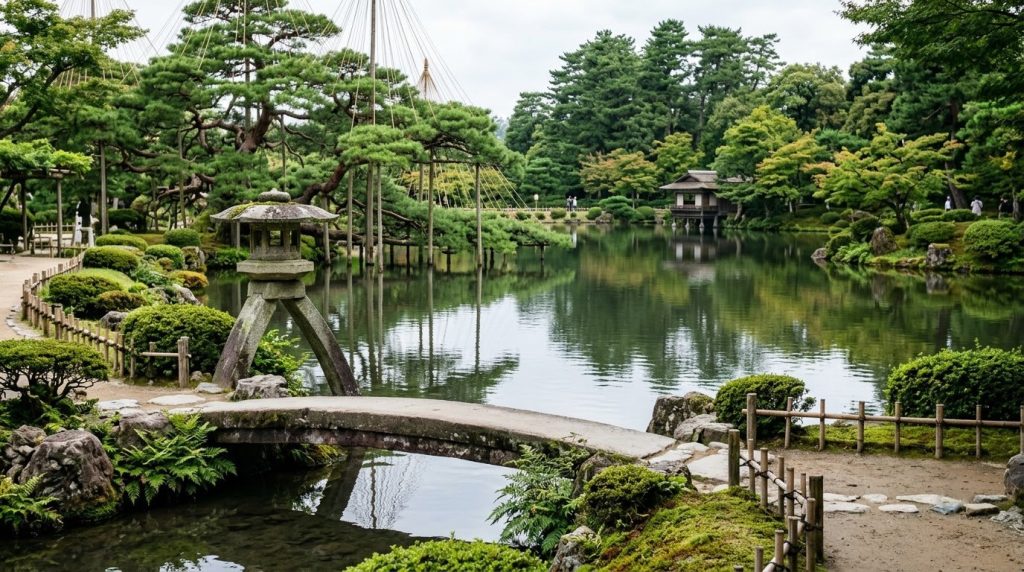
A single ride costs 220 yen for adults and 110 yen for children (about USD 1.40 and USD 0.70) regardless of distance, and a one-day pass runs in the 700 to 800 yen range (roughly USD 4.50 to 5) depending on where it’s purchased, with discounted admission to roughly two dozen attractions built into the pass.
Tickets are not sold on board; buy a paper pass in advance from the station tourist information counter, a Hokutetsu Group counter, or a participating hotel front desk.
Walking fills in the gaps the loop bus leaves. From a Korinbo hotel such as KUMU Kanazawa, Kenrokuen Garden and Nagamachi’s samurai district are both within a 10-minute walk, so the bus becomes optional rather than essential for guests based there.
From a station hotel, the loop bus is the more practical choice for reaching Kenrokuen, Omicho Market, or Higashi Chaya, since each sits 20 to 30 minutes away on foot.
Kanazawa also runs a bike-share system called Machi-nori, with docking stations scattered around the station, Korinbo and Omicho Market, useful for a quick ride between those three hubs without waiting for the next loop bus. The system suits travelers comfortable cycling on Japanese city streets rather than someone testing two wheels in traffic for the first time.
Taxis are a backup rather than a default, useful mainly late at night once the loop bus has stopped running, or for carrying luggage between the station and a ryokan in Higashi Chaya’s narrower lanes, where larger vehicles cannot always pull up directly outside.
Suica and other nationwide IC cards are not accepted on the loop bus in most cases, so carrying coins or a paper pass avoids a holdup when boarding.
Which Kanazawa area to book
Kanazawa Station covers the widest hotel selection and puts the Shinkansen platform, the Forus mall, and a dozen restaurants at the door. Korinbo sits closer to Kenrokuen Garden and Nagamachi’s samurai lanes, better for travelers who want to walk to the sights before the tour buses arrive.
Higashi Chaya itself has almost no hotels; the tea-house lanes are lined with private machiya townhouse rentals instead, better suited to groups than to solo travelers comparing nightly rates.
When these hotels are the wrong choice
Most visitors treat Kanazawa as a one or two-night stop on the Hokuriku Shinkansen line rather than a multi-night base, which makes a station-side hotel more useful than a scenic one.
Winter snow, common from December through February, changes which lanes are walkable, so a hotel picked for its lantern-lit street in July can mean a slushy 15-minute walk in January instead.
Station-side hotels such as Hyatt Centric Kanazawa, Dormy Inn Kanazawa, and Daiwa Roynet Hotel Kanazawa Eki Nishiguchi trade the atmosphere of Korinbo or the samurai district for a platform reachable without checking a map, which is the right call on a tight itinerary and the wrong one for travelers who came for the scenery.
Kanazawa hotel FAQs
How far is Kanazawa Station from Kenrokuen Garden? It runs about a 25-minute walk, or roughly 10 minutes by loop bus for 220 yen (about USD 1.40) one way, which is why most visitors treat the station and Korinbo as two distinct hotel bases rather than one.
Do I need to book a hotel with a shuttle bus? No. Kanazawa’s loop bus and compact layout mean dedicated hotel shuttles are unnecessary; every hotel in this guide is reachable by the public loop bus or on foot.
Is Kanazawa walkable without a car? Yes, within the station, Korinbo and Omicho triangle. A car adds little for a city stay and becomes a liability in the narrow lanes around Higashi Chaya and Nagamachi, where parking is limited and mostly paid.
When do hotel rooms sell out furthest in advance? Cherry blossom season in late March and early April and the autumn foliage weeks in November are Kanazawa’s two busiest hotel-booking windows, when rooms at the mid-range properties in this guide sell out earliest.
Winter, from December through February, brings snow that changes which lanes are walkable, as covered above, so pack for a slower, slushier walk between hotel and sights during those months.
Can I pay for the loop bus with a credit card? Hotels in this guide all accept major credit cards at check-in. The loop bus does not accept IC cards like Suica in most cases and runs largely on cash and paper passes, so carrying coins or a pre-bought pass avoids a delay at the door.
Pairing Kanazawa with Tokyo, Kyoto and the Japan Alps
Kanazawa connects to Tokyo in 2 hours 28 minutes on the Hokuriku Shinkansen, close enough to add as a side trip from a longer 4-day Tokyo itinerary or a stretched Tokyo budget guide swing through central Japan.
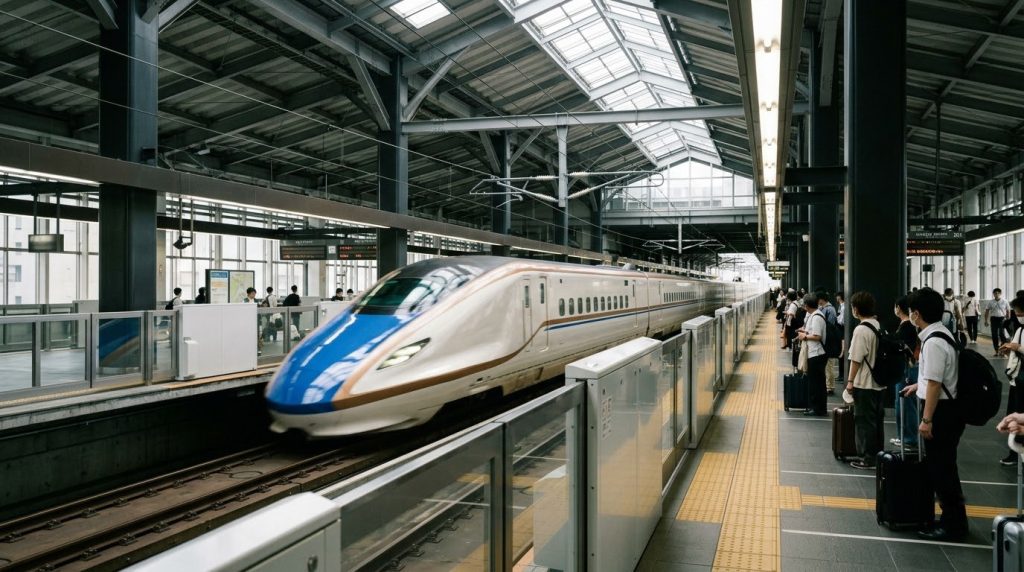
Kyoto takes about 2 hours total, changing from the Thunderbird limited express to the Hokuriku Shinkansen at Tsuruga, which makes Kanazawa a reasonable add-on to a Kyoto itinerary or a stop on a wider Tokyo vs Kyoto comparison trip.
Travelers heading into the Japan Alps can take a direct highway bus to Takayama, running roughly 2 to 3.5 hours depending on the departure, before continuing on to Shirakawa-go’s thatched-roof villages.