Bruges vs Ghent: Which Belgian City Should You Pick? (2026)
Disclosure: Some links in this guide are affiliate links. If you book or buy through them, we may earn a small commission at no extra cost to you — it helps keep our guides free.
You are visiting Belgium for the first time and want canal scenery.
See hotels in Bruges →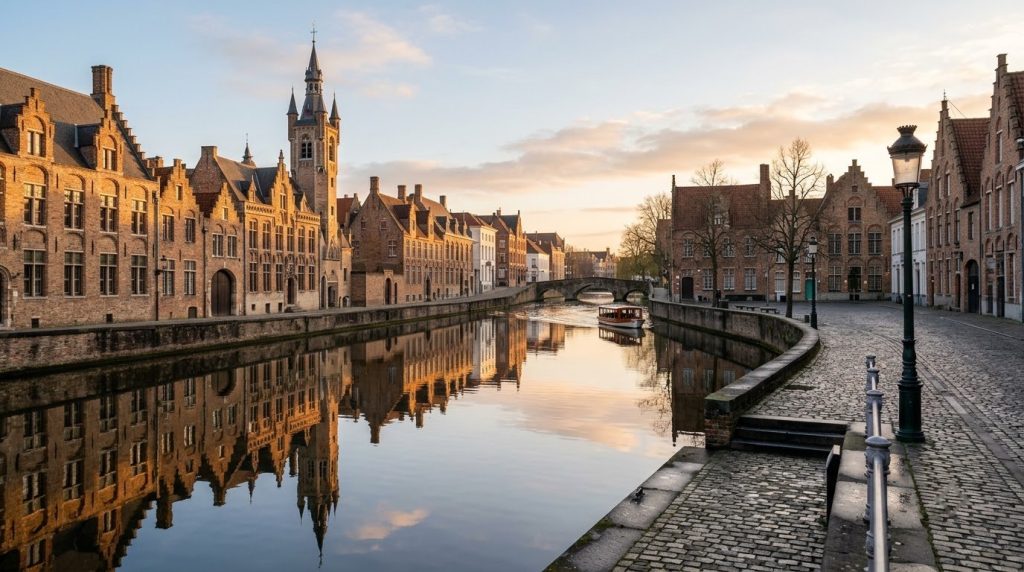
Bruges wins for a first trip to Belgium, but Ghent wins if you have 2 or more nights and want a real city: the two are only 22 to 28 minutes apart by train, so the smartest plan is to sleep in one and day-trip the other.
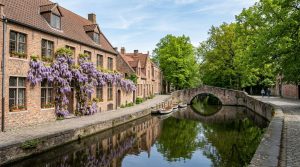
Bruges is the postcard of canals and a 366-step belfry; Ghent is a working university city with a castle, a world-class altarpiece and bars that stay busy after the day-trippers leave.
| Factor | Bruges | Ghent |
|---|---|---|
| Best for | First-timers, couples, photographers | Repeat visitors, nightlife, budget travelers |
| Feel | Preserved medieval town, UNESCO-listed core | Lived-in university city |
| Population | About 118,500 | About 270,000 |
| Signature sight | Belfry climb, USD 18 (EUR 16) | Gravensteen castle, USD 17 (EUR 15) |
| Train from Brussels | 55–65 min, USD 18–20 (EUR 16.20–17.60) | About 30–36 min, from about USD 9.50 |
| Evening crowds | Quiet once tour groups leave | Lively, especially along the Graslei |
| Hotel prices | Higher | Roughly 10% cheaper |
The short verdict by traveler type
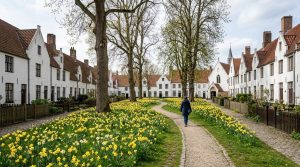
First-timers: pick Bruges. If you only have one day in Belgium outside Brussels, Bruges delivers the canal-and-gable scenery you came for in a compact, walkable center. Use our Bruges itinerary to sequence the Markt, Burg and Beguinage before the tour buses arrive.
Couples: Bruges, but stay overnight. The romance only works in the evening and early morning, when the day crowds are gone.
Families: Bruges for younger kids (boat rides, chocolate shops, short distances), Ghent for teens who would rather explore a real medieval castle.
Budget travelers and night owls: Ghent. Lodging and food run about 10% lower according to travelers who compared both, and the student population of a city more than twice Bruges’ size keeps bars and cheap eats open late.
How the two cities actually feel on the ground
Bruges’ historic center has been a UNESCO World Heritage Site since 2000, and it shows: almost every street looks like a film set. The city draws roughly 8 million visitors a year, and midday in summer the lanes around the Markt can feel like a theme park queue.
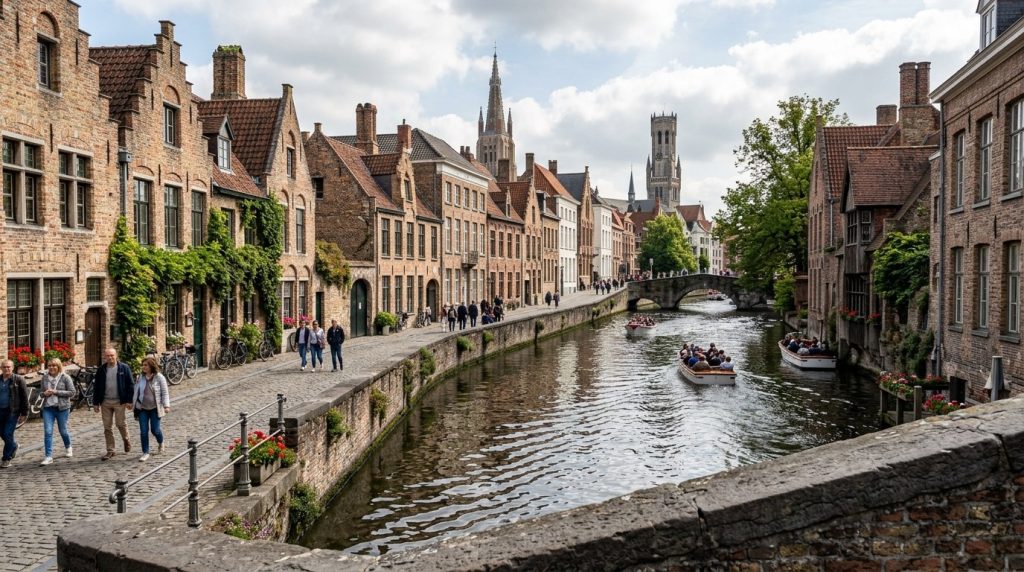
Ghent has equally striking architecture along the Graslei and Korenlei quays, surrounded by a normal city of trams, students and offices: less fairy tale, more real life.
Sights and ticket prices compared
Bruges’ headline is the Belfry: 83 meters tall, 366 steps, and an adult ticket of EUR 16 (USD 18), dropping to EUR 15 on winter weekdays. Entry is capped at small groups every 20 minutes, so book a time slot online.
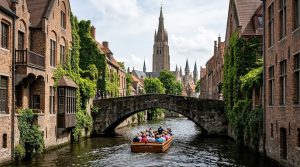
The other must is a 30-minute canal boat ride at EUR 15 (USD 17) for adults and EUR 9 (USD 10) for kids 4–11; boats run daily from March through October, and you cannot pre-book as an individual. Our list of the best things to do in Bruges covers the free sights that balance those costs.
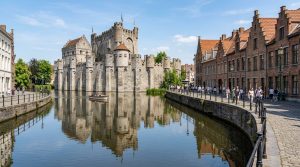
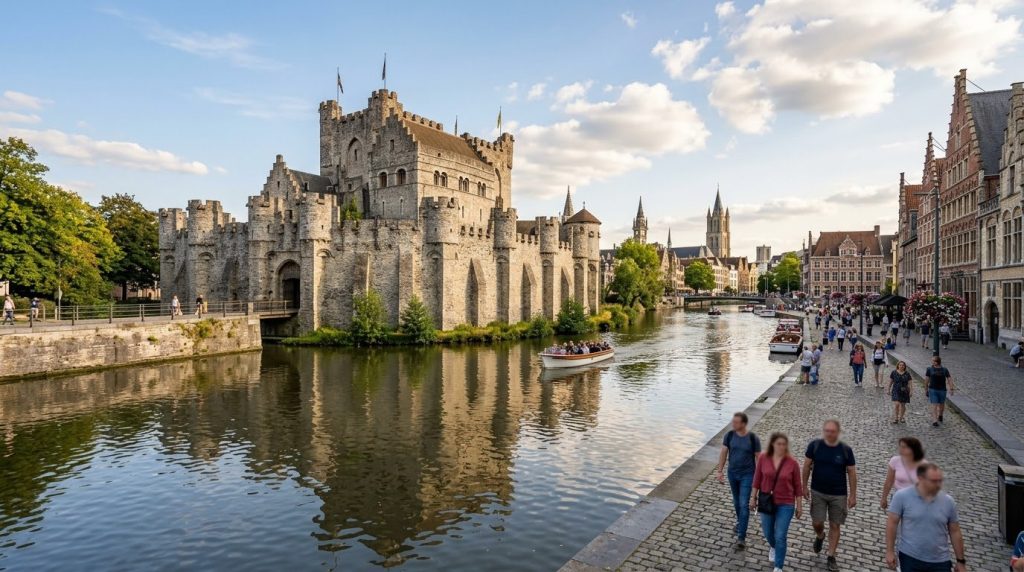
Ghent’s two big tickets are heavier on history. Gravensteen, the Castle of the Counts, costs EUR 15 (USD 17) with an audio guide included; it is open daily 10 a.m. to 6 p.m., last entry 4:40 p.m. In St. Bavo’s Cathedral, the van Eyck brothers’ Ghent Altarpiece costs EUR 12.50 (USD 14) to see on its own, or EUR 16 (USD 18) with the augmented-reality tour, and you need a timed slot.
One honest caveat for 2026: several upper panels are shown as photographic reproductions while restoration finishes, expected in spring 2027. Cathedral entry itself is free. For the rest of the city, see our best things to do in Ghent.
Getting there and between them by train
The cities sit about 40 km apart on the same SNCB/NMBS main line. Prices below are converted at USD 1 = EUR 0.89.
– Bruges to Ghent: 22–28 minutes on direct trains, with roughly 80–90 departures a day. Advance fares on booking sites start around USD 7–10. – Brussels to Bruges: 55–65 minutes direct, about every 30 minutes. A standard adult single is EUR 16.20–17.60 (USD 18–20) depending on the source and date checked. – Brussels to Ghent: about 30–36 minutes, from roughly USD 9.50 one-way.
Belgian domestic fares are fixed, so there is no penalty for buying at the station on the day. The real savings come from timing: adults 26–64 get about 30% off at weekends, travelers under 26 or over 65 pay reduced fares anytime, and kids under 12 ride free with an adult.
Buy tickets in the SNCB app or at belgiantrain.be, and note that Bruges station is about 1.5 km from the center, a 15-minute walk through Minnewater Park.
What each city costs per day
Our Bruges budget guide puts a backpacker day at EUR 65–100 (USD 73–112) and a mid-range day at EUR 150–220 (USD 169–247), including a bed. Ghent lands close to that, with lodging and meals running about 10% less on average.
The bigger cost difference is when you go, not where: summer and December weekends push Bruges hotel rates up fastest, which is why the best time to visit Bruges for value is spring or early fall on weekdays.
US passport holders still enter Belgium visa-free for up to 90 days in any 180-day period within the Schengen area. ETIAS has not launched yet, and the EU says it will announce a start date several months in advance, so check the official EU travel site before you fly.
The US State Department rates Belgium at Level 2, Exercise Increased Caution, updated 23 July 2026. Normal city-break precautions apply in both, mainly watching for pickpockets in crowded squares.
Can you do both in one day?
Technically yes, since the train link is under half an hour, but you would spend much of the day walking between stations and sights, and Gravensteen alone takes 1.5–2 hours. A better split for a 3-night stay: 2 nights in your base city, one full day in the other, and leave by 9 a.m. to beat the crowds.
What to eat in Bruges and Ghent
Belgian waffles split into two distinct styles, and both cities serve each. The Brussels waffle is light, rectangular and crisp, made from a thin batter; the Liège waffle is smaller, denser and sweeter, made from a yeasted dough studded with pearl sugar that caramelizes on the griddle.
Street vendors in both Bruges and Ghent sell the Liège style most often, so if you only try one, that is the one you will find on nearly every corner.
Beer is the other must. Only six breweries worldwide are certified to use the Trappist label on their beer, operating under the International Trappist Association’s rules requiring the beer be brewed within or near a working monastery under monk oversight, among them Chimay, Orval, Rochefort, Westmalle and Westvleteren, all Belgian.
Ghent’s bars, with a bigger student population to keep busy, tend to pour a wider range of them than Bruges’ more tourist-focused pubs.
Ghent also has its own specific food identity worth seeking out: waterzooi, a creamy chicken or fish stew, and Tierenteyn-Verlent, a mustard shop on the Groentenmarkt that has made its own recipe by hand since 1790. Both are reasons to eat a meal in Ghent rather than treating it purely as a day trip from Bruges.
Cobblestones and getting around with limited mobility
Both historic centers are cobblestoned, and Bruges’ stones have been rated a relatively smooth 4 out of 5 for wheelchair users by an accessible-travel review site, meaning the ride is bumpy but manageable rather than genuinely difficult. Ghent’s main pedestrian stretches along the Graslei and Korenlei are similarly uneven but flat, without the steps that trip up some other European old towns.
The one activity that is not accessible in either city is the canal boat ride. Bruges’ official tourism site states plainly that neither the boats nor their embarkation points are wheelchair accessible, since all five boarding locations sit at water level and require a few steps down.
Travelers who cannot manage stairs should skip the boat and see the canals from the footpaths instead, which run alongside most of the same water at no cost and no time slot required.
Minnewater Park in Bruges, a short walk from the train station, underwent renovations that left its main paths smooth and step-free, making it one of the easier green spaces to reach without tackling the Markt’s cobblestones first. Ghent’s quayside paths along the Graslei are similarly flat, so a wheelchair or stroller can cover a good share of either city’s highlights without needing the boat at all.
Where to stay
Bruges historic center (around the Markt and Burg): best for first-timers and couples who want to step outside at 7 a.m. to empty canals. Expect the highest prices.
Bruges, Sint-Anna and Langestraat area: quieter streets east of the center, a short walk to the Markt, slightly better value and a local feel.
Ghent, near the Graslei and Patershol: the choice if you base yourself in Ghent for nightlife and restaurants, with Bruges as an easy day trip.
Find your Bruges hotel on the map
Live prices from Booking, Airbnb and more — move the map or change dates to compare stays across Bruges.
Frequently Asked Questions
Is Bruges or Ghent better for a day trip from Brussels?
Bruges is the classic day trip if you have never been to Flanders, because its compact center packs the most scenery into a few hours. The train takes 55–65 minutes and costs EUR 16.20–17.60 one-way. Ghent is closer, at about 30–36 minutes, and makes more sense if you want a castle, art and a livelier city.
Can you visit Bruges and Ghent on the same day?
You can, since direct trains between them take 22–28 minutes and run frequently all day. In practice you will only skim each city, because the stations sit outside both historic centers and Gravensteen alone needs 1.5–2 hours. One full day per city, or one night in each, gives a far better trip.
Is Ghent worth visiting if I have already seen Bruges?
Yes. Ghent is not a smaller copy of Bruges. It has a real medieval castle, the Ghent Altarpiece in St. Bavo’s Cathedral, and a large student population that keeps the city busy at night. Travelers who found Bruges too crowded or too polished often prefer Ghent’s lived-in atmosphere.
How many days do you need in Bruges and Ghent?
Two to three days covers both comfortably: one or two days in your base city and one day trip to the other. One day in Bruges is enough for the main sights if you start early, while Ghent rewards an evening stay, when the quays and bars are at their liveliest.