
Disclosure: Some links in this guide are affiliate links. If you book or buy through them, we may earn a small commission at no extra cost to you — it helps keep our guides free.
How Many Days in Bruges? The Complete 1, 2 + 3-Day Itinerary for 2026
Two days in Bruges is the sweet spot. One day works as a day trip from Brussels, three days suits slow travelers who want cycling and day trips. Most visitors get this wrong by over-scheduling a city that rewards wandering, not rushing. Here is exactly how to plan each option so nothing is wasted.
Key Takeaways
– 1 day: Arrive by 8:30am, hit Rozenhoedkaai, Belfry (pre-book), canal boat, Begijnhof. Fully doable from Brussels (1h train).
– 2 days (ideal): Day 1 for iconic sights, Day 2 for Groeningemuseum, De Halve Maan brewery, and a canal bike loop.
– 3 days: Add Sint-Janshuis Windmill, the Lace Centre, and a 30-minute train to Ghent or 15 minutes to the North Sea coast.
– Bruges receives over 8 million visitors per year (Visit Bruges, 2025), making early-morning timing critical.
– Canal boats run 10am-6pm at EUR 12 per adult; no booking needed but arrive early to beat the queue.
How Many Days in Bruges? The Honest Answer
Bruges receives over 8 million visitors per year (Visit Bruges, 2025), yet its medieval core is only about 430 hectares. That compact size is the key to planning. One day covers the headline sights. Two days lets you breathe, explore a museum, and catch the city after the day-trippers leave. Three days opens up cycling routes, windmills, and easy escapes to Ghent or the North Sea coast.
Most people underestimate how quickly the crowds arrive. Tour groups from Brussels start flooding Markt Square by 10:30am. If you have only one day, your arrival time matters more than your itinerary. If you have two or three days, your second morning is actually the most relaxed you will feel in the entire city.
One fact that rarely appears in standard itinerary guides: Bruges empties dramatically after 5pm. Day-trippers board their coaches, and the canals turn quiet. Dinner on the water at 7pm feels like a completely different city from the midday rush. Building your evenings around this rhythm is more valuable than any extra museum ticket.
bruges travel guide
For full destination context before you plan, read our Bruges travel guide.
1-Day Bruges Itinerary: Day Trip Perfect Plan
A single day in Bruges is enough to see the defining icons if you arrive early and stay focused. Brussels Midi to Bruges takes around 60 minutes by Intercity train (SNCB, 2026), and the first trains depart before 7am. Aim to be walking Rozenhoedkaai by 8:30am.
Hour-by-Hour Day 1 Schedule
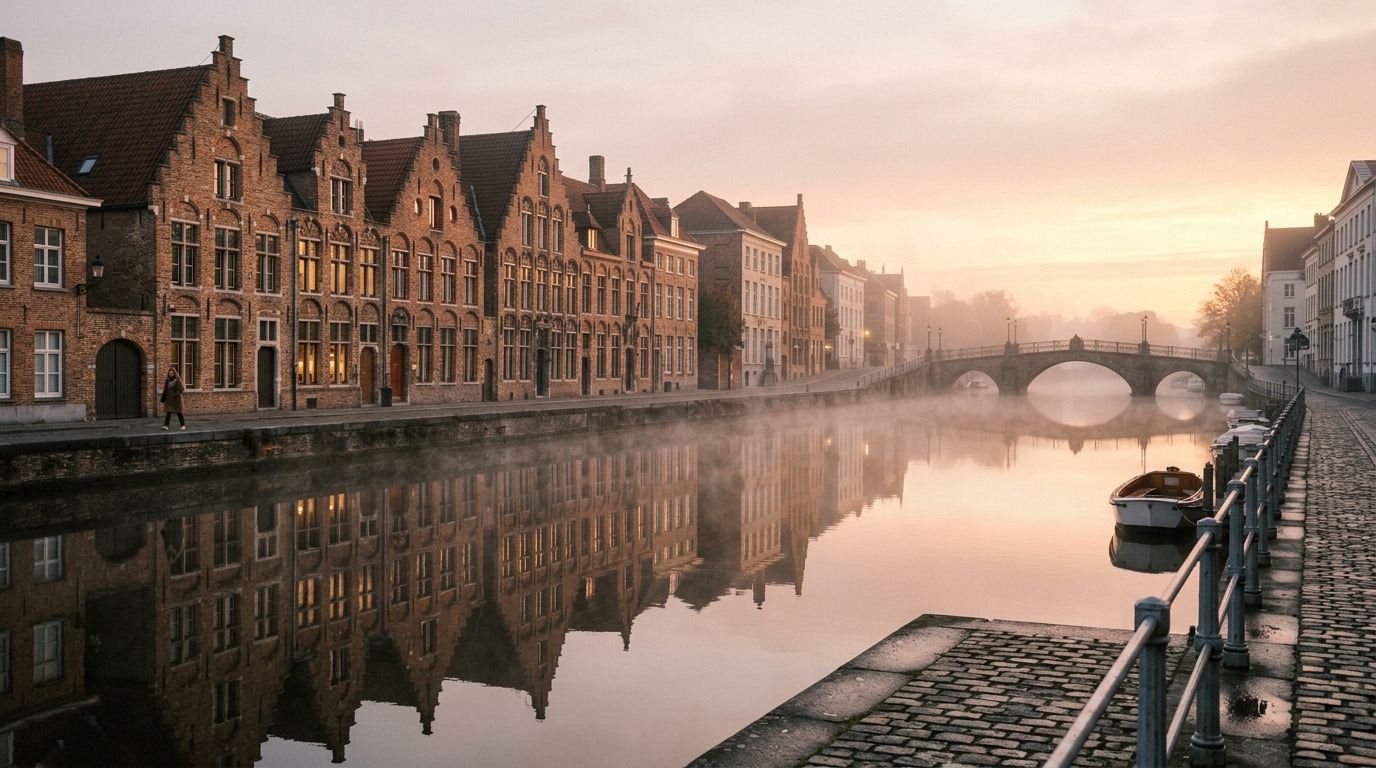
8:30am – Rozenhoedkaai viewpoint. This is the most-photographed canal corner in Belgium. Before 9am the light is soft, the reflections are crisp, and you will share the spot with almost nobody. Photography takes 20-30 minutes. Linger longer and you will watch it transform from quiet to crowded.
9:30am – Belfry of Bruges. Book online in advance; the Belfry regularly sells out by midday (Ticketmaster BE, 2025). It opens at 9:30am. The 366-step climb takes 20-25 minutes up. Allow 45-60 minutes total, including the carillon chamber and the panorama at the top. Tickets cost EUR 16 for adults.
11:00am – Markt Square + coffee. Walk to Markt, the central square flanked by the Provincial Court and guild houses. Take a table at one of the cafes, order a flat white, and watch the horse-drawn carriages circle. This is also the best spot to orient yourself before the afternoon.
12:30pm – Lunch near Burg Square. Burg Square, one block east of Markt, has more local options than the tourist-heavy Markt cafes. Look for stoofvlees (Flemish beef stew) served over frites. Budget EUR 15-20 per person for a sit-down lunch.
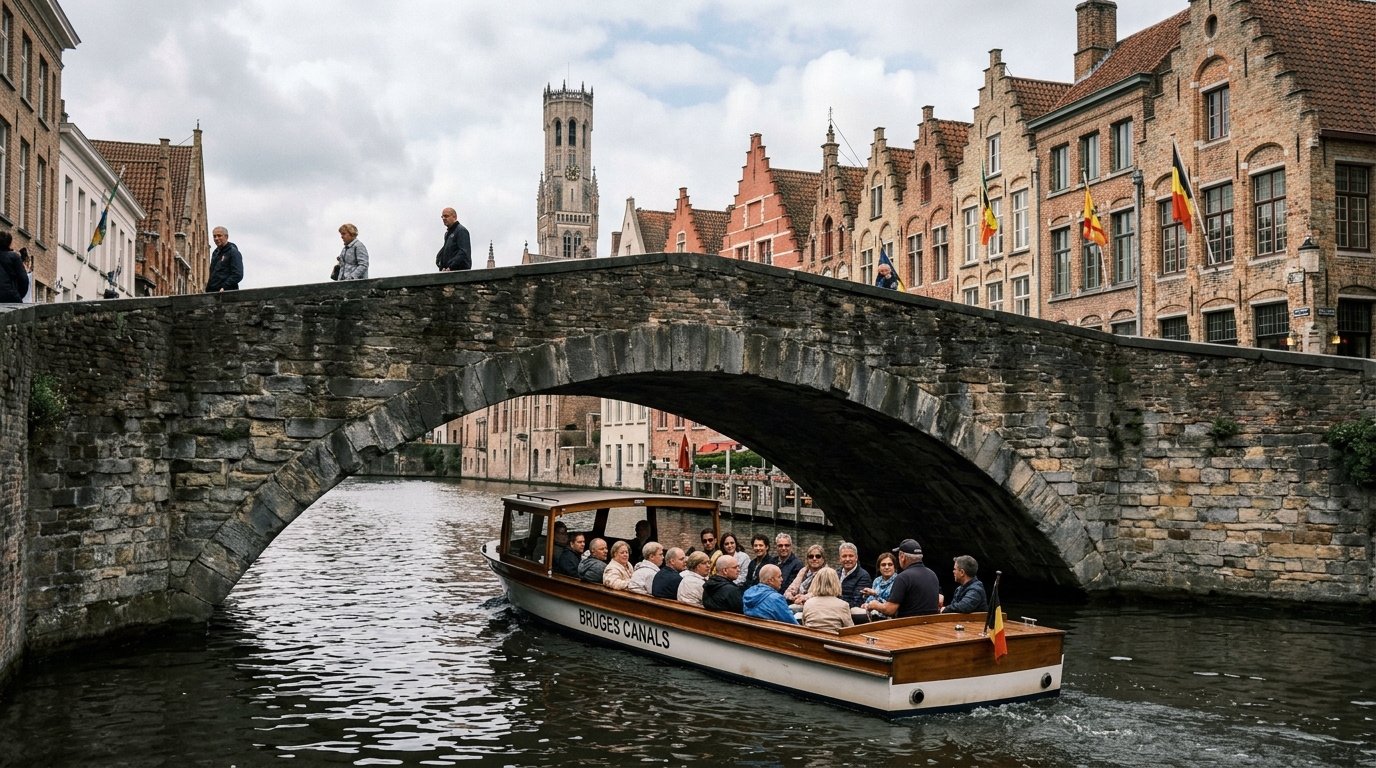
2:00pm – Canal boat ride. Boats depart from five landing stages near Rozenhoedkaai and Burg Square. They run 10am-6pm daily, no booking required. The 30-minute circuit costs EUR 12 per adult. Queues build after 2pm, so arriving at 1:45pm puts you in a manageable line.
3:00pm – Basilica of the Holy Blood. This two-storey chapel beside Burg Square holds what is believed to be a relic of the Holy Blood of Christ. Entry to the lower chapel is free; the treasury museum costs EUR 2.50. It takes 20-30 minutes and is one of the most atmospheric stops in the city.
4:00pm – Begijnhof. Walk 10 minutes south to this UNESCO-listed beguinage, a walled courtyard of white-painted houses that once housed lay religious women. It is free to enter and remains genuinely tranquil even in high season. The inner garden is peaceful for 20-30 minutes of slow walking.
5:30pm – Chocolate shop. Bruges has over 50 chocolate shops (Belgian Chocolate Association, 2024). The best approach: avoid any shop on Markt Square (tourist pricing) and walk one or two streets back. Neuhaus and Del Rey are reliable; a small box of pralines costs EUR 8-15.
7:00pm – Dinner canal-side. By 7pm the day-trippers are gone. Book a table at a canal-facing restaurant and order moules-frites with a Belgian tripel. This is the payoff for every early-morning start.
2-Day Bruges Itinerary: The Ideal Visit
Two days is the most satisfying way to see Bruges. Day 1 covers the icons from the 1-day plan. Day 2 shifts to museums, the brewery, and a canal bike loop that most visitors skip entirely.
Day 2 Hour-by-Hour Schedule
9:00am – Groeningemuseum. This is Belgium’s premier collection of Flemish Primitive paintings, including Jan van Eyck’s “Madonna with Canon van der Paele.” Tickets cost EUR 12 (Museabrugge, 2026). Allow 90 minutes. The collection is small enough to absorb fully without museum fatigue.
11:30am – Memling in Sint-Jan. A five-minute walk from Groeningemuseum, this museum inside the former Sint-Janshospitaal houses six works by Hans Memling, a 15th-century master who worked almost exclusively in Bruges. Tickets cost EUR 12. Together with Groeningemuseum, these two form a half-day museum pairing that no art-interested visitor should miss.
Most itineraries split these museums across two days. Visiting both back-to-back on a single morning is actually more efficient. The combined walk between them is under 400 meters, and the thematic continuity (Flemish medieval painting through to Memling’s devotional works) makes each collection feel richer.
1:00pm – Fish Market (Vismarkt) lunch. Walk north to the open-air fish market beside the Dijver canal. On weekday mornings local traders sell fresh North Sea catch; by lunchtime the surrounding restaurants serve it cooked. Order a plate of grey shrimp croquettes (garnaalroketten) for EUR 14-18.
2:30pm – De Halve Maan Brewery tour. Bruges’ last operating city-center brewery has been producing Brugse Zot since 1564 (De Halve Maan, 2026). Tours run at 11am and 3pm; book ahead as they sell out. Cost is EUR 10 and includes a beer. The 45-minute tour ends on the rooftop with a panoramic city view.
4:00pm – Canal bike loop. Rent a bike near Markt for EUR 15 per day. The 8km canal loop heading north toward the Damme windmills takes about two hours at a leisurely pace. The path is flat, signposted, and almost entirely car-free. This is where Bruges stops feeling like a theme park and starts feeling like a real Flemish town.
6:30pm – Minnewater evening walk. The “Lake of Love” at the southern edge of the old town is at its best in the evening light. Swans cluster around the 14th-century sluice gate. Allow 30 minutes before heading to dinner.
8:00pm – Belgian dinner. Order moules mariniere, a waterzooi (Ghent-style chicken or fish stew), or a carbonnade flamande. Pair with a Bruges tripel. Budget EUR 25-35 per person with wine or beer.
Find hotels within walking distance of both museum clusters through Check live hotel prices — the area around Dijver canal puts you centrally for both day itineraries.
3-Day Bruges Itinerary: Slow Travel + Day Trips
Three days in Bruges means you have seen the icons, absorbed the museums, and now you can afford to be unhurried. Day 3 divides naturally between a quieter morning in Bruges and an afternoon day trip.
Day 3 Hour-by-Hour Schedule
9:00am – Sint-Janshuis Windmill. Four windmills line the northeastern ramparts of Bruges. Sint-Janshuis is the only one open to visitors (Museabrugge, 2026) and operates a working mill during summer months. Entry costs EUR 4. The walk along the ramparts from Kruispoort gate takes 15 minutes and is one of the least-touristed corners of the city.
10:30am – Lace Centre (Kantcentrum). Belgian lacemaking was added to the UNESCO Intangible Cultural Heritage list in 2023 (UNESCO, 2023). The Kantcentrum in the Balstraat hosts daily demonstrations by local lacemakers and a compact museum. Tickets cost EUR 6. Allow 45-60 minutes.
12:00pm – Train to Ghent. Ghent is 30 minutes from Bruges by direct train, with tickets from EUR 8 each way (SNCB, 2026). Arriving by 12:30pm gives you 4-5 hours comfortably.
In Ghent: visit Gravensteen castle (EUR 14, 1.5 hours), walk the Graslei and Korenlei canal quays, and find lunch at one of the student-friendly spots near Vrijdagmarkt. The Graffiti Alley (Werregarenstraat) is free and takes 20 minutes. Return trains to Bruges run every 30 minutes.
6:00pm – Return to Bruges. You arrive back with enough time for a quiet canal walk before dinner.
Evening – Beer tasting. Bruges has around 30 bars specializing in Belgian beer (Belgian Beer World, 2024). The Brugs Beertje on Kemelstraat stocks over 300 labels and the staff give genuine guidance. Order a Trappist Westmalle Dubbel or a local Bruges tripel as a starting point.
Find your Bruges hotel on the map
Live prices from Booking & Airbnb — tap a pin to compare stays around the Historic Centre (Markt) and beyond.
Best Time of Day to See Bruges
The single biggest factor in your Bruges experience is when you are on the streets, not which streets you choose. Bruges receives most of its 8 million annual visitors as day-trippers, and they follow a predictable pattern (Visit Bruges, 2025).
Tour buses begin arriving by 10:30am. The Markt and the canal boat queues reach peak density between noon and 3pm. By 5pm most coaches have departed, and by 6pm the city quiets significantly.
The best light for Rozenhoedkaai falls between 6am and 7am (golden hour after sunrise) and again from 7pm to 8pm in summer. Arriving at 8:30am still gives you 90 minutes of manageable crowds before the tour groups arrive in force.
Rain is not a reason to reschedule. The canals reflect low cloud beautifully, and the covered arcade at Burg Square and the Basilica interior remain comfortable. Belgian weather averages 180 rainy days per year (Royal Meteorological Institute of Belgium, 2025), so building flexibility into your morning timing is wiser than hoping for guaranteed sun.
best things to do in bruges
Planning your activities list? Our full guide to the best things to do in Bruges covers every major sight with opening hours and ticket prices.
Bruges Itinerary Tips: What Most Visitors Miss
Standard travel advice focuses on what to see. The more valuable tip in Bruges is what not to do. Buying a horse-drawn carriage ride on Markt Square costs EUR 55 for 35 minutes and deposits you back where you started. The same EUR 55 buys a canal boat ride, a Groeningemuseum ticket, lunch, and a praline box. The canals already give you the cinematic Bruges view for free on foot.
Timing the Canal Boat
The canal boats run 10am-6pm daily. The first boats at 10am carry the smallest crowds. By 2pm the queue on a summer Saturday can stretch 45-60 minutes. If you plan to do only one boat ride, join the queue at 9:50am and be first on the water.
Booking What Sells Out
Two things regularly sell out in Bruges: Belfry time slots and De Halve Maan brewery tours. Both have limited capacity and both are worth prioritizing. Book the Belfry when you book your train tickets. Book De Halve Maan the day before at minimum. Everything else in Bruges can be done without advance reservations.
The Chocolate Shop Price Trap
Shops directly on Markt Square charge a premium of 20-40% over shops one block away (Which?, 2024). Walk to Steenstraat or Simon Stevinplein for the same quality pralines at better prices. The praline is the local specialty: a chocolate shell with a soft ganache, cream, or nut filling.
Evening Dining Strategy
Most Bruges restaurants on the canal add a view surcharge. The canal-facing tables at 7pm are worth it. Make the reservation at check-in. By 8pm, tables are often available walk-in, but you lose the best light.
is bruges worth visiting
Still deciding whether to go? Read our honest take on is Bruges worth visiting for a balanced view including crowds and costs.
Getting Around During Your Itinerary
Bruges old town is 430 hectares and entirely walkable. From the train station to Markt Square takes 20 minutes on foot or 8 minutes by bus. Almost every sight in the 1-day and 2-day itineraries is within 15 minutes’ walk of Markt. Stay connected: grab a travel eSIM from Airalo before you go so you have data the moment you land.
| Mode | Cost | Best For | Notes |
|---|---|---|---|
| Walking | Free | All core sights | Old town fits inside a 2km radius |
| Canal boat | EUR 12/adult | Scenic overview | 10am-6pm, no booking, 30 min ride |
| Bike rental | EUR 15/day | Canal loop, windmills | Flat terrain, 8km loop = 2h leisurely |
| Bus (De Lijn) | EUR 3/ride | Train station to center | Routes 1, 4, 14 from station |
| Taxi | EUR 10-15 | Rain, luggage | Taxis at station rank, no app needed |
Source: De Lijn, Visit Bruges, 2026
Train Connections
The Brussels-Bruges Intercity runs every 30 minutes during the day, taking 60 minutes (SNCB, 2026). From Brussels Airport, add 20 minutes for the airport express to Brussels Midi.
For Ghent day trips (Day 3), direct trains run every 30 minutes, taking 30 minutes and costing around EUR 8 each way. For the North Sea coast, the Bruges-De Panne coastal tram is an experience in itself: 15 minutes to Blankenberge, EUR 3.50.
bruges hotels
For accommodation recommendations sorted by location and budget, see our guide to Bruges hotels.
Frequently Asked Questions
Is 1 day enough for Bruges?
One day is enough to see the headline sights: Rozenhoedkaai, the Belfry, a canal boat, the Basilica of the Holy Blood, and Begijnhof. You will cover roughly 5-6km on foot. Arrive before 9am from Brussels (1h, EUR 17-22 each way via Trainline) to beat the crowds. You will not regret a second day, but one day is genuinely satisfying if timed well.
Is 3 days too long in Bruges?
Three days is not too long if you use Day 3 strategically. The city itself can feel fully explored after two days, but Ghent (30 min, EUR 8) and the Belgian coast (15 min) make Day 3 feel varied. Three days also suits travelers who want a relaxed base for cycling, lacemaking, and windmill visits without rushing any one sight.
What is the best time to visit Bruges?
April to June and September to October offer the best balance: mild temperatures (12-18C), lower crowds than July-August, and long daylight hours for photography. July and August are peak season; crowds are heaviest and prices highest. Winter (November to February) is quiet and atmospheric, though some canal boat operators reduce hours (Visit Bruges, 2025).
How much does a 2-day Bruges trip cost?
A rough budget for 2 days: train from Brussels EUR 35-44 return, mid-range hotel EUR 120-180/night, Belfry EUR 16, canal boat EUR 12, Groeningemuseum EUR 12, Memling in Sint-Jan EUR 12, De Halve Maan tour EUR 10, meals EUR 30-40/day, bike rental EUR 15. Total for 2 days ex-accommodation: approximately EUR 160-220 per person. Book accommodation through Check live hotel prices for the best canal-district rates.
Do you need to book anything in advance for Bruges?
Yes: the Belfry and De Halve Maan brewery tours both sell out regularly and should be pre-booked. Everything else in the itinerary (canal boats, museums, restaurants except high-end ones) can be done walk-in.
Conclusion
Two days in Bruges is the answer most visitors should hear. One day works if you arrive early and stay disciplined. Three days rewards anyone who wants to cycle, explore Ghent, or simply slow down. The structure of your visit matters less than your timing: before 10am and after 5pm, Bruges belongs to you. The canals are quiet, the reflections are sharp, and the city looks exactly like the medieval trading capital it once was.
Plan your Brussels-Bruges train early, pre-book the Belfry, and save at least one dinner for a canal-side table after the day-trippers have gone home. That combination turns a good trip into a memorable one.
For the full picture before you book, start with our Bruges travel guide and the best things to do in Bruges.