
Disclosure: Some links in this guide are affiliate links. If you book or buy through them, we may earn a small commission at no extra cost to you — it helps keep our guides free.
Kyoto Travel Guide 2026: Temples, Gion & First-Timer Tips
This Kyoto travel guide is built for first-timers who want the essentials without guesswork: what the famous temples actually cost, how to move between them, and how to behave in Gion so you leave a good impression. Kyoto served as Japan’s imperial capital for over a thousand years, and it still holds 17 UNESCO World Heritage sites within the city and its immediate surroundings (UNESCO, 2025), which is why almost every visit centers on shrines, temples, and old wooden lanes. How long to give the city is answered separately in how many days you need in Kyoto.
Two things trip up newcomers most: transport and etiquette. Kyoto’s bus network is dense but slow at peak hours, the popular 700-yen bus day pass was discontinued back in 2023 (Kyoto City Transportation Bureau), and Gion now posts fines for photographing geisha on private streets. Below we cover the top temples and shrines, Gion, Arashiyama, Fushimi Inari, bus versus train, the ICOCA card, etiquette, arrival from Osaka and Tokyo, and when to go.
Key Takeaways
– Most temples charge 300 to 600 yen: Kinkaku-ji and Kiyomizu-dera are both 500 yen for adults, while Fushimi Inari and the Arashiyama Bamboo Grove are completely free.
– Skip the old day pass math: the 700-yen bus pass is gone; a single city bus ride is a flat 230 yen, and the Subway & Bus 1-Day Pass now costs 1,100 yen.
– Get an ICOCA card first: a physical ICOCA costs 2,000 yen (including a 500-yen refundable deposit) and works on buses, subways, and JR trains with a single tap.
– Arrive smart: Kansai Airport to Kyoto on the Haruka express takes about 75 minutes; Osaka to Kyoto is 14 minutes by Shinkansen or about 30 minutes on the 580-yen JR Special Rapid.
– Best weather is spring and autumn: cherry blossoms peak around March 28 to April 5 in 2026, and maple foliage peaks roughly November 15 to 30.[PERSONAL EXPERIENCE] We have based ourselves in Kyoto three times, most recently for six nights in November, and the single habit that changed our trips was starting before 7am. We reached Fushimi Inari at 6:40am with the torii tunnels nearly empty, then walked the Arashiyama bamboo path before the tour buses arrived. By 10am both places were shoulder-to-shoulder, so we treated mornings as sightseeing and afternoons as tea houses and slow neighborhoods. Specific properties by tier, ryokan included, are ranked in our guide to the best hotels in Kyoto.
What are the must-see temples and shrines in Kyoto?
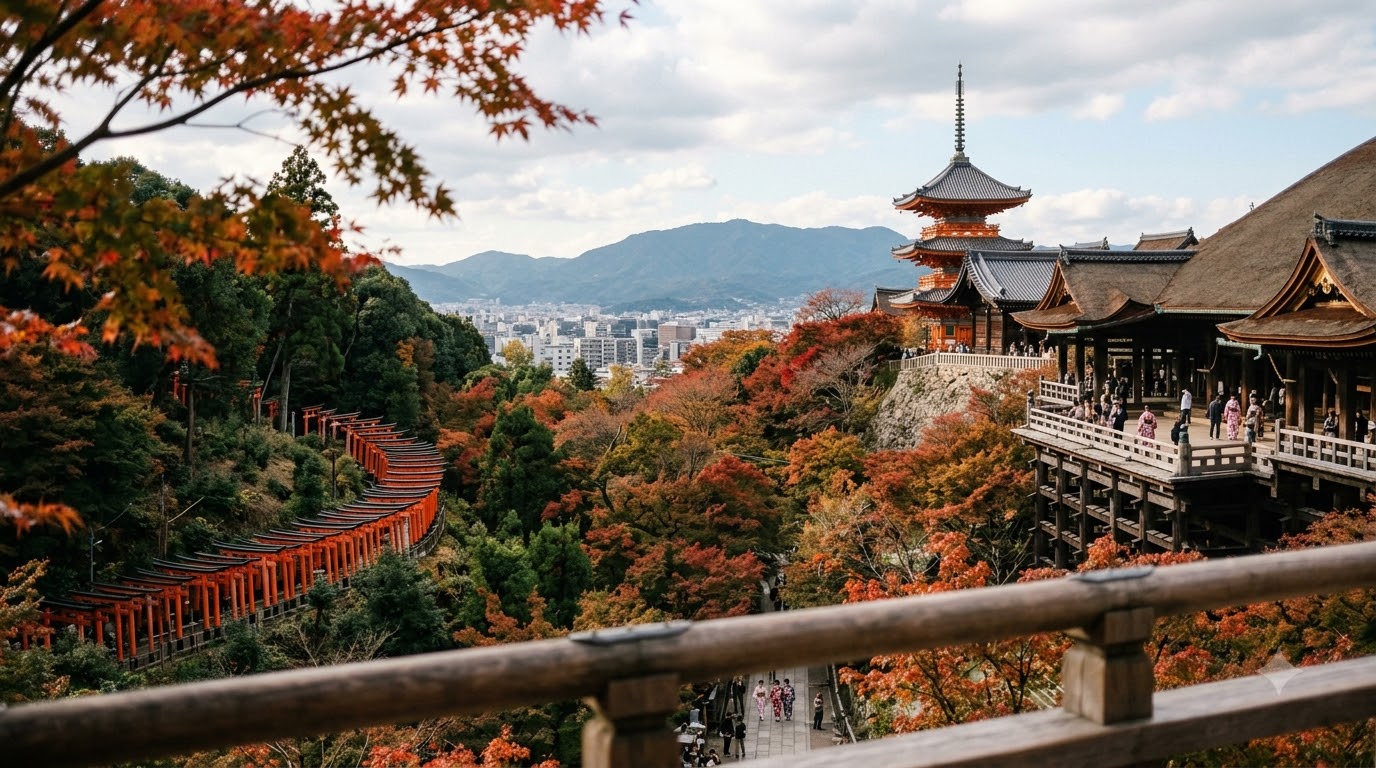
The core Kyoto temple circuit is small enough to cover in two to three focused days, and most sites open around 9am. Kyoto has hundreds of temples and shrines, but first-timers usually build their days around a short list of headliners spread across the north, east, and south of the city. For a deeper ranking of sights beyond this shortlist, see our guide to the best things to do in Kyoto.
Here are the anchor sites with verified 2026 details:
- Kinkaku-ji (Golden Pavilion): 500 yen for adults, open 9:00am to 5:00pm; the gold-leaf pavilion over a reflecting pond is the postcard shot of Kyoto.
- Kiyomizu-dera: 500 yen for adults, open 6:00am to 6:00pm (until 6:30pm in July and August); its wooden stage juts out over a hillside of maples.
- Fushimi Inari Taisha: free, open 24 hours; the shrine office and shops staff from 9:00am to 5:00pm.
- Arashiyama Bamboo Grove: free, open 24 hours; a roughly 2-kilometer loop path runs through the towering stalks.
- Ginkaku-ji (Silver Pavilion): 500 yen for adults, reached via the walkable Philosopher’s Path through the eastern hills.
We usually pair northern and eastern sites on separate days because the bus ride across the city center can eat 40 minutes at rush hour. On our last visit we did Kinkaku-ji at opening, then moved to Ryoan-ji’s rock garden a short walk away, which kept us out of the midday crowds entirely.
| Site | Adult admission | Hours (2026) | Free? |
|---|---|---|---|
| Fushimi Inari Taisha | 0 yen | 24 hours | Yes |
| Arashiyama Bamboo Grove | 0 yen | 24 hours | Yes |
| Kinkaku-ji | 500 yen | 9:00-17:00 | No |
| Kiyomizu-dera | 500 yen | 6:00-18:00 | No |
| Ginkaku-ji | 500 yen | 9:00-17:00 (varies) | No |

The 3-Day Kyoto Itinerary
The plan we use ourselves — sent straight to your inbox.
- Day-by-day route
- Where to stay
- Real 2026 costs
Free · No spam · Unsubscribe anytime
How do you visit Fushimi Inari and Arashiyama without the crowds?
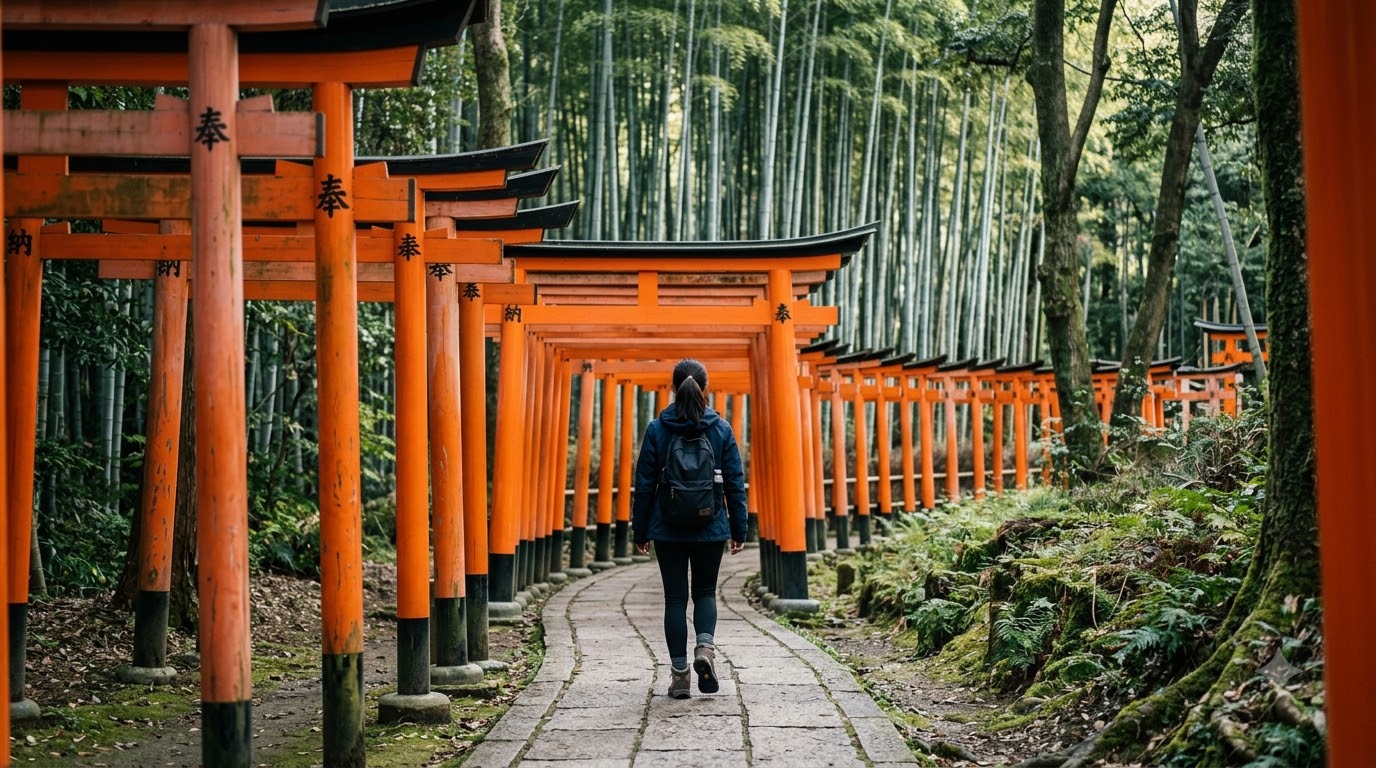
Go early or go late, because both sites are free, open around the clock, and therefore have no queue to slow the crowd down. Fushimi Inari’s thousands of vermillion torii gates climb Mount Inari, and the full loop to the summit takes about two to three hours round trip. Most visitors only walk to the Yotsutsuji intersection about 30 to 45 minutes up, where the city view opens out.
Practical timing notes we rely on:
- Fushimi Inari before 7:30am: the lower torii tunnels photograph cleanly with almost no one in frame; by 10am it is a slow shuffle.
- Climb past Yotsutsuji: foot traffic drops sharply above the midpoint, and the upper shrines feel genuinely quiet even at midday.
- Arashiyama Bamboo Grove before 8am or after 5pm: the 2-kilometer path is narrow, so late afternoon golden hour is the calm alternative to dawn.
- Combine Arashiyama sights: add Tenryu-ji temple (garden entry around 500 yen) and the Togetsukyo Bridge to justify the trip west.
- Fushimi Inari is on the JR Nara Line: two stops and about 5 minutes from Kyoto Station, so it slots neatly into an early start.
What are the rules for Gion and Kyoto etiquette?
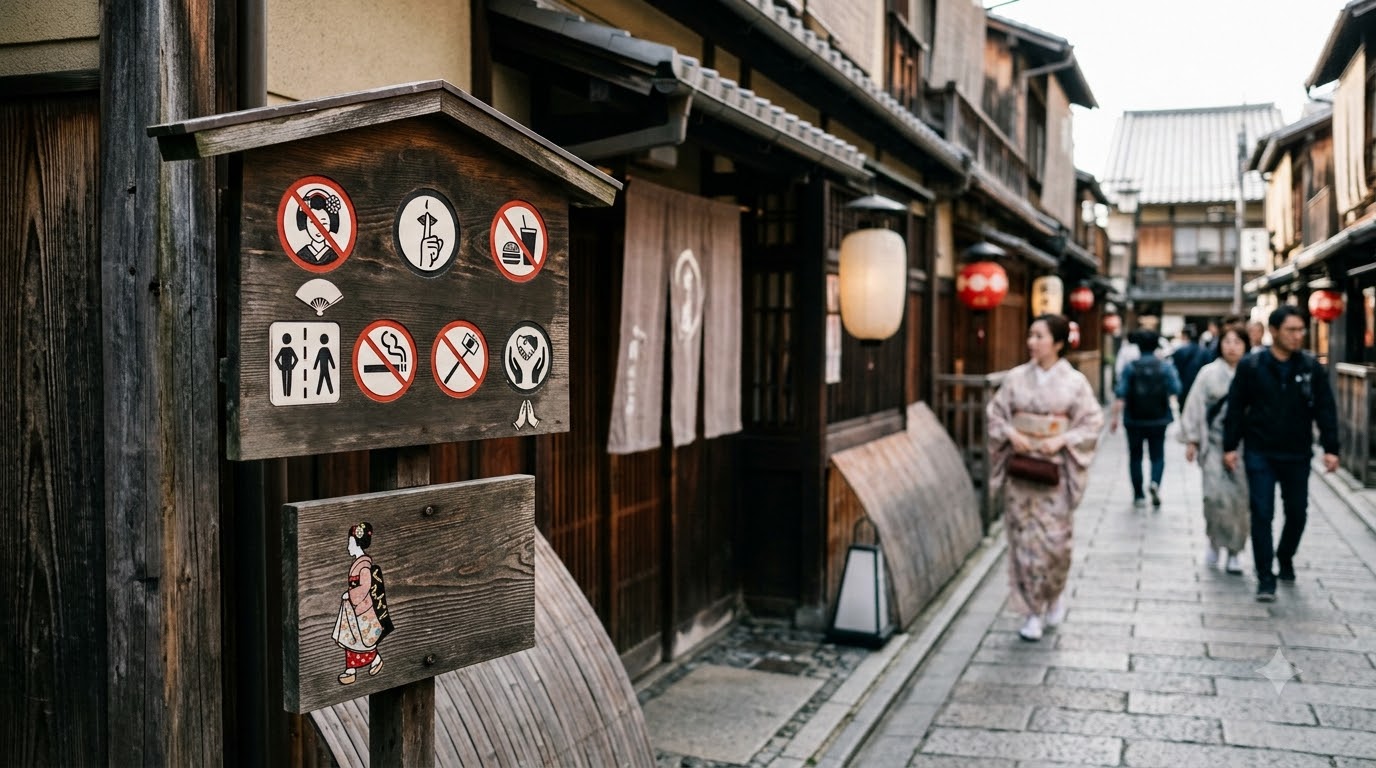
Treat Gion as a living neighborhood, not a theme park, and keep your camera down on the small private lanes. Gion is Kyoto’s historic geisha district, and since 2024 local residents have posted signs warning of a 10,000-yen fine for photographing geiko and maiko or entering designated private side streets without permission (Kyoto Shimbun, 2024). The main thoroughfare, Hanamikoji Street, is a public road where photography is not banned, but even there the courteous move is to ask before pointing a lens at anyone.
Etiquette that keeps you welcome across Kyoto:
- Do not chase or corner geisha: the fines exist because tourists grabbed and blocked working performers on their way to appointments.
- Stay off private alleys in Gion: the branch lanes off Hanamikoji are residential and restaurant property, clearly signposted.
- Keep your voice low at temples: many are active places of worship, and photography is banned inside most main halls.
- Remove shoes where indicated: wooden temple interiors and traditional inns expect socks-only floors.
- Carry your trash: public bins are rare, so most locals pocket wrappers until they get home.
We walked Hanamikoji at dusk on our last trip and saw a maiko step out for an appointment; the visitors who quietly made room got a small bow, while the ones who rushed forward got a firmly closed door. The difference in reception was obvious.
The 3-Day Kyoto Itinerary
Hour-by-hour plan, where to stay and what it really costs — free PDF.
Free · No spam · Unsubscribe anytime
Kyoto transport: should you take the bus or the train?
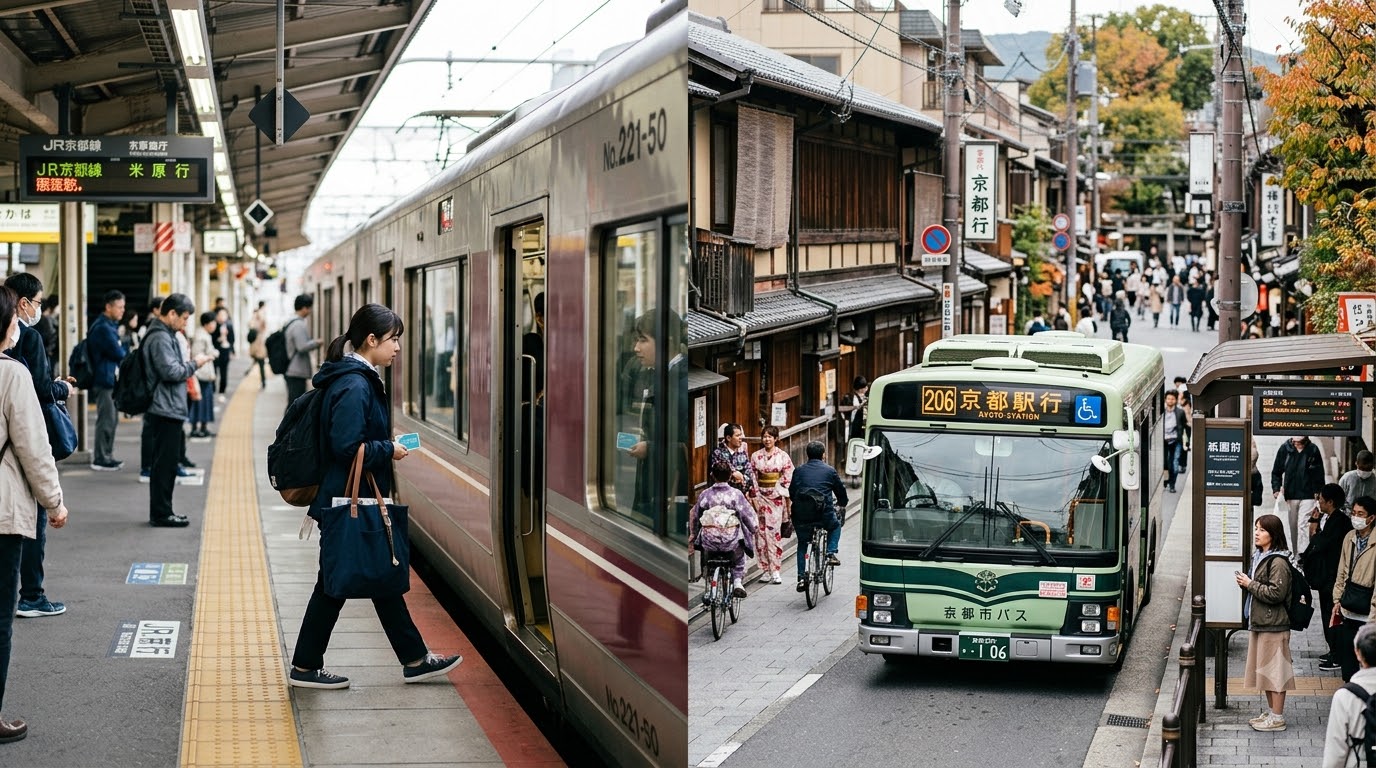
Use trains and subways for speed and buses only for stops the rail network misses. Kyoto’s buses reach nearly every temple, but they run on congested surface streets, so a cross-town ride can take far longer than the map suggests. The subway is limited to two lines, yet the JR, Keihan, and Hankyu rail lines fill many gaps quickly.
Fares and passes, verified for 2026:
- City bus flat fare: 230 yen for adults within the flat-fare zone, 120 yen for children, paid on exit.
- Subway single ride: 220 to 360 yen depending on distance.
- Subway & Bus 1-Day Pass: 1,100 yen for adults, worth it only if you take four or more rides in a day.
- The old 700-yen bus day pass: discontinued in 2023 and no longer accepted, so ignore older guides that still recommend it.
- Fushimi Inari, Arashiyama, and Uji: all reached faster by JR or Keihan train than by bus.
| Route | Best mode | Time | One-way fare |
|---|---|---|---|
| Kyoto Station to Fushimi Inari | JR Nara Line | ~5 min | 150 yen |
| Kyoto Station to Arashiyama | JR Sagano Line | ~15 min | 240 yen |
| Kyoto Station to Kinkaku-ji | City bus | ~40 min | 230 yen |
| Gion to Kiyomizu-dera | Walk | ~15 min | 0 yen |
We rarely buy the day pass anymore. On a typical temple day we take two or three train hops and one bus, which lands under the 1,100-yen break-even point, and the ICOCA card handles all of it without buying separate tickets.
Do you need an ICOCA card in Kyoto?
Yes, an ICOCA card is the simplest way to pay across every network, and it removes the daily hassle of counting coins for the bus. ICOCA is the Kansai region’s rechargeable IC card, and a single tap covers buses, subways, JR trains, and even convenience-store purchases. A physical card costs 2,000 yen, which includes a 500-yen refundable deposit plus 1,500 yen of usable balance, sold at JR ticket machines and Kansai Airport.
How we set it up and use it:
- Buy at the airport or any JR station: machines have an English menu and take cash for the initial 2,000 yen.
- Or add a mobile IC card: ICOCA loads into Apple Wallet, and Suica works in Google Pay on many phones for tap-to-pay without a plastic card.
- Top up as you go: ticket machines and some convenience stores reload the balance in cash.
- One tap, every network: no need to calculate fares before boarding, which matters most on crowded buses.
- Refund the deposit later: JR West stations return the 500-yen deposit and remaining balance when you leave the region.
How do you get to Kyoto from Osaka and Tokyo?
Kyoto is a short hop from Osaka and about two and a quarter hours from Tokyo by bullet train. The city has no airport of its own, so most visitors arrive through Kansai International Airport, Osaka, or Tokyo and finish the trip by rail. To decide which base suits your trip, our Tokyo vs Kyoto comparison breaks down the trade-offs in detail.
Verified 2026 connections:
- Kansai Airport (KIX) to Kyoto: the Limited Express Haruka runs direct in about 75 minutes, roughly every 30 minutes, for around 3,600 yen for a reserved seat.
- Osaka to Kyoto by Shinkansen: Shin-Osaka to Kyoto is just 14 minutes, though it costs more than local rail.
- Osaka to Kyoto by JR Special Rapid: about 30 minutes from Osaka Station for 580 yen, the best value option.
- Osaka to Kyoto by Hankyu: about 40 to 45 minutes from Osaka-Umeda to Kyoto-Kawaramachi in the city center for 410 yen.
- Tokyo to Kyoto by Nozomi Shinkansen: 2 hours 15 minutes, around 14,170 yen for a standard reserved seat.
| From | Fastest mode | Travel time | Approx. fare |
|---|---|---|---|
| Kansai Airport | Haruka express | ~75 min | ~3,600 yen |
| Osaka (Shin-Osaka) | Shinkansen | ~14 min | ~1,440 yen |
| Osaka (Umeda) | Hankyu line | ~40 min | 410 yen |
| Tokyo | Nozomi Shinkansen | 2 h 15 min | ~14,170 yen |
When we come from Tokyo we book the Nozomi a day ahead through the SmartEX app to guarantee a window seat on the Mt. Fuji side, which appears on the right about 40 minutes out of Tokyo.
When is the best time to visit Kyoto?
Spring and autumn deliver the best weather and scenery, with late April and October offering the strongest balance of comfort and manageable crowds. Kyoto sits in a basin that traps heat, so summers are hot and humid while winters are cold but clear. The two headline seasons are cherry blossoms in early spring and maple foliage in late autumn, and both draw heavy crowds and higher hotel prices. For a full month-by-month breakdown, see our guide to the best time to visit Kyoto.
Season notes for 2026 planning:
- Cherry blossoms: full bloom is forecast around March 28 to April 5, 2026, the single busiest window of the year.
- Autumn foliage: maples peak roughly November 15 to 30, rivaling the cherry season for crowds.
- Summer heat: August is the hottest month with highs above 30 degrees Celsius (86 degrees Fahrenheit) and high humidity.
- Winter calm: December to February averages around 5 degrees Celsius (41 degrees Fahrenheit), with the thinnest crowds and lowest rates.
- Sweet spots: October runs a mild 14 to 24 degrees Celsius, and early May stays warm and comfortable after the Golden Week rush.
| Season | Months | Typical high | What to expect |
|---|---|---|---|
| Spring | Mar-May | 15-23 C | Cherry blossoms, big crowds late Mar-early Apr |
| Summer | Jun-Aug | 30-35 C | Hot, humid, rainy season in June |
| Autumn | Sep-Nov | 18-27 C | Maple foliage peaks mid-to-late Nov |
| Winter | Dec-Feb | 8-10 C | Cold, clear, quietest and cheapest |
Find your Kyoto hotel on the map
Live prices from Booking & Airbnb — tap a pin to compare stays around Gion and Kyoto Station and beyond.
Where should first-timers stay in Kyoto?
Base yourself near Kyoto Station, in Gion-Higashiyama, or in Downtown Kawaramachi for the easiest access to sights and transport. Each area suits a different travel style, and choosing well saves you an hour of daily commuting. Our detailed Kyoto neighborhood and hotel guide compares each district, but the short version is straightforward:
- Kyoto Station area: best for rail connections, day trips to Osaka and Nara, and late arrivals or early departures.
- Gion and Higashiyama: best for atmosphere, walkable temples, and evening strolls through historic lanes.
- Downtown Kawaramachi and Pontocho: best for dining, nightlife, and central subway and Hankyu access.
- Arashiyama: best for a quiet, scenic base if you do not mind being west of the center.
We have stayed in all three central areas and found Gion-Higashiyama the most rewarding on foot, since Kiyomizu-dera, Yasaka Shrine, and Kodai-ji are all within a 20-minute walk of one another.
Frequently Asked Questions
How many days do you need in Kyoto?
Three full days is the sweet spot for first-timers, covering the temple circuit without rushing. One day suits the Fushimi Inari and eastern Higashiyama temples, a second covers Arashiyama and Kinkaku-ji in the west and north, and a third leaves room for Gion, Nishiki Market, and a day trip to Nara or Uji. Four days lets you slow down for tea houses and gardens; our list of the top things to do in Kyoto helps fill any extra time.
Is Kyoto expensive for tourists?
Kyoto is moderate by Japanese standards, and temple admissions are cheap. Most temple entries run 300 to 600 yen, many major sights like Fushimi Inari are free, and a filling lunch of udon or a rice set costs around 800 to 1,200 yen. Accommodation is the main variable, spiking sharply during cherry blossom and autumn foliage seasons, so timing your trip using our best time to visit Kyoto guide directly affects your budget.
Can you visit Kyoto as a day trip from Osaka?
Yes, and it is one of the easiest day trips in Japan. The JR Special Rapid links Osaka Station to Kyoto in about 30 minutes for 580 yen, and trains run several times an hour. Leave by 8am, focus on one district such as Higashiyama or Arashiyama, and you can see a great deal before the last evening train back.
Do you need cash in Kyoto?
Carry some cash, because many temples, small shrines, and older restaurants do not accept cards. Temple admission booths and street-food stalls are frequently cash-only, and while an ICOCA card covers transport and convenience stores, it will not pay a temple entry gate. A daily buffer of 5,000 to 10,000 yen in cash covers most situations.
Is it rude to take photos of geisha in Kyoto?
On Gion’s private streets, yes, and it can cost you a 10,000-yen fine. The ban applies to designated private lanes where geiko and maiko live and work, not to public roads like Hanamikoji Street. Even where photography is allowed, ask first, keep your distance, and never block or follow a performer heading to an appointment.
Final thoughts
Kyoto rewards travelers who plan around its rhythms rather than fighting them: start early, ride trains for speed and buses only when needed, tap an ICOCA everywhere, and read the room in Gion. With free sights like Fushimi Inari and the Arashiyama bamboo path balancing the paid temples, a first visit stays affordable while still feeling like the storybook version of old Japan. Use the sibling guides linked above to plan your neighborhood, your season, and the specific sights that fit your days.