
Disclosure: Some links in this guide are affiliate links. If you book or buy through them, we may earn a small commission at no extra cost to you — it helps keep our guides free.
Jungfraujoch Top of Europe 2026: Is It Worth It?
A trip to Jungfraujoch Top of Europe costs roughly CHF 190-250 return in 2026, takes a full half-day from Interlaken, and delivers Europe’s highest railway station at 3,454 metres above sea level (Jungfrau Railways, 2026). Whether it is worth that price depends almost entirely on one thing: the weather. On a clear day, the view over the 23-kilometre Aletsch Glacier, a UNESCO World Natural Heritage site, is one of the great sights in the Alps. In a whiteout, you pay premium money to stand inside a cloud.
This guide breaks down the real 2026 ticket prices, compares the fast Eiger Express route against the classic cog railway, walks through what you actually do at the top (Sphinx Observatory, Ice Palace, Glacier Plateau), explains how to book and check the forecast, and shows two cheaper mountains that give you 80 percent of the drama for half the cash. For the wider region, pair this with our Interlaken travel guide and the full list of things to do in Interlaken.
Key Takeaways
– Ticket cost 2026: A standard Grindelwald-Jungfraujoch return is CHF 239.20 in peak season (May-Oct) and CHF 201.20 the rest of the year; from Interlaken plan on CHF 230-280 (Jungfrau Railways, 2026).
– Altitude: The station sits at 3,454 m and the Sphinx observation deck at 3,571 m, reached by a lift that climbs 108 m in 25 seconds.
– Time budget: Allow 2.5-3 hours at the summit plus travel; the Jungfrau Railway itself covers the final 9.3 km in about 25-35 minutes.
– Discounts: Swiss Travel Pass holders get 25 percent off, Half Fare Card holders 50 percent, and Jungfrau Travel Pass holders pay just CHF 63 for the Eigergletscher-Jungfraujoch section.
– Cheaper swaps: Grindelwald First (CHF 72-76 return) and Schilthorn (CHF 108 return) cost a fraction of Jungfraujoch with comparable panoramas.[PERSONAL EXPERIENCE] We went up twice on the same trip, and the two visits could not have been more different. The first morning fog closed in below Eismeer and we saw nothing but grey; the second, three days later, we caught a cloudless 8am departure and the Aletsch Glacier stretched to the horizon. That contrast is the single most important thing we can tell you: buy a flexible ticket and go on the clear day, not the day your itinerary says.
Is Jungfraujoch Top of Europe worth it in 2026?
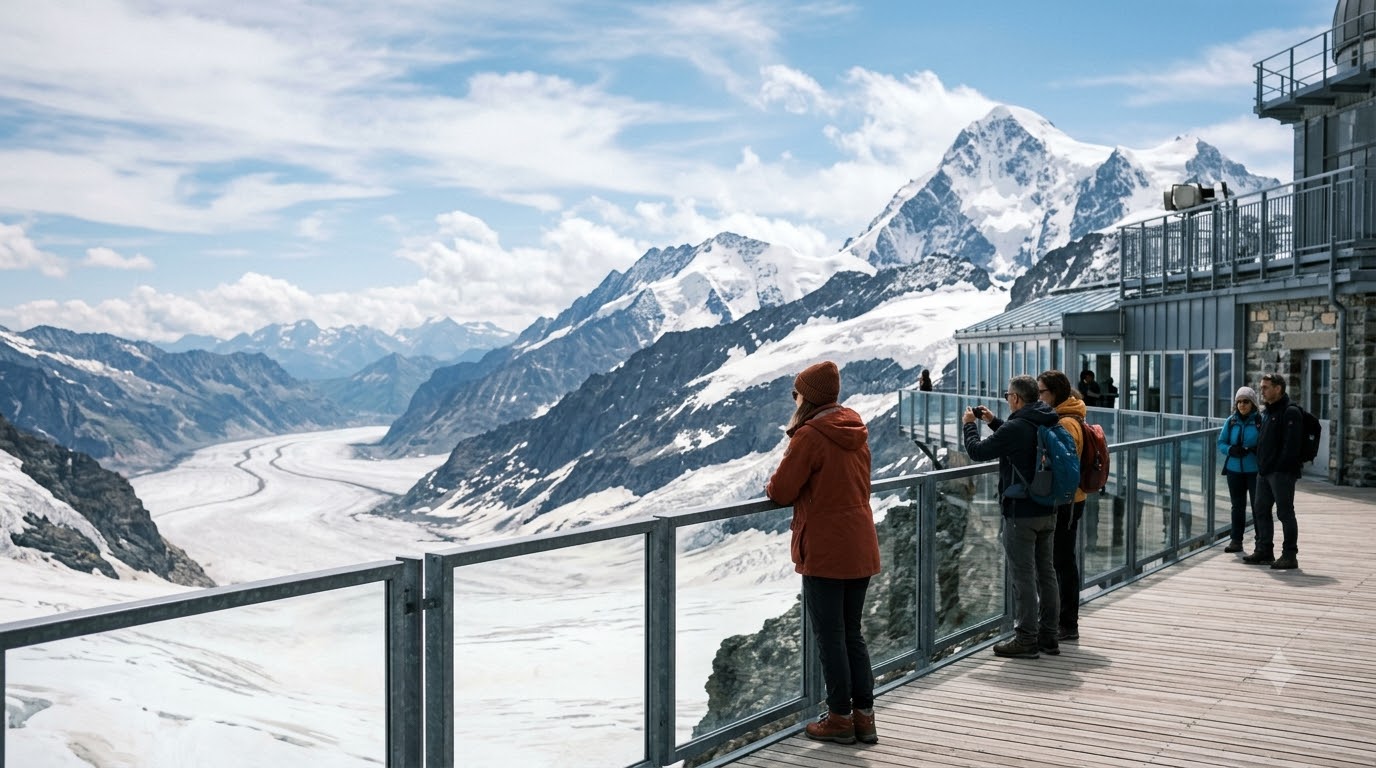
Jungfraujoch is worth it on a clear day and a poor use of money in bad weather. The experience is genuinely unique: no other train in Europe climbs this high, and the combination of glacier, ice tunnels and thin mountain air is hard to replicate. The price and the weather risk are the two honest caveats.
Here is how we would decide:
- Go if you have a flexible date, the forecast shows sun, and a bucket-list Alpine summit matters more than the cost.
- Go if you hold a Swiss Travel Pass or Jungfrau Travel Pass that cuts the fare sharply.
- Skip or swap if the peak is forecast to be clouded in, your budget is tight, or you get uneasy above 3,000 m.
- Swap if you have already ridden a high cable car this trip and mainly want the view, not the “highest station” title.
On our last visit in spring 2026, the crowds thinned noticeably after 1pm as tour groups descended, so a late-morning arrival gave us the summit terraces at their busiest and the early train gave us the clearest air. If you can only pick one variable to optimise, pick weather over crowds.

The 3-Day Interlaken Itinerary
The plan we use ourselves — sent straight to your inbox.
- Day-by-day route
- Where to stay
- Real 2026 costs
Free · No spam · Unsubscribe anytime
How much does the Jungfraujoch ticket cost in 2026?
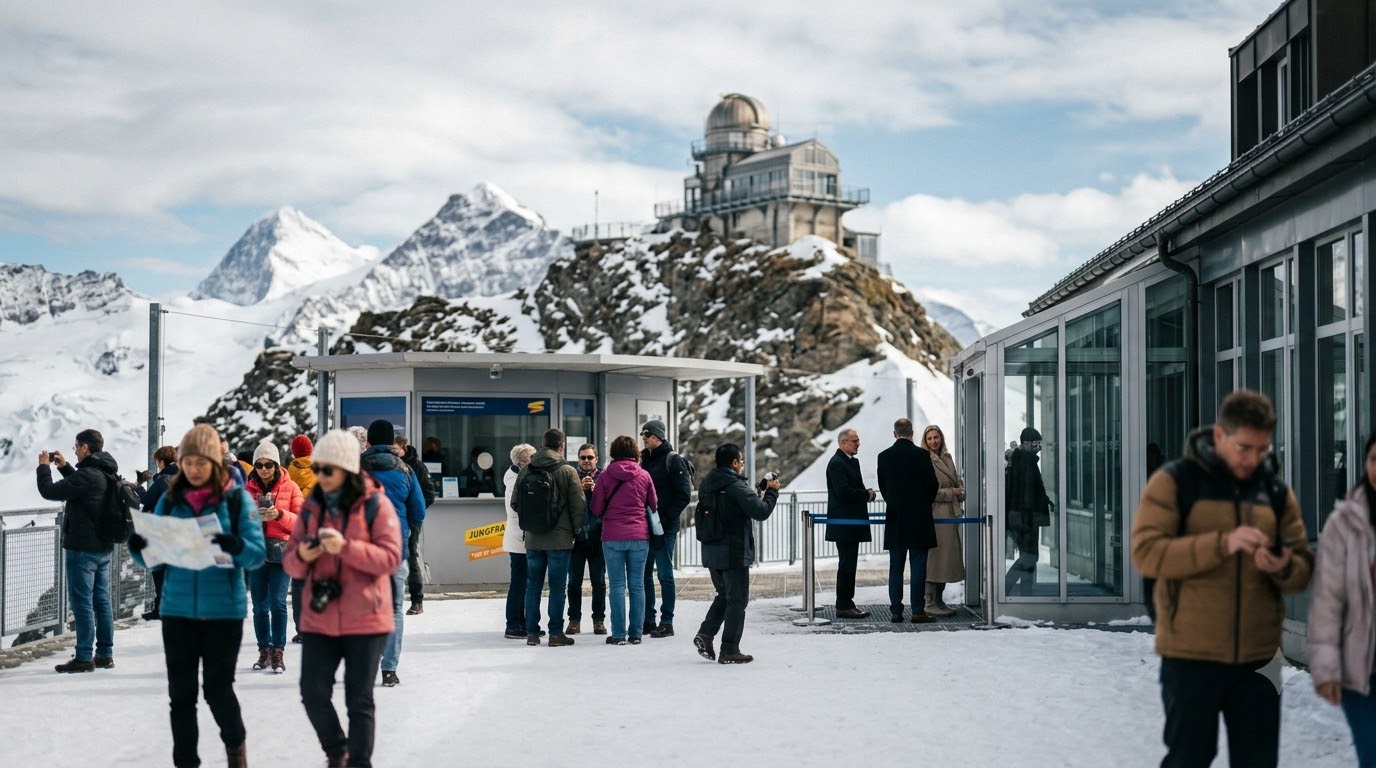
Expect to pay between CHF 190 and CHF 250 for a standard adult return in 2026, with the exact figure driven by season, starting point and any pass you hold. Peak season (1 May to 31 October) is the most expensive window, and a per-person seat reservation of CHF 10 is strongly recommended and effectively mandatory in summer (Jungfrau Railways, 2026).
| Fare type (2026) | Peak (May-Oct) | Off-peak | Notes |
|---|---|---|---|
| Grindelwald return, standard | CHF 239.20 | CHF 201.20 | Most common starting point |
| From Interlaken return | CHF 230-280 | CHF 210-250 | Varies by exact route |
| Seat reservation | +CHF 10 | Optional | Per person, valid on return leg |
| Swiss Travel Pass holder | 25% off | 25% off | Roughly CHF 150-180 net |
| Swiss Half Fare Card | 50% off | 50% off | Best single discount card |
| Jungfrau Travel Pass | CHF 63 | CHF 63 | For Eigergletscher-Jungfraujoch leg only |
Sources: Jungfrau Railways (jungfrau.ch) and myswissalps.com, 2026.
A few money notes from planning our own trips:
- The Half Fare Card is the strongest value if you are doing several Swiss excursions, halving nearly every mountain fare including this one.
- The Jungfrau Travel Pass pays off fastest if you also ride Grindelwald First, Schilthorn-adjacent lifts, and local trains around Lauterbrunnen over several days.
- Children under 6 travel free, and a “Good Morning Ticket” on early departures shaves money off the standard fare if you descend before a set midday cut-off.
- Booking direct at jungfrau.ch avoids the reseller markups that push some third-party “skip the line” tickets well above CHF 300.
Find your Interlaken hotel on the map
Live prices from Booking & Airbnb — tap a pin to compare stays around Interlaken and the Jungfrau region and beyond.
Eiger Express vs the classic railway: which route?
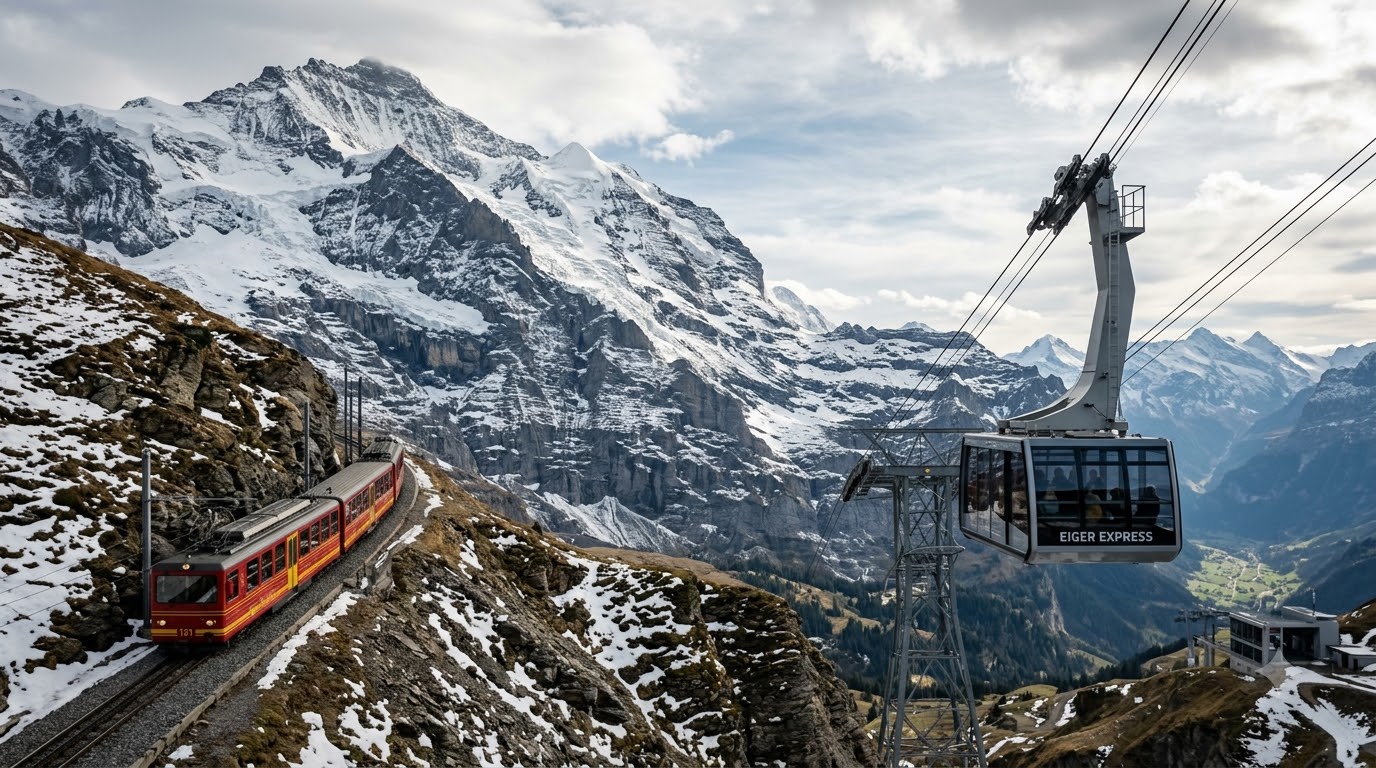
The Eiger Express gondola is the faster route and the classic cog railway is the more scenic one, and most visitors now combine both. Since the Grindelwald Terminal opened, the Eiger Express tricable gondola carries you from the valley to Eigergletscher station (2,320 m) in about 15 minutes, cutting roughly 47 minutes off the old journey (Jungfrau Railways, 2026).
| Route option | Time to summit | Character | Best for |
|---|---|---|---|
| Eiger Express + train | ~45 min total | Fast, modern gondola then short cog | Saving time, avoiding motion sickness |
| Classic railway via Kleine Scheidegg | ~2 hr+ total | Slow, historic cog railway | Scenery, nostalgia, the full experience |
| Up one way, down the other | Half day | Best of both | First-time visitors |
Sources: Jungfrau Railways (jungfrau.ch), 2026.
The stretch we would never skip is the final leg on the Jungfrau Railway itself. Opened in 1912, this cog line runs 9.3 km from Kleine Scheidegg (2,061 m) up through Eigergletscher and Eismeer (3,158 m) to the summit. At Eismeer the train pauses for about five minutes so you can look out through the viewing gallery blasted into the Eiger’s north face. When the line first opened the climb took 1 hour 15 minutes; today it is roughly 25 minutes (Jungfrau Railways, 2026). Our advice: ride the Eiger Express up to save your morning energy, then take the classic railway down.
To reach either starting point, most travellers base themselves in Grindelwald or Lauterbrunnen. See our Grindelwald travel guide for the Terminal and Eiger Express, and the Lauterbrunnen travel guide if you prefer the waterfall valley as your base.
The 3-Day Interlaken Itinerary
Hour-by-hour plan, where to stay and what it really costs — free PDF.
Free · No spam · Unsubscribe anytime
What to do at the top: Sphinx, Ice Palace and the plateau
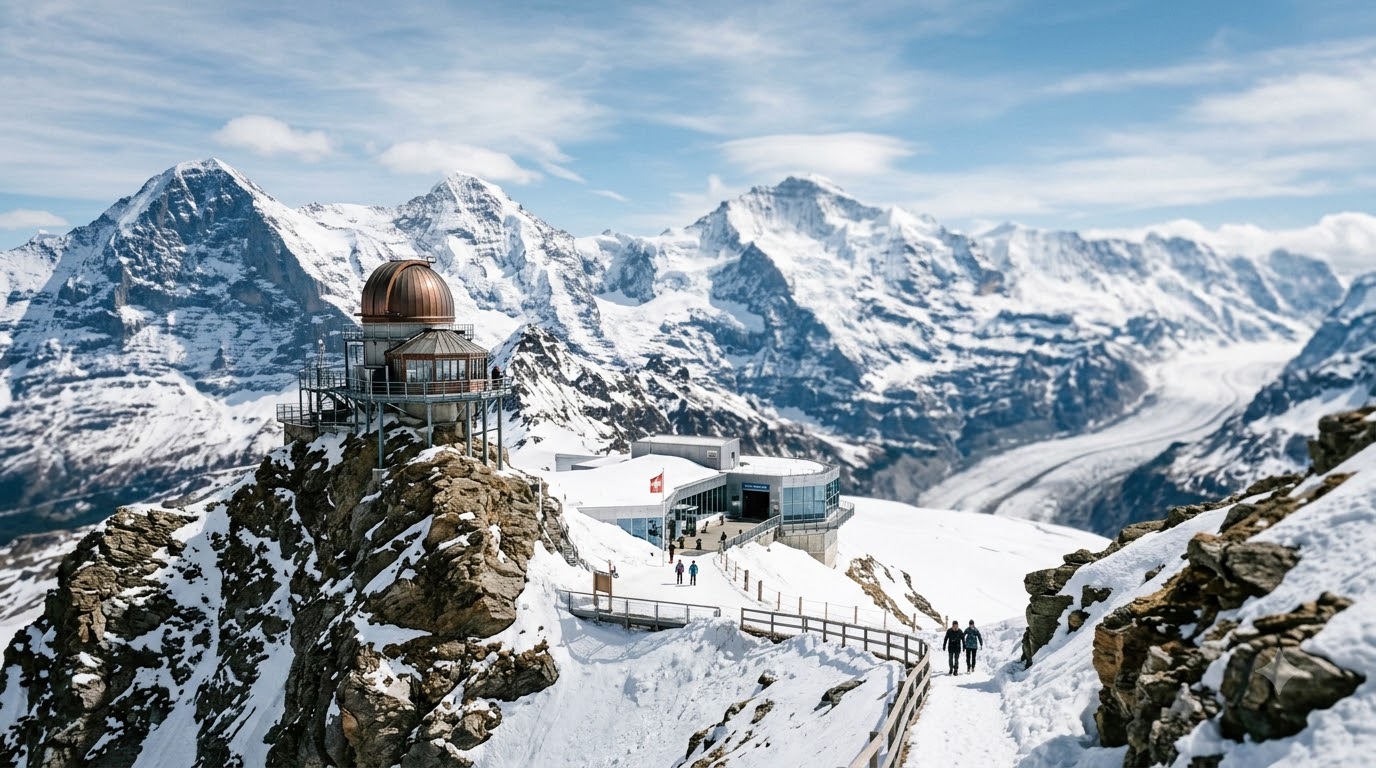
Plan on 2.5 to 3 hours at the summit to cover the main attractions without rushing. Everything sits inside or just outside the station complex, connected by tunnels, so you stay sheltered between viewpoints.
The core sights, ranked by how much we would prioritise them:
- Sphinx Observatory (3,571 m): The highest viewing terrace, reached by a lift that rises 108 m in 25 seconds. On a clear day this is the money shot over the Aletsch Glacier.
- Ice Palace: A maze of tunnels and sculptures carved into the glacier, held at -3 degrees Celsius year-round. Wear grippy shoes; the floor is literally ice.
- Glacier Plateau: Step outside onto the snow at over 3,400 m, with the Jungfrau summit rising behind you.
- Alpine Sensation: A walk-through corridor telling the story of how the railway was built through the mountain.
- Lindt Swiss Chocolate Heaven: A commercial stop, but a warm one, and a decent place to regroup before descending.
Two practical things we learned: altitude is real up here, so walk slowly and drink water, and the temperature outside can sit well below freezing even in July, so pack a warm layer and sunglasses regardless of the valley weather.
Best time to visit and how to catch a clear day
The best time to visit Jungfraujoch is a clear, cold morning, and the single most useful habit is checking the live summit webcam before you commit. The mountain makes its own weather, so a sunny Interlaken can still mean a clouded-in summit.
| When | Conditions | Trade-off |
|---|---|---|
| Early morning (first trains) | Clearest air, thinnest crowds | Early start required |
| Winter (Dec-Feb) | Deep snow, best clarity odds | Cold, shorter daylight |
| Shoulder (Apr-May, Oct) | Fewer tourists, lower fares | Variable weather |
| Peak summer (Jul-Aug) | Warmest, busiest | Highest prices, afternoon cloud build-up |
Sources: field observations and Jungfrau Railways timetable, 2026.
Our clear-day checklist, refined over two visits:
- Check the jungfrau.ch summit webcam the evening before and again at breakfast; if the peak is socked in, wait or swap plans.
- Take one of the first departures to beat both the crowds and the afternoon cloud that often builds after midday in summer.
- Buy a flexible or open-date ticket so a bad forecast does not force you up on the wrong day.
- Keep a spare buffer day in your Interlaken itinerary specifically for this excursion.
Cheaper alternatives: Grindelwald First and Schilthorn
If Jungfraujoch’s price or forecast puts you off, Grindelwald First and Schilthorn deliver comparable Alpine views for roughly a third to half the cost. Neither is the “highest station in Europe,” but both put you on a dramatic summit with panoramic terraces.
| Mountain | Return fare 2026 | Height / highlight | Why choose it |
|---|---|---|---|
| Jungfraujoch | CHF 201-280 | 3,454 m, Aletsch Glacier | The bucket-list summit |
| Schilthorn (Piz Gloria) | ~CHF 108 | 2,970 m, 360-degree revolving restaurant | Bond-film views, half the price |
| Grindelwald First | CHF 72-76 | 2,168 m, Cliff Walk and adventure park | Cheapest, family activities |
Sources: Jungfrau Railways (jungfrau.ch) and myswissalps.com, 2026.
How we would choose between them:
- Pick Schilthorn for the widest panorama and the revolving Piz Gloria restaurant; the CHF 108 return from Stechelberg is roughly half the Jungfraujoch fare.
- Pick Grindelwald First for the best value and extras like the Cliff Walk, First Flyer zip line and mountain carts; the standard return runs CHF 72-76 and it is free with the Jungfrau Travel Pass.
- Pick Jungfraujoch only when the forecast is clear and the “Top of Europe” title genuinely matters to you.
For a fuller rundown of regional excursions and how they compare, our things to do in Interlaken guide lays out the whole menu, and the Interlaken travel guide covers where to stay for easy access to all three mountains.
Frequently Asked Questions
How much does it cost to go to Jungfraujoch in 2026?
A standard adult return costs CHF 201.20 off-peak and CHF 239.20 in peak season (May-October) from Grindelwald, or roughly CHF 230-280 from Interlaken, plus a CHF 10 seat reservation in summer. Swiss Travel Pass holders save 25 percent and Half Fare Card holders 50 percent (Jungfrau Railways, 2026).
How long do you need at Jungfraujoch?
Allow 2.5 to 3 hours at the summit to see the Sphinx Observatory, Ice Palace, Glacier Plateau and Alpine Sensation without rushing. Adding travel from Interlaken, budget a half to full day for the whole excursion.
Is the Eiger Express faster than the train?
Yes. The Eiger Express tricable gondola reaches Eigergletscher station in about 15 minutes and cuts roughly 47 minutes off the old journey to the summit. Many visitors ride the gondola up and the historic cog railway down for the scenery.
What is the altitude of Jungfraujoch and does it cause sickness?
Jungfraujoch station sits at 3,454 m and the Sphinx deck at 3,571 m. Some visitors feel light-headed or breathless at this altitude, so move slowly, stay hydrated, and give yourself a few minutes to adjust after stepping off the train.
Is Jungfraujoch worth it if the weather is bad?
No. In cloud or fog the panoramic views disappear and you pay premium prices to stand inside the weather. If the summit webcam shows poor conditions, wait for a clear day or choose a cheaper alternative like Grindelwald First or Schilthorn instead.
Final word
Jungfraujoch rewards patience more than any other excursion in the Bernese Oberland. Go up on a clear morning with a flexible ticket and it earns every franc; force it on a grey day and you will wonder what the fuss was about. Watch the webcam, keep a spare day in your plan, and if the forecast turns, swap without regret for Schilthorn or Grindelwald First. The mountains are not going anywhere, and the view is worth waiting for.