Is San Francisco Safe? An Honest Answer for Visitors (2026)
Disclosure: Some links in this guide are affiliate links. If you book or buy through them, we may earn a small commission at no extra cost to you — it helps keep our guides free.
Yes, San Francisco is safe for most visitors: the city recorded 28 homicides in 2025, its lowest count since 1954, and car break-ins fell 43% that year. The real risk for a tourist is not violence.
It is a smashed rental-car window at a viewpoint, a phone grabbed off a cafe table, or an unpleasant few blocks in the Tenderloin after dark. Stay in the right neighborhood, never leave anything in a parked car, and San Francisco is an easy city to explore.
| Risk | Reality in 2026 | What to do |
|---|---|---|
| Car break-ins | About 10 a day citywide in early 2026, down from roughly 85 a day in 2017 | Leave the car empty, bags at the hotel |
| Violent crime | Down 18% in 2025; rarely touches tourists | Normal big-city awareness at night |
| Tenderloin and Mid-Market | Open drug use and the city’s highest crime concentration | Don’t book a hotel there; skip it after dark |
| Street scams | Costumed photo “tips,” CD hustles, shell games at the Wharf | Say no and keep walking |
| Phone snatching | Common at outdoor tables and on transit | Keep your phone off the table |
The honest answer: safer than its reputation
Many Americans still picture the boarded-up storefronts of the pandemic years, but the numbers have moved a long way. According to the San Francisco Police Department’s 2025 year-end figures, overall crime dropped 25%, property crime fell 27%, robberies were down 24% and motor vehicle thefts dropped 44%. Berkshire Hathaway Travel Protection ranked San Francisco 15th on its list of the world’s safest cities for 2026.
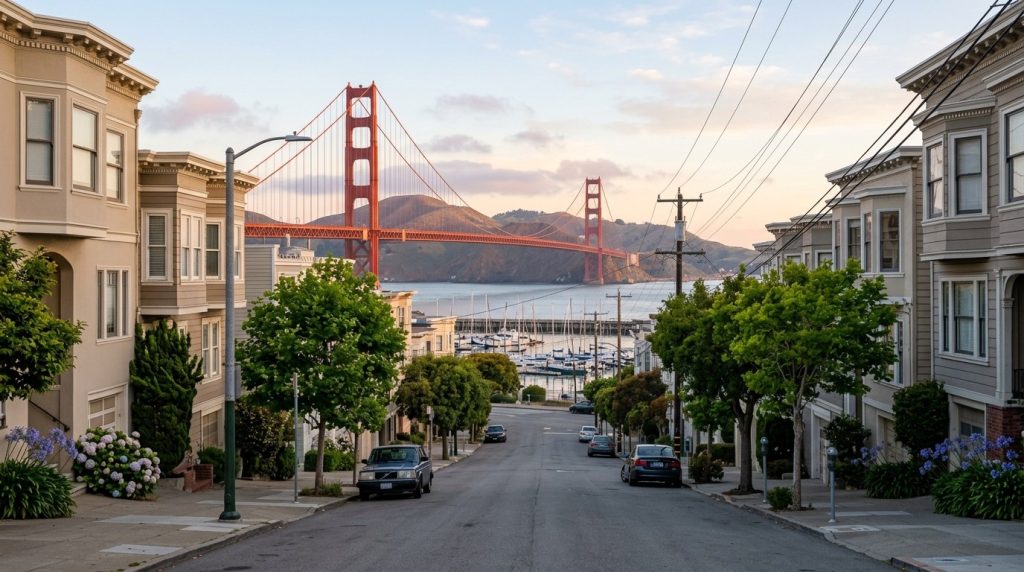
You will still see visible drug use in a few central districts. It is mostly unsettling rather than dangerous, but it shapes where you should sleep.
Car break-ins: the crime that actually hits tourists
If anything goes wrong on your trip, it will most likely involve a car. Thieves target rentals because they know luggage and laptops are inside. The good news: SFPD data analyzed by GrowSF shows fewer than 1,800 reported car burglaries in the first half of 2026, roughly 10 a day, an 88% drop from the 2017 peak.
Break-ins still cluster where visitors park and walk away for an hour: Golden Gate Bridge lookouts, Twin Peaks, Alamo Square, Lombard Street and Fisherman’s Wharf garages. Three rules prevent nearly all of it:
– Leave the car completely empty. Not hidden in the trunk at the parking spot, but empty. – Leave luggage with your hotel’s front desk, as the SFPD advises out-of-town visitors. – Skip the rental car inside the city.
Muni costs USD 2.85 per ride with Clipper or a contactless card (USD 3 in cash), and a 3-day Visitor Passport is USD 35 including cable cars. Rent a car only for day trips from San Francisco to wine country or Muir Woods.
Neighborhoods to avoid after dark
The trouble spots are compact and predictable:
– The Tenderloin. The smallest police district but with persistently high robbery and assault numbers, plus an open-air drug market around Hyde and Eddy streets. Cheap hotels here are cheap for a reason. – Mid-Market and Civic Center, especially UN Plaza and Sixth Street in SoMa.
Fine for a daytime walk to City Hall, not for a late stroll back from dinner. – Some Mission blocks near the BART stations late at night. Go for dinner and murals, then take a rideshare home.
Fisherman’s Wharf, North Beach, Chinatown, the Marina, Hayes Valley, the Presidio and Golden Gate Park all feel relaxed by day and most evenings. Our 5-day San Francisco itinerary strings these areas together so you rarely cross the rough patches on foot.
Scams that actually happen
The scams here are small-time:
– Costumed character photos at Fisherman’s Wharf. A superhero waves you in for a “free” picture, then demands a tip, sometimes as much as USD 40. – The free CD hustle. Someone hands you a CD, signs it, then insists you owe them money.
Don’t take anything pushed into your hand. – Shell games near the Wharf and along the Embarcadero. The “winners” in the crowd are part of the crew. – Fake QR codes on parking machines. SFMTA found fraudulent “phone pay” stickers on Fisherman’s Wharf meters leading to a fake payment page. Pay through the official app or machine.
A firm “no thanks” ends almost all of them. For the city’s real highlights without the tourist-trap layer, start with the best things to do in San Francisco.
Getting around: Muni, BART, cable cars and rideshare
Public transit is the smartest way to see the city and largely safe in daytime. The main risk is phone snatching on crowded Muni and BART cars just before the doors close, so pocket your phone near the doors.
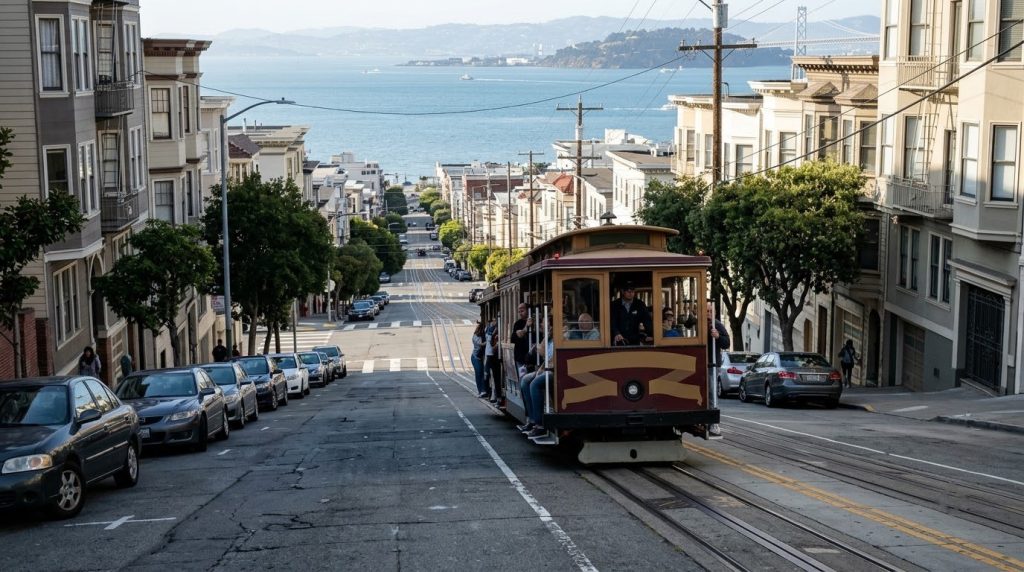
The Powell and Market cable car turnaround sits on the edge of the Tenderloin, so keep an eye on your bag in the line. At night, rideshare is the easy default. Pack a layer too: fog makes summer evenings cold, one reason the best time to visit San Francisco is usually early fall.
Solo and female travelers
San Francisco is a comfortable solo destination. The adjustments match any large US city: avoid the Tenderloin and Mid-Market at night, use rideshare after late dinners, and keep drinks in sight. Women traveling alone tend to feel at ease in North Beach, the Marina, Hayes Valley and Union Square, and the Castro anchors one of the most LGBTQ+-welcoming cities in the country.
UK and Canadian readers can check their own governments: Canada rates the United States as “take normal security precautions,” and the UK Foreign Office notes violent crime rarely affects tourists while warning against leaving passports in rental cars.
Wildfire smoke and air quality: a seasonal consideration
San Francisco itself rarely burns, but smoke from wildfires elsewhere in California and the broader West can drift into the Bay Area and affect outdoor air quality for days at a time, typically during the state’s drier fire-season months.
When smoke rolls in, local air district officials issue air quality advisories, sometimes called Spare the Air alerts, and the sky can turn hazy or take on an orange cast on the worst days.
For most visitors this is an inconvenience rather than a danger: outdoor plans such as a walk in the Presidio or a ferry ride to Alcatraz are better moved indoors or rescheduled on a smoky day rather than pushed through. Travelers with asthma or other respiratory conditions should take it more seriously, packing any usual medication and checking a local air quality reading before a heavy outdoor day.
There is no way to predict a smoke event months ahead, so build a backup museum day or two into any multi-day San Francisco itinerary rather than scheduling every outdoor activity back to back.
What to do in an emergency
– 911 for police, fire or medical emergencies, including a break-in in progress. – 415-553-0123, the SFPD non-emergency line, to report a car break-in afterward. You can also file online or call 311; your insurer will want the report number. – Buy travel insurance that covers stolen belongings, since rental-car coverage usually excludes personal items.
What to pack for San Francisco’s changeable weather
San Francisco’s microclimates mean a single day can swing from foggy and cool near the coast to warm and sunny a few blocks inland, so layers matter more here than almost anywhere else in the country. A light jacket or sweater is worth carrying even in summer, when fog can keep afternoons in the Marina or near Golden Gate Park noticeably cooler than a sunny morning in the Mission suggested.
Comfortable, closed walking shoes earn their place given the city’s hills; Nob Hill, Russian Hill and the cable car routes all involve real gradients that flat sandals make harder than they need to be. A crossbody bag or bag with a zip closure, already useful given the phone-snatching risk covered earlier, also keeps hands free on steep sidewalks.
A separate day bag or tote that folds flat is useful for day trips such as the Alcatraz ferry or a wine country outing, both breezy and cool on the water or in the hills even when the city itself feels mild, which is why the layers mentioned above matter beyond a typical sightseeing day.
Where to stay
Where you sleep matters more than anything else here. Three areas suit most travelers:
– Union Square and Nob Hill for first-timers who want transit and cable cars at the door. Stay north of Union Square toward Nob Hill, not on the blocks sloping into the Tenderloin. – North Beach and Fisherman’s Wharf for families who want evening walks to dinner along the waterfront. – The Marina and Cow Hollow for couples who want a quieter, residential feel near the Presidio.
For a deeper breakdown by budget, see where to stay in San Francisco.
Find your San Francisco hotel on the map
Live prices from Booking, Airbnb and more — move the map or change dates to compare stays across San Francisco.
Frequently Asked Questions
Is San Francisco safe to walk around at night?
Most tourist areas, including North Beach, the Marina, Fisherman’s Wharf and the blocks north of Union Square, are fine for evening walks. Avoid the Tenderloin, Mid-Market, Civic Center and Sixth Street in SoMa after dark. Past midnight, a rideshare is the simplest choice, since the hills and fog make long night walks unpleasant anyway.
Is the Tenderloin dangerous for tourists?
The Tenderloin has the city’s most concentrated crime, plus open drug use around Hyde and Eddy streets. Daytime pass-throughs rarely cause problems, but it is not a place to book a budget hotel or wander at night. Nothing on a typical sightseeing list requires walking through it, so most visitors simply route around it.
Has crime in San Francisco gone down?
Yes. SFPD reported a 25% drop in overall crime in 2025, an 18% drop in violent crime and a 43% fall in car break-ins, with 28 homicides, the fewest since 1954. Break-ins kept falling in 2026, averaging around 10 a day in the first half of the year versus roughly 85 a day in 2017.
Should I rent a car in San Francisco?
Not for the city itself. Parking is scarce, the hills are stressful, and rental cars are the main break-in target. Use Muni, cable cars and rideshare in town, then rent a car only for day trips, and never leave bags or electronics in it, even in the trunk.