Hakone Itinerary: The Loop in 1 to 2 Days (2026)
Disclosure: Some links in this guide are affiliate links. If you book or buy through them, we may earn a small commission at no extra cost to you — it helps keep our guides free.
This Hakone itinerary runs the full Hakone Loop in one 6 to 8 hour circuit, or splits it across 2 days with an onsen overnight using the 2-day Hakone Free Pass at USD 46 (JPY 7,100).
It suits first-time visitors doing one big day trip from Tokyo and slow travelers pairing the loop with a ryokan stay, but skip it if you have under 6 hours free or need step-free transfers at every stage.
| Stage | Transport | Time | What you see |
|---|---|---|---|
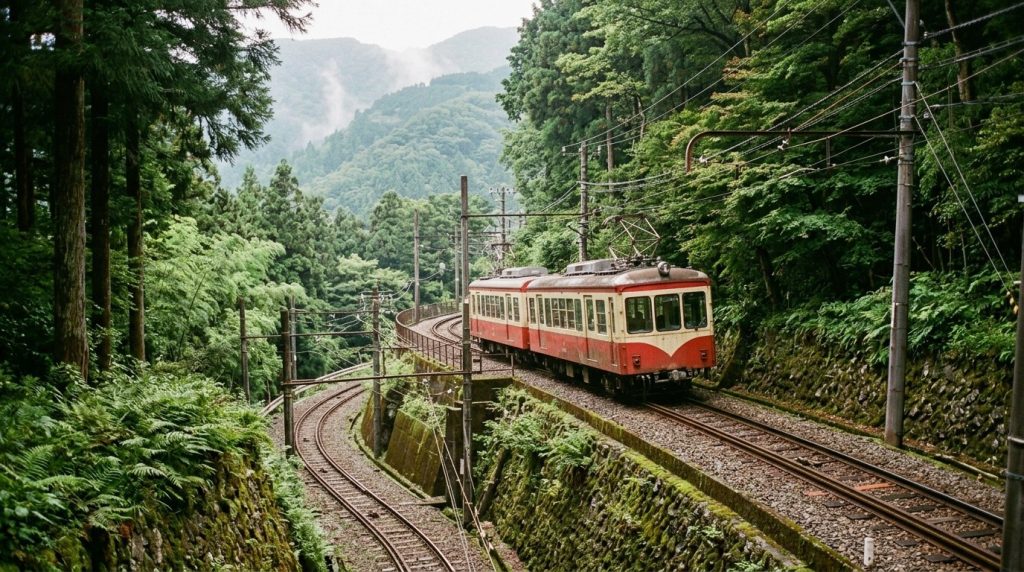
| Hakone-Yumoto to Gora | Hakone Tozan Railway | About 35 to 40 min | Switchback mountain train, hydrangeas in June |
| Gora to Sounzan | Hakone Tozan Cable Car | About 10 min | Funicular climb above Gora park |
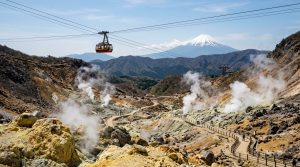
| Sounzan to Owakudani | Hakone Ropeway | About 6 min | First sulfur-valley views, Mount Fuji on clear days |
| Owakudani to Togendai | Hakone Ropeway, same line | Rest of the roughly 30 min ropeway run | Descent toward Lake Ashi |
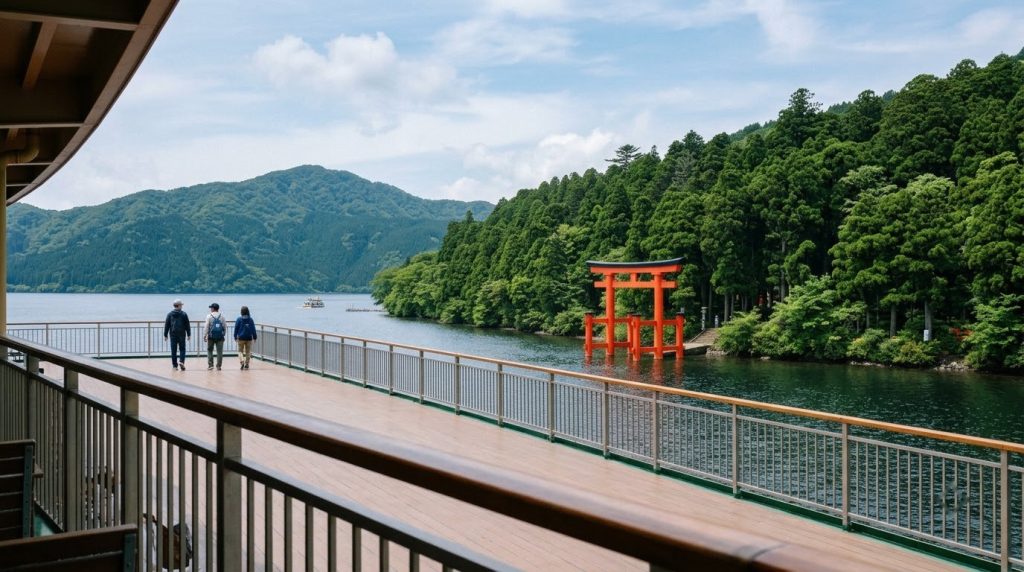
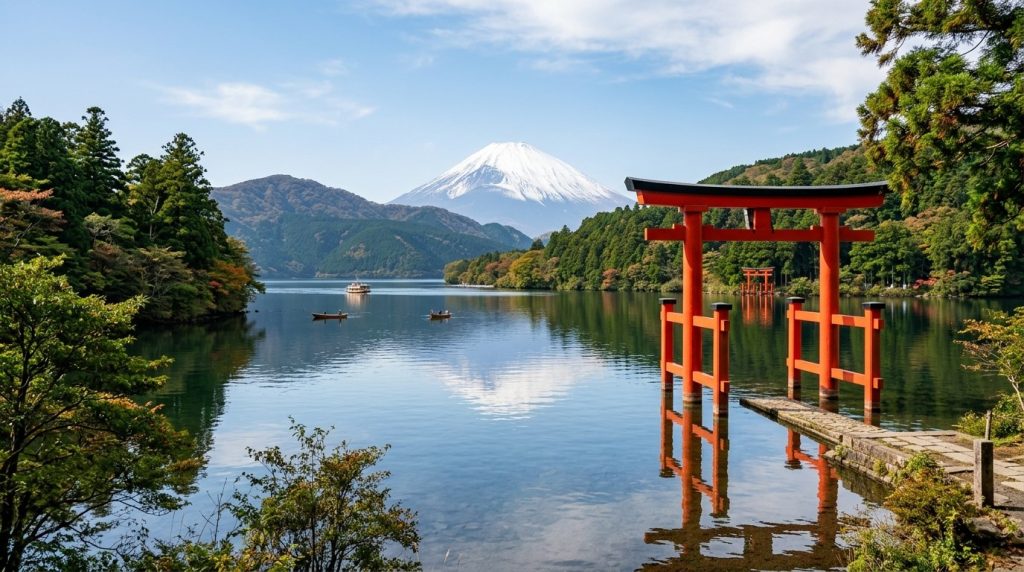
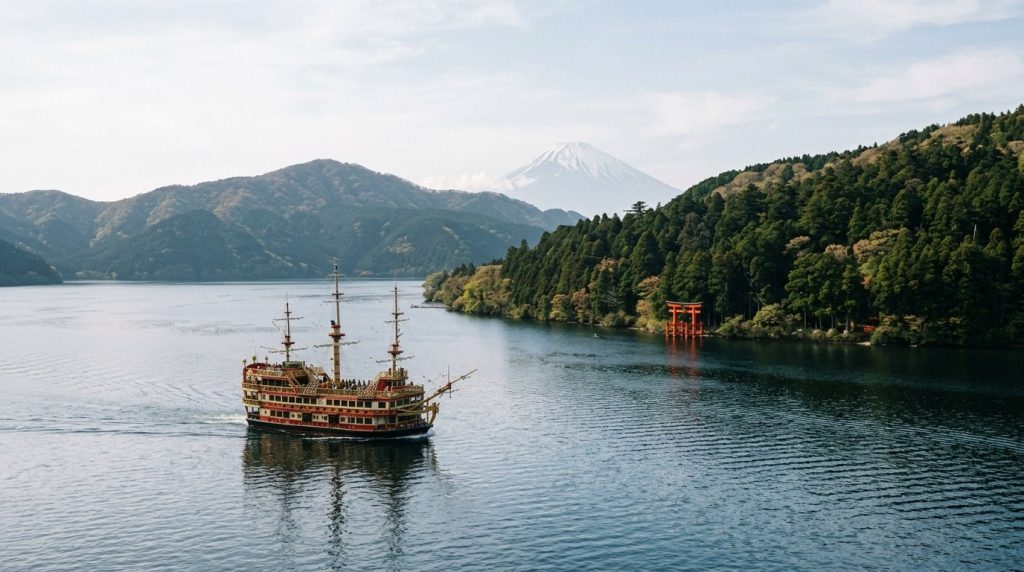
| Togendai to Hakone-machi or Motohakone | Hakone Sightseeing Cruise | About 25 to 35 min | Lake Ashi, the floating torii at Hakone Shrine |
| Hakone-machi to Odawara or Hakone-Yumoto | Hakone Tozan Bus | Varies with traffic | Lakeside road back down |
Best time to visit Hakone
Mount Fuji views from the ropeway and Lake Ashi are most reliable from December through February, when cold, dry winter air carries less haze than the rest of the year; mornings are consistently the best window for a sighting in any season, since cloud and heat haze tend to build through the afternoon.
Winter days in Hakone run cold, so dress for an outdoor loop, but the clearer skies make it the better bet if seeing Fuji matters more to you than comfort.
Late March through April brings cherry blossoms along the Hayakawa River and around Lake Ashi, with sakura typically peaking in early to mid-April, while hydrangeas take over the Hakone Tozan Railway’s trackside slopes in June, as noted above.
June is also the start of Japan’s rainy season in this region, which runs warm and humid through summer with the wettest spells concentrated in June, so pack rain gear and expect the ropeway and cruise to be more exposed to delays than in drier months.
Autumn is the other strong pick: peak fall foliage around Hakone generally falls in late October to mid-November, and the combination of color on the mountainside with a reasonable shot at a clear Fuji view makes this the most popular season for the loop, which also means the busiest trains, buses, and boats of the year.
If avoiding crowds matters as much as the view, aim for a weekday in late November or in the cold-but-clear window of January and February rather than a weekend in peak foliage season, when ryokan around Gora and Lake Ashi sell out well in advance for the two-day version of this itinerary.
Getting to Hakone from Tokyo without the Free Pass
The route above assumes the Odakyu Line from Shinjuku paired with the Hakone Free Pass, which is the simplest option for most visitors.
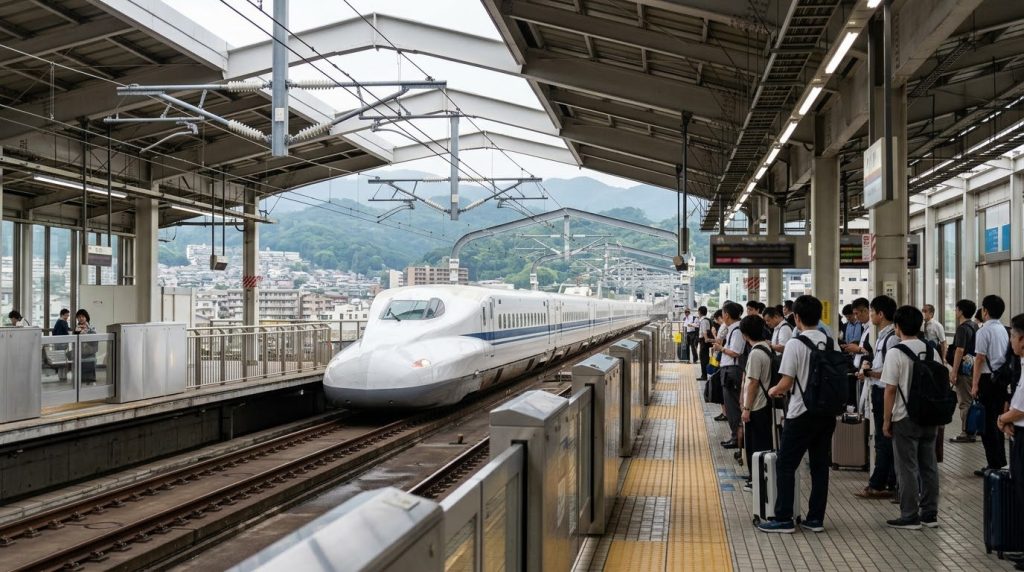
Travelers already holding a Japan Rail Pass, or arriving from elsewhere on the JR network, have another way in: ride the Tokaido Shinkansen from Tokyo or Shinagawa Station to Odawara on a Kodama or Hikari service, since the fastest Nozomi trains are not covered by the pass.
That ride takes roughly 30 to 35 minutes and costs about JPY 3,500 one-way in a non-reserved seat, which the Japan Rail Pass covers in full. From Odawara, the Hakone Tozan Railway continues on to Hakone-Yumoto in about 15 minutes, a short local connection that picks up the loop at the same starting point described above.
The Hakone Tozan Railway, cable car, ropeway, cruise, and local buses that make up the rest of the loop are not JR lines, so the Japan Rail Pass does not cover any of them.
Rather than paying for each leg separately, buy a Hakone Free Pass at Odawara Station once you arrive; Odakyu sells a version of the pass that starts from Odawara instead of from Shinjuku, aimed at exactly this kind of traveler who does not need the Odakyu Line portion covered.
This approach suits anyone combining Hakone with a wider Japan Rail Pass itinerary toward Kyoto or Osaka, where doubling back to Shinjuku just to start the Odakyu Line route adds a detour with no real benefit over a Shinkansen ride that the pass already includes.
On weekends and national holidays, non-reserved Shinkansen cars toward Odawara can fill up at peak travel times, so reserving a seat in advance, still free with the pass on any train besides the Nozomi and Mizuho services, is worth doing if your trip falls on a busy date.
The one-day loop, in order
The 2-day Hakone Free Pass covers every leg on this table plus the Odakyu Line round trip from Shinjuku, so buy it before you start rather than paying per ride. Board the Odakyu Line at Shinjuku, switch to the Hakone Tozan Railway at Odawara or Hakone-Yumoto, and ride up to Gora.
From Gora, the Tozan Cable Car climbs to Sounzan, where the Hakone Ropeway takes over for the run through Owakudani to Togendai on Lake Ashi. The Hakone Sightseeing Cruise, the pirate ship, then crosses to Hakone-machi or Motohakone, and a bus returns you to Odawara or Hakone-Yumoto.
If you haven’t decided whether the day is worth it at all, read the separate verdict on whether Hakone is worth visiting first, since this piece only covers the route once you’ve said yes.
Travelers who want Mount Fuji views without the full transport chain should compare this against a dedicated Mount Fuji day trip from Tokyo, which trades the loop for one mountain view.
The Odakyu Romancecar is optional and separate from the Free Pass math. It cuts the Shinjuku to Hakone-Yumoto leg to a reserved seat but adds a limited express surcharge of USD 7 (JPY 1,150) for a digital ticket or USD 8 (JPY 1,200) for paper, on top of the base fare the pass already covers.
Skip it if you’re on a budget; the regular Odakyu Line service on the same tracks costs nothing extra once you’re holding the pass.
Which direction to travel, and why it matters
Going Hakone-Yumoto to Gora to Sounzan to Owakudani to the lake, the sequence in the table above, is what most day-trippers and tour buses already do, so you reach Owakudani in the late-morning to early-afternoon window when it’s busiest.
Reversing that order, starting at Lake Ashi with an early Sightseeing Cruise and finishing with the ropeway down through Owakudani, puts you at the sulfur valley before the bulk of the bus traffic arrives, provided you leave Tokyo early enough to be at Togendai when the boats start running. Either direction carries the same risk.
The last connections run earlier than the loop’s overall 6 to 8 hour length suggests. The Hakone Ropeway’s last car leaves around 4:45pm (about 4:15pm in winter), and the last Sightseeing Cruise sailing from Togendai runs to roughly 5:00pm in the main season, earlier from December through mid-March.
If you’re still doing the ropeway leg after 4pm, you’re at real risk of missing the last boat and having to bus around the lake instead. Build your day backward from whichever of those two cutoffs comes first, not forward from your start time.
The two-day version, with an onsen overnight
Splitting the loop over 2 days removes the last-connection pressure entirely, because you stop at the halfway point instead of racing to finish it.
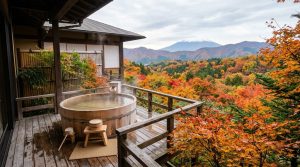
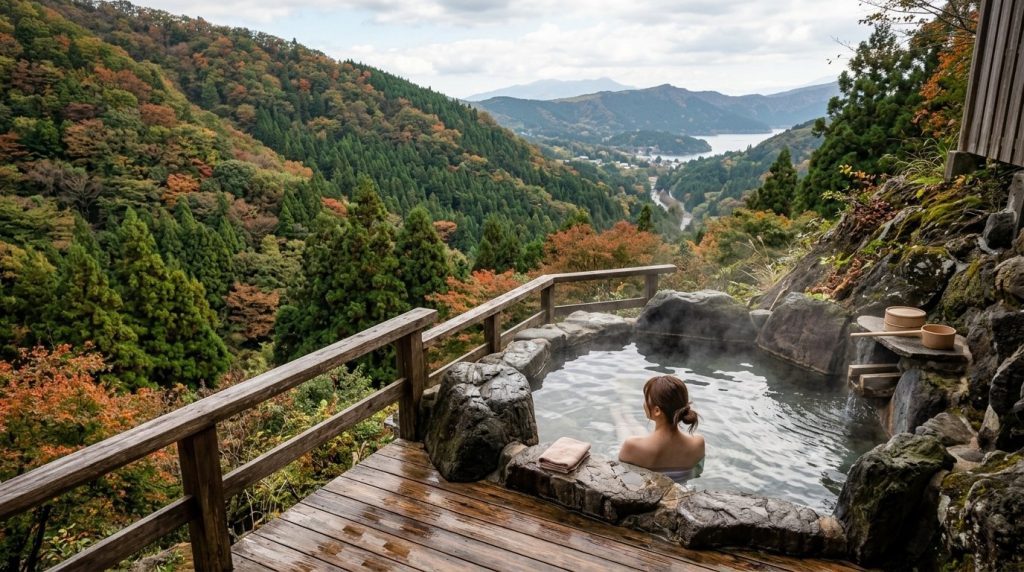
Do the Odakyu Line, Tozan Railway, and cable car to Gora on day one, check into a ryokan around Gora or Lake Ashi, and use the afternoon for an onsen soak instead of pushing on to the ropeway.
Day two starts fresh with the ropeway through Owakudani, the cruise across Lake Ashi, a proper visit to Hakone Shrine at Motohakone instead of a rushed photo stop, and the bus back to Odawara or Hakone-Yumoto in the afternoon.
The 3-day Hakone Free Pass, at USD 49 (JPY 7,500) versus USD 46 (JPY 7,100) for the 2-day version, is the better buy here since it covers the same unlimited local transport across the extra night without forcing you to recheck timetables.
If this loop is one stop inside a longer Tokyo trip, it slots in as a single overnight detour within a 4-day Tokyo itinerary rather than needing its own dedicated trip.
The Free Pass math
The pass earns back its cost the moment you ride the ropeway and the pirate ship in the same day, since those two alone typically run close to what the Odakyu round trip costs on its own.
The 2-day pass at USD 46 (JPY 7,100) bundles the Odakyu Line round trip from Shinjuku, worth about USD 17 (JPY 2,540) bought as two separate one-way non-reserved fares at USD 8 (JPY 1,270) each, together with unlimited rides on the Tozan Railway, the Tozan Cable Car, the Hakone Ropeway, the Sightseeing Cruise, and designated Tozan and Odakyu buses inside the loop.
Buying each of those legs individually, round trip, comes out close to the pass price on its own before you’ve added a single ropeway or boat ride, so the pass wins for anyone doing the full loop rather than a single spot. It does not cover the Romancecar surcharge; that stays a separate add-on regardless of which pass you hold.
What to cut or skip if the weather turns
Owakudani is the piece most likely to force a change of plan, because the ropeway closes for high wind or elevated volcanic gas readings with little advance notice, and the nature trail around the vents closes independently of the ropeway itself.
When the ropeway is down between Sounzan and Owakudani or beyond, a replacement bus runs the same route, so the loop still completes, just slower and without the aerial view.
On a no-Fuji day, when haze or cloud rules out the mountain view from the ropeway or the lake, cut the time you’d planned to spend waiting at Owakudani for a clearing and use it at Hakone Shrine or the Hakone Open-Air Museum instead, both of which work regardless of visibility.
If the Sightseeing Cruise is suspended for wind, the bus around the lake from Togendai to Hakone-machi covers the same ground in less scenic form, so the loop is never fully blocked by one closure alone.
What to eat along the Hakone Loop
Hakone-Yumoto, Moto-Hakone, and Gora have the widest choice of places to eat along the route, so plan a meal stop around one of those three rather than the smaller stations in between.
The best-known snack on the loop is the kuro-tamago, or black egg, sold at Owakudani: a regular egg boiled in the valley’s sulfur-rich hot spring water until the shell turns black, sold in sets at the stalls near the ropeway station.
Local legend claims eating one adds several years to your life, which is a fun photo-stop story rather than anything to plan a meal around, since it’s a snack, not lunch. For an actual sit-down meal, soba is the dish to look for.
The Hakone area has several dedicated soba restaurants along the old Hakone road and in the Yumoto and Moto-Hakone areas, serving both hot and cold preparations, with cold zaru soba a popular order in warmer months.
Gyudon, a bowl of simmered beef and onion over rice, is a reliable, quick option in the station areas for travelers watching the clock between loop connections, since it’s fast to order and eat compared with a multi-course meal.
If you’re doing the two-day version of this itinerary with a ryokan stay, dinner is often included as part of a kaiseki multi-course meal at the inn itself, in which case plan your eating-out budget around lunches on the loop rather than dinner.
Whichever stop you pick, build in extra time around a meal near Owakudani or Togendai, since those are also the two points on the loop most likely to see queues form around midday in high season.
Practical travel tips for the loop
Suica, Pasmo, and other IC cards work on the Odakyu Line segment between Shinjuku and Odawara or Hakone-Yumoto, but the Hakone Free Pass, not an IC card, is what covers the Tozan Railway, cable car, ropeway, cruise, and local buses that make up the loop itself, so don’t expect to just tap an IC card through every gate on this route.
Carry some cash in addition to a card: smaller food stalls at Owakudani and some of the older shops along the lakeside in Moto-Hakone and Hakone-machi do not reliably take cards.
Coin lockers are available at Hakone-Yumoto Station, and a baggage forwarding counter there will send a suitcase ahead to your accommodation the same day if you check it in by around midday, which is worth using if you’d rather do the loop without wheeling a suitcase through the cable car and ropeway queues.
If you’re on the one-day version and returning the same night, the lockers alone are enough; save the forwarding service for the two-day plan when your bag needs to meet you at a ryokan rather than back at Hakone-Yumoto.
Mobile signal is generally reliable around the main stops on the loop, but it can drop briefly on sections of the ropeway and in the mountains around Owakudani, so download or screenshot your Free Pass details and the day’s timetable before you leave Tokyo rather than counting on a live connection throughout the trip.
Comfortable, closed-toe shoes matter more than they do for a typical city day, since the cable car, ropeway, and shrine paths at Moto-Hakone all involve uneven ground, steps, or gravel rather than flat pavement.
Where to stay on this route
Staying overnight near Gora or Lake Ashi rather than commuting back to Tokyo is what makes the 2-day version work, since it removes the last-train and last-boat deadline entirely. For a full shortlist by neighborhood, including which side of the loop each hotel sits closest to, see our best hotels in Hakone guide.
Find your Hakone hotel on the map
Live prices from Booking, Airbnb and more — move the map or change dates to compare stays across Hakone.