Best Time to Visit Prague: Month-by-Month Guide 2026
Disclosure: Some links in this guide are affiliate links. If you book or buy through them, we may earn a small commission at no extra cost to you — it helps keep our guides free.
- May and September are the sweet spots, with average highs of 21°C (70°F) and 20°C (68°F), long daylight, and thinner crowds than July or August.
- Summer is peak season: July and August highs reach 26°C (79°F), but this is also when 8.3 million annual visitors concentrate and hotel rates hit their ceiling.
- Christmas markets on Old Town Square run 28 November 2026 to 6 January 2027, open daily 10:00 to 22:00 (Prague City Tourism, 2026).
- January and February are cheapest, with city-centre rooms often 30-40% below the €170 summer average, but expect highs of just 3-5°C (37-41°F).
- June is the wettest month at around 87 mm of rain, while February is the driest at roughly 42 mm (climate normals, climatestotravel).
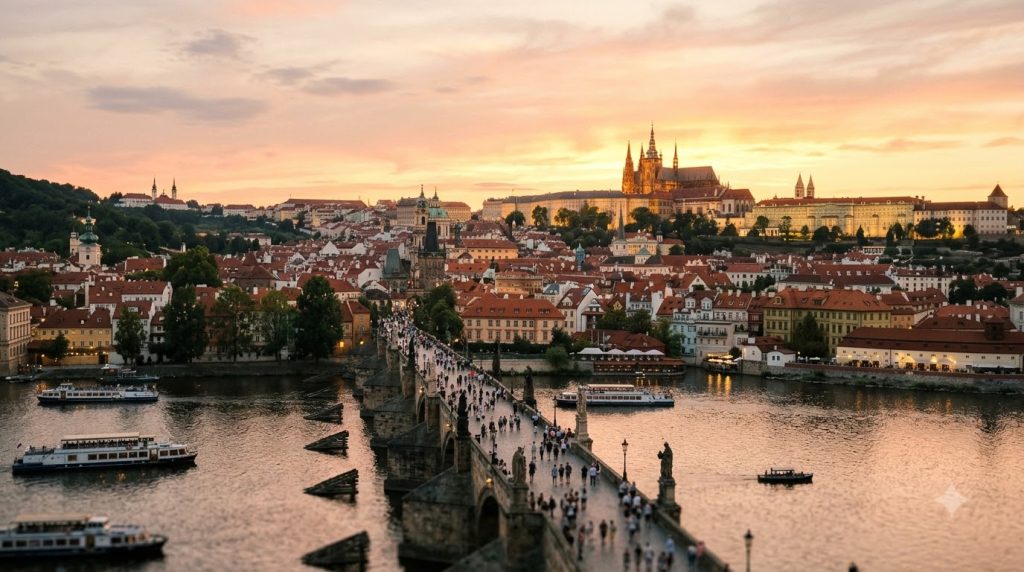
The best time to visit Prague is May, September, and early June, when daytime highs sit around 21°C (70°F), the crowds have not yet peaked, and hotel rates fall below the summer ceiling.
Prague drew 8.3 million visitors in 2025, a 3% rise on the year before (Prague City Tourism / Czech Statistical Office, 2026), so timing your trip well is now the difference between a relaxed weekend and a shoulder-to-shoulder scrum on Charles Bridge.
This guide walks through Prague season by season, with a month-by-month weather table, the truth about summer crowds, and the exact dates for the 2026 Christmas markets. The swing between a quiet April morning and an August afternoon on the Old Town Square is hard to overstate.
Here is how to pick the window that matches your budget, your tolerance for cold, and the Prague you actually want to see.
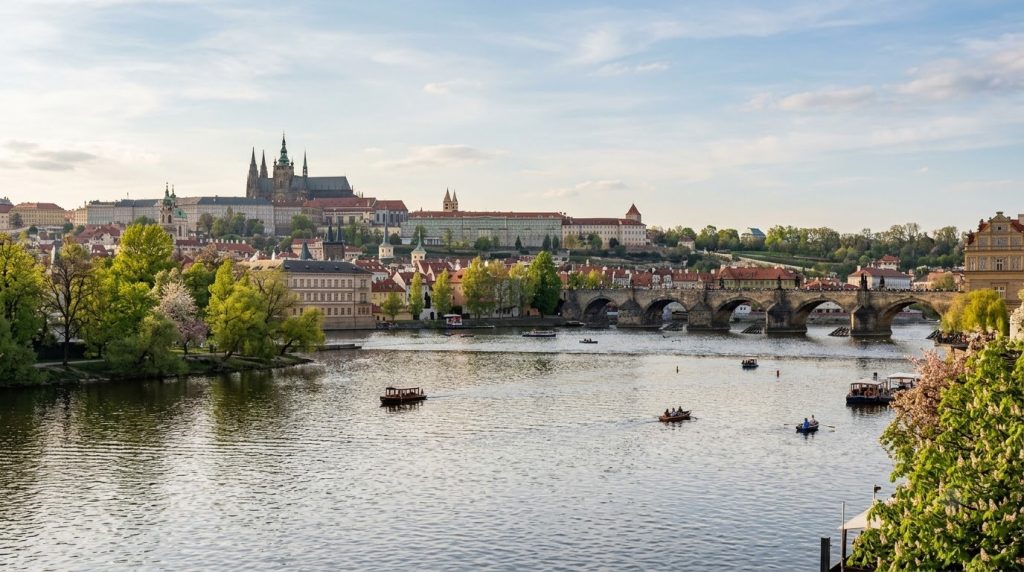
Our favourite by a clear margin was the third week of May: we crossed Charles Bridge at 7am with maybe a dozen other people, then sat outside a Malá Strana café in short sleeves by lunch. The same bridge in August took twenty minutes to cross through the crowd.
What Is the Overall Best Time to Visit Prague?
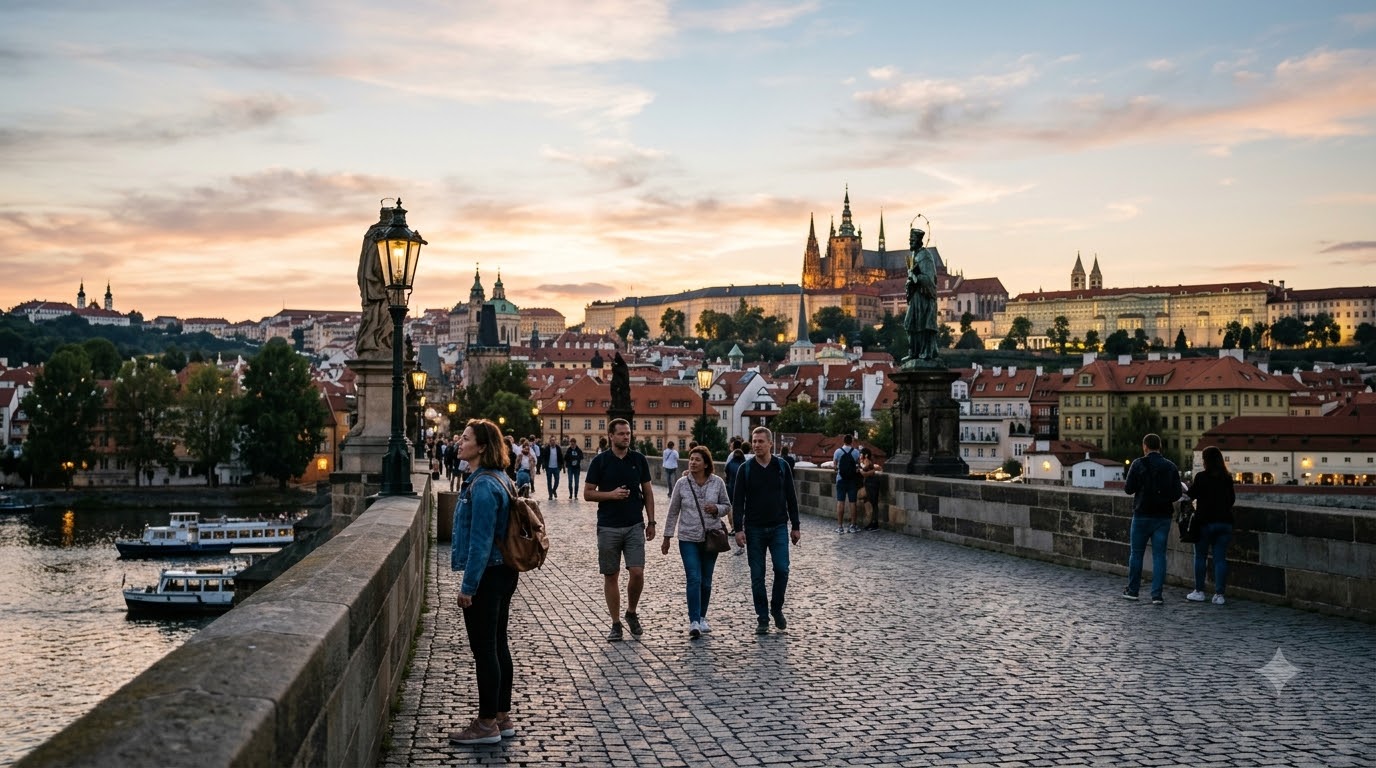
Mid-May through mid-June and all of September are the best overall windows. You get mild, walkable weather, gardens and riverbanks in full leaf, patio dining, and enough daylight to fit in day trips, without the dense summer crowds or the winter chill. These are the months we recommend to first-timers who want the postcard version of the city with room to breathe.
Here is who each broad window suits best:
- May to mid-June: best for photographers and walkers, mild highs of 21-24°C (70-75°F), blooming gardens, long evenings.
- September to mid-October: best for value plus good weather, warm days, golden light, grape-harvest and beer festivals.
- Late November to December: best for atmosphere, Christmas markets, mulled wine, first snow, but short daylight.
- January to February: best for budget travellers, lowest prices, quiet sights, but genuine cold.
- July to August: best only if you need summer school-holiday dates and accept peak crowds and prices.
Prague sits inland with a moderately continental climate, so it never gets Mediterranean-hot and rarely gets brutally cold. That makes the shoulder seasons unusually generous compared with, say, a coastal city, and it is why we keep steering people away from the July-August default. Once you have your dates, our full Prague travel guide covers where those seasons change what you should pack and book.
Prague Weather by Month: Quick Reference Table
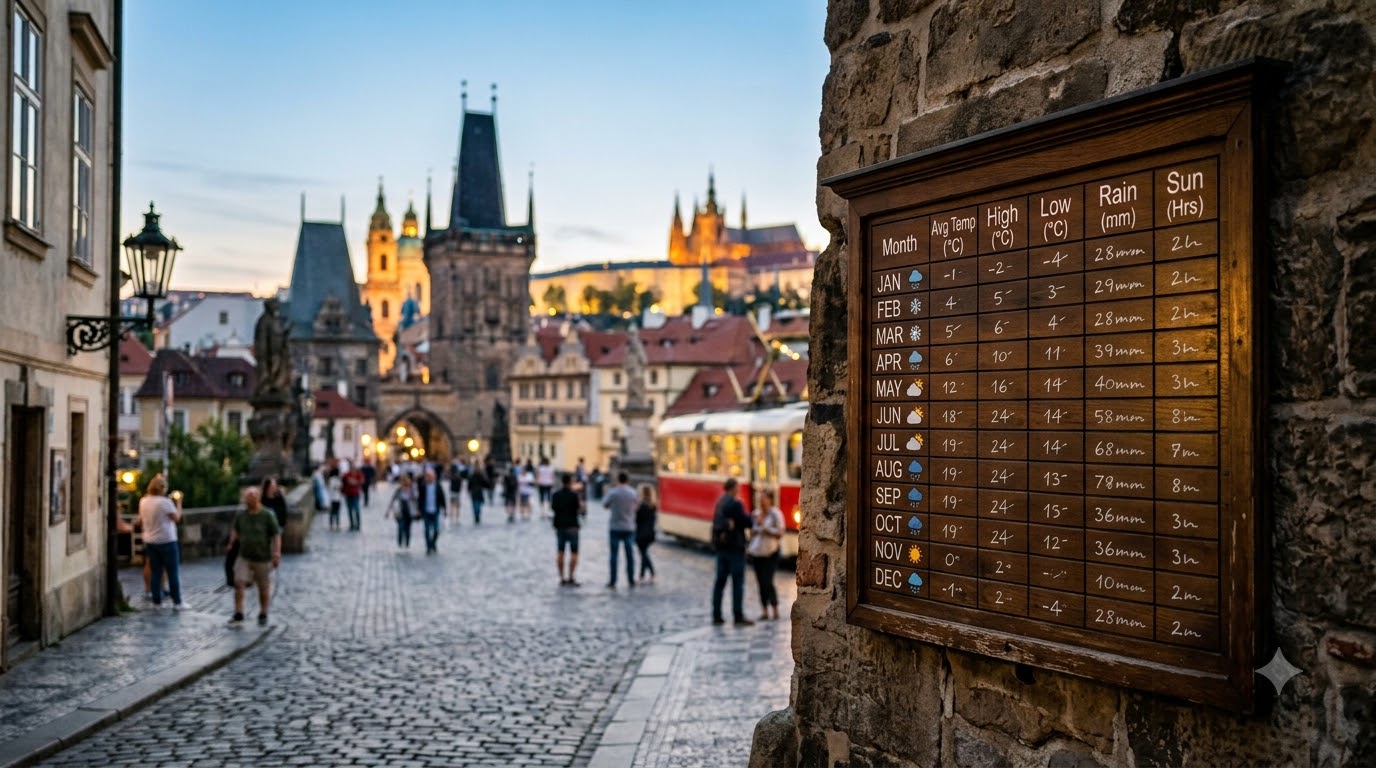
Temperatures climb from near-freezing in January to a comfortable mid-20s°C in July and August, then slide back through a mild autumn. Rain is spread across the year but concentrates in early summer, so the shoulder months of April, September, and October are often drier and clearer than June.
| Month | Avg High | Avg Low | Rainfall | Crowd Level |
|---|---|---|---|---|
| January | 3°C / 37°F | -2°C / 28°F | ~44 mm | Low |
| February | 5°C / 41°F | -1°C / 30°F | ~42 mm | Low |
| March | 10°C / 50°F | 2°C / 36°F | ~46 mm | Low-Moderate |
| April | 16°C / 61°F | 5°C / 41°F | ~50 mm | Moderate |
| May | 21°C / 70°F | 10°C / 50°F | ~77 mm | Moderate-High |
| June | 24°C / 75°F | 13°C / 55°F | ~87 mm | High |
| July | 26°C / 79°F | 15°C / 59°F | ~82 mm | Very High |
| August | 26°C / 79°F | 14°C / 57°F | ~77 mm | Very High |
| September | 20°C / 68°F | 11°C / 52°F | ~50 mm | High |
| October | 14°C / 57°F | 6°C / 43°F | ~47 mm | Moderate |
| November | 7°C / 45°F | 2°C / 36°F | ~45 mm | Low-Moderate |
| December | 3°C / 37°F | -1°C / 30°F | ~45 mm | High (markets) |
Figures are climate normals; Prague’s annual rainfall totals around 709 mm, with June the wettest month and February the driest (climatestotravel). Note the December spike in crowds is entirely market-driven, not weather-driven.
Is Spring the Best Season in Prague?
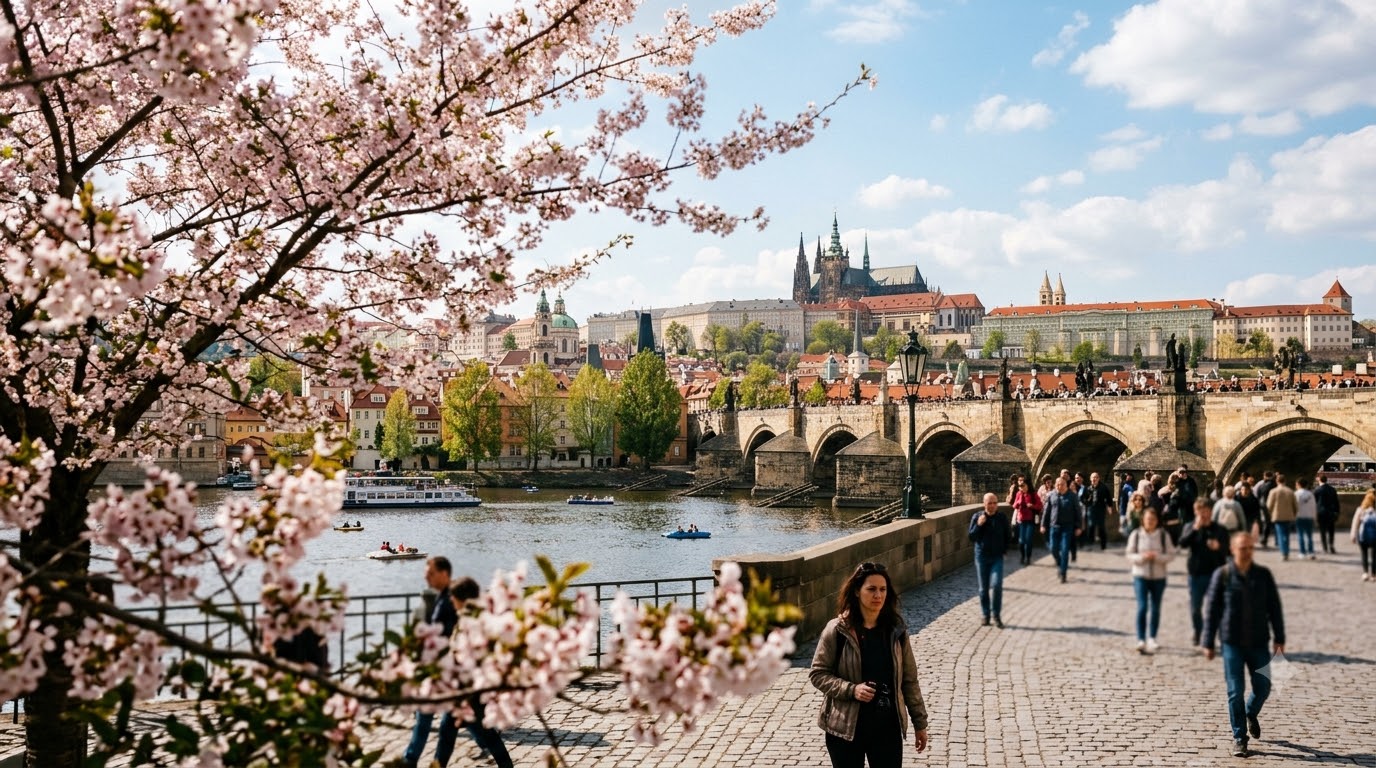
Spring, especially May, is the best season for most travellers. The city shakes off winter fast: by late April the gardens below Prague Castle reopen, the Vltava riverbanks fill with locals, and highs climb from a chilly 10°C (50°F) in March to a mild 21°C (70°F) in May. Rain picks up toward June, but you trade a few showers for full greenery and long evenings.
What spring gives you, concretely:
- March: quiet and cheap, highs near 10°C (50°F), but bare trees and unpredictable weather; good for museum-heavy trips.
- April: shoulder pricing, highs around 16°C (61°F), gardens reopening, Easter markets on Old Town Square with painted eggs and trdelník stalls.
- May: the peak of spring, highs of 21°C (70°F), patio season begins, and daylight stretches past 8pm.
- Petřín Hill orchards bloom in April and early May, one of the best free views in the city.
Hiking up Petřín and along the castle gardens before 10am in May usually means no queues. If you want the best things to do in Prague without the summer bottleneck, spring is where the math works.
Find your Prague hotel on the map
Live prices from Booking & Airbnb — tap a pin to compare stays around the Old Town and beyond.
How Bad Are Summer Crowds in Prague?
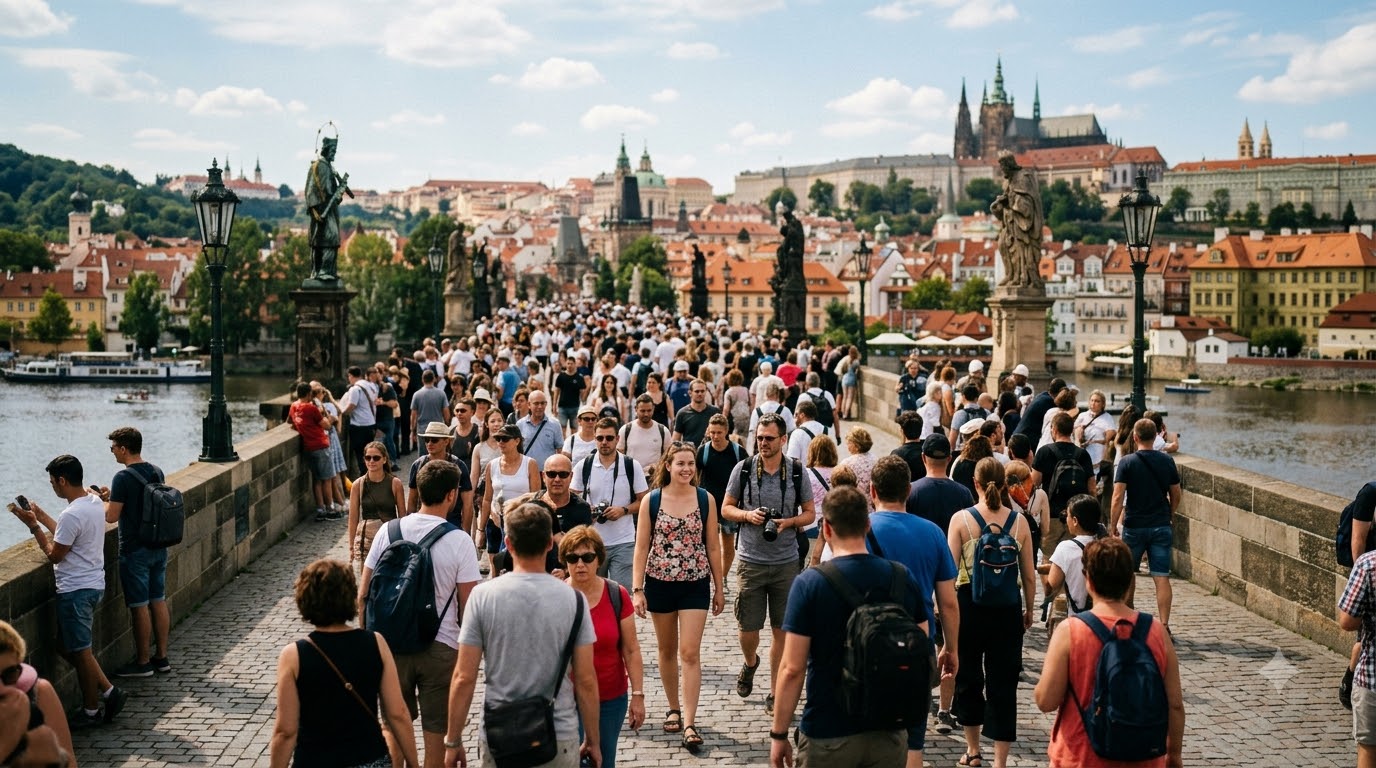
Summer crowds are genuinely heavy, and July and August are the two months we most often steer people away from. This is when the bulk of Prague’s 8.3 million annual visitors arrive at once, when Charles Bridge stays packed from mid-morning to dusk, and when city-centre room rates push toward and past the €170 average (Prague City Tourism, 2026). Highs of 26°C (79°F) are pleasant, but the density is the problem. Packed bridges and trams are where pickpockets work, and our look at Prague safety explains why the State Department still puts Czechia at Level 1 of 4.
If summer is your only option, plan around the crush:
- Start at 7-8am: Charles Bridge, the Astronomical Clock, and Old Town Square are near-empty for the first two hours after sunrise.
- Book the Astronomical Clock tower and Prague Castle with timed tickets in advance; walk-up queues in July run 45-60 minutes.
- Use the evenings: crowds thin after 7pm and the light on the river is at its best.
- Base yourself outside the tourist core in Vinohrady or Žižkov for cheaper rooms and calmer mornings; see our where to stay in Prague breakdown by neighbourhood.
- Escape the heat and density with a day trip to Kutná Hora or Český Krumlov, both under three hours return.
Summer is not a bad time to see Prague. It is simply the most expensive and the most crowded, and unless school-holiday dates force your hand, September delivers nearly the same weather with a fraction of the pressure.
Why Is Autumn a Hidden Sweet Spot?
Autumn, and September in particular, is our favourite value window. Highs hold at a warm 20°C (68°F) in September before easing to 14°C (57°F) in October, rainfall drops back to around 50 mm after the wet early summer, and the summer crowd disperses once European schools resume. Add golden foliage along the river and in Stromovka park, and you get the summer look at shoulder prices.
The autumn rundown:
- September: the standout month, highs of 20°C (68°F), dry-ish, patios still open, crowds down sharply from August.
- Early October: crisp and photogenic, highs of 14-16°C (57-61°F), foliage peaks around mid-month, layers required.
- Late October to November: quiet and cheap, highs sliding to 7°C (45°F), shorter days, but bargain rooms and empty sights.
- Signal of the season: outdoor beer gardens like Letná and Riegrovy Sady stay open on warm September evenings with skyline views.
Hotel rates in late September tend to run well below August prices for the same room. If you can only travel outside summer for the good weather, this is the window to target, and it pairs neatly with our 3-day Prague itinerary for a long weekend.
When Do the Prague Christmas Markets Open in 2026?
The main Prague Christmas markets on Old Town Square and Wenceslas Square run from 28 November 2026 to 6 January 2027, open daily from 10:00 to 22:00, with some food stalls serving later (Prague City Tourism, 2026). This is the one time the crowds are worth joining rather than avoiding, and it turns the coldest, darkest month into arguably the most atmospheric.
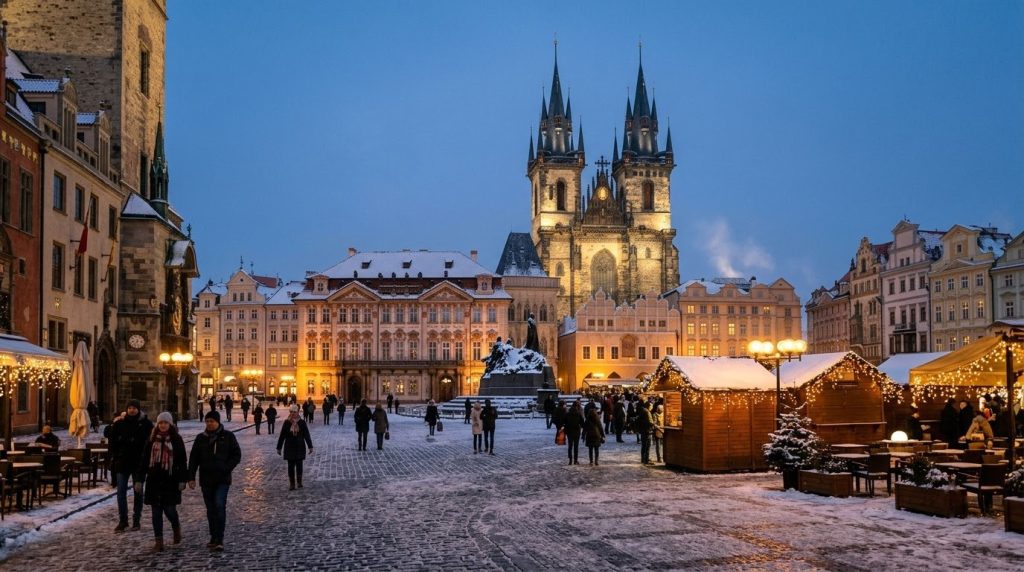
Key winter and market facts:
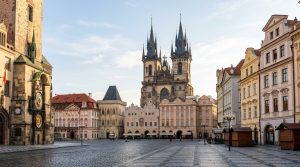
- Old Town Square market: the largest, framed by Týn Church, with a giant tree, nativity, and craft stalls; 28 Nov 2026 to 6 Jan 2027.
- Prague Castle and Republic Square run their own markets on overlapping late-November to early-January dates.
- What to eat and drink: svařák (mulled wine), medovina (honey wine), grilled klobása sausage, and trdelník; expect roughly 80-120 CZK (about €3-5) per item.
- Weather to pack for: December highs of just 3°C (37°F) and lows near freezing, with a decent chance of snow; bring a proper coat, gloves, and grippy shoes for icy cobbles.
- January and February keep the low prices but lose the markets after 6 January, making them the quietest, cheapest weeks of the year.
The markets get busiest on the weekend evenings of the two weeks before Christmas, so a weekday afternoon visit early in December gives you the same magic with far more room to move.
When Is the Cheapest Time to Visit Prague?
The cheapest time to visit Prague is mid-January through February and again in the first half of November, once the markets have closed or before they open. City-centre rooms that command around €170 a night in peak summer routinely fall 30-40% in deep winter (Prague City Tourism reported a citywide average near €123 per room in 2025). The trade-off is cold and short daylight, not a worse city. Budget-minded travelers should also see how Prague stacks up against Budapest, since crowd-sourced data now puts Budapest restaurant prices above Prague’s.
To squeeze the most value out of your dates:
- Target the last two weeks of January or all of February for the lowest room rates of the year.
- Fly midweek: Tuesday and Wednesday departures from the UK and Europe are typically cheaper than Friday or Sunday.
- Avoid the Christmas-market fortnight (mid-to-late December) if price is your priority; it is winter’s one expensive stretch.
- Book flexible, refundable rooms early and rebook if a better rate appears, especially for the volatile December window.
Even in the cheapest weeks, Prague’s indoor draws, its cafés, beer halls, galleries, and the warmth of a mulled-wine stall, hold up well against the cold, which is why winter budget trips here work better than in most European capitals.
Month-by-Month: Picking Your Window
Each traveller priority points to a different month, so here is the shorthand we use when friends ask us to just tell them when to go.
| Your Priority | Best Months | Why |
|---|---|---|
| Best all-round weather | May, Sep | Highs of 20-21°C (68-70°F), moderate crowds |
| Lowest prices | Late Jan, Feb | Rooms 30-40% below summer peak |
| Fewest crowds | Feb, early Nov | Quiet sights, cheap rooms, cold weather |
| Christmas markets | Late Nov to Dec | Old Town Square markets, mulled wine, snow |
| Warmest days | Jul, Aug | Highs of 26°C (79°F), but peak crowds |
| Autumn value | Sep, early Oct | Warm days, foliage, post-summer prices |
For a first Prague trip focused on weather and atmosphere, we would book the third week of May or the second week of September without hesitation. Budget travellers who do not mind the cold should grab February. And if the markets are the whole point, aim for a weekday in early-to-mid December before the pre-Christmas surge.
Frequently Asked Questions
What is the best month to visit Prague?
May and September are the best months. Both deliver mild highs around 20-21°C (68-70°F), long daylight, and noticeably thinner crowds than July or August. May brings blooming gardens and patio season, while September pairs warm days with post-summer hotel prices and golden foliage, making it the strongest value month of the year.
What is the cheapest time to visit Prague?
Mid-January through February is the cheapest, with city-centre rooms often 30-40% below the roughly €170 summer average (Prague City Tourism, 2025). Early November, before the Christmas markets open, is also inexpensive. The trade-off is cold weather, with highs of just 3-5°C (37-41°F) and short daylight hours.
When are the Prague Christmas markets in 2026?
The main markets on Old Town Square and Wenceslas Square run from 28 November 2026 to 6 January 2027, open daily 10:00 to 22:00 (Prague City Tourism, 2026). The Prague Castle market runs on overlapping dates. Weekday afternoons early in December are the least crowded time to visit them.
Is summer a good time to visit Prague?
Summer offers the warmest weather, with July and August highs of 26°C (79°F), but it is the most crowded and expensive season. Charles Bridge and Old Town Square stay packed from mid-morning to evening. If you visit in summer, start sightseeing by 7-8am and book major attractions with timed tickets in advance.
How many days do you need in Prague?
Three full days is enough to see the historic core, Prague Castle, Charles Bridge, the Old Town, and Malá Strana, plus one day trip. Add a fourth or fifth day if you want a slower pace or to reach Kutná Hora or Český Krumlov. Our 3-day Prague itinerary maps out an efficient route. To fill that extra day, our list of the best day trips from Prague ranks Kutna Hora first, about 51 minutes away by direct train for roughly USD 8.
Final Word: Choosing Your Prague Dates
For the best balance of weather, atmosphere, and value, aim for May, early June, or September, when Prague gives you mild days, long light, and enough space to enjoy the best things to do in Prague without the summer crush. Chasing the lowest prices instead? Late January and February cut room rates sharply if you can handle the cold.
And if the glow of a mulled-wine stall on a snowy square is the trip you are picturing, the late-November-to-December markets are unbeatable.
Whichever window you land on, pick your neighbourhood with our where to stay in Prague guide, then build the rest of the trip from our complete Prague travel guide.