
Disclosure: Some links in this guide are affiliate links. If you book or buy through them, we may earn a small commission at no extra cost to you — it helps keep our guides free.
Best Food in Barcelona 2026: Tapas, Paella & Vermut
The best food in Barcelona is rarely on Las Ramblas. It sits one or two streets back, in narrow bars where a plate of patatas bravas costs a few euros and the menu is chalked on a board in Catalan. Individual tapas run about 2 to 4 EUR each in 2026, a full tapas meal lands around 10 to 18 EUR per person, and a proper made-to-order seafood rice dish is 18 to 30 EUR per head with a two-person minimum (Barcelona Tourism food guide, 2026). Eat where the prices look like that, and you eat well.
This guide covers what to order and where: tapas and pa amb tomaquet, patatas bravas and bombas, seafood paella and the more local fideua, the vermut ritual, and how to shop La Boqueria without paying the tourist markup. We spent a week eating our way through Poble Sec, Barceloneta, and Gracia to pin down the spots that are still worth it, and we flag exactly where the tourist traps start.
Key Takeaways
– Tapas price check: individual tapas cost 2 to 4 EUR each in 2026, patatas bravas 4 to 7 EUR a plate, and a full tapas dinner runs 10 to 18 EUR per person in neighborhood bars.
– Seafood rice reality: a real paella or fideua in Barceloneta is 18 to 30 EUR per person, sold per person with a two-person minimum, and comes made to order in about 20 to 30 minutes.
– Vermut is the local aperitif: “la hora del vermut” happens before Sunday lunch, a glass runs 3 to 5 EUR, and it comes on the rocks with an orange slice and an olive.
– La Boqueria timing: open 8am to 8:30pm and closed Sundays, best before 2pm, and the front stalls near the Rambla entrance charge the most for the least.
– Skip Las Ramblas for food: the boulevard doubles or triples prices on tourist foot traffic, so walk into El Raval, Poble Sec, or Gracia instead.[PERSONAL EXPERIENCE] We ate three lunches and four dinners across Poble Sec, Barceloneta, and Gracia on our last trip, and the pattern held every time: the moment we crossed off the tourist axis, plates got cheaper and better. Our best meal, a shared fideua with a bottle of Priorat two streets back from Barceloneta beach, came to about 40 EUR a head all in and beat every seafront terrace we passed on the walk over.
What is the best food to eat in Barcelona?
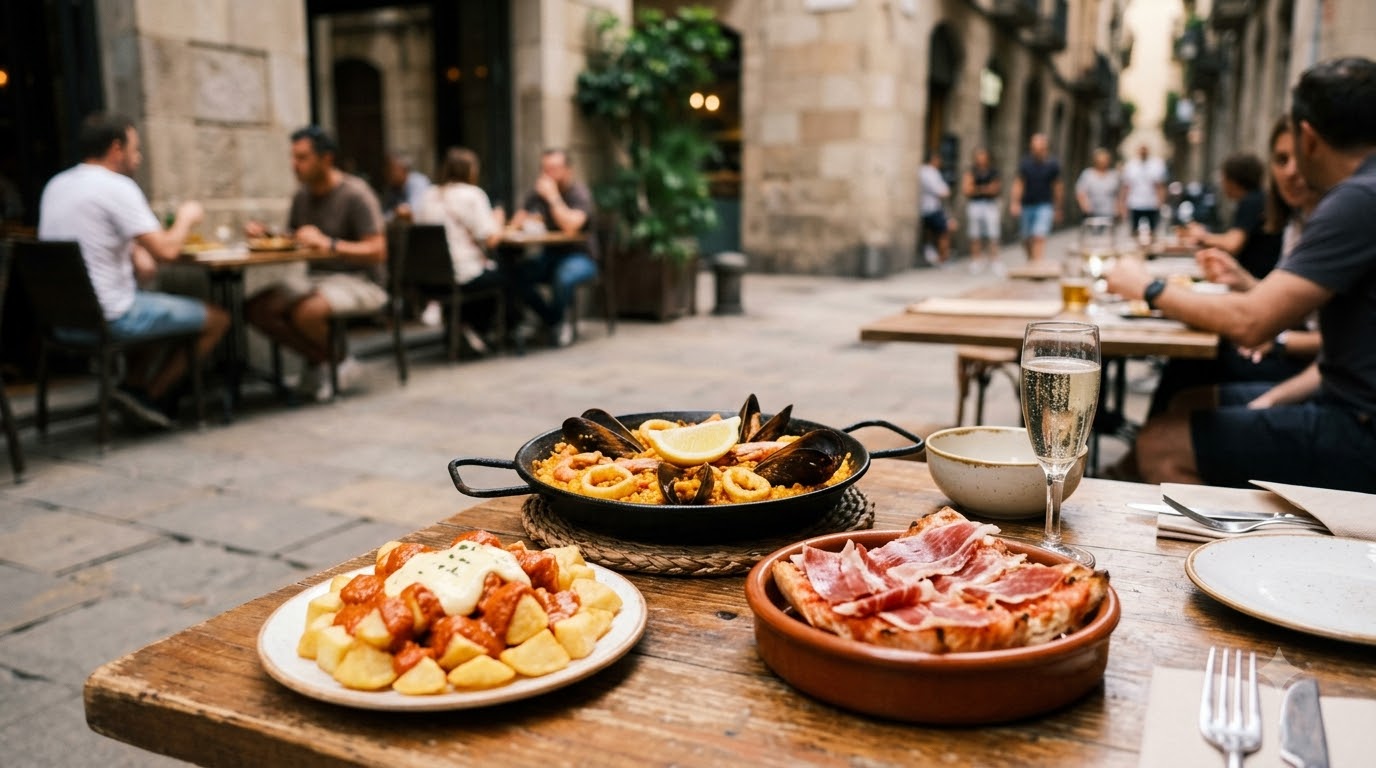
The best food in Barcelona is Catalan, not generic Spanish, and the dishes below are the ones locals actually order. Barcelona shares tapas culture with the rest of Spain but keeps its own repertoire built on bread, seafood, and grilled vegetables. Order these and you cover the essentials:
- Pa amb tomaquet: grilled bread rubbed with ripe tomato, garlic, and olive oil, served alongside almost everything, often 2.50 to 3.50 EUR as a montadito base.
- Patatas bravas: fried potato with spicy brava sauce and sometimes aioli, 4 to 7 EUR a plate and the single best value-for-flavour tapa in the city.
- Bomba: a Barceloneta invention, a fried potato-and-meat croquette ball with brava and aioli, born in the fishermen’s quarter.
- Escalivada: smoky roasted peppers, aubergine, and onion in olive oil, usually cold, a Catalan staple.
- Fideua: the local answer to paella, made with short toasted noodles instead of rice, and arguably more Barcelona than seafood paella itself.
- Crema catalana: the Catalan custard dessert with a burnt-sugar crust, close to creme brulee but scented with citrus and cinnamon.
You do not need a restaurant to eat well here. A standing counter, a paper napkin on the floor, and a loud room are good signs. Our rule after this trip: if the menu is only in English and a waiter is waving you in, keep walking. For a wider plan of the city around these meals, our Barcelona travel guide sets the neighbourhoods in context.
The 3-Day Barcelona Itinerary
The plan we use ourselves — sent straight to your inbox.
- Day-by-day route
- Where to stay
- Real 2026 costs
Free · No spam · Unsubscribe anytime
How much does tapas cost in Barcelona in 2026?
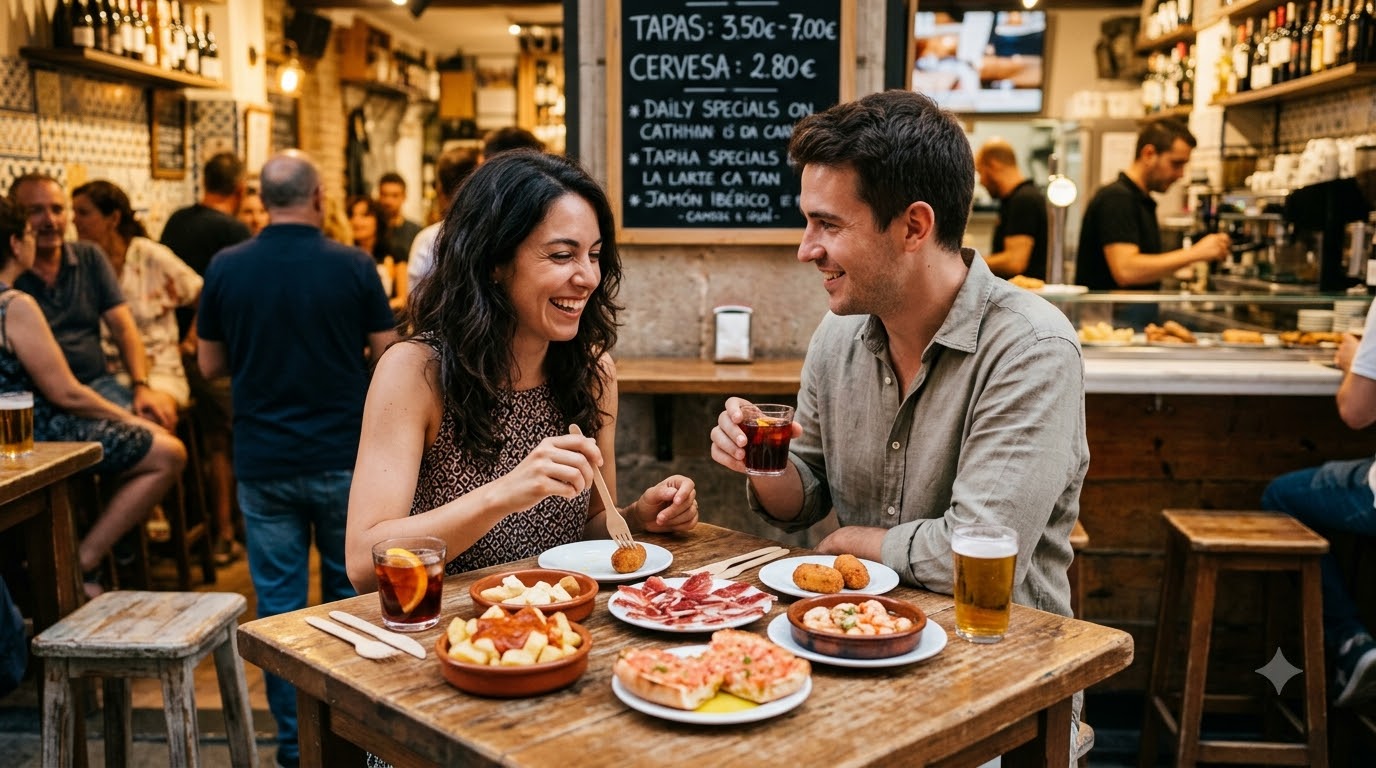
Tapas in Barcelona cost 2 to 4 EUR per individual plate in 2026, with a satisfying multi-plate dinner landing between 10 and 18 EUR per person in a neighborhood bar (Barcelona Tourism food guide, 2026). Prices climb fast the closer you get to Las Ramblas and the cathedral, and drop just as fast in Poble Sec, Sant Antoni, and Gracia. We tracked what we actually paid and cross-checked it against current menus.
| Dish | Typical 2026 price | Where it is best value |
|---|---|---|
| Individual tapa | 2 to 4 EUR | Gracia, Poble Sec bars |
| Pintxo (toothpick) | 2 to 2.50 EUR | Basque-style pintxo bars |
| Patatas bravas | 4 to 7 EUR | Neighborhood tapas bars |
| Pa amb tomaquet montadito | 2.50 to 3.50 EUR | Quimet & Quimet, Poble Sec |
| Vermut (glass) | 3 to 5 EUR | Vermuterias, Gracia |
| Full tapas dinner | 10 to 18 EUR per person | Off the tourist axis |
| Menu del dia (lunch) | 12 to 18 EUR | Weekday lunch, citywide |
The single best-value meal in Barcelona is the weekday menu del dia: a fixed three-course lunch with bread and a drink, served Monday to Friday roughly 1pm to 3.30pm, for 12 to 18 EUR (Spain Food Guide, 2026). It is how locals eat their biggest meal, and it is the cheapest way to try a proper sit-down Catalan kitchen. We ate a three-course menu del dia near Sant Antoni for 14 EUR including wine, and it was the best-value plate of the week.
For a classic Poble Sec crawl, Quimet & Quimet is the reference point: a tiny standing-room bar stacked to the ceiling with bottles, serving montaditos built on pa amb tomaquet for roughly 2.50 to 3.50 EUR each (Barcelona Born and Bred, 2026). Go early, because there is no seating and it fills by 1pm.
Find your Barcelona hotel on the map
Live prices from Booking & Airbnb — tap a pin to compare stays around Eixample and the Gothic Quarter and beyond.
Where do you find the best seafood paella and fideua?
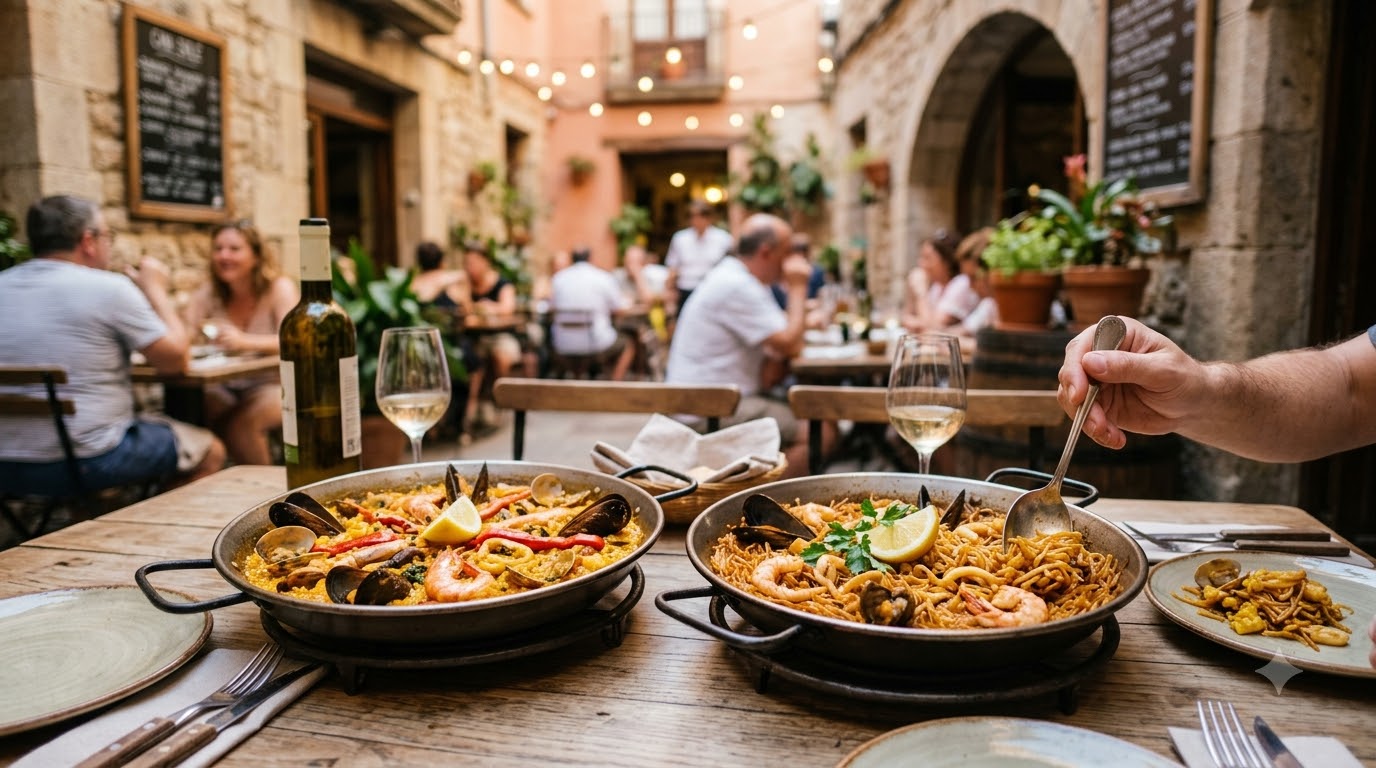
The best seafood rice is in Barceloneta, the old fishermen’s quarter, but on the streets set back from the boardwalk rather than the seafront terraces. Barceloneta holds the strongest seafood-rice tradition and the freshest catch, and the reliable rice restaurants sit one or two blocks in from the beach with better value than the terraces facing the sand (Barcelona Tourism seafood guide, 2026). Expect 18 to 30 EUR per person for a made-to-order rice dish, priced per person with a two-person minimum, and about 35 to 45 EUR a head once you add a starter and wine.
Two rules save you here. First, real rice is cooked to order and takes 20 to 30 minutes; if a terrace offers “paella now” it is reheated. Second, fideua is the smart local order:
- Can Ros: a Barceloneta cornerstone serving rice and seafood since 1908, in the heart of the fishermen’s quarter on Passeig de Joan de Borbo.
- Cal Pep: a legendary standing bar near the Born, no fixed menu, you eat what the counter sends out.
- 7 Portes: a grand old dining room dating to 1836, known for its rice dishes and a reliable classic choice.
- El Cangrejo Loco: a marina restaurant regularly named among the city’s best for fideua.
- Fideua over paella: the same seafood-and-saffron idea built on toasted noodles, and more authentically Barcelona than the tourist paella.
Avoid the giant photo menus of neon-yellow paella along the Barceloneta boardwalk and around Port Olimpic. That colour is food dye, not saffron, and the price rarely matches the quality. If you are basing yourself near the water for beach and seafood, our where to stay in Barcelona breakdown covers which parts of Barceloneta are worth it.
The 3-Day Barcelona Itinerary
Hour-by-hour plan, where to stay and what it really costs — free PDF.
Free · No spam · Unsubscribe anytime
What is vermut and where do you drink it?
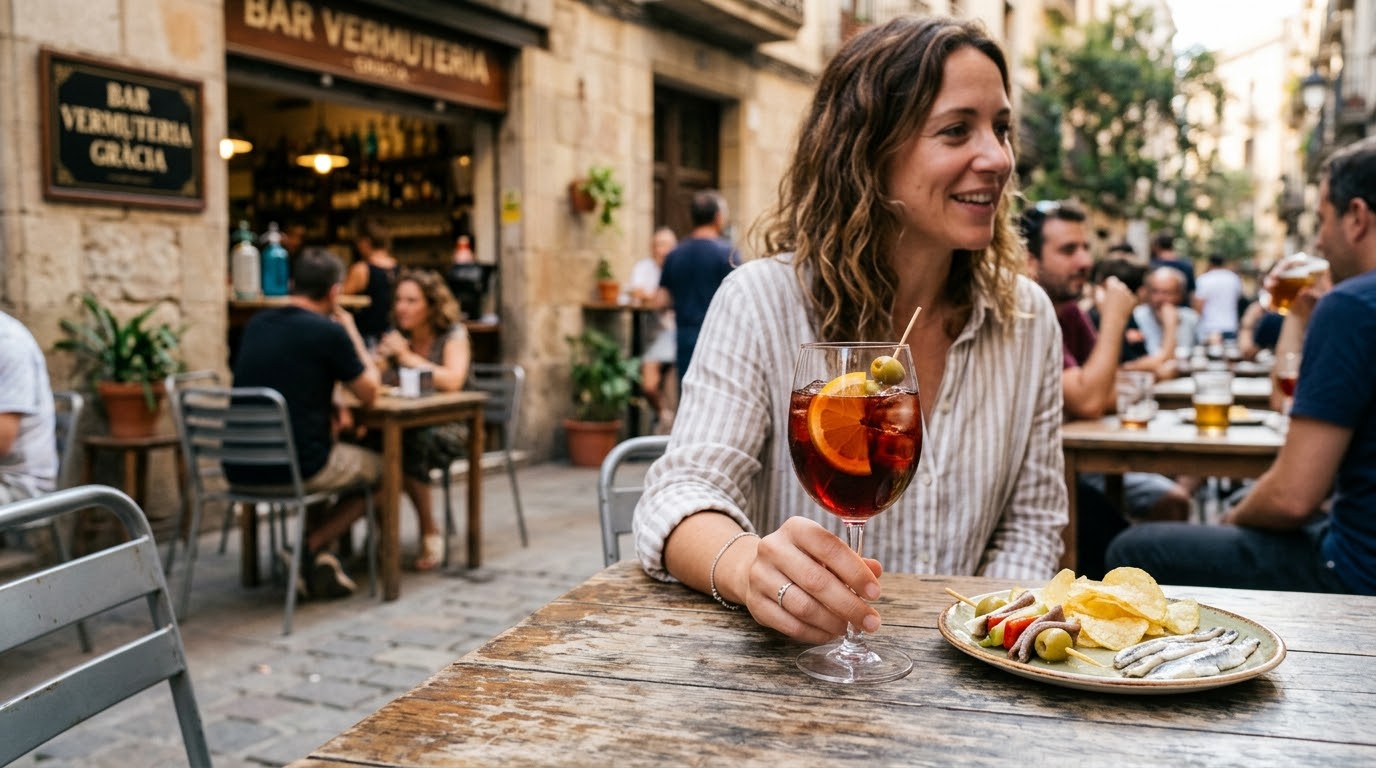
Vermut is Barcelona’s aperitif ritual, and “fer el vermut” (doing the vermut) is a social hour before lunch, especially on Sundays. It is fortified, herb-infused wine served on the rocks with an orange slice and an olive, sipped slowly with small bites like anchovies, olives, and crisps (Barcelona Turisme, 2026). A glass runs 3 to 5 EUR, and many old bars leave the bottle on your table and simply ask how many glasses you poured. We built two afternoons around it and it is the most relaxed, most local way to eat and drink in the city.
Gracia has more vermut bars per square meter than anywhere else in Barcelona, with leafy squares perfect for a slow crawl. These are the ones we would send a friend to:
- Bar Electricitat (Barceloneta): a rustic tapas bar named for the first building in the quarter wired for mains electricity, with house vermut and a famous Barceloneta bomba.
- Vermuteria del Tano (Gracia): feels like drinking in someone’s living room, one of the best vermuterias in Vila de Gracia.
- Vermuteria Lou (Gracia): by Joanic metro, humble room, and its huevos estrellados once won best tapa in Barcelona.
- Puigmarti (Gracia): great food alongside the drink, with standout smoked sardines and sesame.
- El Bandarra: popular terrace bar with quality bites while you sip.
Sunday around noon is the moment. Squares like Placa de la Vila de Gracia and Placa del Sol fill with families and friends fer el vermut before a long lunch, and it slots naturally into a first-timer’s plan, which our 3-day Barcelona itinerary builds around.
How do you shop La Boqueria without getting ripped off?
La Boqueria is worth visiting, but only if you get past the first three rows and go before 2pm. The Mercat de la Boqueria on La Rambla is open 8am to 8:30pm and closed on Sundays, though some stalls shut as early as 2pm once the shellfish sells out (Boqueria Barcelona, 2026). The front stalls near the Rambla entrance charge tourist prices for tourist-quality food, while quality and value both improve sharply deeper inside. Here is how we work it:
- Go before 2pm: the market is in full swing mid-morning, and stalls with fresh fish and produce start closing early afternoon.
- Walk past the first three rows: entrance stalls near the Rambla are the most overpriced; vendors further in assume tourists will not venture that far and price accordingly.
- Eat at a counter bar: Pinotxo Bar for traditional Catalan cooking, Bar Central for seasonal plates, and Kiosko Universal for grilled fish are the reliable stools.
- Carry cash: the smaller stalls and counter restaurants prefer euros over cards.
- Skip the 60-EUR chocolate and pre-cut fruit cups: the fruit tent near the front is also a known pickpocket spot.
The market sits right on La Rambla, which brings us to the one hard warning of this guide.
Which Barcelona food areas should you avoid?
Avoid eating on Las Ramblas itself, where tourist foot traffic often doubles or triples prices for food that is rarely good (Barcelona Hacks, 2026). The boulevard’s sit-down terraces, the sangria-and-paella combo menus, and the photo-menu restaurants around it are the clearest tourist traps in the city. The fix is simple: walk two minutes off the axis. We never had a bad meal once we did.
- Skip Las Ramblas terraces: overpriced combo menus and reheated paella aimed squarely at foot traffic.
- Skip the Boqueria front stalls: juice and fruit cups at a heavy markup, better and cheaper deeper in.
- Skip seafront Barceloneta photo menus: neon paella and inflated per-plate prices along the boardwalk.
- Go instead to Poble Sec: Carrer de Blai is lined with pintxo bars charging a couple of euros a toothpick.
- Go instead to Gracia or Sant Antoni: neighborhood bars, vermut, and weekday menus del dia at local prices.
Timing helps too. Catalan kitchens run late: lunch peaks 2 to 3.30pm and dinner rarely starts before 8.30 or 9pm, so a bar that is busy at 6.30pm is usually feeding tourists. If you want more to do between meals, our guide to the best things to do in Barcelona pairs neighborhoods with the food scenes above, and the full Barcelona travel guide ties it all together.
Frequently Asked Questions
What is the most famous food in Barcelona?
Pa amb tomaquet (bread with tomato) is the most emblematic everyday food, served alongside nearly every meal. For a signature dish, seafood fideua and the Barceloneta bomba are the most distinctly local, while patatas bravas is the tapa nearly everyone orders. Crema catalana is the classic dessert.
How much should I budget for food per day in Barcelona?
Plan roughly 30 to 50 EUR per person per day for food in 2026 if you eat well but not lavishly: a weekday menu del dia lunch at 12 to 18 EUR, a tapas dinner at 15 to 25 EUR, plus coffee and a vermut. A seafood-rice splurge in Barceloneta at 35 to 45 EUR a head is a once-per-trip meal, not a daily one.
Is the food on Las Ramblas any good?
No, Las Ramblas is the clearest food tourist trap in Barcelona, where prices are often doubled or tripled for mediocre food. Walk two minutes into El Raval, Poble Sec, or the Gothic backstreets and both quality and value improve immediately.
When is La Boqueria market open?
La Boqueria is open Monday to Saturday from 8am to 8:30pm and closed on Sundays. Arrive before 2pm for the best selection, since fish and produce stalls begin closing in the early afternoon once they sell out.
What is the difference between paella and fideua?
Paella is built on rice, while fideua uses short toasted noodles in place of the rice, with the same seafood and saffron base. Fideua originated on the Catalan and Valencian coast and is considered the more local order in Barcelona. Both are cooked to order and take 20 to 30 minutes.
Final word
Barcelona feeds you well the moment you stop eating where you are told to. Order the tapas at a standing counter, take the weekday menu del dia, book a made-to-order fideua in Barceloneta, and give yourself a slow Sunday vermut in Gracia. Cross off Las Ramblas, go before 2pm at La Boqueria, and carry cash. Do that and the best food in Barcelona costs less and tastes better than almost anything on the tourist trail.