
Disclosure: Some links in this guide are affiliate links. If you book or buy through them, we may earn a small commission at no extra cost to you — it helps keep our guides free.
Where to Stay in Barcelona: Best Areas 2026
The best area to decide where to stay in Barcelona depends on your trip: choose El Born or the Gothic Quarter for atmosphere and walkability, Eixample for wide streets and better value, Gracia for a local neighborhood feel, and Barceloneta if you want the beach at your doorstep. All five sit within a 25-minute metro ride of each other, so no choice traps you far from the city’s highlights.
One number should shape your budget before location does. From April 1, 2026, Barcelona charges a flat 5 euro per-person municipal surcharge on top of the regional Catalonia tourist tax, pushing the combined nightly tax to 8.40 euro at four-star hotels and 12 euro at five-star hotels (idealista, 2026). That tax is the same wherever you sleep, which is why the neighborhood you pick matters more for the experience than for the bill. This guide breaks down each district by price, traveler type, and the one risk every visitor should plan around: pickpockets.
Key Takeaways
– Gothic Quarter averages around 197 euro per night for hotels and puts you in the medieval core, but its crowds make it Barcelona’s busiest pickpocket zone.
– El Born sits next door with the same historic walkability, better restaurants, and slightly calmer streets, the sweet spot for most first-timers.
– Eixample runs 20 to 40 percent cheaper than the Gothic Quarter for equivalent four-star quality, with wide sidewalks and Gaudi landmarks on your block.
– Barcelona’s 2026 tourist tax is a flat 5 euro municipal surcharge per person per night plus the regional levy, reaching 12 euro nightly at five-star hotels.
– Pickpocketing made up 48.1 percent of all reported crime in Barcelona in 2023, but 99 percent of incidents involve no violence, so the risk is to your wallet, not your safety.[PERSONAL EXPERIENCE] We have based ourselves in three different Barcelona neighborhoods across separate trips, and the pattern held every time: the Gothic Quarter looked romantic on arrival and wore thin by night two, while El Born and Gracia kept pulling us back for dinner. On our last visit we spent four nights on Carrer del Rec in El Born and walked to the beach, the cathedral, and Sant Antoni market without touching the metro once.
Find your Barcelona hotel on the map
Live prices from Booking & Airbnb — tap a pin to compare stays around Eixample and the Gothic Quarter and beyond.
What Is the Best Area to Stay in Barcelona for First-Timers?
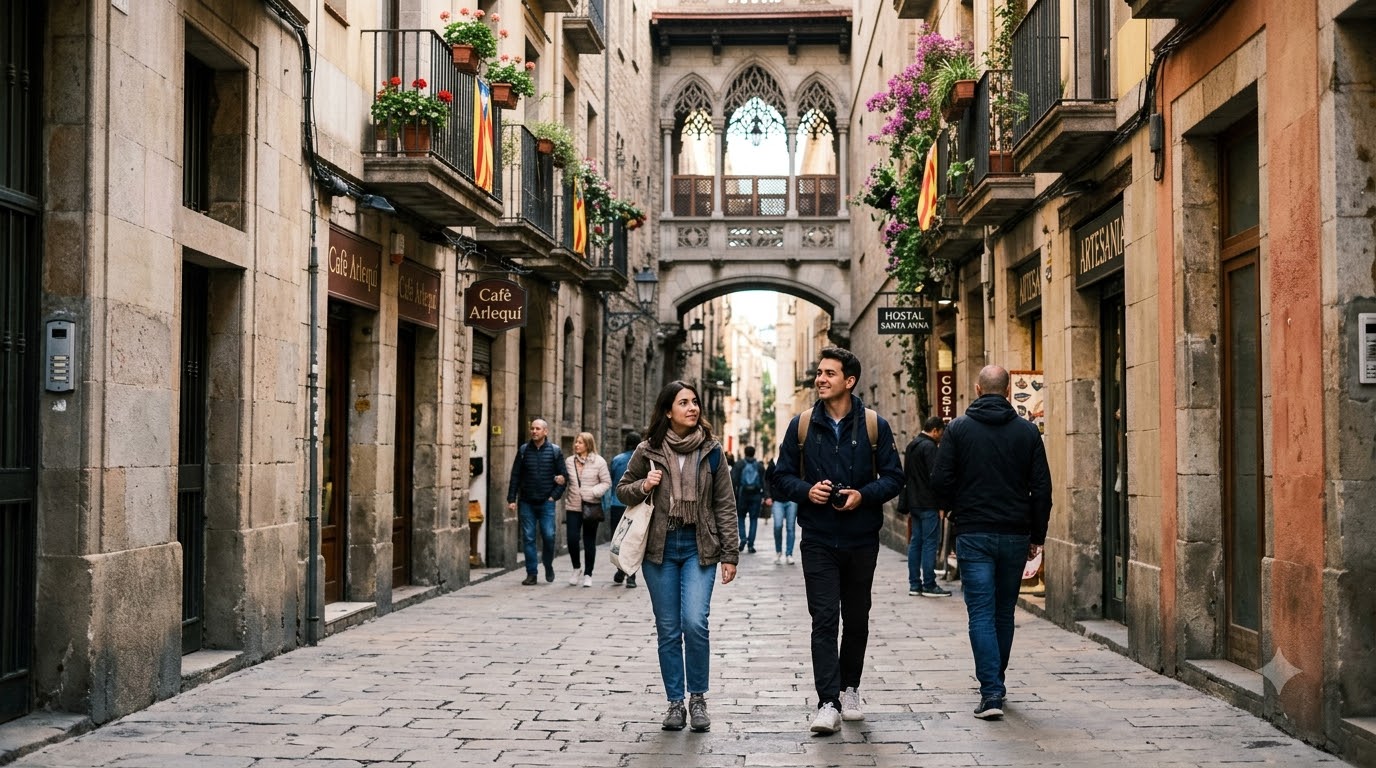
For a first visit, El Born (also called La Ribera) is the strongest single choice because it combines the old-city charm of the Gothic Quarter with better food and marginally thinner crowds. You get cobblestone lanes, the Picasso Museum, and the Santa Maria del Mar basilica, all inside a 10-minute walk, while the Barceloneta beach sits 15 minutes away on foot.
Here is how the main areas map to traveler types:
- First-time sightseers: El Born or the Gothic Quarter, for walkable access to the cathedral, Las Ramblas, and the waterfront.
- Couples and food lovers: El Born or Gracia, for intimate restaurants and wine bars over tourist menus.
- Families: Eixample, for wide sidewalks, apartment-style stays, and step-free metro stations.
- Beach and nightlife seekers: Barceloneta, for sand, seafood, and late-night beach bars.
- Budget and long-stay travelers: Sant Antoni or Poble Sec, for local prices a short walk from the center.
- Design and architecture fans: Eixample, home to the Sagrada Familia, Casa Batllo, and La Pedrera.
The 3-Day Barcelona Itinerary
The plan we use ourselves — sent straight to your inbox.
- Day-by-day route
- Where to stay
- Real 2026 costs
Free · No spam · Unsubscribe anytime
Gothic Quarter (Barri Gotic): Historic Core, Heaviest Crowds
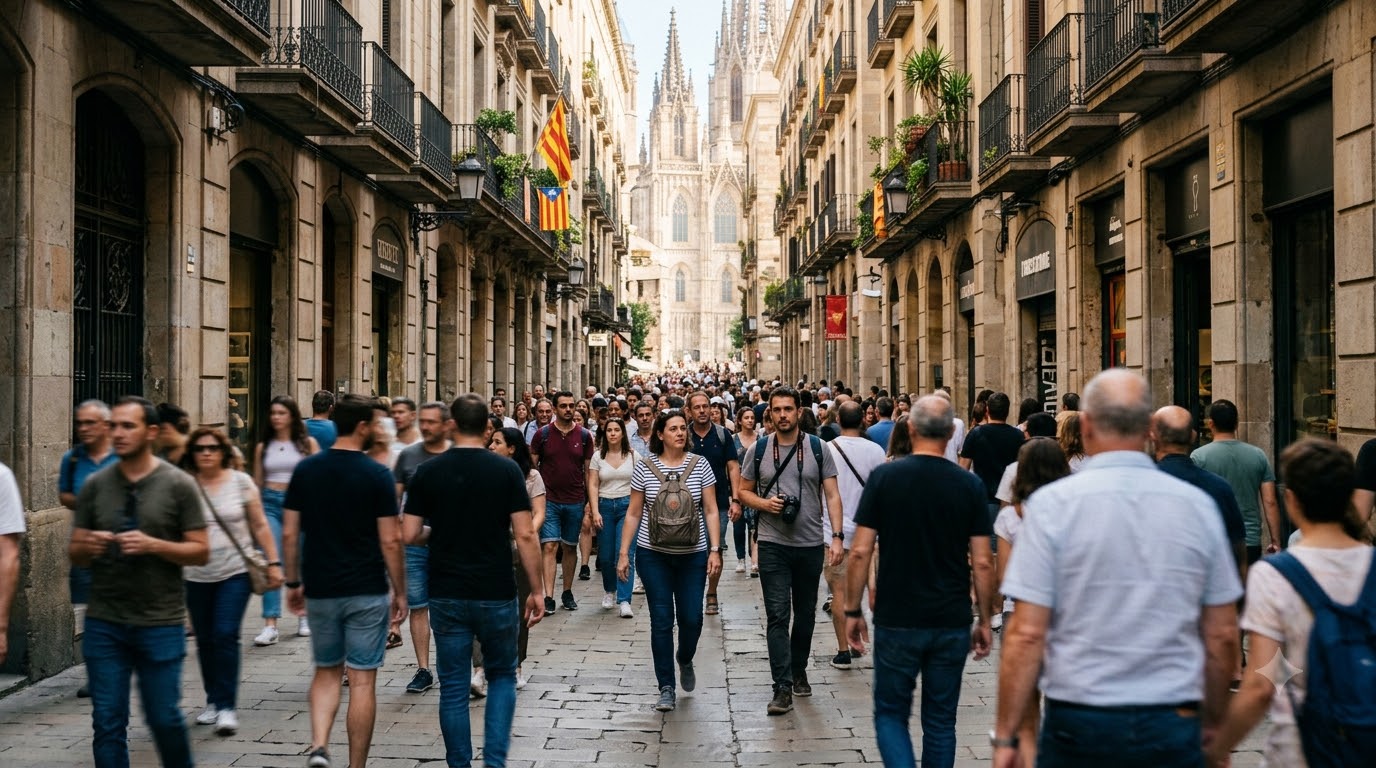
Stay in the Gothic Quarter if your top priority is sleeping inside Barcelona’s oldest streets, but go in knowing it is the most crowded and most pickpocketed part of the city. The district packs Roman walls, the cathedral, and Placa Reial into a maze of narrow lanes where hotel rates average roughly 197 euro per night, with two-star rooms from about 129 euro and four-star properties starting near 199 euro (KAYAK, 2026).
The trade-off is noise and density. On our first Barcelona trip we stayed two nights near Carrer d’Avinyo and found the same lanes that felt magical at 9 a.m. became a shoulder-to-shoulder crush by evening. The area works best for travelers who want to step out of the door into the postcard, and who will keep a hand on their bag on Las Ramblas.
What the Gothic Quarter does well:
- Central location: everything in the old town is a 5 to 10 minute walk, and Liceu and Jaume I metro stops connect the rest of the city.
- Atmosphere: medieval architecture, hidden plazas, and street musicians you cannot fake in a newer district.
- Late dining: tapas bars and terraces stay open past midnight around Placa Reial.
- Downsides: the highest crowd density, the most aggressive pickpockets, and small rooms in old buildings with thin walls.
El Born: The First-Timer Sweet Spot
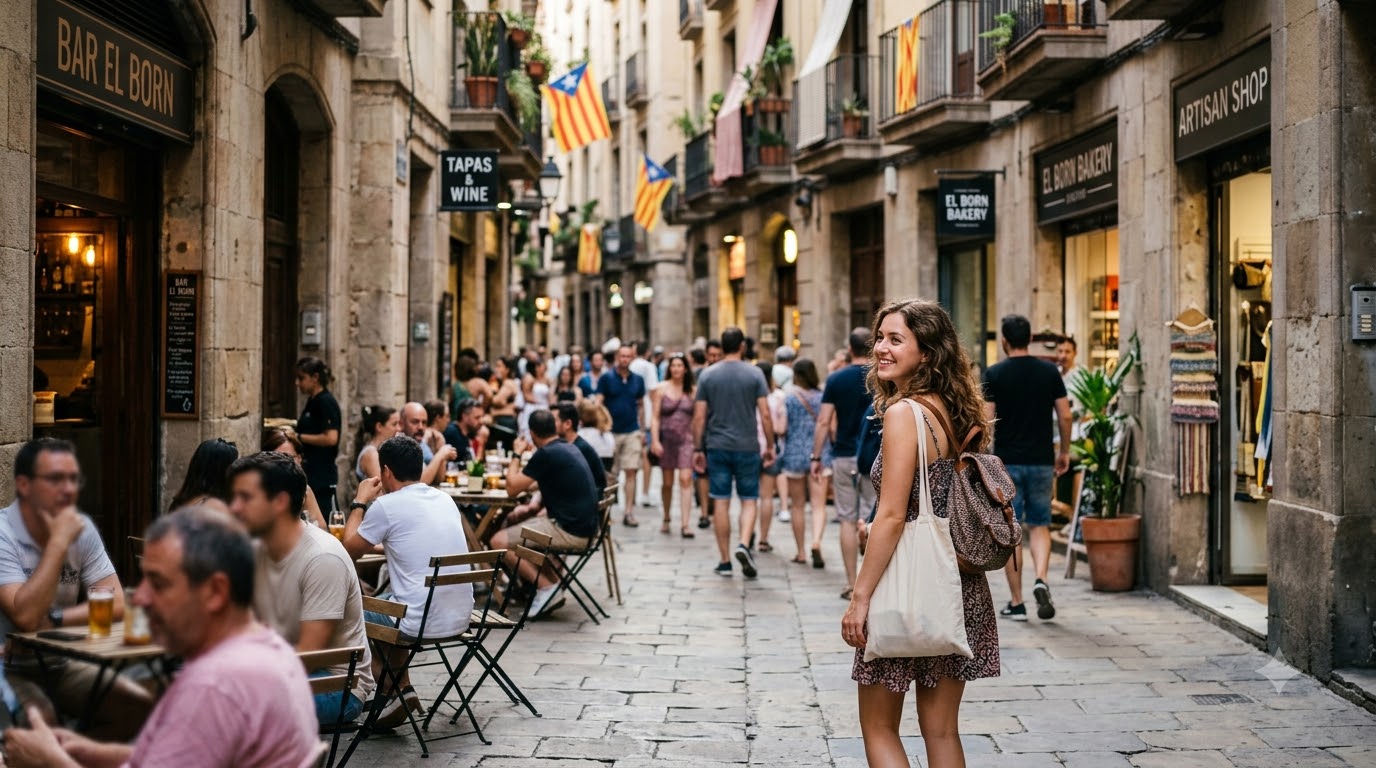
El Born gives you the Gothic Quarter’s history with a better dinner and a calmer street, which is why it tops our list for most visitors. The neighborhood centers on the pedestrian Passeig del Born and the Gothic Santa Maria del Mar church, with the Picasso Museum and the Born Cultural Centre a few blocks apart.
Prices sit close to the Gothic Quarter, but the density eases just enough to matter. We have circled back to Carrer del Rec and Carrer de la Princesa for tapas on every trip, and the walk to Barceloneta beach takes about 15 minutes through the waterfront.
Reasons El Born wins for first-timers:
- Balanced location: old-town core on one side, beach and waterfront on the other, both walkable.
- Food quality: independent tapas bars, wine cellars, and brunch spots over tourist-trap menus del dia.
- Slightly calmer: fewer cruise-day crowds than Las Ramblas, though still busy on weekends.
- Culture on foot: Picasso Museum, Santa Maria del Mar, and the Born market all within 10 minutes.
The 3-Day Barcelona Itinerary
Hour-by-hour plan, where to stay and what it really costs — free PDF.
Free · No spam · Unsubscribe anytime
Eixample: Best Value and the Gaudi Landmarks
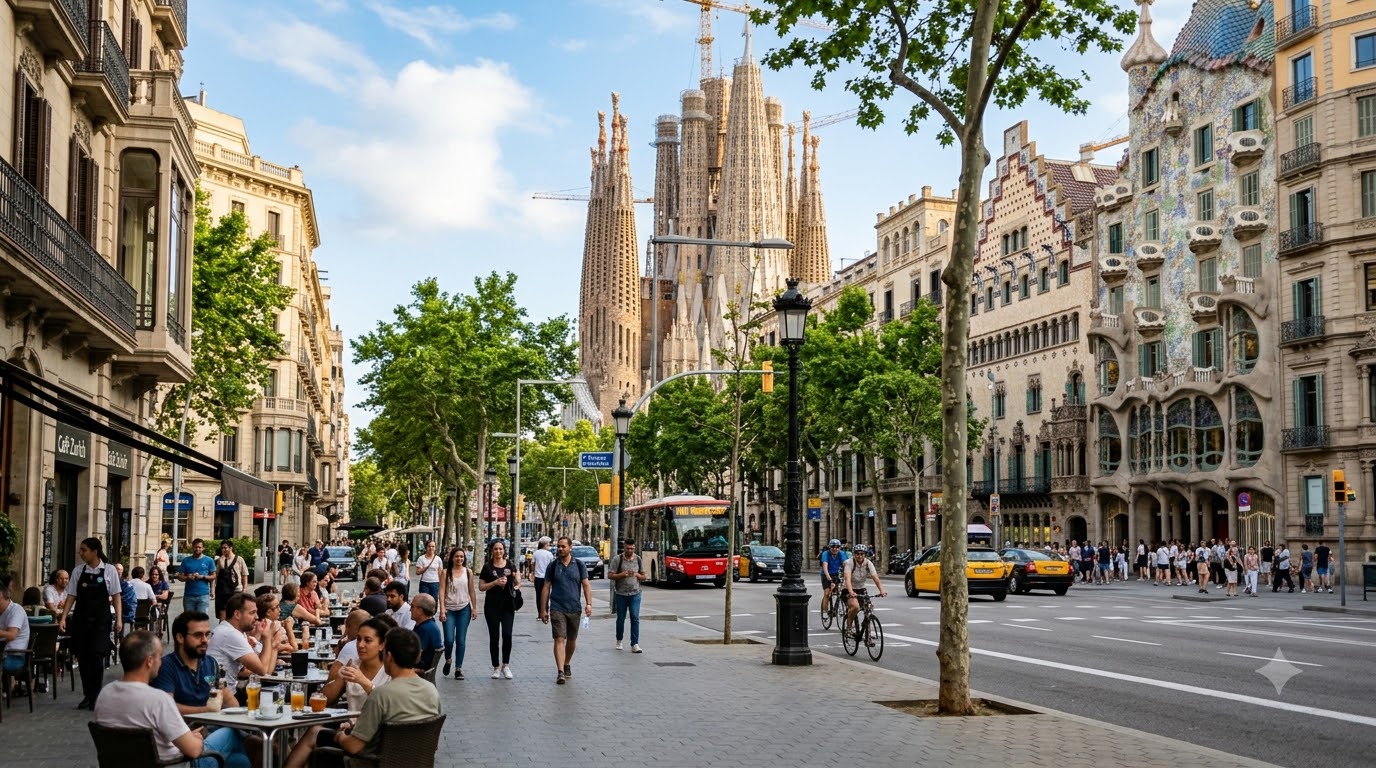
Eixample is the smartest pick for value and space, running 20 to 40 percent less per night than the Gothic Quarter for equivalent four-star quality (Rate Ranger, 2026). Ildefons Cerda’s 19th-century grid gives the district wide sidewalks, octagonal intersections, and the modernist landmarks most people fly in to see: the Sagrada Familia, Casa Batllo, and La Pedrera all sit here.
The grid splits into two halves worth knowing. The Right Eixample (Dreta) holds the marquee Gaudi buildings and higher rates. The Left Eixample (Esquerra) is quieter and cheaper, still a flat 10-minute metro from the center. Families and longer-stay travelers get the most from Eixample’s apartment-style stays and step-free stations, and the district’s modernist landmarks headline our roundup of the best things to do in Barcelona.
| Neighborhood | Avg. hotel/night | Vibe | Best for | Walk to beach | Pickpocket risk |
|---|---|---|---|---|---|
| Gothic Quarter | ~197 EUR | Medieval, dense | Old-town atmosphere | ~15 min | Very high |
| El Born | ~180 EUR | Historic, foodie | First-timers, couples | ~15 min | High |
| Eixample | ~140 EUR | Wide grid, modernist | Value, families, design | ~25 min metro | Moderate |
| Gracia | ~130 EUR | Local, village-like | Repeat visitors, long stays | ~30 min metro | Low to moderate |
| Barceloneta | ~160 EUR | Beach, seafood | Beach and nightlife | 0 min | High on beach |
Prices are approximate 2026 nightly averages for mid-range hotels and exclude the tourist tax. Figures compiled from KAYAK, Tripadvisor, and Rate Ranger listings, August 2026.
Gracia: Where Locals Actually Live
Choose Gracia if you have seen the headline sights before or want a stay that feels like a neighborhood rather than an attraction. Once a separate town, Gracia keeps its village layout of low buildings and pedestrian squares like Placa del Sol and Placa de la Vila, where residents outnumber tourists at the cafe tables.
Rates run among the lowest of the central options, near 130 euro per night, and Gaudi’s Park Guell sits at the top edge of the district. We spent three mornings working from Gracia cafes on one trip and never heard a rolling suitcase, the clearest sign you have left the tourist core. The trade-off is distance: you are a 15 to 20 minute metro ride from the beach and old town.
Gracia suits you if:
- You value local life over being steps from the cathedral.
- You want lower prices without leaving the well-connected center.
- You plan longer stays and prefer neighborhood markets and squares to hotel lobbies.
- You are visiting Park Guell, which sits within walking distance uphill.
Barceloneta and the Waterfront: Beach at Your Door
Stay in Barceloneta only if the beach is the point of your trip, because you trade central sightseeing access for sand and seafood. The old fishermen’s quarter is a tight grid of narrow buildings pressed against the Mediterranean, with the boardwalk, beach bars, and paella restaurants on your doorstep and hotel rates around 160 euro per night.
The neighborhood is a 15-minute walk or one metro stop from El Born, so it is not remote, but it is a dead-end for old-town wandering. Keep a close eye on your belongings on the sand itself, where beach theft spikes in summer. For a beach-forward long weekend it delivers exactly what it promises; for a first cultural visit, sleep closer to the center and visit the beach for the day.
Is Barcelona Safe? How to Choose a Neighborhood Around Pickpockets
Barcelona is safe for tourists in terms of personal harm but has one of Europe’s highest pickpocketing rates, so neighborhood choice and daily habits matter more than any single crime statistic. Pickpocketing accounted for 48.1 percent of all reported crime in Barcelona in 2023, and the city logged 94,517 petty thefts in 2024, roughly 259 per day (barcelonatourism.org, 2026). Yet 99 percent of these incidents involve no violence: the target is your wallet, phone, or passport, not you.
Risk clusters around crowds, transit, and tourist chokepoints rather than specific residential streets. That means the quieter you go, the lower your exposure: Gracia and the Left Eixample see far fewer incidents than Las Ramblas.
Practical rules that cut your risk sharply:
- Avoid ground-floor and street-facing rooms on Las Ramblas and the busiest Gothic Quarter lanes if noise and crowd access concern you.
- Use a cross-body bag with a zip worn in front, and never a back pocket, on the metro and La Rambla.
- Stay alert at the Sagrada Familia, Park Guell, and metro Line 3, the routes thieves work most.
- Split your cash and cards, leaving one card and your passport in the hotel safe.
- Treat beach theft as a summer certainty: never leave a bag unwatched on Barceloneta sand.
For a wider view of costs, timing, and getting around, our complete Barcelona travel guide covers transport passes and budgets, while our breakdown of the best time to visit Barcelona explains why hotel rates swing hardest around the late-February Mobile World Congress.
Where to Stay in Barcelona by Budget
Match the neighborhood to your nightly budget and you will not overpay for a location you do not need. These bands reflect 2026 mid-range hotel averages and exclude the tourist tax.
- Under 120 EUR/night: Sant Antoni, Poble Sec, or the Left Eixample, all a short walk or one metro stop from the center.
- 120 to 160 EUR/night: Gracia for local character or Eixample for space and Gaudi landmarks.
- 160 to 200 EUR/night: El Born for the first-timer sweet spot or Barceloneta for beachfront.
- Over 200 EUR/night: the Gothic Quarter’s boutique hotels and Passeig de Gracia’s five-star addresses.
Once you have your base, plan the days around it: our guide to the best things to do in Barcelona sorts attractions by district, and our 3-day Barcelona itinerary shows how to string them together without backtracking across the city.
Frequently Asked Questions
Where should I stay in Barcelona for the first time?
Stay in El Born for a first visit. It gives you the Gothic Quarter’s historic, walkable streets with better restaurants and slightly thinner crowds, plus a 15-minute walk to both the cathedral and Barceloneta beach. Eixample is the best-value alternative if you want more space and lower rates.
Is the Gothic Quarter a good area to stay in Barcelona?
The Gothic Quarter is excellent for atmosphere and central access but is Barcelona’s most crowded and most pickpocketed district. Choose it if sleeping inside the medieval core is your priority and you will stay alert on Las Ramblas. If you want the same walkability with a calmer street and better food, El Born next door is a stronger pick.
How much does the Barcelona tourist tax add per night in 2026?
From April 1, 2026, Barcelona charges a flat 5 euro municipal surcharge per person per night on top of the regional Catalonia tourist tax. The combined nightly total reaches 8.40 euro at four-star hotels and 12 euro at five-star hotels. The tax is the same in every neighborhood and is usually charged at checkout.
Which Barcelona neighborhood is safest from pickpockets?
Gracia and the Left Eixample have the lowest pickpocket exposure because they are residential and see fewer tourist crowds. The highest-risk zones are Las Ramblas, the Gothic Quarter’s busiest lanes, the metro, and crowded sights like the Sagrada Familia and Park Guell. Crowd density, not the neighborhood name, drives the risk.
Is Barceloneta a good place to stay in Barcelona?
Barceloneta is ideal if the beach is your trip’s focus, offering sand, seafood, and boardwalk bars at your door for around 160 euro per night. It is a poor base for old-town sightseeing, since it dead-ends at the water. For a first cultural visit, stay near the center and treat Barceloneta as a day trip.
Where you sleep in Barcelona shapes the trip more than almost any other decision, but no choice among these five neighborhoods is a mistake, because they all sit within a short metro ride of each other. Pick El Born or the Gothic Quarter for atmosphere, Eixample for value and space, Gracia for a local feel, and Barceloneta for the beach, then keep your bag zipped and your passport in the safe. The city rewards travelers who plan around its one real risk and stop worrying about the rest.