How Many Days in Barcelona (2026)
Disclosure: Some links in this guide are affiliate links. If you book or buy through them, we may earn a small commission at no extra cost to you — it helps keep our guides free.
- 3 to 4 days for the Gaudi landmarks and the old-town core, or 2 days for just the two headline sights.
- Check whether Sagrada Familia and Park Guell still have open timed-entry slots on your dates.
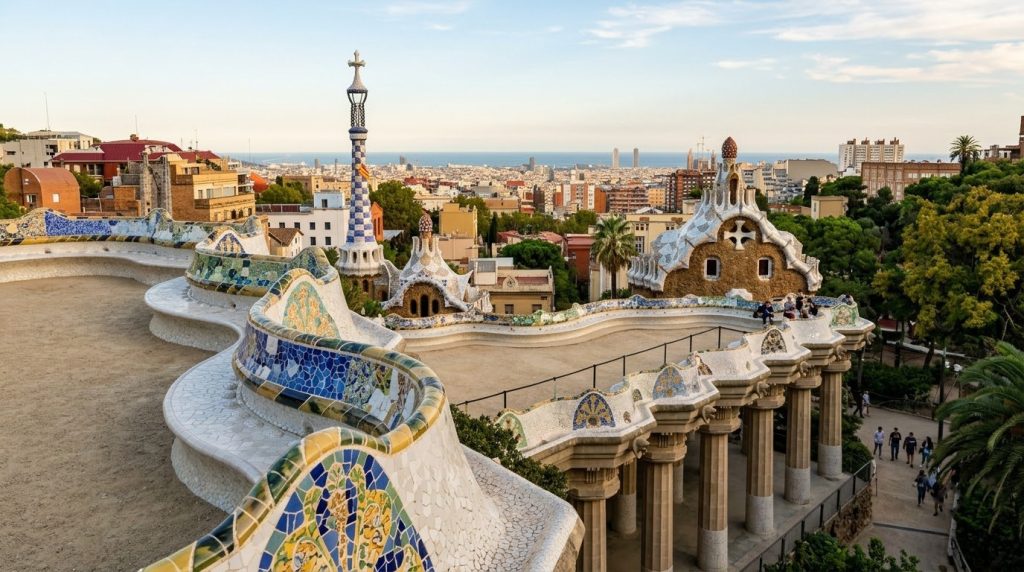
The short answer to how many days in Barcelona you need is 3 to 4 days for the Gaudí landmarks and the old-town core, or 2 days if the two headline sights are all you want. That answer moves by a full day or more once you check whether Sagrada Familia and Park Güell still have open timed-entry slots on your travel dates.
| Days | What you fit in | Timed-entry sights | Approx cost/person (USD) | Best for |
|---|---|---|---|---|
| 2 days | Sagrada Familia, Park Güell, a Gothic Quarter walk | 2 | USD 125-220 (excl. hotel) | Layovers, cruise stops, a Spain-trip add-on |
| 3 to 4 days | Sagrada Familia with towers, Park Güell, one Gaudí house, Gothic Quarter, El Born, Barceloneta | 3 to 4 | USD 330-440 (excl. hotel) | First-time visitors, a standard city break |
| 5 days or more | All the major Gaudí sites plus a day trip such as Montserrat or Sitges | 4 to 5 | USD 550 or more (excl. hotel) | Slow travelers, repeat visitors, food-focused trips |
Rates use EUR/USD 1.16, verified today. Cost bands exclude accommodation.
2 days – the minimum that works
Two days works only if Sagrada Familia and Park Güell are the only two sights that matter to you. That itinerary fills one morning at Sagrada Familia, one morning or afternoon at Park Güell, and leaves the rest of the time for a walk through the Gothic Quarter and El Born rather than a third paid attraction.
Casa Batlló, La Pedrera, and Camp Nou get cut entirely, along with any day trip; see the full things to do in Barcelona list for what a longer stay would add back in. Because both headline tickets require a fixed time slot, book them before departure rather than after landing, since same-day availability is rare even outside July and August.
Arriving without both tickets already confirmed usually means dropping one of the two sights rather than finding a same-day replacement slot.
3 to 4 days – the standard answer, and why
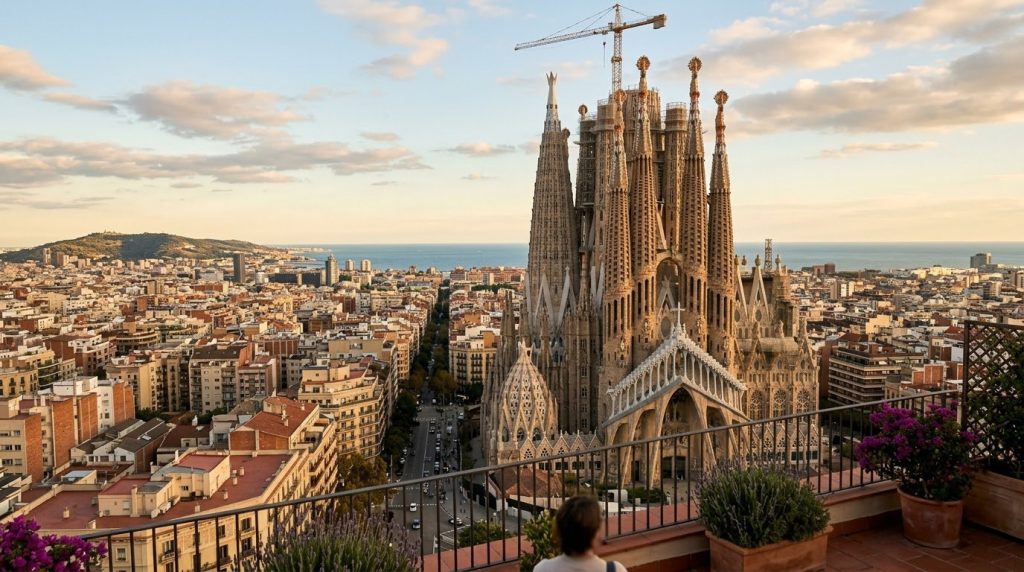
Three to four days is the standard answer because it is the minimum time that fits both Gaudí headline sights, one of his two townhouses, and the old town without a rushed schedule. A day-by-day route for this length, including which neighborhood to base in each morning, is already mapped out in the 3-day Barcelona itinerary.
A fourth day typically goes to Barceloneta beach, Montjuïc, or a slower pass through Gràcia, and gives enough buffer that a missed morning does not collapse the rest of the plan. This length also gives more flexibility on where to sleep, covered in where to stay in Barcelona.
5 days or more – when the extra days pay off
Five days or more pays off when it buys a day trip, not when it just stretches the same city-center sights over more mornings. The extra one or two days typically go to Montserrat, the wine region of Penedès, or the beach town of Sitges, none of which fit into a 3-day plan without cutting a Gaudí site.
Five days also allows both Casa Batlló and La Pedrera instead of picking one, plus a second visit to Park Güell’s free 95 percent of the grounds without the timed Monumental Zone ticket. Below five days, a day trip usually means trading it for a landmark. Above five days, Barcelona itself is mostly covered and the extra time is discretionary.
The extra days also absorb a rained-out or heat-shortened morning without forcing a sight to be dropped entirely.
Why timed-entry tickets decide your trip length
Barcelona’s headline sights decide trip length through ticket availability, not walking distance between them. Sagrada Familia sells basic entry at EUR 26 (USD 30), releases booking slots 60 days ahead, and its popular hours, early morning, late afternoon, and anything with tower access, sell out 10 to 14 days ahead during peak season (April through October).
Tower access is not included in the basic ticket. It must be added at booking as a separate timed slot, choosing either the Nativity or Passion tower, for a EUR 10 supplement (EUR 36 / USD 42 total), and that slot sells out roughly 3 weeks ahead in peak season, sometimes within hours during July and August.
A temporary centenary surcharge of EUR 2 to 5 also applies from May through December 2026, marking 100 years since Gaudí’s death. The basilica’s central Tower of Jesus Christ was structurally completed in February 2026, but its public viewing platform is not scheduled to open until 2027.
2026 access is therefore still limited to the Nativity and Passion towers as before, and the completion milestone mainly affects why June 2026 dates are selling out earlier than usual, not which towers you can enter.
Park Güell runs the same logic at a smaller scale: general admission is EUR 18 (USD 21), entry comes in capped 30-minute windows of 1,400 visitors per hour, and the most popular slots can be gone by mid-morning even outside peak season. A 2-day trip has to lock both tickets before departure with almost no flexibility to shift plans.
A 5-day trip booked weeks out can move a Sagrada Familia slot by a day if the weather or the schedule changes. Cross-check your dates against the site’s best time to visit Barcelona guide, since the peak-season sellout windows above assume travel between April and October.
Montserrat as the Day Trip That Justifies Day Five
Montserrat is the cleanest add-on for a longer stay because the trip is public-transport simple. Trains on the FGC R5 line toward Manresa leave from Plaça d’Espanya, reachable by Metro lines L1 and L3, and run about once an hour. The Montserrat visitor site describes the trip as roughly 90 minutes, made up of about 60 minutes on the train and 20 on the rack railway plus the transfer.
Cable car or rack railway
The choice depends on where you get off the train, so decide before boarding.
- Cable car (Aeri): board at Montserrat-Aeri, the first stop. The ride takes about 5 minutes, with cars every 15 minutes in roughly the 9:30 a.m. to 7 p.m. window, depending on season. It is not suitable for wheelchair users.
- Rack railway (Cremallera): board at Monistrol de Montserrat, the second stop. The ride takes about 15 minutes and the railway is fully accessible.
Do not get off at Olesa de Montserrat, which has a cable car that does not go to the monastery. Early trains mean cooler temperatures and fewer people. Hikers can also climb up on foot, about 1 hour from the Aeri stop or 1 to 1.5 hours from Monistrol.
When fewer days in Barcelona is the better trip
Fewer days works better than more when the extra time would not go toward a new sight or a real day trip.
Traveling in July or August without a tower slot booked two or three weeks out is one case: at that point, 2 days on the two headline sights plus a beach town add-on such as Sitges delivers more than 5 days spent working around sold-out tickets.
Barcelona as one stop on a longer Spain trip, alongside Madrid or Sevilla, is another: budgeting only 2 to 3 days here protects time for the rest of the itinerary instead of diluting it.
A repeat visitor who has already done Sagrada Familia and Park Güell also gets more from 2 focused days built around a single new day trip, such as the Penedès wine region, than from 5 days re-covering the same monuments.
On a tight budget, 2 days keeps spend to two entry tickets and a handful of meals, while 5 days multiplies lodging and food costs for sights that are, after the second Gaudí site, mostly repeats of the same architectural style.
Families traveling with young children also tend to get more from 2 days than 5, since timed-entry queues and a full day of walking wear out a toddler faster than a longer, slower-paced trip allows for.
Getting Around Barcelona on a Short Stay
Transport fares in 2026 take little of the budget, but choosing the wrong ticket wastes time, especially on arrival. According to TMB, a single ticket costs EUR 2.90 (USD 3.40) and covers one journey on the metro, bus, or Montjuic funicular. A T-casual with 10 journeys starts at EUR 13 (USD 15).
The airport is the exception. Neither the single ticket nor the T-casual works at the Aeroport T1 and T2 stations on the L9 Sud line. The airport ticket costs EUR 5.90 (USD 6.80) for one metro journey including those stations.
Which ticket suits which trip length
On a 2-day trip with Sagrada Familia, Park Guell, and old-town walking, a T-casual covers most rides. On a 3 to 4 day stay with more neighborhood hopping, compare it with the Hola Barcelona Travel Card, which TMB lists from EUR 12.50 (USD 14.50) and describes as good for up to 5 days. The page gives only that starting price, so check the Hola Barcelona site for the duration you need.
The Gothic Quarter, El Born, and Barceloneta are all walkable from one another, so most metro rides are for the Gaudi sights, Montjuic, and the airport.
Where to stay for each trip length
A 2-day trip runs smoothest based in Eixample or El Born, both walkable to Sagrada Familia or the old town with a short metro ride to Park Güell.
A 3-day-or-longer stay has more room to pick a neighborhood by budget or vibe, from Gràcia’s local, lower-priced streets to Barceloneta for beach access; the full area-by-area breakdown is in where to stay in Barcelona.
Both Sagrada Familia and Park Güell sit closer to Eixample and Gràcia than to the beachfront, which matters most on a 2-day trip where transit time is worth reclaiming. Compare live rates across neighborhoods on the map below before booking.
Find your Barcelona hotel on the map
Live prices from Booking, Airbnb and more — move the map or change dates to compare stays across Barcelona.
Planning the whole trip? Start with our Barcelona travel guide for the overview, then use this page for the details.