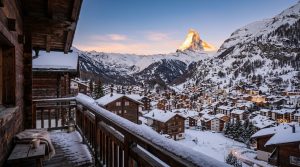
Best Time to Visit Zermatt (2026)
Disclosure: Some links in this guide are affiliate links. If you book or buy through them, we may earn a small commission at no extra cost to you — it helps keep our guides free.
- The best time to visit Zermatt is July, when the average high reaches 14.2C for clear Matterhorn views.
- Skiers should target January through March instead.
- In May and November most lifts shut for maintenance; avoid unless glacier skiing only.
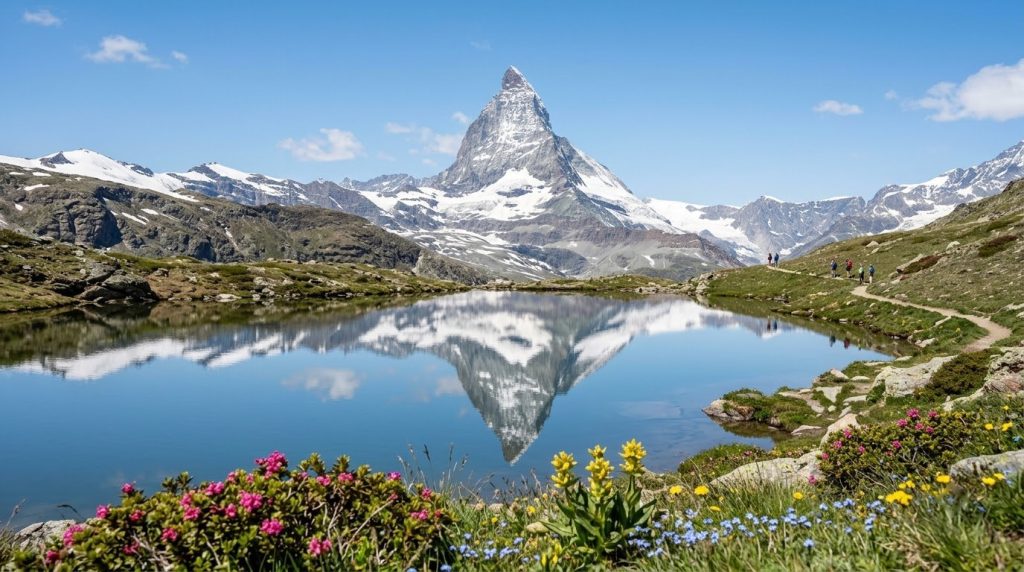
The best time to visit Zermatt is July, when the average high reaches 14.2°C (58°F) for clear Matterhorn views, against an average high of just -7°C (19°F) in January. The exception is skiers chasing deep snow and short lift lines, who should target January through March instead of the July-to-September hiking peak.
| Month | Weather | Lifts and trails | Crowds | Verdict |
|---|---|---|---|---|
| January | Cold, avg high -7°C/19°F | Full ski area and Theodul Glacier open | Busy through early January | Solid skiing, book ahead |
| February | Coldest month, avg high near -7°C | Full ski area open | Peak (half-term weeks) | Best snow, highest prices |
| March | Milder, avg high 1-3°C | Full ski area, spring-snow skiing | Busy around Easter | Strong skiing, fewer deep-freeze days |
| April | Warming, avg high 5-7°C | Sunnegga/Rothorn close Apr 11, Gornergrat Apr 18, 2027; Glacier Paradise stays open | Thins after Easter | Only worthwhile for glacier skiing |
| May | Spring thaw, avg high 8-11°C | Most valley lifts shut for maintenance; Glacier Paradise summer pass from May 4 | Lowest of the year | Skip unless glacier-only |
| June | Mild, avg high 12°C+ | Sunnegga reopens mid-June, trails clear by late June | Building | Good value before peak season |
| July | Warmest, avg high 14.2°C | Full trail network and Glacier Paradise open | Peak summer | Best weather for hiking |
| August | Warm, afternoon storms common | Full trail network open | Busiest month | Excellent hiking, book far ahead |
| September | Cooling, avg high 10-12°C | Trails open all month; Blauherd/Rothorn close around Oct 4 | Thins after mid-month | One of the best hiking windows |
| October | Cold snap begins, avg high 5-7°C | Sunnegga closes Oct 11; Gornergrat maintenance starts Nov 2 | Low | Only Glacier Paradise still fully open |
| November | Coldest transition, avg high 0-2°C | Most of the lift network shut for maintenance until Nov 28 | Lowest of the year | Avoid unless glacier skiing only |
| December | Winter begins, avg high -2 to 0°C | Sunnegga/Rothorn/Gornergrat reopen Nov 28; full area running by mid-month | Builds toward Christmas | Good from mid-month onward |
Summer (July to September) – hiking and the Matterhorn at its clearest
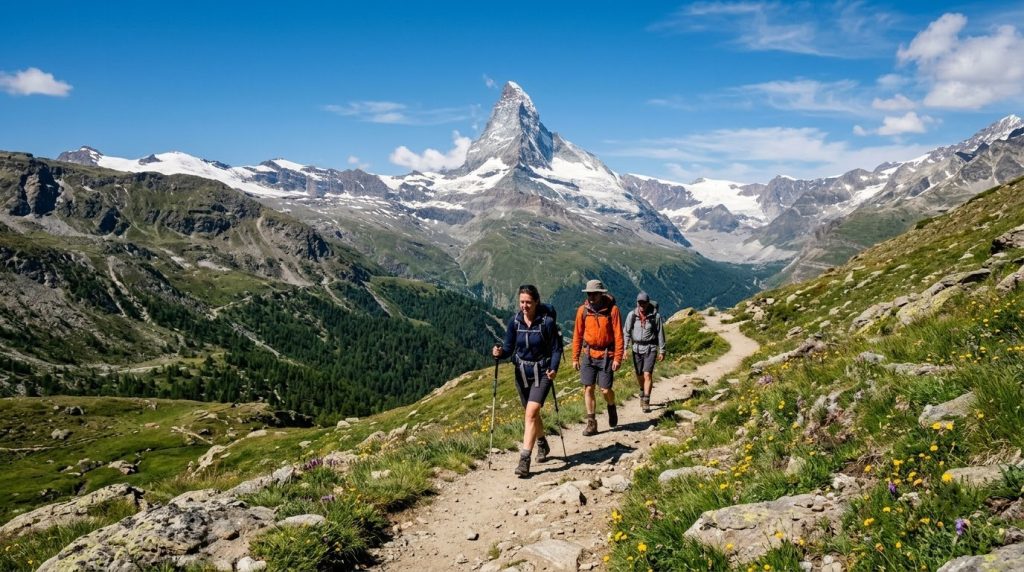
Summer, from July to September, is Zermatt’s clearest window for hiking and Matterhorn photography. July is the warmest month, with an average high of 14.2°C (58°F), and also the wettest, with roughly 188mm of monthly rainfall that tends to fall as short afternoon thunderstorms rather than all-day rain.
The valley’s hiking lifts, including Sunnegga, Gornergrat, and Rothorn, run their full summer timetables through this stretch, and the Matterhorn Glacier Paradise cable car adds glacier skiing on top of the trail network. August draws the heaviest crowds of the year, so hotel and restaurant bookings fill weeks ahead.
September brings drier, clearer air as the thunderstorm pattern eases, and trails stay fully open until Blauherd and Rothorn close for maintenance around October 4. Hikers who want the Matterhorn without the August queues should aim for the first three weeks of September instead.
Winter (December to April) – the ski season
Winter, from mid-December through April, is Zermatt’s main ski season, built on reliably high-altitude snow. January is the coldest month, averaging -7°C (19°F) on a cold day and -3.3°C (26°F) as a monthly average, and the full lift network runs alongside the Matterhorn Glacier Paradise above it.
For winter 2026/27, Sunnegga and Rothorn close on April 11, 2027, Gornergrat follows on April 18, and the wider season wraps up May 3, 2027.
A Swiss Travel Pass in second class costs USD 314 (CHF 254) for three days, USD 493 (CHF 399) for six days, or USD 542 (CHF 439) for eight days at today’s verified rate of USD 1 = CHF 0.81; the pass covers rail and many mountain transport connections but not the ski lift network itself.
Zermatt is car-free, so drivers leave vehicles at the 2,100-space covered car park in Tasch and ride the roughly 12-minute shuttle train into the village, which runs every 20 minutes. For a season-by-season look at the rest of the country, see our guide to the best time to visit Switzerland.
Year-round skiing on the Theodul Glacier
Zermatt is one of the few Alpine resorts that skis 365 days a year, and the reason is the Theodul Glacier above the village.
The Matterhorn Glacier Paradise cable car climbs from Trockener Steg to Klein Matterhorn at 3,883 meters, and its official pricing runs on a summer schedule from May 4 through October 31, 2026, then rolls straight into winter rates from November 1. A one-day pass in the May-to-October window costs USD 122 (CHF 99) for an adult.
In practice, this means the glacier keeps turning while nearly everything else in Zermatt’s lift network shuts down for the autumn changeover, which is the trap covered next.
The shoulder weeks that catch people out
The real closed season in Zermatt is not where most visitors expect it, and it falls in autumn rather than deep winter. Blauherd and Rothorn stop running for hikers around October 4, 2026, and Sunnegga follows on October 11.
The Gornergrat Railway then suspends entirely from November 2 to 14, 2026 for maintenance, runs a limited timetable from November 15 to 27, and returns to normal service only once winter operations begin on November 28.
That leaves a gap of close to seven weeks, from roughly mid-October to late November, when the valley’s hiking lifts are down and the winter ski area has not yet opened, and the Matterhorn Glacier Paradise is the only lift still running a full schedule.
Hotels feel this too: the five-star Mont Cervin Palace typically closes for the season around September 20 and reopens around December 10, which is a useful marker for how much of Zermatt quietly shuts for those weeks.
Anyone building an itinerary around late-October or November glacier skiing should confirm opening hours directly with Matterhorn Paradise before booking, since the glacier lift is the one exception in an otherwise dormant valley.
When NOT to visit Zermatt
Early-to-mid November is the weakest stretch of the Zermatt calendar, since the summer hiking lifts have already closed and the winter ski area will not open for another two to three weeks.
A near-mirror gap opens in spring: the main winter lifts close in mid-April, but Sunnegga does not reopen for hikers until mid-June, leaving roughly eight weeks where valley trails are inaccessible even though snow is melting in the village.
Late February through early March brings the heaviest ski crowds and the highest room rates of the year, driven by half-term school holidays across Europe, so visitors chasing value should avoid that window even though the skiing itself is excellent.
None of these periods make Zermatt a bad destination; they just mean fewer lifts, higher prices, or both, depending on which gap a trip lands in. Travelers weighing a nearby alternative for those weak weeks can compare options in our Grindelwald travel guide.
How to get to Zermatt
Zermatt has no airport of its own and no road access for private cars, so every trip funnels through one of two gateway cities and a short cogwheel ride.
From Zurich Airport, the fastest regular trains reach Zermatt in roughly 3 hours 20 minutes to 3 hours 40 minutes with a single change at Visp, running hourly with no reservation required; from Geneva, the fastest connections take close to 3 hours, also with a change along the way.
Both routes use ordinary Swiss rail services, not a special train, so a standard point-to-point ticket or a Swiss Travel Pass, covered elsewhere on this page, works for the whole journey.
The scenic alternative is the Glacier Express, which links Zermatt to St Moritz rather than to Zurich or Geneva directly, and is a slower, pricier way to travel rather than a faster one: the full route takes around 8 hours, with second-class fares typically running USD 122 to 193 (CHF 99 to 156) and first-class fares USD 221 to 331 (CHF 179 to 268), on top of a separate seat reservation fee.
It suits travelers treating the train ride itself as the main event, not anyone trying to reach Zermatt quickly from a Swiss airport.
Whichever route is used, the final leg is the same: Zermatt’s center is closed to private cars, so anyone driving to the region leaves the vehicle at the car park in Tasch and finishes the trip on the shuttle train into the village, as covered earlier on this page. Travelers arriving by train from Visp continue directly into Zermatt without that extra step.
Altitude and health considerations
Zermatt village itself sits at 1,620 meters, high enough to notice on arrival, mostly as faster breathlessness on the walk from the station to a hotel with luggage, but not high enough to trigger altitude sickness for most healthy visitors.
The bigger risk sits further up the mountain, at the Matterhorn Glacier Paradise cable car’s upper station near Klein Matterhorn, which tops out close to 3,883 meters, more than double the village’s elevation and well within the range where altitude sickness becomes a real possibility, even for visitors who feel completely fine in the village below.
Symptoms to watch for at altitude include headache, nausea, dizziness and unusual fatigue, and the standard advice applies here as anywhere else at elevation: ascend gradually where the itinerary allows, stay well hydrated, and descend if symptoms do not ease after a short rest.
Because the cable car delivers visitors to nearly 3,900 meters within minutes rather than over hours of gradual climbing, as a hike would, travelers with any history of altitude sensitivity should treat a same-day round trip to the glacier as the part of a Zermatt visit most likely to cause a problem, not the village stay itself.
Travelers combining a glacier excursion with strenuous activity, such as skiing, hiking, or a workout at altitude, should ease into exertion rather than pushing hard immediately on arrival at the top station, since the combination of low oxygen and sudden physical effort is what typically brings symptoms on.
What to pack for Zermatt
What belongs in a Zermatt packing list depends heavily on which season from the table above is on the itinerary, since the gap between a July hiking day and a January ski day is wider here than in most destinations.
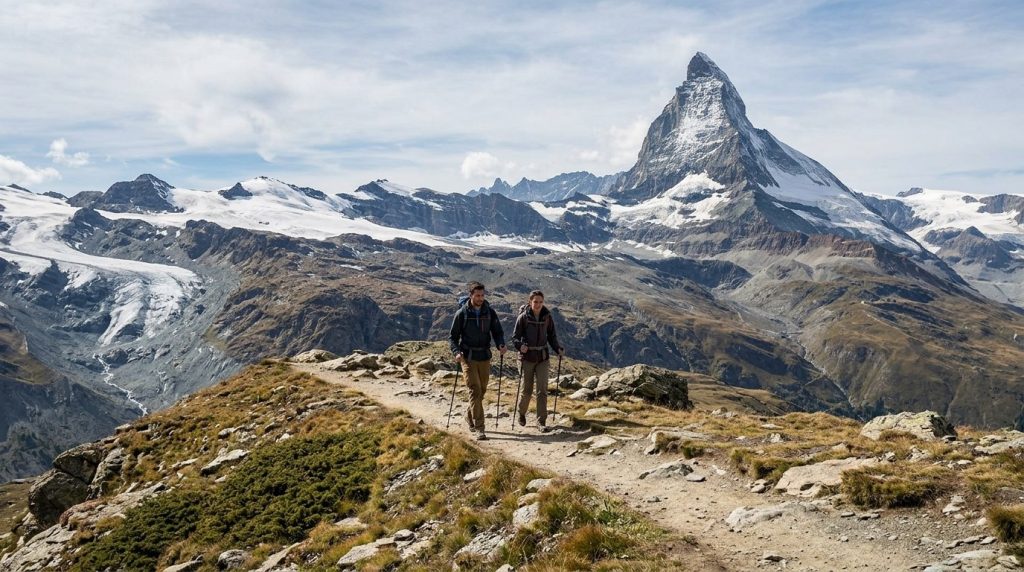
Summer visitors need layers more than heavy gear: mornings and evenings in the village stay cool even in July and August, while a hike up toward Gornergrat or Sunnegga can swing from sun to sudden afternoon cloud, so a packable rain shell and a warm mid-layer belong in a day pack even on a clear-looking morning.
Winter visitors need the obvious ski gear, but should not overlook proper eye protection and sunscreen, since high-altitude sun reflecting off snow is stronger than it looks on a cold day, and reflected glare at the glacier’s elevation can cause sunburn even with cloud cover at village level.
Good waterproof boots matter off the slopes too, since village streets and uncleared side paths can stay icy well after a snowfall despite regular clearing on the main routes.
Across both seasons, the car-free layout covered above means a bag that travels easily matters more than it would in a destination reachable by car.
The final leg from the shuttle train in Tasch, or from Zermatt’s own station, to a hotel door is usually on foot or by electric hotel taxi, so a bag with wheels suited to cobbled or snow-packed streets, rather than loose soft luggage, makes that last stretch easier.
Saving money on a Zermatt trip
Zermatt is one of the pricier Alpine resorts, but a few choices affect the total cost more than others.
Travel dates matter most: the shoulder weeks either side of the main season, covered earlier on this page, combine lower hotel rates with reduced lift operations, so travelers chasing value rather than a full lift network should target the weeks just after the main winter season opens or just before the summer hiking lifts close, rather than the deep-winter or peak-summer weeks when both crowds and prices peak together.
Lift tickets add up quickly across a multi-day stay, and multi-day passes generally work out cheaper per day than buying single-day tickets repeatedly, though the saving depends on how many days are actually used for skiing or the glacier cable car versus simple sightseeing.
A Swiss Travel Pass, covered elsewhere on this page, bundles the train journey in with regional transport but does not cover the ski lift network itself, so budgeting for lift tickets separately avoids an unwelcome surprise on arrival.
Accommodation away from the absolute village center, such as a short walk from the main street rather than directly on it, typically costs less without adding meaningful travel time in a village this compact.
Half-board rates, which bundle breakfast and dinner into the room price, are also worth comparing directly against booking a room only and eating at independent restaurants, since Zermatt’s restaurant prices sit high enough that a bundled half-board rate often works out cheaper for a multi-night stay, particularly outside the cheaper self-catering studios.
Plan your Zermatt trip
Once a travel window is set, the next decisions are where to stay and how to get around. Zermatt’s car-free layout means location matters more than usual, and our Zermatt hotels guide breaks down which villages areas suit skiers versus summer hikers. For a wider look at basing a trip across the region, our Swiss Alps travel guide covers how Zermatt fits alongside other resort towns.
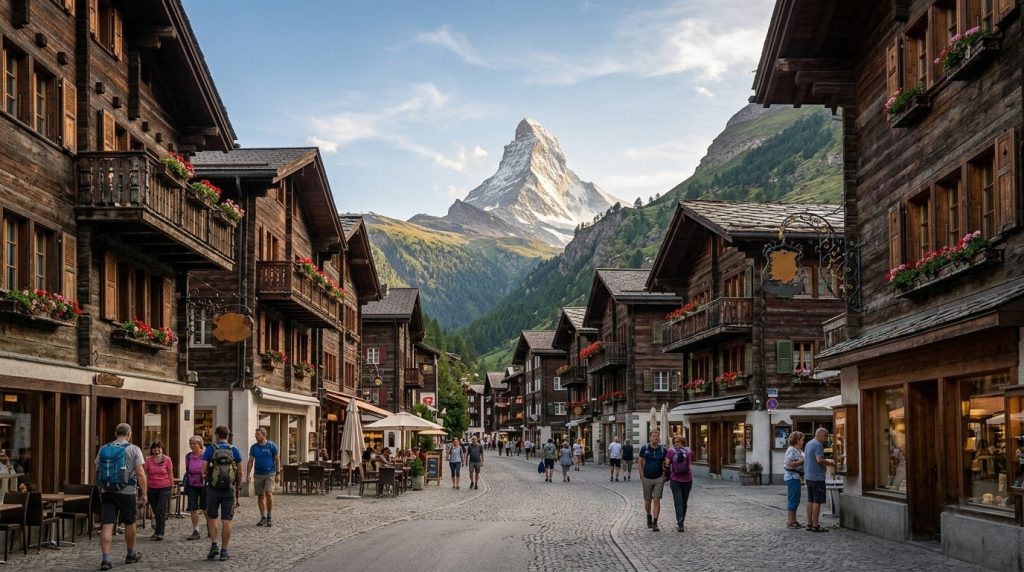
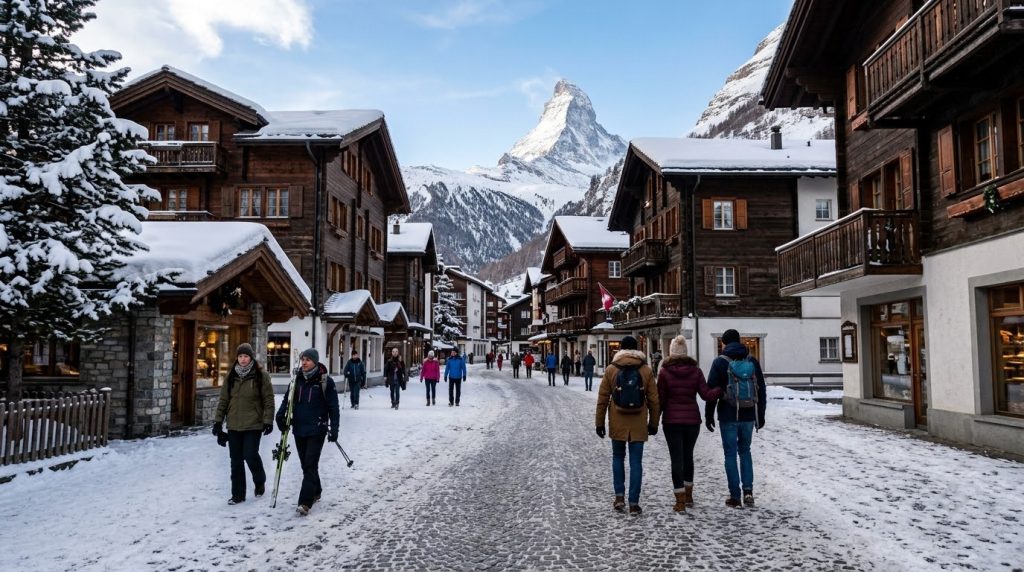
Find your Zermatt hotel on the map
Live prices from Booking, Airbnb and more — move the map or change dates to compare stays around Zermatt.