Best Hotels in Zermatt (2026)
Disclosure: Some links in this guide are affiliate links. If you book or buy through them, we may earn a small commission at no extra cost to you — it helps keep our guides free.
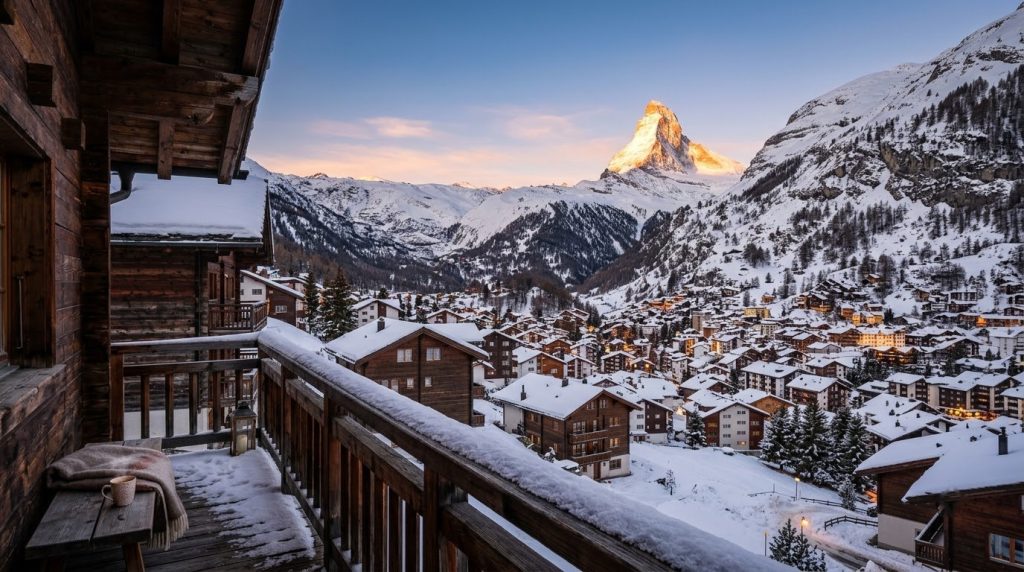
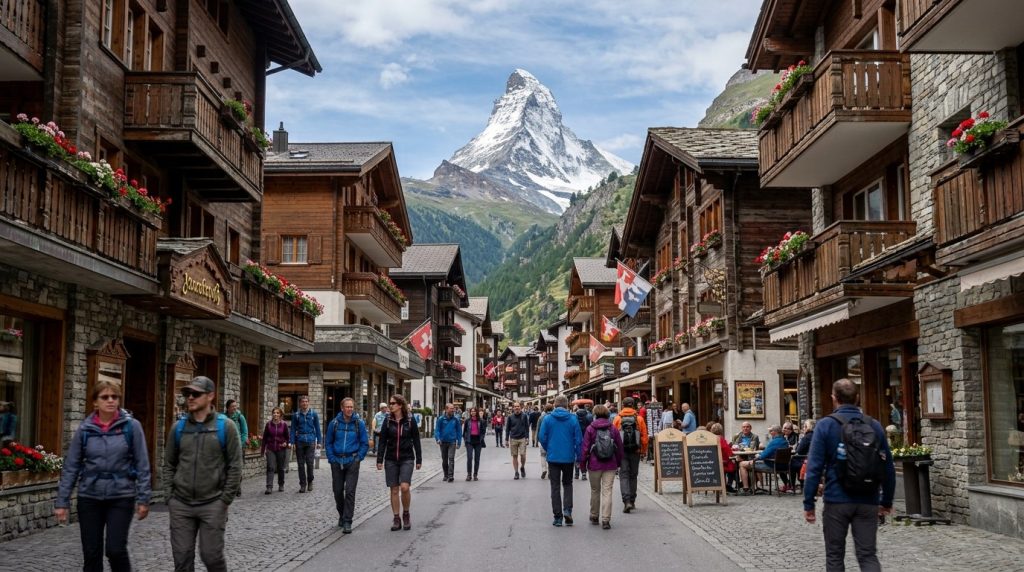
The best hotels in Zermatt range from CHF 100 budget doubles at Hotel Bristol to CHF 1,200-a-night chalet suites at CERVO Mountain Resort, with nearly every property sitting on or within a few minutes’ walk of car-free Bahnhofstrasse.
Skiers chasing first lifts should book near the Sunnegga or Gornergrat stations, while first-time visitors on a tighter budget do better in the village centre, a flat walk from restaurants and the train station.
Quick answer: This guide breaks down the best areas and stays in Zermatt. See live prices and availability now:
| Hotel | Area | Tier | Price/night (USD · CHF) | Best for | Book |
|---|---|---|---|---|---|
| Grand Hotel Zermatterhof | Bahnhofstrasse, village centre | Luxury | USD 853–1,440 · CHF 690–1,165 | Heritage grand-hotel spa stays | Check rates |
| CERVO Mountain Resort | Riedweg, edge of village near Sunnegga | Luxury | USD 865–1,483 · CHF 700–1,200 | Ski-in/ski-out chalet suites | Check rates |
| Backstage Hotel Vernissage | Hofmattstrasse, village centre | Luxury | USD 593–717 · CHF 480–580 | Design-forward boutique with spa | Check rates |
| Schweizerhof Zermatt | Bahnhofstrasse, village centre | Mid-range | USD 342+ · CHF 277+ | Matterhorn-view balconies, indoor pool | Check rates |
| Alex Alpine Resort | village centre, 2 min from station | Mid-range | USD 378+ · CHF 306+ | Families wanting a spa and pool | Check rates |
| Hotel Butterfly | Bodmenstrasse, village centre | Budget | USD 169+ · CHF 137+ | Simple rooms near the Gornergratbahn | Check rates |
| Hotel Bristol | Schluhmattstrasse, village centre | Budget | USD 124+ · CHF 100+ | Basic doubles with Matterhorn views | Check rates |
| Hotel Bahnhof | 100 m from the train station | Budget | USD 49+ pp · CHF 40+ pp | Dorm beds and a self-catering kitchen | Check rates |
Prices above are converted at today’s rate of CHF 1 to roughly USD 1.24 and marked “+” where only a low-season starting rate could be confirmed. Zermatt runs on two peak seasons, so treat every figure as a floor, not a guarantee.
Where to book, at a glance
Nearly all of these hotels sit inside a ten-minute walk of Zermatt’s Bahnhofstrasse, so the map below is the fastest way to see how close a listing actually is to the lifts before you commit.
Find your Zermatt hotel on the map
Live prices from Booking, Airbnb and more — move the map or change dates to compare stays around Zermatt.
Best luxury hotels in Zermatt
Grand Hotel Zermatterhof anchors Bahnhofstrasse 55, and it has held that spot since 1879. Its balconies split two ways: some frame the Matterhorn directly, others look down over the village rooftops, and even the smallest doubles get one view or the other. Low-season doubles run CHF 690 (USD 853) a night, climbing to CHF 1,165 (USD 1,440) over Christmas and New Year or in mid-February.
Check rates: Grand Hotel Zermatterhof →
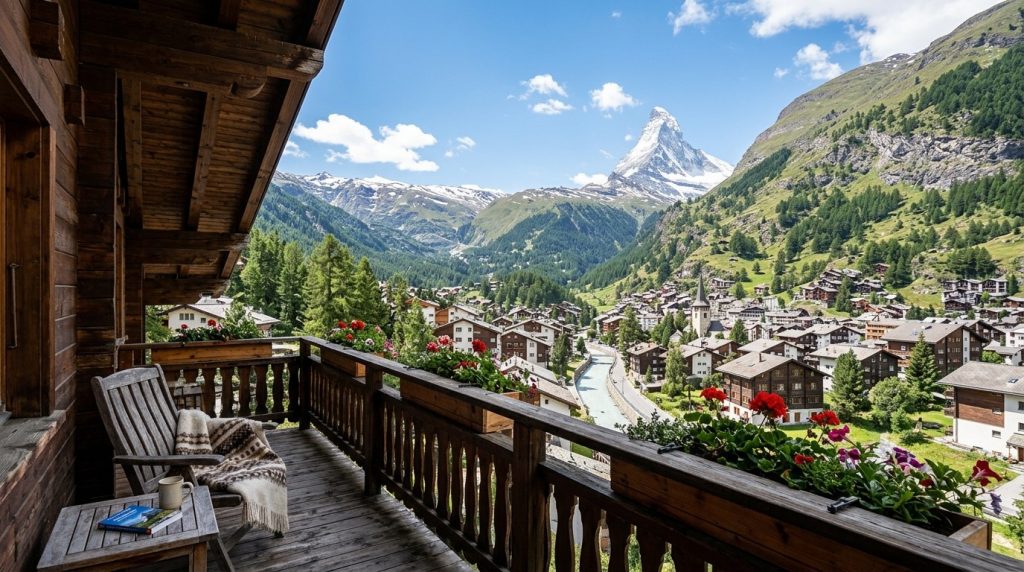
CERVO Mountain Resort sits on the village edge at Riedweg, connected to the Sunnegga valley station by its own private lift, so guests step from a wood-clad chalet suite straight onto the slopes. Rooms lean into timber and sheepskin textures, and several suites open onto private terraces built for watching skiers descend past a steaming outdoor hot tub.
Check rates: CERVO Mountain Resort →
Nightly rates move from CHF 700 (USD 865) in low season to CHF 1,200 (USD 1,483) at Christmas or February half-term.
Backstage Hotel Vernissage, on Hofmattstrasse opposite the skating rink, is architect Heinz Julen’s own design statement, carrying a Michelin Key for its individuality. Rooms come as Cube Lofts or Deluxe Doubles with freestanding bathtubs and handcrafted furniture built in Julen’s own Zermatt workshop. The Cottage Room runs CHF 480 (USD 593) a night in summer and CHF 580 (USD 717) in winter, before rising further over the festive weeks.
Check rates: Backstage Hotel Vernissage →
Mont Cervin Palace, the Leading Hotels of the World address on Bahnhofstrasse, also belongs in this tier for its scale and service, though published rates vary too widely across booking platforms to quote a single verified figure here. Worth noting for planning: the property closes seasonally between September 20 and December 10, so it is not bookable for a shoulder-season trip.
Best mid-range hotels in Zermatt
Schweizerhof Zermatt, a 95-room address at Bahnhofstrasse 5, markets itself as a small luxury hotel and mostly earns it, with balconied rooms facing the Matterhorn, an indoor pool, and a fitness room. Aggregator listings put a standard double from roughly CHF 277 (USD 342) a night in low season, rising sharply into the ski months.
Check rates: Schweizerhof Zermatt →
Alex Alpine Resort, two minutes from the train station, is built around families rather than romance, with a swimming pool, sauna, tennis hall, and individually decorated rooms, some with a fireplace or jacuzzi. Classic rooms start near CHF 306 (USD 378) a night in low season.
Check rates: Alex Alpine Resort →
Best budget stays in Zermatt
Hotel Butterfly, a Best Western on Bodmenstrasse, sits about 820 feet from the Gornergratbahn station and prices simple three-star doubles from CHF 137 (USD 169) a night. Hotel Bristol, on Schluhmattstrasse near the Kirchbrücke bridge, is a 44-room family-run three-star with some Matterhorn-facing rooms, priced from CHF 100 (USD 124) a night.
Check rates: Hotel Butterfly →
Hotel Bahnhof, 100 metres from the station, mixes private rooms with dorm beds and a guest kitchen, and charges from CHF 40 (USD 49) per person, per night, making it one of the few true budget beds inside the village itself.
Best time to visit Zermatt
Zermatt runs on two travel seasons rather than one simple calendar. Winter, roughly December through March, is ski season, with average daytime highs sitting around 4-5 degrees Celsius and overnight lows well below freezing. Summer, June through August, is hiking season, with highs climbing to roughly 18-19 degrees Celsius and long daylight hours for mountain walks. Month-by-month weather and crowd patterns are broken down in our guide to the best time to visit Zermatt.
Each season draws a different crowd and a different hotel rate, so deciding what you want to do on the mountain matters more than picking a specific month.
September is the standout shoulder month. Average highs still hover near 15 degrees Celsius, the lifts for both skiing on the Theodul Glacier and summer hiking trails are running, and the month averages only about five rainy days, the lowest of the year.
May and June, by contrast, are the wettest stretch, averaging 17 and 18 rainy days respectively, which can mean socked-in mountain views and muddy high trails even though the village itself stays open and functional.
Book the December to March window for consistent snow and the longest list of open ski lifts, accepting the higher rates already covered above for that period. Book September for a lower chance of rain, mild hiking temperatures, and access to both glacier skiing and valley trails in the same trip, without the July-August crowd peak.
Which part of Zermatt to book
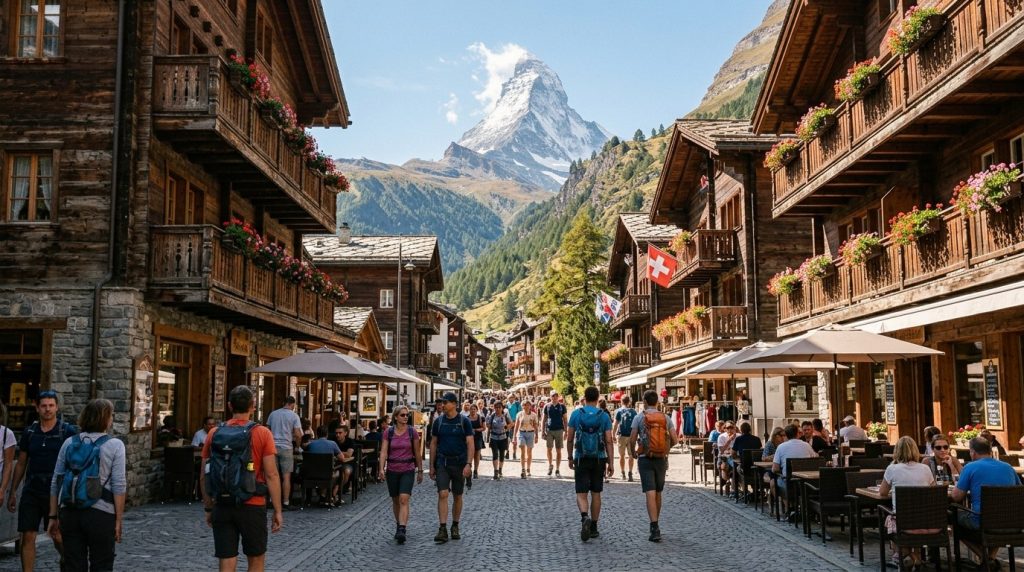
Bahnhofstrasse and the streets just off it put you within a flat five-minute walk of the train station, restaurants, and most lift departure points, which is why Zermatterhof, Schweizerhof, and Hotel Post all cluster there.
Paying extra for a confirmed Matterhorn-facing room only matters if you plan to spend real time on the balcony, since the mountain is visible from many street corners in town anyway. Anyone skiing first thing every day should weight CERVO’s private Sunnegga lift, or a short walk to the Gornergrat station, over a village-centre address.
Things to do in Zermatt
Matterhorn Glacier Paradise is Europe’s highest cable car station, lifting visitors to roughly 3,883 metres for a close-up view of the Matterhorn’s south face and an ice cave carved into the glacier itself. A round-trip ticket from Zermatt runs CHF 104 in low season (November to April) and rises to CHF 132 in high season (July and August), with a Swiss Travel Pass cutting the fare by half.
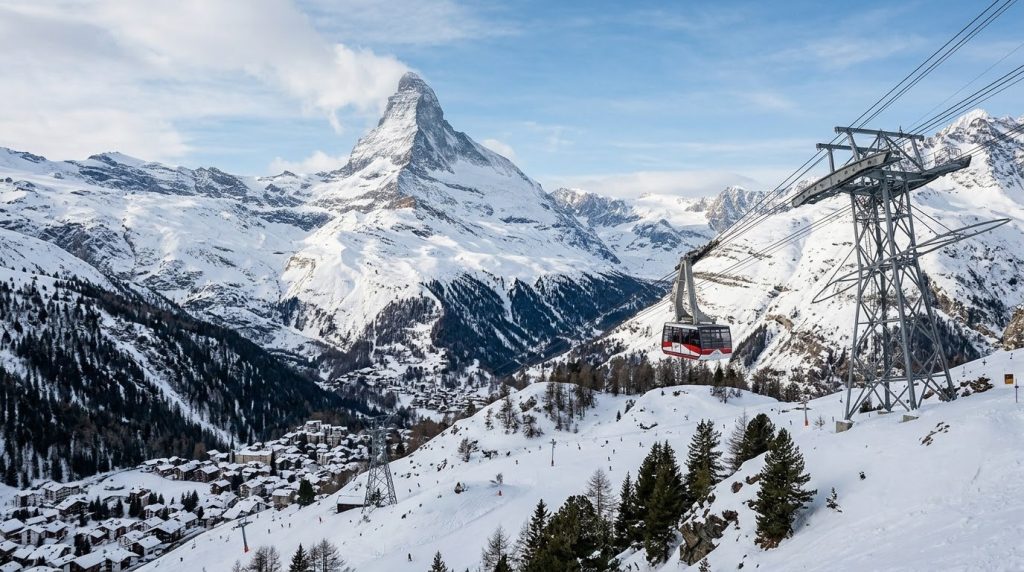
The Gornergrat cogwheel railway, running since 1898, climbs 1,485 vertical metres over a 9.3-kilometre track from Zermatt’s 1,604-metre station to the 3,089-metre summit, making it one of the highest open-air rack railways in Europe.
A round-trip adult ticket costs CHF 96 in winter (November to April) and CHF 132 in summer (May to October), and the ride is widely rated as the single best vantage point for photographing the Matterhorn without a hike.
For a lower-key outing, the Five Lakes Trail (5-Seenweg) links a string of small alpine lakes between the Sunnegga and Blauherd stations, with several of the lakes reflecting the Matterhorn on a calm day. It is a moderate walk rather than a technical hike, and it pairs well with either cable car ticket above as a half-day add-on without committing to a full mountain excursion.
When these hotels are the wrong choice
Zermatt is car-free, so nobody drives to any of these hotels. Drivers leave their car at the Matterhorn Terminal in Täsch, a 2,100-space covered garage, and ride a roughly 12-minute shuttle train into Zermatt that runs about every 20 minutes, then walk or taxi the last stretch with luggage.
That adds real time and a transfer to every arrival and departure, which is a dealbreaker for anyone wanting to unload a car at their hotel door.
Several hotels also close for weeks between seasons, typically mid-April to mid-June and again in the back half of autumn, and Mont Cervin Palace’s own September 20 to December 10 closure is a clear example. Book a shoulder-season trip without checking exact reopening dates and a reservation can simply not exist. Finally, a Matterhorn view is genuinely weather-dependent.
Cloud sits on the mountain often enough in any season that paying a premium for a view room is a bet, not a guarantee, and a village-view room on a clear morning can outperform a Matterhorn-facing room on an overcast one.
What to know before you go
Zermatt village sits at 1,604 metres, and both main cable cars climb well above 2,000 metres, the altitude where mild altitude sickness can begin for sensitive travellers.
Headaches, light dizziness, and shortness of breath are the most commonly reported symptoms at Matterhorn Glacier Paradise’s 3,883-metre summit station, so pace the first day at altitude, drink more water than usual, and keep the visit short if symptoms appear rather than pushing through a full day on the mountain.
Switzerland runs on the Swiss franc, and most hotels and restaurants in Zermatt take major cards without issue, but smaller mountain huts, kiosks, and ski-lift snack bars can still be card-only or cash-only depending on the outlet, so carrying a mix of both avoids a stranded moment partway up the mountain.
Layers matter more than any single jacket: temperatures at the 3,089-metre Gornergrat summit or the 3,883-metre glacier station run noticeably colder and windier than the village below, even in summer, so a warm layer and sun protection belong in the bag regardless of the season on the itinerary.
Zermatt’s own train station connects directly to Täsch, Visp, and the wider Swiss rail network, so once luggage is unloaded at a hotel, no car is needed for the rest of the stay; every lift, trail, and restaurant in this guide sits within walking distance or a short train ride of the village centre.
Pairing Zermatt with the rest of Switzerland
Zermatt works well as one stop on a longer Alpine loop rather than a standalone trip. Travelers heading north often route through the Interlaken hotels where to stay guide before continuing to Grindelwald, and a well-planned Grindelwald travel guide covers the Eiger side of that same region.
Those adding a lake city can check where to stay in Lucerne for a lower-altitude break between mountain stops, and the broader Swiss Alps travel guide ties the whole itinerary together with train routing between all four bases.