Florence Itinerary: 1, 2 and 3 Days (2026)
Disclosure: Some links in this guide are affiliate links. If you book or buy through them, we may earn a small commission at no extra cost to you — it helps keep our guides free.
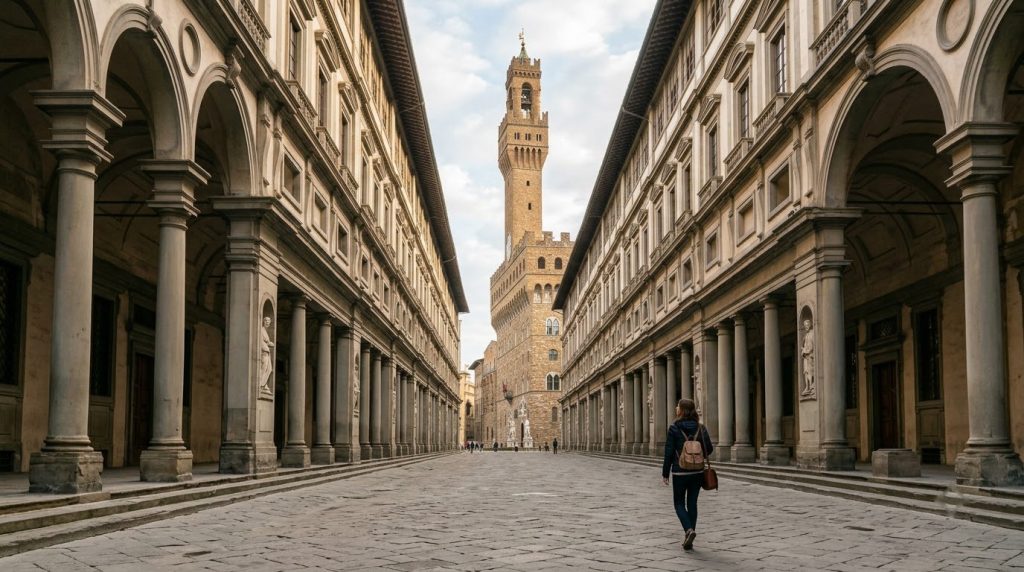
A 2-day Florence itinerary covers the Uffizi Gallery, the Duomo and the Accademia’s David without feeling rushed, while a 3-day Florence itinerary adds a Tuscany day trip for Chianti vineyards or San Gimignano. The right length depends on whether Florence is your main stop or one leg of a wider Italy trip.
| Days | Route | Booked in advance | Approx cost/person (USD) |
|---|---|---|---|
| 1 day | Duomo area, Uffizi, Ponte Vecchio | Uffizi timed entry | USD 90-110 (EUR 78-95) |
| 2 days | Add Accademia, Boboli Gardens, Oltrarno | Uffizi + Accademia timed entry | USD 160-200 (EUR 138-172) |
| 3 days | Add a Chianti or San Gimignano day trip | Uffizi + Accademia + tour or car rental | USD 240-300 (EUR 207-259) |
Prices convert at roughly USD 1.16 per EUR 1 as of September 2026 and exclude lodging.
Getting to Florence: airport, train and the T2 tram
Most travelers reach Florence either by air through Amerigo Vespucci Airport (FLR), a few kilometers north of downtown, or by train into Santa Maria Novella station, which sits within easy walking distance of the Duomo.
The T2 tram line now runs directly between the airport and Santa Maria Novella, with departures roughly every 10 minutes and a ride of about 21 to 23 minutes; a single ticket costs EUR 2 (about USD 2.30). Bus line 23 covers similar ground for about EUR 1 to 2, though the trip runs closer to 40 minutes.
A fixed-rate taxi from the airport into the center runs roughly EUR 20 to 32 depending on the time of day, with daytime rates at the lower end and evening, weekend, and holiday rates higher, plus a small per-bag surcharge of around EUR 1 to 1.20.
Private car or minivan transfers start from about EUR 45 and suit groups or anyone arriving with heavy luggage who wants a fixed price booked in advance rather than a metered fare.
Travelers connecting from Rome, Milan, Venice, or Pisa generally arrive by train rather than by air, since rail links between those cities and Florence are frequent and land directly at Santa Maria Novella, about a 10 to 15 minute walk from the Duomo and the start of the one-day itinerary below.
Whichever way you arrive, Florence’s historic center is compact enough that once you are off the tram, bus, or train, nearly every stop on this itinerary is reachable on foot.
Renting a car for the city portion of the trip is more a liability than a help, since most of the center falls inside a restricted traffic zone that visiting cars cannot enter without a permit; save the rental for the Tuscany day trip on day three instead.
Best time to visit Florence
April through June and September through October are Florence’s shoulder-season sweet spot, combining mild temperatures with lighter crowds than peak summer. Spring days warm steadily from around 59°F (15°C) in March to the mid-70s°F (23-24°C) by late May, while fall cools from the high 70s°F (around 26°C) in September to about 70°F (21°C) in October. Month-by-month weather and crowd patterns are broken down in our guide to the best time to visit Italy.
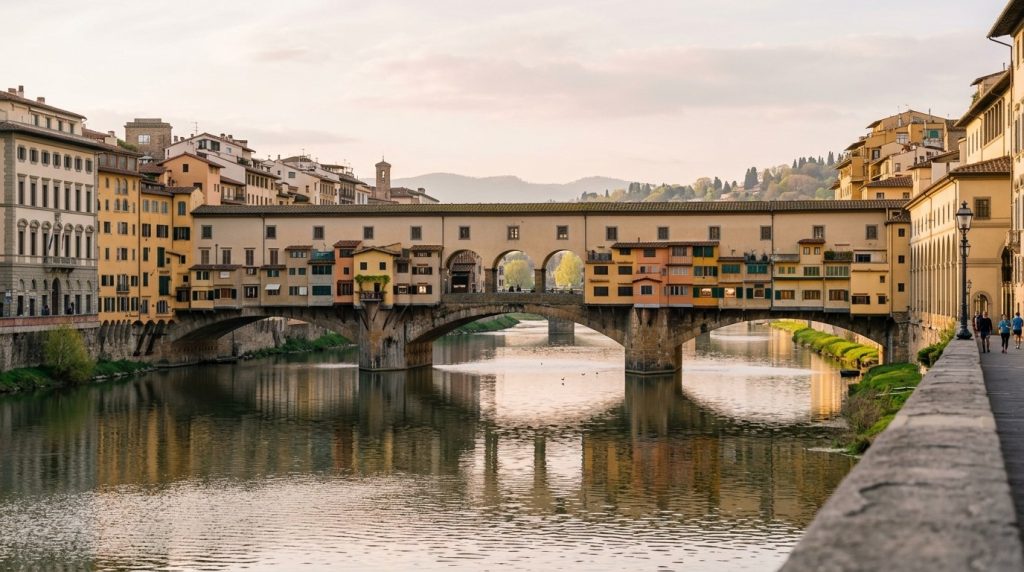
Summer, especially July and August, brings the heaviest heat, with highs regularly climbing into the high 80s and sometimes the 90s°F, and it is also when Florence is at its busiest and priciest; many Italian businesses close for stretches of August as locals leave the city.
Winter runs cold, with daytime highs around 50-53°F (10-12°C) and nights near or below freezing, but it is the quietest and cheapest season, and museum queues shrink accordingly.
November tends to be the wettest month, though October, December, March, and April also see a fair amount of rain, so packing a compact umbrella is worth it outside the driest summer months.
For this itinerary specifically, the Tuscany day trip on day three is more comfortable in spring or fall, when neither the Chianti vineyards nor San Gimignano’s hilltop streets are baking in midsummer heat, and the sunset view from Piazzale Michelangelo lingers longer in the evening light during the longer spring and summer days.
1-day Florence itinerary
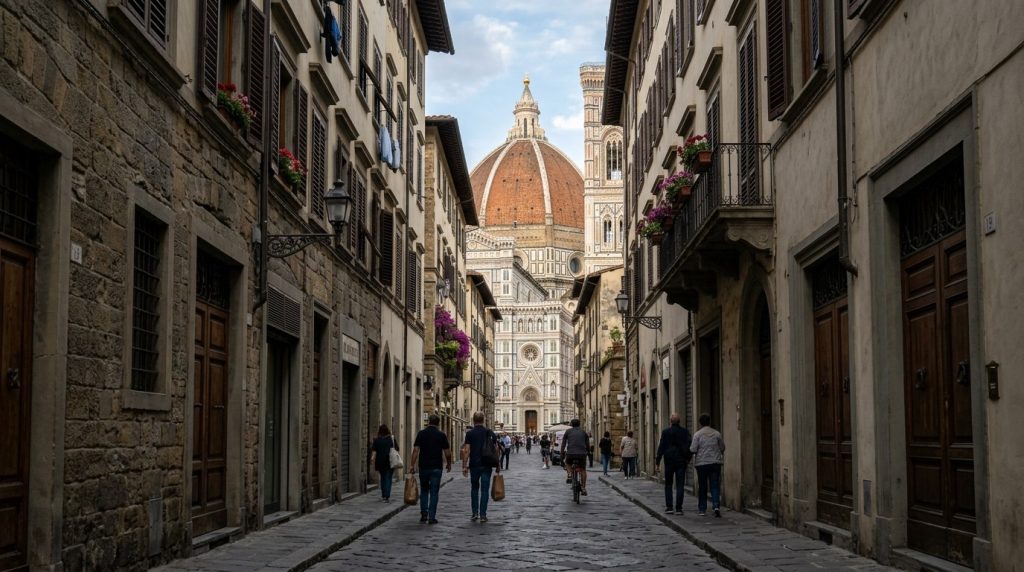
One day is enough to see Florence’s headline sights but only one major museum, so pick the Uffizi Gallery over the Accademia unless Michelangelo’s David is your priority. Start early at the Duomo complex, since Brunelleschi’s dome and the baptistery draw long lines by mid-morning.
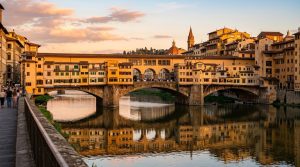
Walk to the Uffizi for a pre-booked timed entry, budgeting two to three hours for the Botticelli and Renaissance rooms. In the afternoon, cross the Ponte Vecchio to the Oltrarno district for lunch away from the tourist-menu streets near the Duomo.
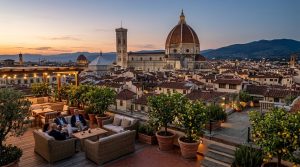
Close the day at Piazzale Michelangelo for the sunset view over the city, reachable on foot in about 25 minutes from the Ponte Vecchio or by bus 12 or 13. This plan skips the Accademia and Boboli Gardens entirely, so anyone who wants to see the original David should extend to two days.
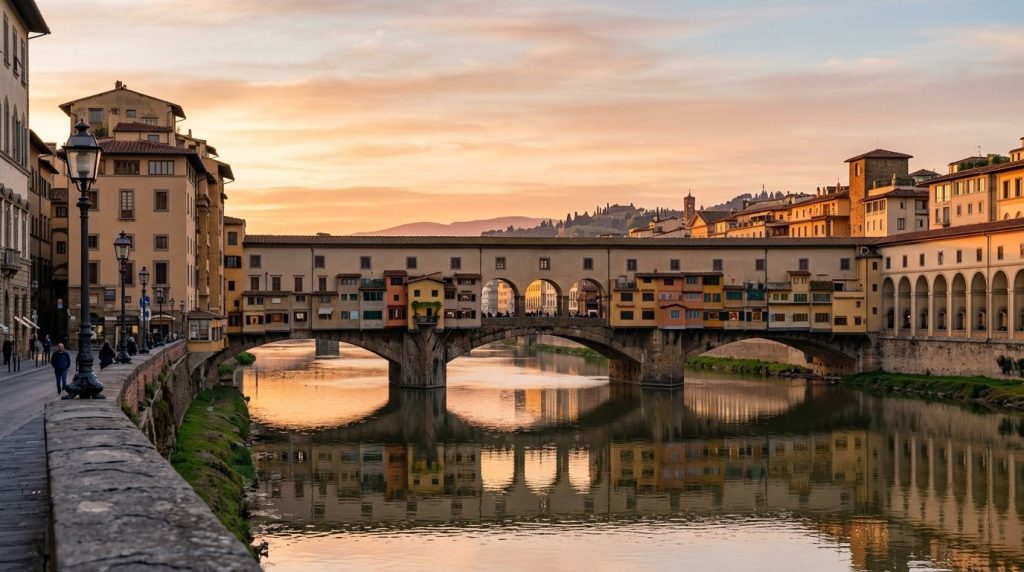
2-day Florence itinerary – the length most visitors should pick
Two days is the itinerary length most first-time visitors should choose, since it fits both headline museums without a rushed schedule. Day one follows the one-day plan above: Duomo, Uffizi, Ponte Vecchio and Piazzale Michelangelo. Day two starts at the Galleria dell’Accademia to see Michelangelo’s David, ideally in a morning slot before tour groups arrive. Those mapping out a day-by-day plan will find a ready-made outline in our Italy itinerary.
From there, walk to the Basilica di Santa Croce, then spend the early afternoon in the Boboli Gardens and Pitti Palace on the Oltrarno side of the river. Late afternoon suits the San Lorenzo Market and the Mercato Centrale food hall for a slower final dinner.
This pacing keeps each museum visit to half a day, which matters because both the Uffizi and the Accademia are large enough that rushing through in under 90 minutes means missing entire wings. Travelers combining Florence with Rome often use this two-day Florence block as the middle leg of a longer Italy trip.
3-day Florence itinerary with a Tuscany day trip
Three days works when a Tuscany day trip matters as much as the city itself, since the extra day goes to the countryside rather than more Florence sights. Days one and two follow the two-day plan: Duomo and Uffizi first, Accademia and Oltrarno second.
Day three leaves the city for Chianti wine country or the hill town of San Gimignano, either as a self-drive rental or a guided small-group tour that includes a winery lunch.
Chianti trips typically run 6 to 8 hours door to door with two or three stops, while San Gimignano alone can be done as a half-day if paired with Siena in the afternoon.
Travelers without a car should book an organized tour rather than attempt Tuscany by public bus in a single day, since regional bus connections between small hill towns are infrequent.
This itinerary length also works well for anyone extending toward the coast afterward with a Cinque Terre itinerary, since Florence sits roughly 90 minutes from La Spezia by direct train.
Church dress code and other Florence sightseeing rules
The Duomo complex, including the Cathedral and the Baptistery, enforces a strict dress code: shoulders and knees must be covered, and flip-flops, tank tops, and short skirts or shorts above the knee are not permitted past the entrance.
Staff at the door do turn visitors away or ask them to cover up with a scarf, so carrying a light shawl or packable layer is worth it even in midsummer heat.
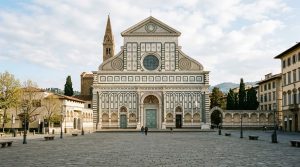
Florence’s other major churches, including Santa Croce and Santa Maria Novella, operate under the same general standard that applies to Catholic churches across Italy, so the same shoulders-and-knees rule is the safe default anywhere on this itinerary that involves stepping inside a church rather than only viewing it from the piazza outside.
Bags are typically screened at the entrance to the Uffizi, the Accademia, and the Duomo complex, and large backpacks or suitcases may need to be checked or left behind, so travel light on museum days rather than arriving straight from a train with full luggage.
Photography without flash is usually allowed inside the museums on this itinerary, though flash and tripods are commonly restricted to protect the artwork, and video recording rules vary by site, so check signage at the entrance rather than assuming the same policy carries from one museum to the next.
The Firenze Card: worth it for a longer stay
The Firenze Card costs EUR 85 (about USD 99) and is valid for 72 hours from the first museum you enter with it, covering one admission each to more than 60 museums, villas, and gardens across the city, including the Uffizi, the Accademia, the Pitti Palace, and the Boboli Gardens.
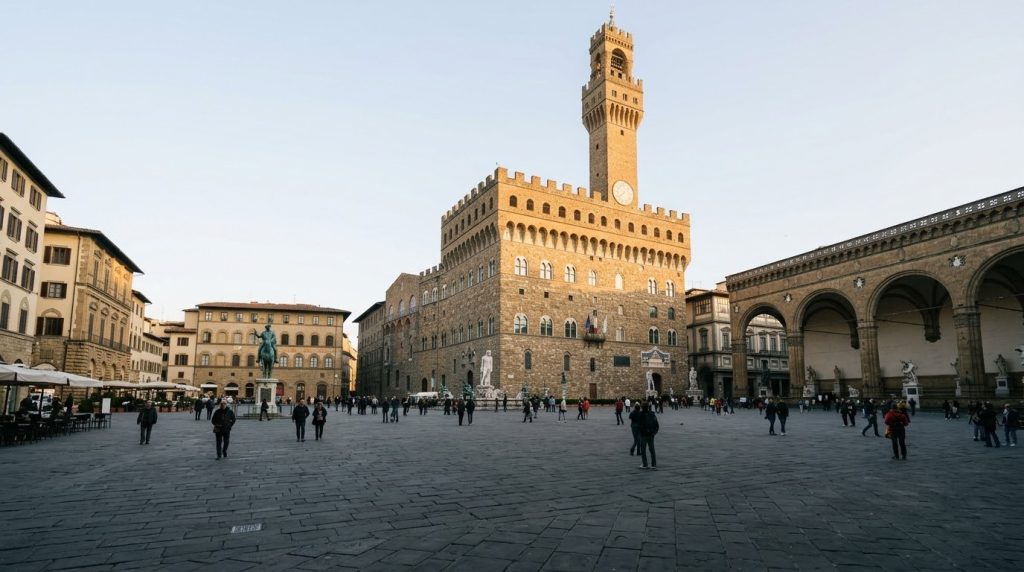
For a one or two-day visit focused only on the Uffizi and the Accademia, buying individual timed-entry tickets for those two museums still works out cheaper than the card, so it is not automatically the better deal.
The math shifts on a three-day visit that also wants the Pitti Palace and Boboli Gardens from the two-day plan above, since those add their own separate entry fees on top of the Uffizi and Accademia if bought individually, and the Firenze Card folds all of them into one upfront price.
Booking windows for the Uffizi and the Accademia fill up fast in spring and summer regardless of which ticket type you hold, so reserve a specific entry slot for both as soon as the card is activated rather than assuming the card alone guarantees a walk-in spot.
The card does not cover Santa Croce, which charges its own separate entry fee outside the Firenze Card circuit, so budget for that admission on top of the card if it is part of your plan.
Families should also check the card’s children’s pricing separately, since the Firenze Card’s free-entry age threshold for minors does not always match the age cutoffs used by individual museums like the Uffizi and the Accademia.
Staying connected: SIM and eSIM options in Florence
Most visitors now handle data in Florence with an eSIM activated before departure rather than hunting for a SIM shop after landing.
Entry-level eSIM data plans for Italy from providers such as Airalo and Saily typically start around USD 4 for about 1GB valid for roughly a week, scaling up through tiers like 5GB for around USD 13 and 10GB for around USD 21 for longer or heavier-use trips; Holafly and similar unlimited-data providers price their plans differently, often as flat-rate unlimited packages rather than fixed data caps, and typically cost more per day than the tiered plans but remove any worry about running out of data mid-trip.
Because pricing and included data change often, compare current plans shortly before your trip rather than relying on last year’s rates.
An eSIM-capable phone connects automatically to a local network the moment you land, which matters for the T2 tram and bus apps covered above, for mapping your way between the Duomo and the Uffizi, and for showing timed-entry tickets on your phone screen at the museum turnstile.
Make sure your phone is eSIM-compatible and unlocked before buying a plan, since a locked phone tied to a home carrier may not accept a second profile.
Travelers who prefer a physical SIM can still buy one from a phone carrier store in the city center, though this generally takes longer than activating an eSIM in advance and requires presenting a passport at purchase under Italian registration rules.
What to book before you arrive
Timed entry at the Uffizi and the Accademia is the single booking that protects a Florence itinerary, because both museums cap walk-up sales and a same-day ticket is not guaranteed. A standard Uffizi ticket costs EUR 25 at the door or EUR 29 booked online, where the extra EUR 4 is the reservation fee that guarantees an entry slot.
In USD that online price is roughly USD 34 (EUR 29) at the September 2026 rate. The Accademia follows the same structure: EUR 16 at the door versus EUR 20 online, also a EUR 4 reservation fee, working out to about USD 23 (EUR 20).
Both museums sell out advance slots during spring and summer, sometimes weeks ahead for popular morning times, so booking two to four weeks before your visit date gives the widest choice of slots; booking inside a week often leaves only afternoon entries.
EU citizens aged 18 to 25 pay a reduced EUR 2 at both museums with ID, and visitors under 18 enter free with proof of age.
An unbooked visitor who shows up hoping for a same-day slot risks losing an hour or more in a standby queue, or missing the museum entirely on a sold-out day, which effectively costs half of a one-day itinerary.
When a shorter Florence trip is the right answer
A shorter Florence trip, or even a single day, makes sense when Florence is not the main event of the wider Italy trip.
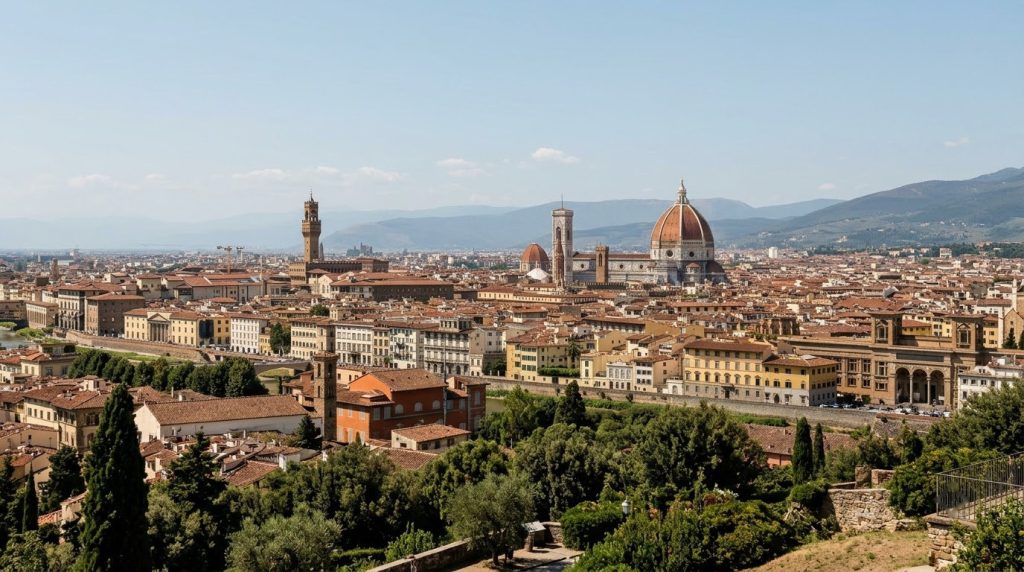
Day-trippers based in Rome can reach Florence by high-speed train in about 90 minutes each way, which supports a single intensive day covering the Duomo and one museum before the last train back; travelers taking this route should check this Rome itinerary in 3 days for how to sequence Florence around Rome’s own sights, and see this guide to where to stay in Rome for a base near Termini station for easy morning departures.
Travelers already staying in Tuscan countryside agriturismos or in towns like Siena or San Gimignano often prefer several half-day trips into Florence over one long stay in the city itself, since a Tuscany base cuts hotel costs and puts Chianti closer.
Anyone continuing south afterward toward Positano or Sorrento should also weigh a shorter Florence stop against more time on this Amalfi Coast travel guide route, since Florence-to-Amalfi connections require a change in Naples and eat most of a travel day.
How to decide – quick cheat sheet
– Pick 1 day if Florence is a stop on a longer Italy trip and you care most about the Uffizi and the Duomo. – Pick 2 days if this is your only Florence visit and you want both the Uffizi and the Accademia without rushing. – Pick 3 days if a Chianti or San Gimignano day trip matters as much as the city center. – Book Uffizi and Accademia timed entry two to four weeks ahead regardless of trip length. – Base in Tuscan countryside instead of Florence if you plan several day trips rather than one city stay.
Where to stay in Florence
Find your Florence hotel on the map
Live prices from Booking, Airbnb and more — move the map or change dates to compare stays around Florence.