How Many Days in Florence? (2026)
Disclosure: Some links in this guide are affiliate links. If you book or buy through them, we may earn a small commission at no extra cost to you — it helps keep our guides free.
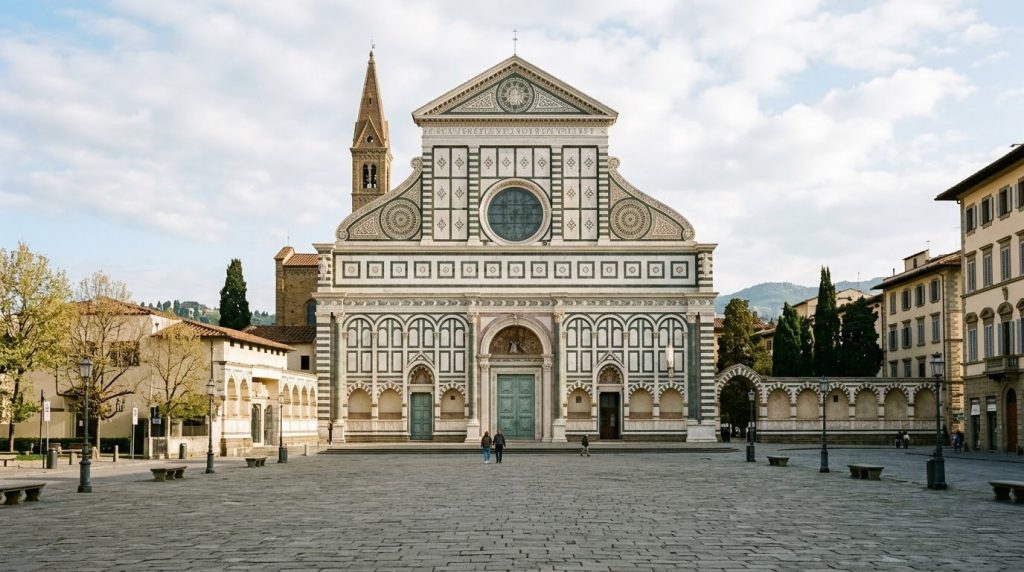
The direct answer to how many days in Florence you need is 2 days for the essential sights or 4 days for a relaxed pace that adds a Tuscany day trip. First-time visitors chasing the Uffizi Gallery, the Duomo, and Michelangelo’s David fit best into 2 days, while repeat visitors, art lovers, and travelers already based in Tuscany should plan on 4 to 5 days.
| Trip length | What you fit in | Who it suits | Approx cost/person (USD) |
|---|---|---|---|
| 1 day | Duomo exterior, Ponte Vecchio, one museum | Day-trippers from Rome or nearby Tuscany | USD 140 (EUR 120) |
| 2 days | Uffizi, Accademia, Duomo climb, Oltrarno | First-timers with limited vacation days | USD 320 (EUR 275) |
| 3 days | Above, plus Boboli Gardens, a market, slower pace | Most first-time visitors | USD 460 (EUR 395) |
| 4-5 days | Above, plus one Tuscany day trip (Siena, Chianti) | Repeat visitors, art lovers, Tuscany-based travelers | USD 650-820 (EUR 560-705) |
Currency note: figures use EUR 1 = USD 1.16, the mid-market rate as of September 2026.
Florence in 1 day
One day in Florence covers the historic center’s headline sights but forces you to pick a single museum, not both the Uffizi and the Accademia.
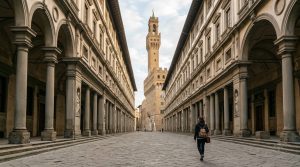
Start early at Piazza del Duomo to see the cathedral exterior and Giotto’s bell tower before the square fills with tour groups, then walk to either the Uffizi Gallery (Botticelli, Renaissance masters) or the Accademia Gallery (Michelangelo’s David), since visiting both in one day means rushing each.
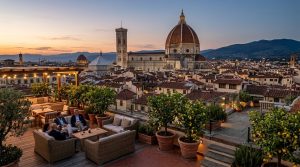
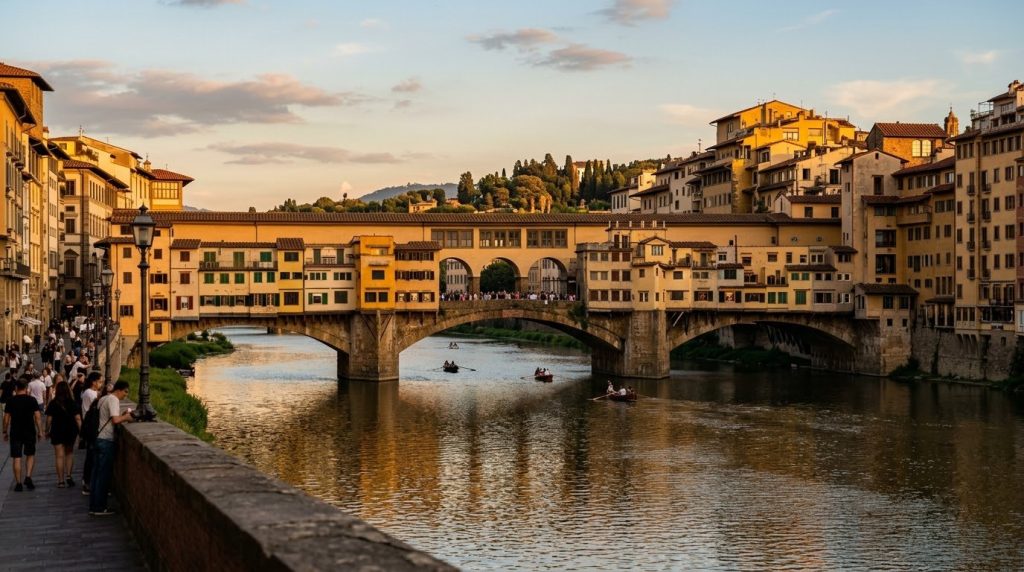
Cross the Ponte Vecchio at midday, eat lunch in the Oltrarno neighborhood away from the main crowds, then finish with a walk to Piazzale Michelangelo for a sunset view over the city. If you are arriving by train from Rome, subtract roughly three hours for the round trip, which leaves six to eight hours of actual sightseeing time.
A single day works as an introduction, not as a substitute for a full visit.
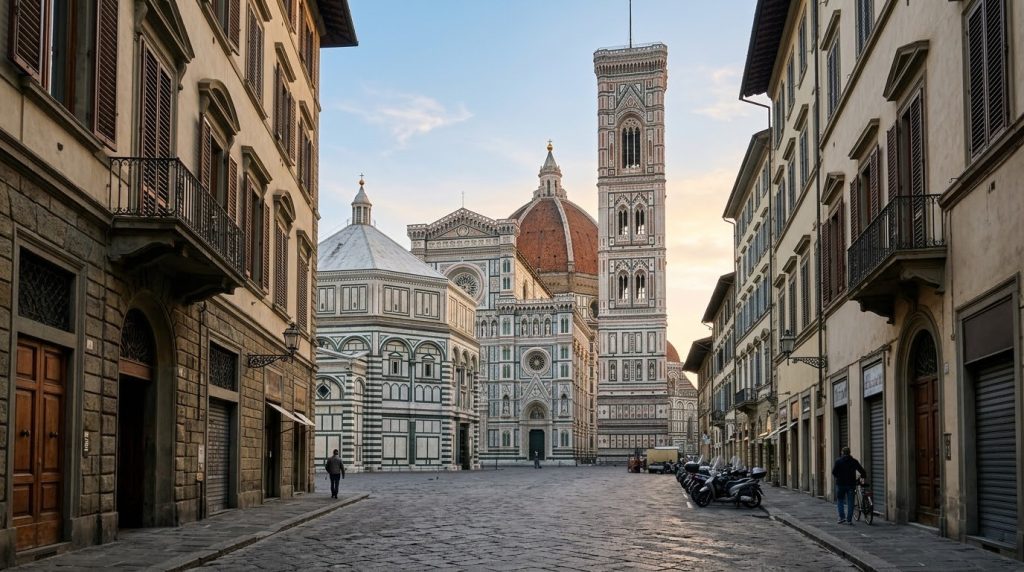
Florence in 2 days – the length most visitors should pick
Two days is the length most first-time visitors should pick because it fits both major museums without a sprint. Spend day one on Renaissance art: the Uffizi Gallery in the morning with a pre-booked timed slot, then the Duomo complex in the afternoon, including the cathedral dome climb if you booked that separately in advance.
Use day two for the Accademia Gallery in the morning to see the David, followed by the Oltrarno side of the Arno river for artisan workshops, the Pitti Palace, and a slower dinner away from the tourist-heavy streets near the Duomo.
This pace still requires booking the Uffizi and Accademia ahead of the trip, since both museums run on timed entry during high season. Two days is tight if you also want the Boboli Gardens or a cooking class, but it covers everything most travelers associate with Florence.
Florence in 3 days
Three days keeps the same core itinerary as the 2-day version but removes the rush and adds room for one slower-paced day.
Use the extra day for the Boboli Gardens behind the Pitti Palace, the San Lorenzo market for leather and food stalls, and a longer walk through the Santa Croce district, where the basilica houses tombs of Michelangelo and Galileo.
Three days also gives enough buffer to handle a rained-out morning or a sold-out timed-entry slot without losing an entire sightseeing block. This is the length to choose if you want to see the major museums without checking the clock every hour, but you are not yet ready to commit to a full Tuscany side trip. Travelers torn between the two destinations can weigh the trade-offs in our Florence vs Venice comparison.
Florence in 4 to 5 days
Four to five days is enough to add one full day trip into the Tuscan countryside without cutting into your Florence sightseeing time. Siena, roughly 90 minutes away by bus or car, adds a second Gothic cathedral and a car-free medieval center built around the shell-shaped Piazza del Campo.
A Chianti wine day trip, whether self-driven or on a small-group tour, adds vineyard visits and a countryside lunch that Florence itself cannot offer.
Travelers extending north can also treat Florence as a base before or after a separate coastal leg; a Cinque Terre itinerary pairs naturally with a Tuscany trip since both are reachable by train from Florence’s Santa Maria Novella station.
Five days rather than four gives you a rest morning or a second countryside option, such as San Gimignano, without feeling rushed.
Why museum booking changes your trip length
Timed entry at the Uffizi Gallery and the Accademia Gallery is the detail that most planning guides underweight, and it can effectively cost you a day if you ignore it.
As of 2026, standard Uffizi tickets cost EUR 25 (USD 29) bought on-site or EUR 29 (USD 34) booked online in advance, and entry is tied to a specific time slot rather than a walk-up queue.
The Accademia Gallery, home to the David, charges EUR 16 (USD 19) at the ticket office when slots remain, or EUR 20 (USD 23) for an advance online booking that includes a EUR 4 reservation fee.
During spring, summer, and the Christmas period, walk-up slots for both museums routinely sell out by mid-morning, and unbooked visitors either queue for over an hour or miss the museum entirely. That lost time is the same crowding pattern seen at major sights in the best time to visit Rome guides, where peak-season timed entry has the same effect.
Booking both museums before you leave home is what actually determines whether 2 days is enough or whether you need 3.
When fewer days is the right answer
Fewer days makes sense for two specific traveler types: Rome-based day-trippers and travelers who prefer to base themselves in the Tuscan countryside instead of central Florence.
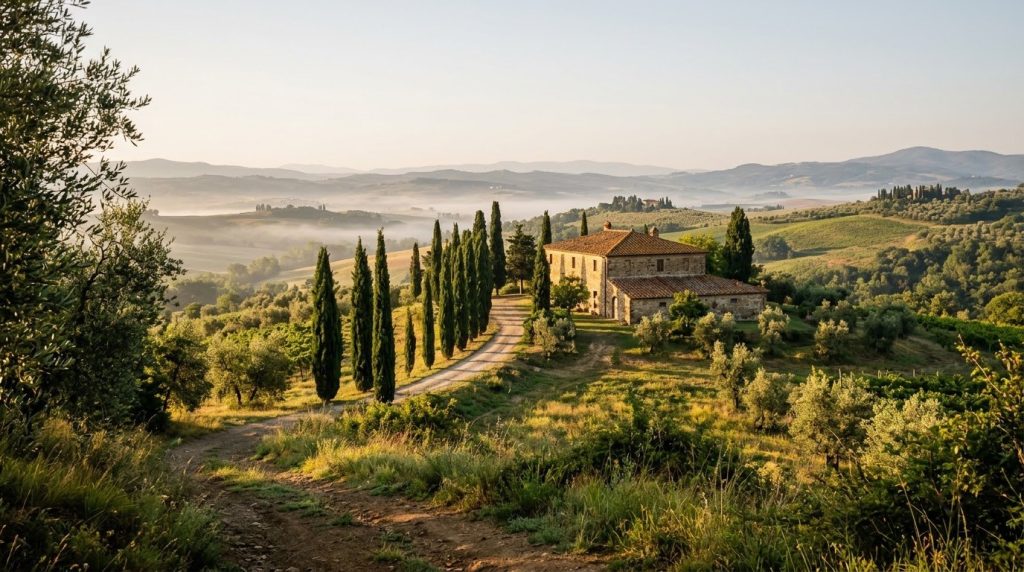
Florence sits about 275 km (170 miles) north of Rome, and the fastest Frecciarossa high-speed trains cover it in as little as 1 hour 22 minutes, with typical journeys closer to 1.5 hours; one-way advance fares start around EUR 19.90 (USD 23) and rise closer to departure.
That makes Florence a realistic single-day trip for anyone already following a 3-day Rome itinerary who wants one Tuscan day without changing hotels.
The second case is travelers staying in a Chianti or Val d’Orcia farmhouse who visit Florence as a single excursion by car or bus rather than sleeping in the city; if you have already sorted out where to stay in Rome as your base and only want a taste of Florence, one focused day beats a rushed overnight stay.
Pisa as an easy half-day add-on
Pisa is a different kind of day trip than Siena or Chianti, since it is genuinely fast and mostly done by early afternoon rather than taking a full day.
High-speed trains from Florence’s Santa Maria Novella station reach Pisa Centrale in as little as 46 to 51 minutes, with one-way tickets starting around USD 9 to USD 14 (EUR 8 to EUR 12) depending on the specific train and how far ahead you book.
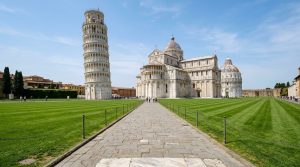
From Pisa Centrale, it is a 20 to 25-minute walk or a short bus ride to the Piazza dei Miracoli, home to the Leaning Tower, the cathedral and the baptistery, and most visitors cover the square itself, the photo spot, and a look inside the cathedral in two to three hours.
Climbing the tower itself runs on a timed-entry system with a strict visitor cap per slot, so it is worth booking that specific ticket online in advance, especially from spring through early autumn when walk-up slots for the climb sell out the way Uffizi and Accademia slots do.
Because the round trip from Florence takes under two hours of total train time, Pisa fits comfortably as a half-day excursion squeezed into a 3-day Florence itinerary without needing the extra overnight that Siena or a Chianti wine tour effectively requires, and it pairs naturally with an early Uffizi or Accademia slot on the same day if you plan the order with the museum’s opening time in mind.
Travelers who have already added Siena or Chianti to a 4 or 5-day trip and still have a half day spare can treat Pisa as the easiest extra stop on the list, rather than a reason to add a sixth day.
Travelers who want to turn the half day into a fuller one can continue from Pisa Centrale to Lucca, a walled medieval town about 25 to 30 minutes further by train for roughly USD 5 (EUR 4), and spend the rest of the afternoon walking or cycling the top of Lucca’s intact city walls before heading back to Florence in the evening.
That Pisa-then-Lucca combination fills a full day comfortably without an overnight stay, since both legs connect by the same regional rail line and neither town needs more than a few hours to see its highlights.
Keep luggage light for this kind of day trip: Santa Maria Novella station has a staffed left-luggage counter (KiPoint) for around USD 8 (EUR 7) a day, and a day spent walking a tower piazza and a city wall is easier without a suitcase in tow.
How to decide – quick cheat sheet
– Pick 1 day if you are day-tripping from Rome or staying in the Tuscan countryside and only want the headline sights. – Pick 2 days if this is a first visit and you want both the Uffizi and the Accademia without sprinting. – Pick 3 days if you want the same sights plus the Boboli Gardens, a market visit, and slack for a delay. – Pick 4 to 5 days if you want to add Siena, Chianti, or a connecting trip toward the coast. – Book Uffizi and Accademia tickets before you leave home regardless of trip length, since walk-up slots sell out in high season.
Where to stay for a short Florence trip
For a 1 to 3 day trip, staying inside or just outside the historic center cuts walking time to the Duomo, the Uffizi, and the Ponte Vecchio to a few minutes, which matters more when your sightseeing window is short. The map below shows live rates from Booking, Airbnb, and other providers around the city center so you can compare distance against nightly cost before deciding.
Find your Florence hotel on the map
Live prices from Booking, Airbnb and more — move the map or change dates to compare stays around Florence.