
Disclosure: Some links in this guide are affiliate links. If you book or buy through them, we may earn a small commission at no extra cost to you — it helps keep our guides free.
15 Best Things to Do in Prague in 2026: Local Guide
The best things to do in Prague in 2026 sit within a 30-minute walk of each other: Prague Castle, Charles Bridge, the Astronomical Clock on Old Town Square, the Jewish Quarter, and the beer halls of the Old Town. The compact medieval core is the whole appeal, and it means you can see the headline sights in two or three days without ever needing a taxi.
Prague drew 8,271,962 visitors in 2025 and kept climbing, welcoming 1,660,515 in the first quarter of 2026 alone, a year-on-year rise of roughly 5 percent (Prague City Tourism / Czech Statistical Office, 2026). That popularity is the one thing that shapes a good trip here: the same landmarks that are magical at 7 a.m. are shoulder-to-shoulder by noon. This guide covers what to see, the real 2026 prices, and the timing tricks that keep the crowds off your photos.
Key Takeaways
– Prague Castle grounds and courtyards are free and open daily 06:00–22:00; interior circuit tickets start at CZK 250 (about EUR 10), with the standard combined ticket around CZK 450 (Prague Castle, 2026).
– The Astronomical Clock’s Apostles procession runs hourly, 09:00–23:00, and is free to watch from Old Town Square; the sequence lasts roughly 45 seconds.
– A 90-minute public transport ticket costs CZK 50 (CZK 46 in the PID Litacka app) and covers trams, metro, and buses across the center (PID, 2026).
– Half a litre of Czech draught beer runs CZK 55–80 in ordinary pubs, still among the cheapest of any European capital.
– The Jewish Quarter combined ticket is CZK 550 and stays valid for three consecutive days across five historic sites.[PERSONAL EXPERIENCE] We spent four days in Prague in spring 2026 and split every morning between one major sight and one long walk. Crossing Charles Bridge at 6:40 a.m. with maybe a dozen other people on it, then watching the same bridge fill solid by 10, taught us more about visiting Prague than any opening-hours page. We came back to Old Town Square three separate evenings just to watch the clock strike from a different corner.
The Best Things to Do in Prague at a Glance
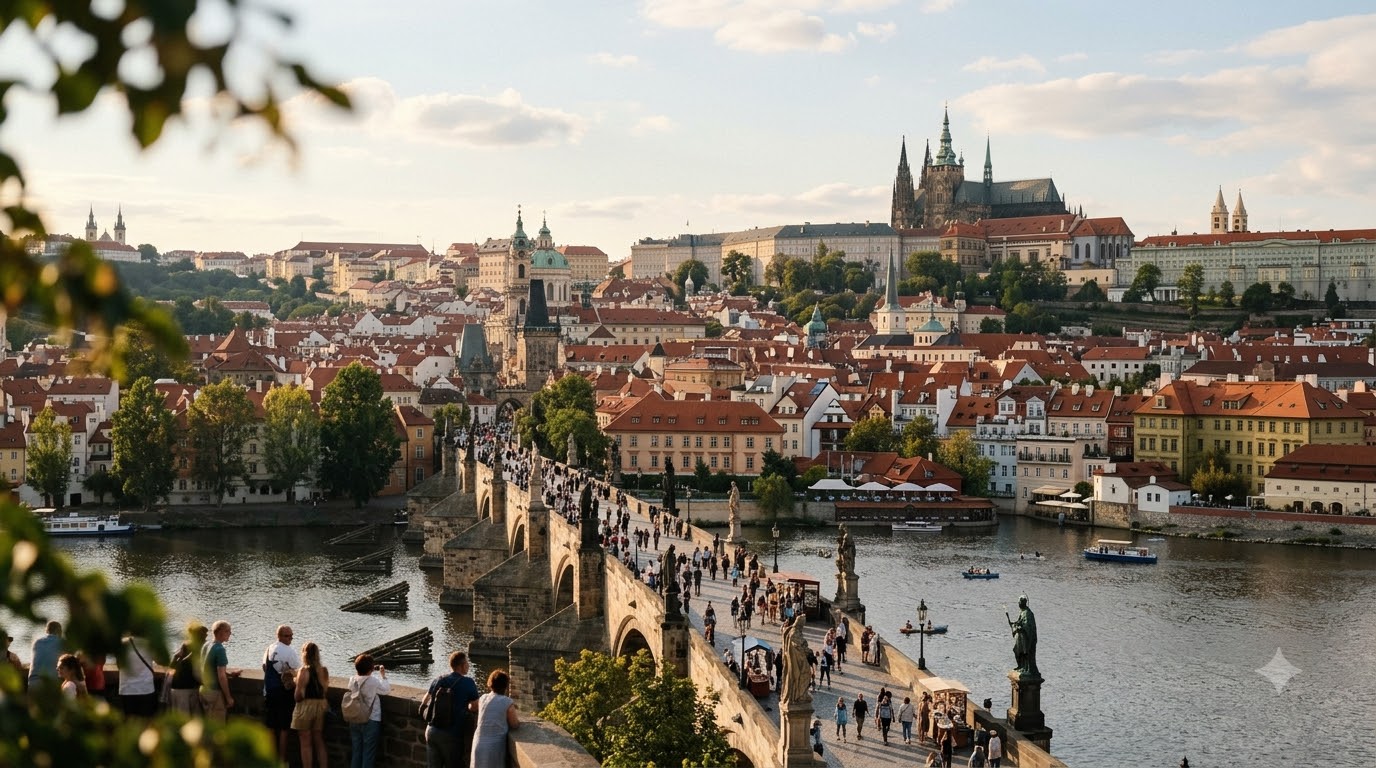
If you only have a short stay, these are the sights we would not skip, ordered roughly by how central they are:
- Prague Castle — the largest ancient castle complex in the world; free grounds, ticketed interiors from CZK 250.
- Charles Bridge — the 14th-century pedestrian bridge lined with 30 baroque statues; free, best at dawn.
- Old Town Square and the Astronomical Clock — the medieval heart, with the hourly clock show; free to stand and watch.
- Jewish Quarter (Josefov) — six synagogues and the Old Jewish Cemetery; combined ticket CZK 550.
- Petrin Hill and Lookout Tower — the city’s best panorama; tower tickets from CZK 250.
- Old Town beer halls — U Fleku (since 1499) and Lokal for fresh Pilsner Urquell.
Everything above except the beer halls is walkable in a single loop. We map the full route in our Prague travel guide, and squeeze it into a tight schedule in the 3-day Prague itinerary.
The 3-Day Prague Itinerary
The plan we use ourselves — sent straight to your inbox.
- Day-by-day route
- Where to stay
- Real 2026 costs
Free · No spam · Unsubscribe anytime
Explore Prague Castle, the World’s Largest Castle Complex
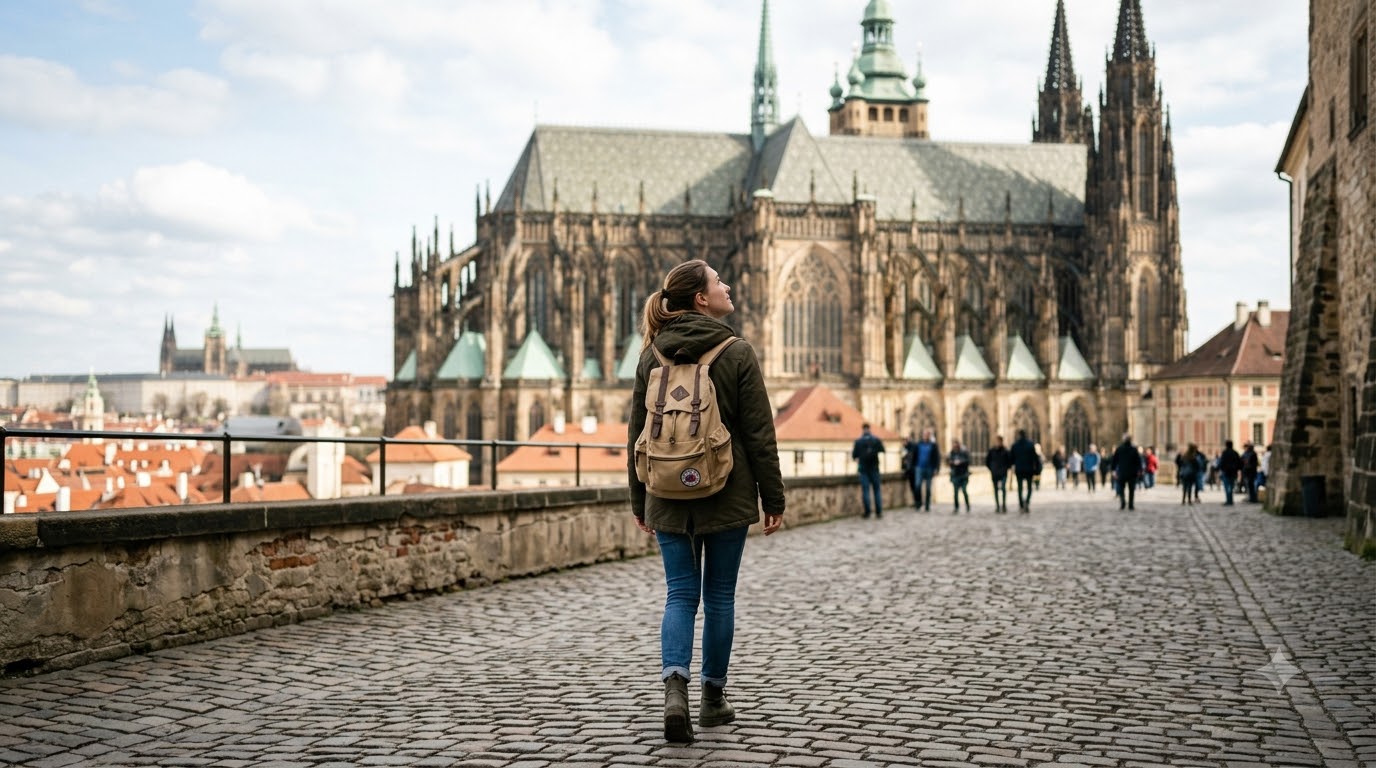
Prague Castle is the single must-see, and the grounds are free. The complex has been the seat of Czech power since the 9th century and, by area, is the largest coherent castle complex on earth. The gates, courtyards, and South Gardens are open daily 06:00–22:00 at no charge, so you can walk in, photograph St. Vitus Cathedral’s exterior, and leave without paying a crown.
You only pay to go inside the historic buildings, and there are a few ticket levels:
- Circuit ticket (short): from CZK 250, covering St. Vitus Cathedral, the Old Royal Palace, St. George’s Basilica, and Golden Lane.
- Standard combined ticket: around CZK 450 for the full set of interiors.
- Interior hours: 09:00–17:00 in summer, 09:00–16:00 in winter; the castle closes only on December 24.
On our last visit we were through the security check by 09:05 and had St. Vitus nearly to ourselves for fifteen minutes before the first tour groups arrived. Come up via the Malostranska tram stop and climb the Old Castle Stairs, or take tram 22 to Prazsky Hrad if you would rather arrive at the top. For where to base yourself relative to the castle, see where to stay in Prague.
Cross Charles Bridge at Dawn
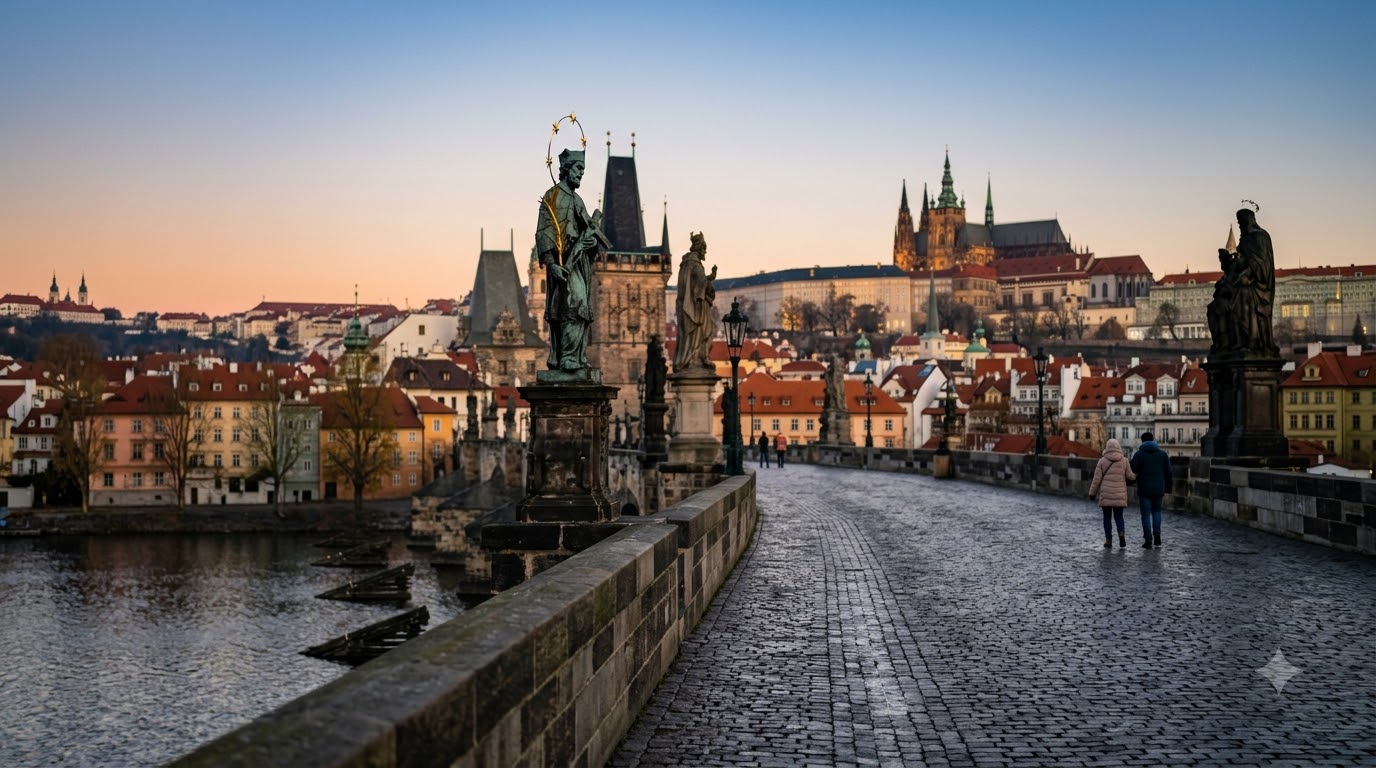
Charles Bridge is free, and dawn is the only time it feels the way the photographs promise. Commissioned by Emperor Charles IV in 1357, the stone bridge stretches roughly 515 metres across the Vltava, connecting the Old Town to the castle side, and it is lined with 30 baroque statues added mostly in the early 1700s. Touching the plaque of St. John of Nepomuk is the traditional wish-for-luck stop, which is why that one bronze relief is polished gold.
By mid-morning the bridge is a slow-moving crowd of caricature artists, buskers, and selfie sticks. We walked it four times and the difference between 6:45 a.m. and 10:00 a.m. was night and day. If you want the postcard shot of the castle framed by the bridge towers, be on the eastern (Old Town) end before sunrise. The Old Town Bridge Tower can be climbed for a small fee for an elevated view back along the span.
The 3-Day Prague Itinerary
Hour-by-hour plan, where to stay and what it really costs — free PDF.
Free · No spam · Unsubscribe anytime
Find your Prague hotel on the map
Live prices from Booking & Airbnb — tap a pin to compare stays around the Old Town and beyond.
Watch the Astronomical Clock in Old Town Square
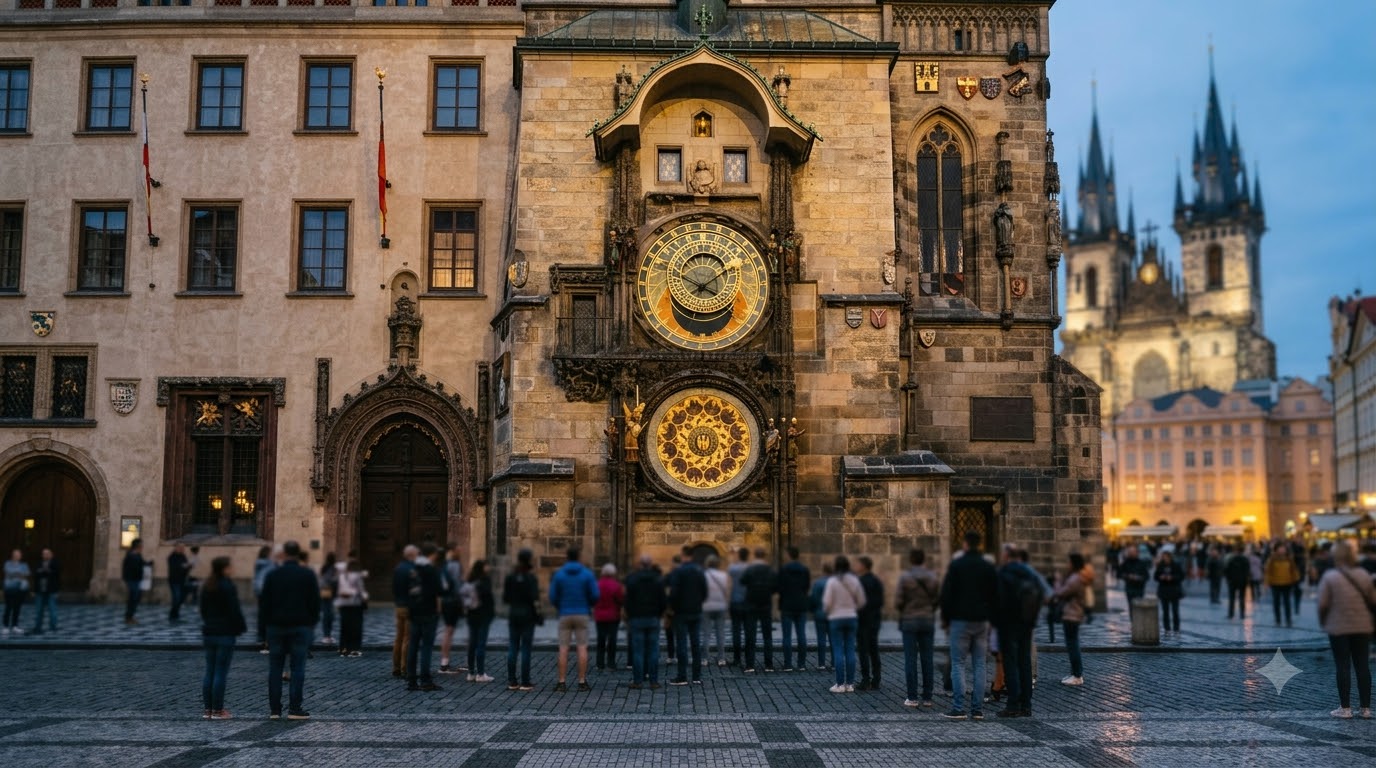
The Astronomical Clock (the Orloj) puts on a free show every hour, and it is the easiest highlight to build a plan around. Mounted on the Old Town Hall in 1410, it is the third-oldest astronomical clock in the world still running. On the hour from 09:00 to 23:00, the “Walk of the Apostles” begins: two windows open, twelve carved figures rotate past, a skeleton representing Death tolls a bell, and the whole thing wraps in about 45 seconds. It is short, a little anticlimactic, and completely worth seeing once.
For a better return on your time, buy the Old Town Hall tower ticket:
- Tower and interior ticket: CZK 350 for adults.
- Early-bird discount: 175 CZK at the box office during the first hour of opening each day.
- Tower hours: Tuesday–Sunday 09:00–20:00, Monday 11:00–20:00.
The tower gives you a rooftop view straight down onto the twin spires of the Tyn Church and the pastel facades ringing the square. Old Town Square itself is free and open around the clock, and it is where the Christmas and Easter markets set up. We watched the clock strike from three different spots on three evenings, and the far corner by the Kinsky Palace was the least crowded each time.
| Attraction | 2026 Entry (Adult) | Approx. EUR | Free Option |
|---|---|---|---|
| Prague Castle interiors | CZK 250–450 | EUR 10–18 | Grounds and courtyards free |
| Astronomical Clock tower | CZK 350 | EUR 14 | Hourly show free from square |
| Charles Bridge | Free | Free | Whole bridge free to cross |
| Jewish Quarter (5 sites) | CZK 550 | EUR 22 | Exterior streets free |
| Petrin Lookout Tower | from CZK 250 | from EUR 10 | Hill and gardens free |
Wander the Jewish Quarter (Josefov)
Josefov holds the most concentrated set of Jewish heritage sites in Europe, and one combined ticket covers most of it. The CZK 550 ticket (about EUR 22) admits you to five monuments of the Jewish Museum in Prague: the Maisel Synagogue, Pinkas Synagogue, Spanish Synagogue, the Ceremonial Hall, and the Old Jewish Cemetery. It stays valid for three consecutive days, which is generous if you would rather split the visit.
A few practical notes that shaped our morning there:
- Old Jewish Cemetery: roughly 12,000 gravestones are packed above an estimated 100,000 burials layered over centuries; it is the emotional core of the quarter.
- Old-New Synagogue: Europe’s oldest active synagogue is a separate CZK 200 supplement on top of the combined ticket.
- Opening days: the museum sites run Sunday–Friday and close on Saturdays and Jewish holidays, so plan around that.
- Time needed: budget two hours minimum, three if you add the Old-New Synagogue.
The Spanish Synagogue, with its gilded Moorish interior, was the one that stopped us in our tracks. Pinkas Synagogue, where the names of nearly 80,000 Czech and Moravian Holocaust victims are written on the walls, is a quiet, difficult, essential room.
Climb Petrin Hill for the Best View in Prague
Petrin Hill gives you the widest view over Prague, and the hill itself is a free public park. Rising about 130 metres above the river on the castle side, Petrin is laced with orchards, rose gardens, and quiet paths that almost nobody in the day-tour crowd bothers with. At the top stands the Petrin Lookout Tower, a 63.5-metre steel structure built in 1891 and modelled on the Eiffel Tower after Czech visitors saw the original in Paris.
- Lookout Tower tickets: from CZK 250; there is an extra charge to take the lift rather than climb the 299 steps.
- Funicular: the hillside funicular reopens around September 1, 2026 after reconstruction, with the single fare rising to CZK 100 (CZK 90 via the Litacka app).
- Free alternative: the walk up from the Ujezd tram stop takes 20–25 minutes through the gardens.
We climbed the tower steps late one afternoon and had the castle, the river bends, and the whole red-roofed sprawl laid out in the low sun. It beats the castle’s own terraces for a full-city panorama. Petrin is also the smart pick if you visit in shoulder season, which we break down in the best time to visit Prague.
Drink in Prague’s Historic Beer Halls
Drinking Czech beer in a proper hall is a genuine thing to do in Prague, not just a way to end the day. The Czech Republic drinks more beer per head than any other country, and Prague stays one of the cheapest capitals in Europe for it: a half-litre of draught runs CZK 55–80 in ordinary pubs, and CZK 45–70 in no-frills local spots away from the square.
Where we would send a first-timer:
- U Fleku — a brewing hall operating since 1499, pouring its own dark lager; CZK 70–100 per glass, touristy but historic.
- Lokal — fresh, unpasteurised Pilsner Urquell tanked daily; CZK 40–70 and a favourite of locals.
- Tourist-trap warning: bars right on Old Town Square and Charles Bridge charge CZK 90–120 or more for the same beer.
A practical tip we learned fast: in a traditional pub, a fresh beer keeps arriving until you put the coaster on top of your glass. Order the tank Pilsner where you can find it, and skip the imported lagers entirely.
Getting Around and Practical Tips for Prague
You will barely need public transport in the historic core, but when you do it is cheap and simple. Trams, the metro, and buses all share the same time-based tickets, and validity depends only on the clock, not the number of transfers.
- 90-minute ticket: CZK 50 (CZK 46 in the PID Litacka app, CZK 55 by SMS).
- 30-minute ticket: CZK 39 (CZK 36 in the app).
- Validation: stamp the ticket once when you board; re-stamping on a transfer voids it and risks a CZK 1,500 fine.
- Airport: bus 119 connects to the Nadrazi Veleslavin metro on a standard 90-minute ticket, far cheaper than a taxi.
- Currency: Prague uses the Czech koruna (CZK), not the euro; in 2026 roughly CZK 24 buys EUR 1, so carry koruna for pubs and markets.
Tram 22 is the sightseeing line worth knowing, running from the New Town up past the castle. For deciding which neighbourhood puts you closest to the sights, our where to stay in Prague guide compares Old Town, Mala Strana, and Vinohrady.
When to Go and What to Budget
The best months to visit Prague are the shoulder seasons of April–May and September–October, when the weather is mild and the crowds thin against the summer peak. Germany was the largest source market in early 2026 with 178,105 visitors, followed by the UK (117,682) and Italy (99,755), so expect the city busiest when those countries take their holidays (Prague City Tourism, 2026).
| Season | Months | Weather | Crowds | Notes |
|---|---|---|---|---|
| Spring | Apr–May | 12–20 C, mild | Moderate | Gardens bloom; best all-round value |
| Summer | Jun–Aug | 20–26 C, warm | Heaviest | Long days, busiest bridges |
| Autumn | Sep–Oct | 10–18 C, crisp | Moderate | Golden light, fewer tour groups |
| Winter | Nov–Mar | -2–5 C, cold | Light except markets | Christmas markets pack December |
A daily budget of EUR 70–110 covers a mid-range trip in 2026: a couple of paid attractions, tram tickets, and meals with beer in local pubs rather than square-front restaurants. We ran closer to EUR 80 a day by eating lunch at pubs one street back from the tourist spine.
Frequently Asked Questions
What are the top things to do in Prague?
The top things to do in Prague are visiting Prague Castle, crossing Charles Bridge, watching the Astronomical Clock strike on Old Town Square, exploring the Jewish Quarter, and climbing Petrin Lookout Tower. All five sit within a compact, walkable historic core, and the castle grounds, the clock show, and Charles Bridge are all free.
How many days do you need in Prague?
Two to three days is enough to see the major sights in Prague comfortably. Two days covers the castle, Charles Bridge, Old Town Square, and the Jewish Quarter at a steady pace; a third day adds Petrin Hill, the Vysehrad fortress, and time to sit in a beer hall without rushing.
Is Prague expensive to visit in 2026?
Prague is one of the more affordable European capitals in 2026. A half-litre of draught beer costs CZK 55–80, a 90-minute transport ticket is CZK 50, and many headline sights, including Charles Bridge and the Astronomical Clock show, are free. A mid-range daily budget of EUR 70–110 is realistic.
Is Prague Castle free to enter?
The grounds, courtyards, and gardens of Prague Castle are free and open daily 06:00–22:00. You only pay to enter the historic buildings such as St. Vitus Cathedral, the Old Royal Palace, and Golden Lane, with circuit tickets from CZK 250 and a standard combined ticket around CZK 450.
When is the best time to visit Prague?
The best time to visit Prague is spring (April–May) or autumn (September–October), when temperatures are mild and the crowds are lighter than the June–August peak. December is busy but atmospheric thanks to the Christmas markets on Old Town Square and Wenceslas Square.
Final Word
Prague rewards early risers and slow walkers. The sights are close enough that a good day here is less about ticking a list and more about looping the same medieval streets at different hours until you find them at their quietest. Start at dawn on Charles Bridge, save the beer halls for the evening, and you will have seen the best of the city on its own terms. Plan the wider trip with our Prague travel guide and 3-day itinerary.