
Disclosure: Some links in this guide are affiliate links. If you book or buy through them, we may earn a small commission at no extra cost to you — it helps keep our guides free.
Prague Travel Guide 2026: First-Timer Essentials
This Prague travel guide gives you the short version first: Prague is compact, walkable, and cheaper than most of Western Europe, and its historic core sits inside a UNESCO-listed area of roughly 8.66 square kilometres (UNESCO World Heritage Centre). The Czech Republic uses the Czech koruna (CZK), not the euro, and in 2026 you get around 24.3 CZK per euro and 20.9 CZK per US dollar (average 2026 rates, exchange-rates.org). Almost everything a first-timer wants to see, Old Town Square, Charles Bridge, Prague Castle, and the Jewish Quarter, fits inside a walkable band along the Vltava River.
We built this guide for a first trip of three to four days. It covers what things cost, how to ride the trams and metro with the Lítačka app, when to visit, and how to reach the center from the airport. Where a topic needs its own deep dive, we point you to a focused article so this page stays a clean starting map rather than a wall of detail.
Key Takeaways
– Currency: Prague uses the Czech koruna (CZK), not the euro. Budget roughly 24.3 CZK per euro or 20.9 CZK per US dollar in 2026, and pay in koruna, not card-terminal euros.
– Transport: A 90-minute ticket costs 46 CZK in the PID Lítačka app or 50 CZK on paper, and a 72-hour pass is 340 CZK in-app (PID, 1 January 2026 tariff).
– Prague Castle: The Circuit ticket is 450 CZK adult and covers St Vitus Cathedral, the Old Royal Palace, St George’s Basilica, and Golden Lane (Prague Castle Administration, 2026).
– Jewish Quarter: The Jewish Town ticket is 600 CZK adult, valid three consecutive days, and every site closes on Saturdays for Shabbat (Jewish Museum in Prague, 2026).
– When to go: May and September give the best mix of mild weather and thinner crowds, with May highs near 21°C and about 15 hours of daylight.[PERSONAL EXPERIENCE] We spent four days in Prague splitting mornings between the two riverbanks and evenings in the backstreets of the New Town. Our biggest lesson: we crossed Charles Bridge before 7am on our first morning and had it nearly to ourselves, then watched it fill shoulder-to-shoulder by 10am. On our last visit we timed the Astronomical Clock show for a weekday lunchtime and still stood three rows back, so we stopped chasing it and used the quiet side streets instead.
Is Prague Expensive? Costs and the Czech Koruna in 2026
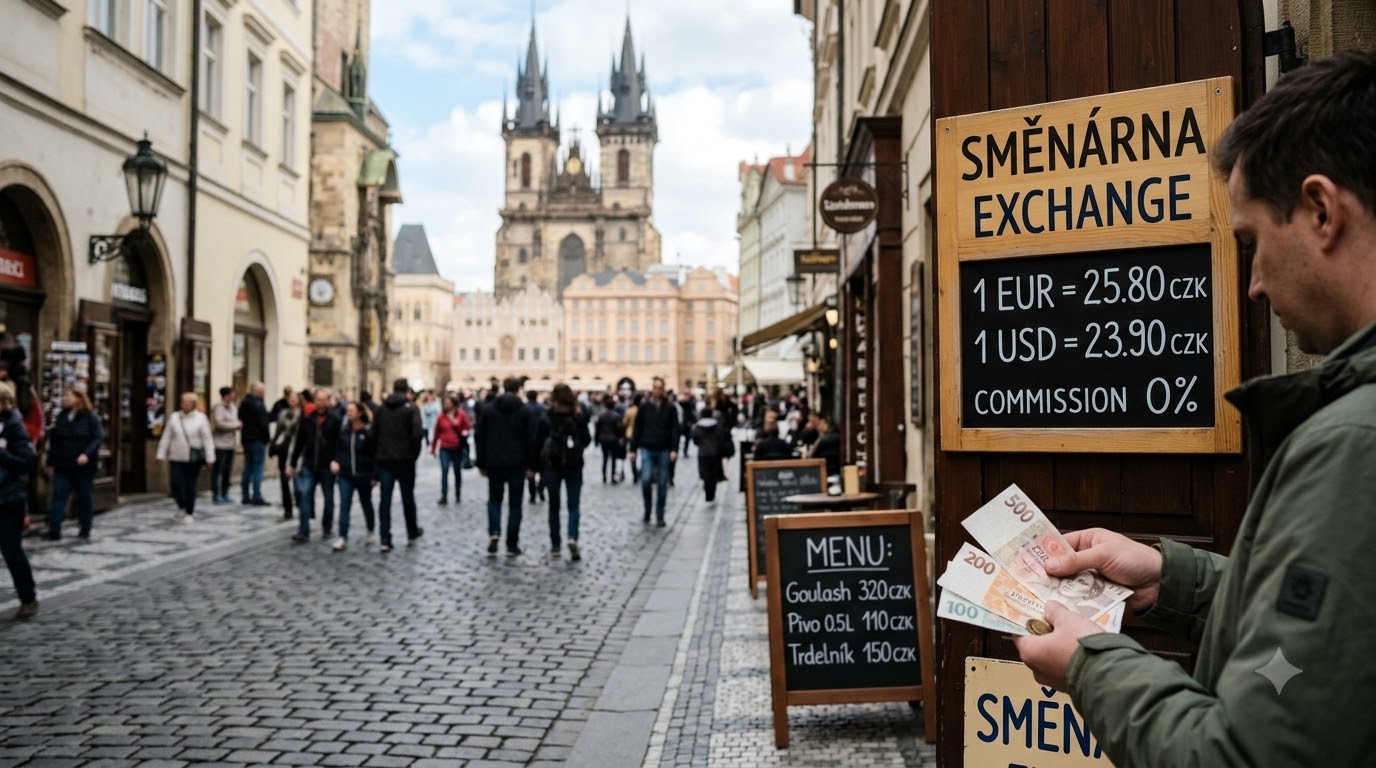
Prague is affordable by Western European standards, and your single most useful money habit is to think in koruna, not euro. Card terminals and some shops offer to charge you in euros through “dynamic currency conversion,” which quietly bakes in a worse rate. On our last visit we always chose to be charged in CZK and let our own bank do the conversion.
Here is a realistic daily spend for a first-time visitor staying central, eating a mix of pub lunches and one nicer dinner, and buying a few attraction tickets.
| Travel style | Accommodation/night | Food/day | Transit + sights/day | Rough daily total |
|---|---|---|---|---|
| Budget (hostel, self-catering) | 700 CZK | 350 CZK | 250 CZK | ~1,300 CZK (~54 EUR) |
| Mid-range (3-star hotel) | 2,400 CZK | 750 CZK | 600 CZK | ~3,750 CZK (~154 EUR) |
| Comfort (4-star, dining out) | 4,500 CZK | 1,400 CZK | 900 CZK | ~6,800 CZK (~280 EUR) |
Quick money facts worth memorizing before you land:
- Prague uses the Czech koruna (CZK); the euro is not accepted at most shops, and where it is, the rate is poor.
- The 2026 average was roughly 24.3 CZK per euro and 20.9 CZK per US dollar (exchange-rates.org, 2026).
- Always choose to pay in koruna, not euros, when a card terminal asks, to avoid dynamic currency conversion markups.
- Withdraw cash from bank ATMs, not the bright-colored “Euronet” machines that push high fees.
- A half-litre of Czech beer often costs 55 to 90 CZK in a local pub, less than bottled water in some tourist cafes.
For a full week-by-week breakdown of how to keep spending low, see our Prague on a budget guide.
The 3-Day Prague Itinerary
The plan we use ourselves — sent straight to your inbox.
- Day-by-day route
- Where to stay
- Real 2026 costs
Free · No spam · Unsubscribe anytime
Getting Around Prague: Trams, Metro, and the Lítačka App
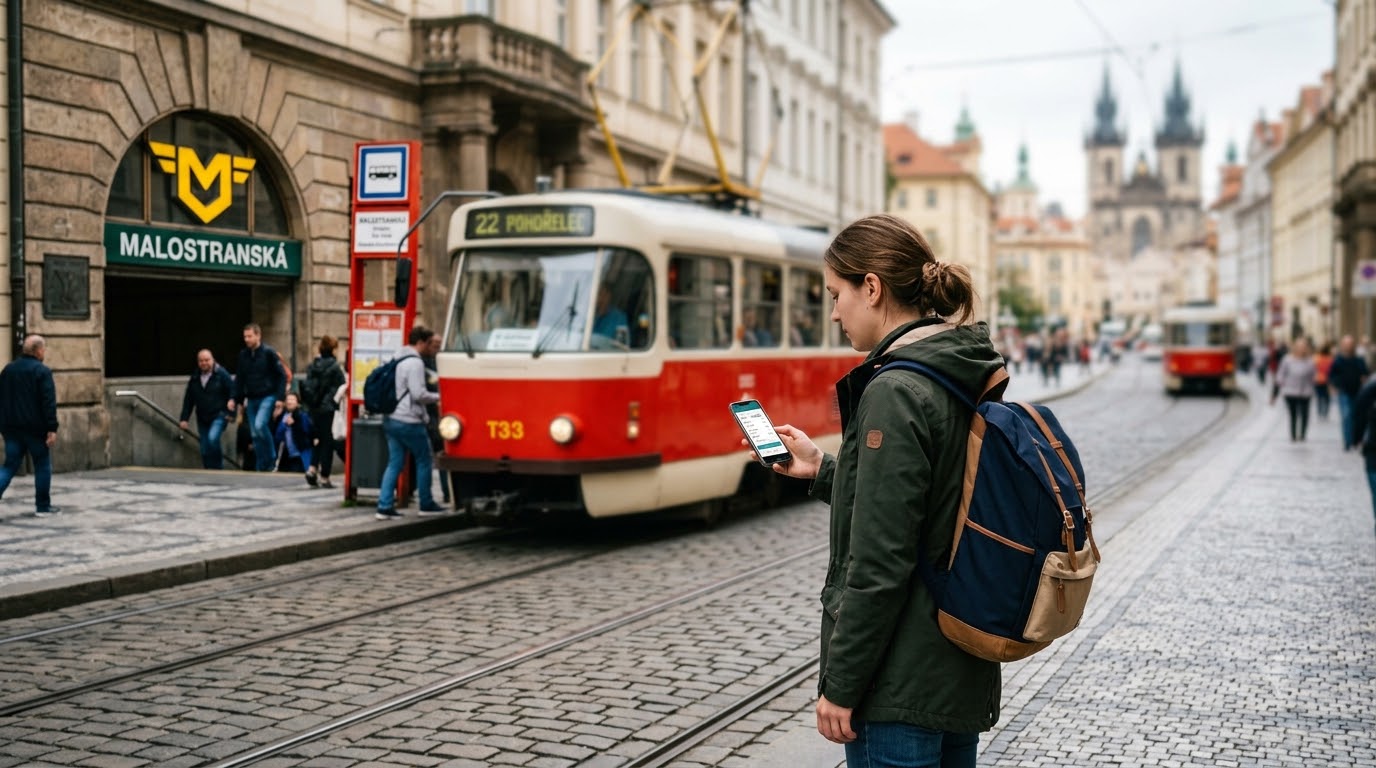
Prague’s transport is one integrated network of metro, trams, and buses, and a single time-based ticket rides all three. You do not buy a ticket per vehicle; you buy time. The system is run by DPP under the regional PID tariff, and prices rose on 1 January 2026.
The cheapest way to buy is the free PID Lítačka app, which shaves a few koruna off every fare and removes the need to find a machine.
| Ticket | In app (Lítačka) | Paper/machine | Best for |
|---|---|---|---|
| 30-minute | 36 CZK | 39 CZK | Short hops across the center |
| 90-minute | 46 CZK | 50 CZK | Most sightseeing days, airport run |
| 24-hour | 140 CZK | 150 CZK | Two-plus rides in a day |
| 72-hour | 340 CZK | 350 CZK | Three-day trips with heavy transit |
Source: Pražská integrovaná doprava (PID), tariff effective 1 January 2026.
Transport rules that save first-timers from a 1,000+ CZK fine:
- Validate paper tickets in the yellow machines the moment you board; the clock starts at validation, not purchase.
- App tickets activate at purchase, so buy them as you step on, not minutes early.
- One 90-minute ticket covers any number of transfers between metro, tram, and bus within the window.
- Trams 22 and 23 are the scenic “sightseeing” lines, climbing past the Castle for the price of a normal ticket.
- Inspectors are plain-clothed and common; the on-the-spot fine for riding without a valid ticket is 1,000 CZK if paid immediately.
Because the center is small, we walked far more than we rode. Full transport detail lives in our dedicated pieces, but for planning your days by neighborhood, start with our guide to the best things to do in Prague.
Old Town and Charles Bridge: The Historic Core
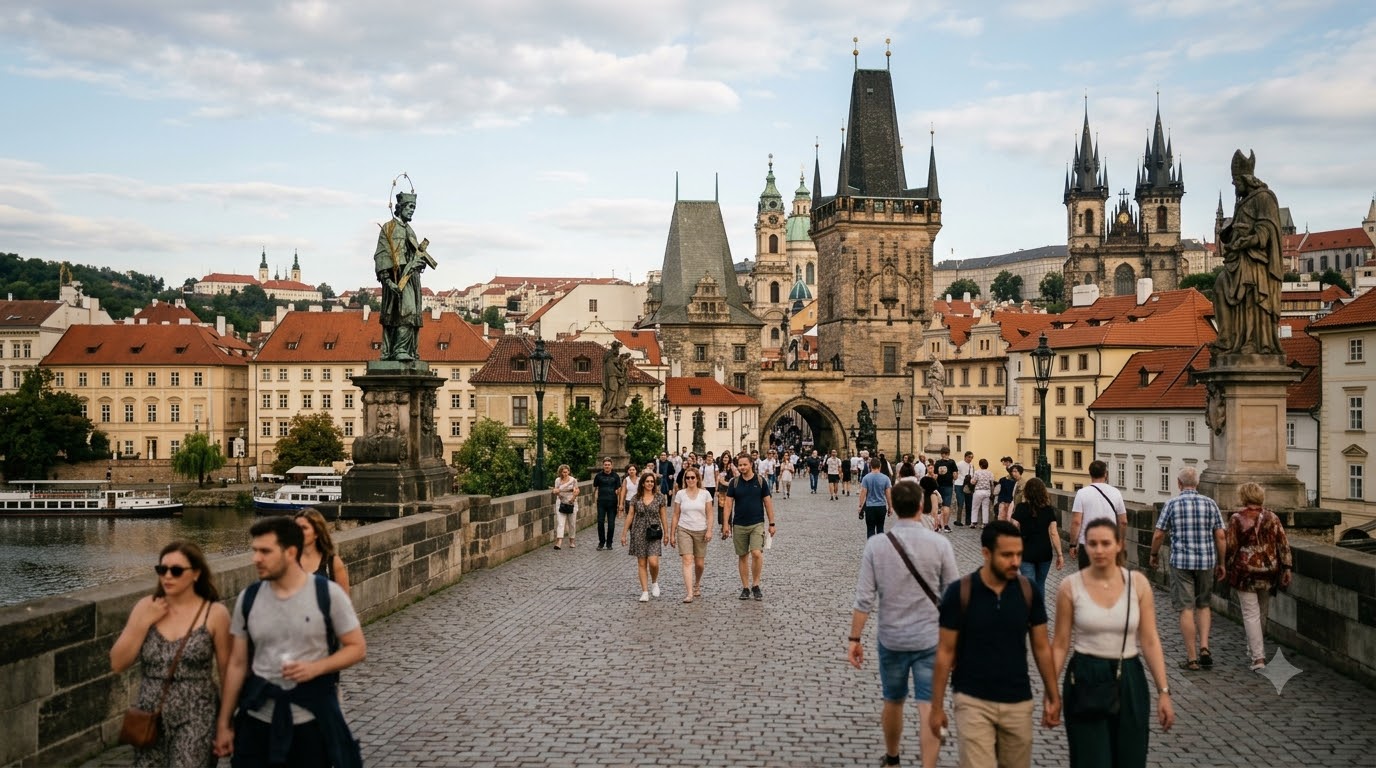
Old Town (Staré Město) and Charles Bridge are the free, open-air heart of any first Prague trip, and both cost nothing to enter. Charles Bridge is a 516-metre pedestrian stone bridge lined with 30 baroque statues, and it connects Old Town to the Castle side. Old Town Square holds the medieval Astronomical Clock, whose “Walk of the Apostles” show runs on the hour.
We treat this district as an early-morning zone. Three mornings in a row we started at Old Town Square before 8am, when the cafes were setting up and the square was nearly empty.
Free and low-cost highlights in the historic core:
- Charles Bridge (Karlův most): free, open 24 hours, quietest before 8am and after 9pm.
- Old Town Square Astronomical Clock: free to watch; the hourly show lasts under a minute, so temper expectations.
- Old Town Hall Tower: climb for a rooftop view of the square, ticketed separately from the clock.
- The Powder Tower (Prašná brána): a Gothic city gate marking the start of the old Royal Route.
- Wenceslas Square: more a broad boulevard than a square, better for people-watching and late-night eats.
The single most useful timing tip we can give: cross Charles Bridge at sunrise. For a full ranked list of sights, see the best things to do in Prague, and for fitting them into a tight schedule, our 3-day Prague itinerary.
The 3-Day Prague Itinerary
Hour-by-hour plan, where to stay and what it really costs — free PDF.
Free · No spam · Unsubscribe anytime
Find your Prague hotel on the map
Live prices from Booking & Airbnb — tap a pin to compare stays around the Old Town and beyond.
Prague Castle and St Vitus Cathedral: What a Ticket Covers
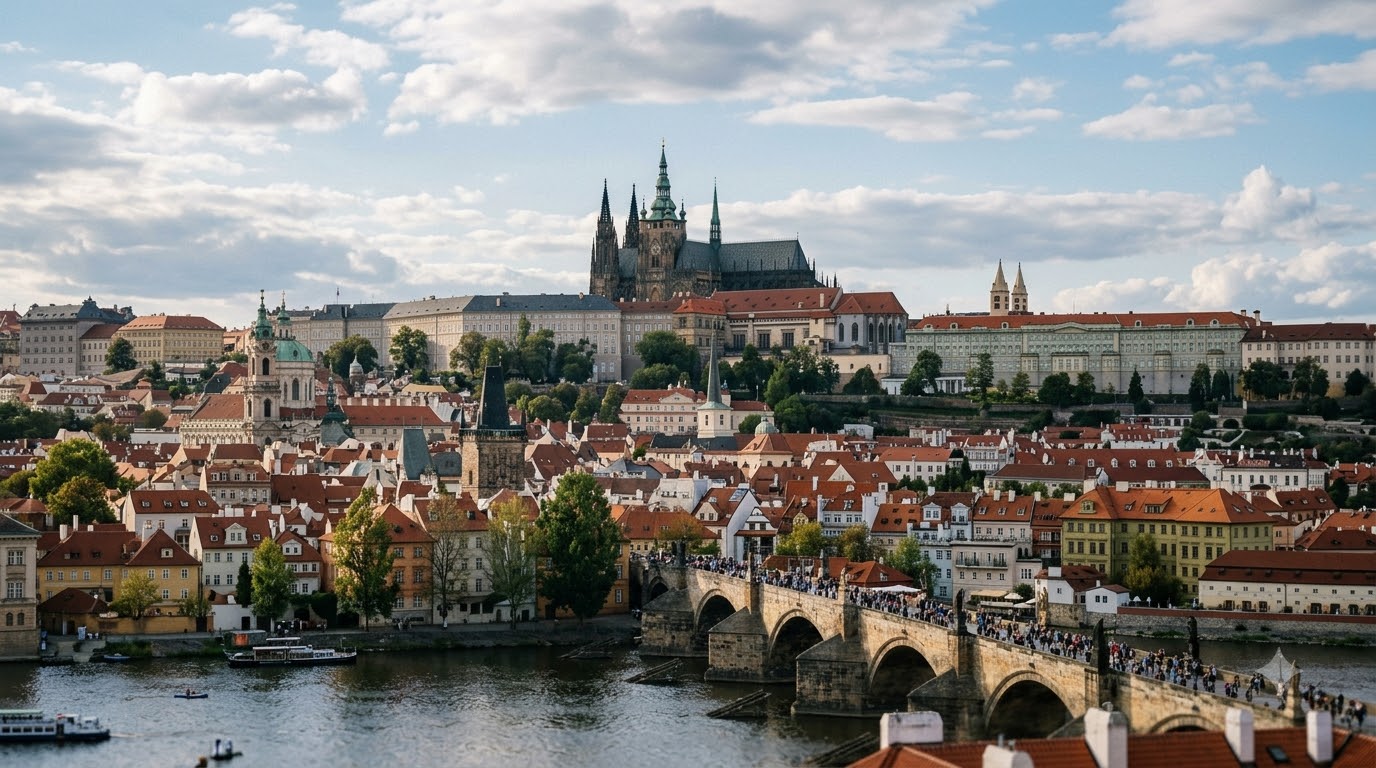
Prague Castle is the largest ancient castle complex in the world by area, and the standard Circuit ticket costs 450 CZK for an adult in 2026. The grounds and gardens are free to walk; you only pay to enter the historic interiors. The Circuit ticket bundles the four buildings most visitors come for.
| Ticket | Adult | Concession | Covers |
|---|---|---|---|
| Prague Castle Circuit | 450 CZK | 300 CZK | St Vitus Cathedral, Old Royal Palace, St George’s Basilica, Golden Lane |
| Cathedral Tower + View Gallery | 200 CZK | 150 CZK | Climb of the Great South Tower |
| The Story of Prague Castle | 300 CZK | 200 CZK | Permanent exhibition in the Old Royal Palace |
Source: Prague Castle Administration (hrad.cz), 2026. Family Circuit ticket 950 CZK.
Practical castle facts to plan your visit around:
- Historic building hours run 10:00 to 19:00 April to June and September, 10:00 to 20:00 July to August, and 10:00 to 17:00 in October, with last entry at 16:40 (hrad.cz, 2026).
- St Vitus Cathedral is inside the Circuit ticket; a short free-entry zone near the entrance lets you glimpse the nave without a ticket, but it is crowded.
- Golden Lane’s tiny colored houses are free after the ticket offices close in the evening in peak season.
- Security screening operates at the gates, so arrive 15 minutes before you want to be inside.
- Trams 22 and 23 stop at Pražský hrad, saving the steep uphill walk from the river.
We climbed the Cathedral Tower once and skipped it the second visit; the 287 steps are worth it only on a clear day. For where to sleep near the Castle versus the Old Town side, see our where to stay in Prague guide.
The Jewish Quarter (Josefov): Tickets and Timing
Josefov, the historic Jewish Quarter, holds the best-preserved complex of Jewish monuments in Europe, and one Jewish Town ticket covers six sites for 600 CZK. It sits just north of Old Town Square, a five-minute walk, and the single ticket is valid for three consecutive days, so you do not need to rush all of it in one visit.
The one scheduling trap: the entire quarter closes every Saturday for Shabbat, plus Jewish holidays. We learned this the hard way on a Saturday and had to return two days later.
| Ticket tier | Price | Notes |
|---|---|---|
| Adult | 600 CZK | Six sites, valid 3 consecutive days |
| Student (under 26) | 400 CZK | Photo ID required |
| Child (6-15) | 200 CZK | Under 6 free |
Source: Jewish Museum in Prague (jewishmuseum.cz), 2026.
What the Jewish Town ticket includes:
- The Old Jewish Cemetery, with roughly 12,000 visible headstones layered over centuries.
- The Old-New Synagogue, completed around 1270 and one of Europe’s oldest active synagogues.
- The Pinkas Synagogue, whose walls list around 78,000 Czech and Moravian Holocaust victims.
- The Spanish Synagogue, known for its Moorish-revival interior.
- The Maisel Synagogue and the Robert Guttmann Gallery’s rotating exhibitions.
Give this quarter a slow half-day; it is the most emotionally weighty stop in the center, not a photo-and-go site.
When to Visit Prague: Weather Month by Month
The best time to visit Prague is May, June, and September, when highs sit in the pleasant low-20s Celsius and the summer crush eases. Prague has a moderately continental climate: cold, often snowy winters and warm, sometimes humid summers. July is the warmest month at around 26°C (79°F).
| Season | Months | Typical daytime high | What to expect |
|---|---|---|---|
| Spring | Apr-May | 13-21°C (55-70°F) | Blossoms, thinner crowds, best value |
| Summer | Jun-Aug | 23-26°C (73-79°F) | Warmest, busiest, long daylight |
| Autumn | Sep-Oct | 10-19°C (50-66°F) | Mild, golden light, easing crowds |
| Winter | Nov-Feb | 0-5°C (32-41°F) | Cold, snow likely, Christmas markets |
Source: climate averages, weather-and-climate.com and Prague City Tourism, 2026.
Season-picking shortcuts:
- May is our top pick: highs near 21°C and about 15 hours of daylight for long sightseeing days.
- September rivals May, with warm days, cooler evenings, and noticeably shorter museum queues.
- July and August are the warmest but the most crowded, with peak hotel rates and midday heat on the bridges.
- December brings Christmas markets on Old Town Square, but highs hover near 2°C and daylight is short.
- January and February are the cheapest and quietest, if you can handle snow and low sun.
For a full month-by-month breakdown including festivals and hotel-price swings, read our best time to visit Prague guide.
From the Airport to the City Center
The cheapest airport transfer is public transport, and a single 90-minute ticket covers the whole trip for 46 CZK in the app. Václav Havel Airport (PRG) sits about 17 km west of the center, and there is no direct metro or train to the terminals yet, so the standard route combines a bus and the metro.
Your main airport-to-center options at a glance:
- Bus 119 (now air-conditioned trolleybuses) runs every 10 minutes from both terminals to Nádraží Veleslavín on Metro Line A, roughly 04:30 to 23:30 (Prague Airport, 2026).
- From Nádraží Veleslavín, Metro A reaches Staroměstská (Old Town) in about 7 minutes; the full airport-to-center trip runs 45 to 60 minutes.
- One 90-minute ticket at 46 CZK (app) or 50 CZK (paper) covers the bus and the metro transfer.
- The Airport Express (AE) bus runs to the main train station (Hlavní nádraží) for a higher flat fare, useful if you have an onward train.
- A metered or pre-booked taxi to the center typically runs several hundred koruna; agree the price or use an app before riding.
We took bus 119 both directions and never waited more than ten minutes for a departure.
Putting This Prague Travel Guide Into Action
The fastest way to turn this Prague travel guide into a real trip is to lock three things first: your dates, your neighborhood, and a loose day-by-day plan. Pick May or September if your calendar is flexible, choose whether you want to sleep on the Old Town side or the quieter Castle side, then slot the big four sights around your quietest mornings.
- For your daily route and must-see ranking, use the best things to do in Prague.
- For choosing a base by budget and vibe, use our where to stay in Prague guide.
- For a ready-made schedule, follow the 3-day Prague itinerary.
- To keep costs down, work through the Prague on a budget guide.
Frequently Asked Questions
Does Prague use the euro or the Czech koruna?
Prague uses the Czech koruna (CZK). The euro is not the national currency and is rarely accepted; where shops do take euros, the exchange rate is poor. In 2026 you get roughly 24.3 CZK per euro and 20.9 CZK per US dollar, so pay in koruna and let your own bank handle the conversion.
How many days do you need in Prague?
Three full days cover the essentials without rushing: one for Old Town and the Jewish Quarter, one for Prague Castle and the Lesser Town, and one for slower wandering or a day trip. A fourth day adds breathing room. Our 3-day Prague itinerary maps this out hour by hour.
Is Prague public transport worth buying a pass for?
If you make three or more rides a day, a 72-hour pass at 340 CZK in the Lítačka app pays for itself against single 90-minute tickets. If you plan to walk the compact center most of the time, buy 90-minute tickets as needed instead. Both cover metro, trams, and buses.
What is the cheapest way from Prague Airport to the center?
Public transport is cheapest: take bus 119 to Nádraží Veleslavín, then Metro A into the center, all on one 90-minute ticket for 46 CZK in the app. The whole trip takes about 45 to 60 minutes and runs from around 04:30 to 23:30.
When is the best time to visit Prague?
May and September offer the best balance of mild weather, long daylight, and thinner crowds, with highs around 20°C. Summer is warmest but busiest and priciest, while December adds Christmas markets at the cost of cold, short days. See our best time to visit Prague guide for the full month-by-month view.
Prague rewards slow mornings and unplanned side streets more than a packed checklist. Lock in your dates and a base, cross Charles Bridge before the crowds arrive, pay in koruna, and let the rest of the city unfold on foot.