
Disclosure: Some links in this guide are affiliate links. If you book or buy through them, we may earn a small commission at no extra cost to you — it helps keep our guides free.
Venice Travel Guide 2026: Canals, Islands & Secret Spots Away from Crowds
Venice does not have roads. It has 150 canals, 400 bridges, and roughly 120,000 permanent residents who share their sinking marble city with over 20 million annual visitors (Venice Tourism Board, 2026). The math is not kind. On peak summer days, tourists outnumber Venetians 2 to 1 in the narrow alleyways between San Marco and the Rialto.
But Venice has a trick it does not advertise: step three calli (alleyways) away from the main routes, and the crowds vanish. The city of 118 islands has corners where you hear nothing but lapping canal water and the echo of your own footsteps. This Venice travel guide covers the highlights, the islands beyond Murano, the neighborhoods where Venetians actually live, and how to visit without draining your bank account.
Key Takeaways
– St. Mark’s Basilica is free but the line wraps the square by 9:30 AM. Book the 3 EUR skip-the-line reservation at basilicasanmarco.it at least a week ahead. The Pala d’Oro golden altarpiece costs 5 EUR extra and is worth every cent.
– The best Venetian experience costs 9.50 EUR: a 24-hour vaporetto pass. Ride Line 1 down the Grand Canal at sunset, the cheapest front-row seat to one of the world’s most beautiful streets (which happens to be made of water).
– The Venice day-tripper tax is real in 2026. From April through July, day visitors pay 5 EUR on designated peak dates. Book the exemption at cda.ve.it if staying overnight. Hotels apply the credit to your bill.
– Skip Murano glass-blowing demonstrations. Visit Burano instead for the candy-colored fishermen’s houses, or Torcello for Byzantine mosaics older than St. Mark’s Basilica, with zero crowds.
– Dinner on the Grand Canal costs triple what it costs two streets inland. Walk five minutes into Cannaregio or Castello and pay 15-20 EUR for the same pasta. Specific properties by sestiere and price tier are ranked in our guide to the best hotels in Venice.We only recommend services we genuinely trust. Learn more.
Best Things to Do in Venice
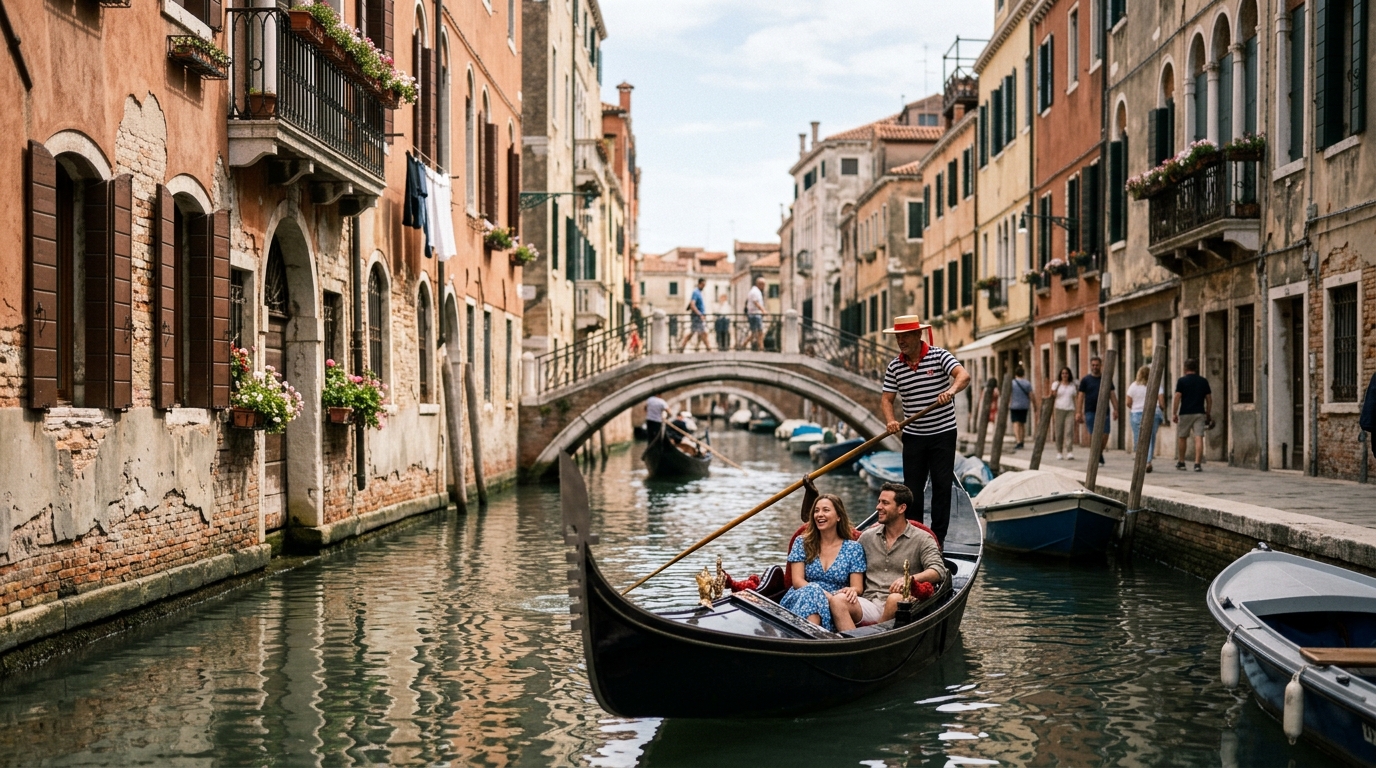
Most people visit Venice with a mental checklist: St. Mark’s Square, Rialto Bridge, gondola ride, done. That covers about 5% of what makes the city worth crossing an ocean for.
St. Mark’s Square and Basilica
St. Mark’s Square fills with water during acqua alta (high water, mostly October-January) and tourists during every other month. Arrive at 8:00 AM and you get the square almost to yourself. By 10:00 AM, the three cafes with live orchestras on the square charging 15 EUR for a cappuccino have filled every seat.
St. Mark’s Basilica is free to enter, but the reservation system (3 EUR per person at basilicasanmarco.it) lets you skip a line that can stretch 90 minutes. Inside, the ceiling mosaics cover 8,000 square meters with gold leaf. The Pala d’Oro behind the main altar is an altarpiece of gold, enamel, and 1,927 precious gems, commissioned in 976 AD and expanded over centuries.
The Campanile (bell tower) costs 10 EUR and takes you up 99 meters via elevator. The view spans the red-tiled rooftops of Venice, the lagoon, and on clear days, the Dolomites 100 kilometers north. The line moves quickly because the elevator is the only way up.
The Rialto Bridge and Market
The Rialto Bridge, completed in 1591, was considered so audacious that architects predicted it would collapse. It has not. The view from the center of the bridge, looking down the Grand Canal at sunset, is the most photographed angle in Venice. Go at 7:00 AM for empty views. Go at sunset with everyone else because some crowds are unavoidable.
The Rialto Market operates Tuesday through Saturday mornings, the same spot where Venetians have bought fish since 1097. The Pescheria (fish market) is a Gothic loggia with marble counters where vendors hawk Adriatic seafood: branzino, cuttlefish, tiny grey shrimp from the lagoon. You are not buying fish, but the spectacle is worth 20 minutes.
Gondola Rides: What to Expect
A gondola ride costs 80 EUR for 30 minutes during the day, 100 EUR after 7:00 PM. The price is set by the city, non-negotiable. Gondoliers charge that price for up to five people, so the per-person cost drops with a group.
Skip the gondola stations near St. Mark’s and the Rialto. Walk to a quieter canal in Cannaregio or Dorsoduro and pick up a gondola there. The route will be calmer, the canals narrower and more atmospheric, and the gondolier less likely to be texting while steering.
For more Venice activity ideas, read our best things to do in Venice guide covering the museums, palazzos, and tours in detail.
The 2-Day Venice Itinerary
The plan we use ourselves — sent straight to your inbox.
- Day-by-day route
- Where to stay
- Real 2026 costs
Free · No spam · Unsubscribe anytime
Secret Spots Away from the Crowds
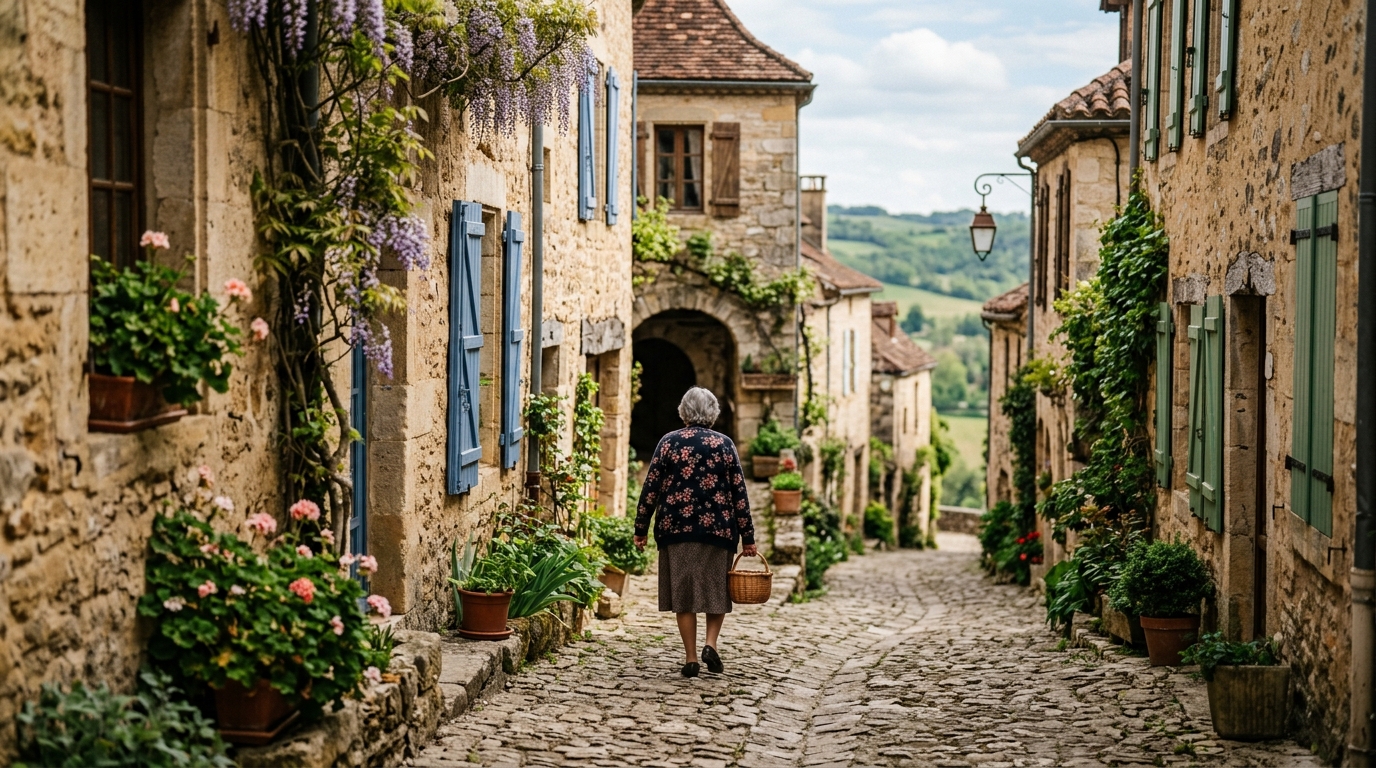
Cannaregio: The Real Venice
Cannaregio is Venice’s largest sestiere (neighborhood) and its most lived-in. The main street, Strada Nova, is busy, but step off it onto Fondamenta della Misericordia and you find canalside restaurants where the tables fill with Venetians at 8:00 PM, not tourists at 6:00. The Jewish Ghetto, the first ghetto in the world (the word “ghetto” is Venetian), occupies a quiet corner of Cannaregio with five historic synagogues, a kosher bakery, and a Holocaust memorial.
The Madonna dell’Orto church (3 EUR) holds two of Tintoretto’s greatest paintings and his tomb. The church sits on a quiet canal in northern Cannaregio surrounded by nothing but residential streets. You might be the only visitor.
Dorsoduro: The Art Student Quarter
Dorsoduro feels like a different city from San Marco, literally across the Grand Canal but emotionally miles away. The Gallerie dell’Accademia (15 EUR) holds the world’s best collection of Venetian Renaissance art. Peggy Guggenheim Collection (16 EUR) houses modern masterpieces in her former palazzo on the Grand Canal, including works by Pollock, Calder, and Magritte.
The Fondamenta delle Zattere is a 2-kilometer promenade along the Giudecca Canal, sunny all afternoon, lined with benches where students from the nearby architecture university read and old Venetians walk dogs. Gelateria Nico at the western end serves gianduiotto (chocolate hazelnut gelato) with whipped cream for 5 EUR, unchanged since 1935.
[PERSONAL EXPERIENCE] Minh sat on the Zattere at 5:00 PM on a Tuesday in May with a gianduiotto, watching the sun drop behind the Giudecca skyline. There were maybe 15 other people along the entire promenade, and none of them were speaking English. At the same moment, St. Mark’s Square was shoulder-to-shoulder.
Libreria Acqua Alta
Venice’s most unusual bookstore protects its books from the regular flooding by storing them in bathtubs, waterproof bins, and a full-size gondola. A staircase of water-damaged encyclopedias leads to a canal view out the back. The resident cats sleep on the history section. It is chaotic, charming, and entirely free.
Go when it opens at 9:00 AM. By 11:00 AM, the single narrow aisle is a human traffic jam of Instagrammers photographing the gondola. The bookstore is genuinely wonderful at 9:00 and genuinely unbearable by noon.
Best Islands to Visit: Murano, Burano & More
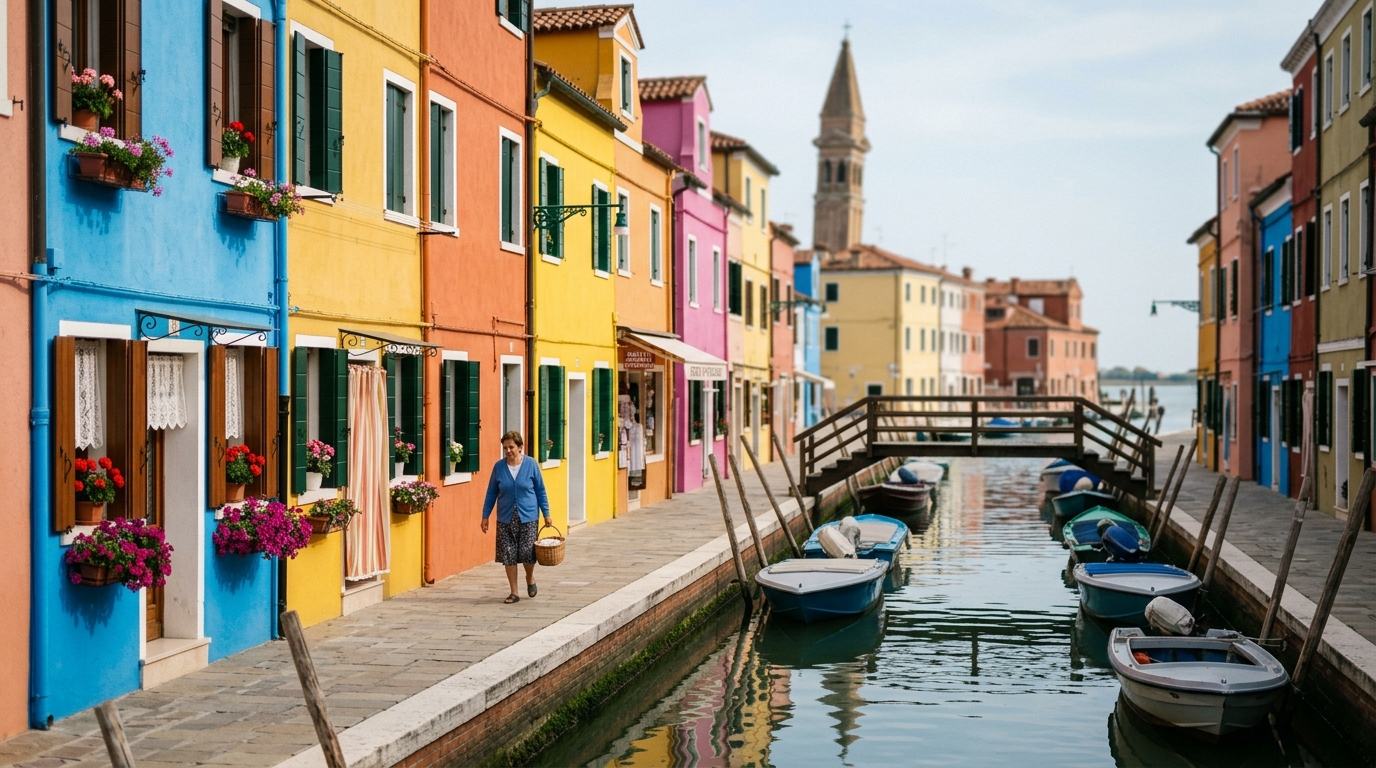
The Venetian Lagoon holds over 100 islands. The three most accessible ones deserve your time, but not in equal measure.
Burano (The One Worth the Trip)
Burano is a fishing village whose houses are painted electric purple, lime green, cherry red, and sunflower yellow. Legend says fishermen painted them bright colors to see home through the fog. Reality says the colors follow a strict municipal code: you must apply to the government before painting your house, and a committee approves the specific shade.
Burano has its own leaning campanile (the church tower of San Martino tilts visibly) and the best seafood risotto in the lagoon. Trattoria al Gatto Nero (the black cat) serves risotto di go (goby fish risotto, 22 EUR) that Venetian families cross the lagoon for. The lace-making tradition still survives in a few shops, but most “Burano lace” sold on the main street comes from China.
The vaporetto (water bus) ride on Line 12 from Fondamente Nove takes 45 minutes and costs 9.50 EUR on a single ticket, or free with the 24-hour pass.
Murano (Skip It Unless You Are Buying Glass)
Murano has been synonymous with glass-making since 1291, when Venice banished all glass furnaces to the island to prevent fires. Today, the main canal is a parade of showrooms selling glass chandeliers, millefiori jewelry, and miniature animals.
The free glass-blowing demonstrations are a con. They show you a 90-second demo of a horse figurine, then funnel you directly into the showroom with high-pressure sales. If you genuinely want Murano glass, go to Simone Cenedese on the far side of the island where the master glassmakers actually work. No demo, no sales pitch, just a gallery of museum-quality pieces.
The Museo del Vetro (Glass Museum, 10 EUR) traces Venetian glass from Roman times to contemporary art. Worth it if you have a genuine interest. Skip it if you do not.
Torcello (The One Nobody Visits)
Torcello was Venice before Venice existed. In the 10th century, 20,000 people lived here. Today, roughly 10 permanent residents remain. The Basilica of Santa Maria Assunta (5 EUR) dates to 639 AD and holds Byzantine mosaics that predate St. Mark’s by 400 years. The Madonna in the apse, a golden figure floating against a gold background, rivals anything in Ravenna for sheer Byzantine power.
The island is silent except for birds. The walk from the vaporetto stop to the basilica takes 10 minutes along a canal lined with reeds. One restaurant, Locanda Cipriani, has served Hemingway, Princess Diana, and Ernest Hemingway again. A Bellini at the garden bar costs 18 EUR and is worth it once.
How to get there: Vaporetto Line 12 to Burano, then Line 9 to Torcello (5 minutes). The total trip from Venice takes about 75 minutes.
The 2-Day Venice Itinerary
Hour-by-hour plan, where to stay and what it really costs — free PDF.
Free · No spam · Unsubscribe anytime
First Time in Venice? Smart Travel Tips
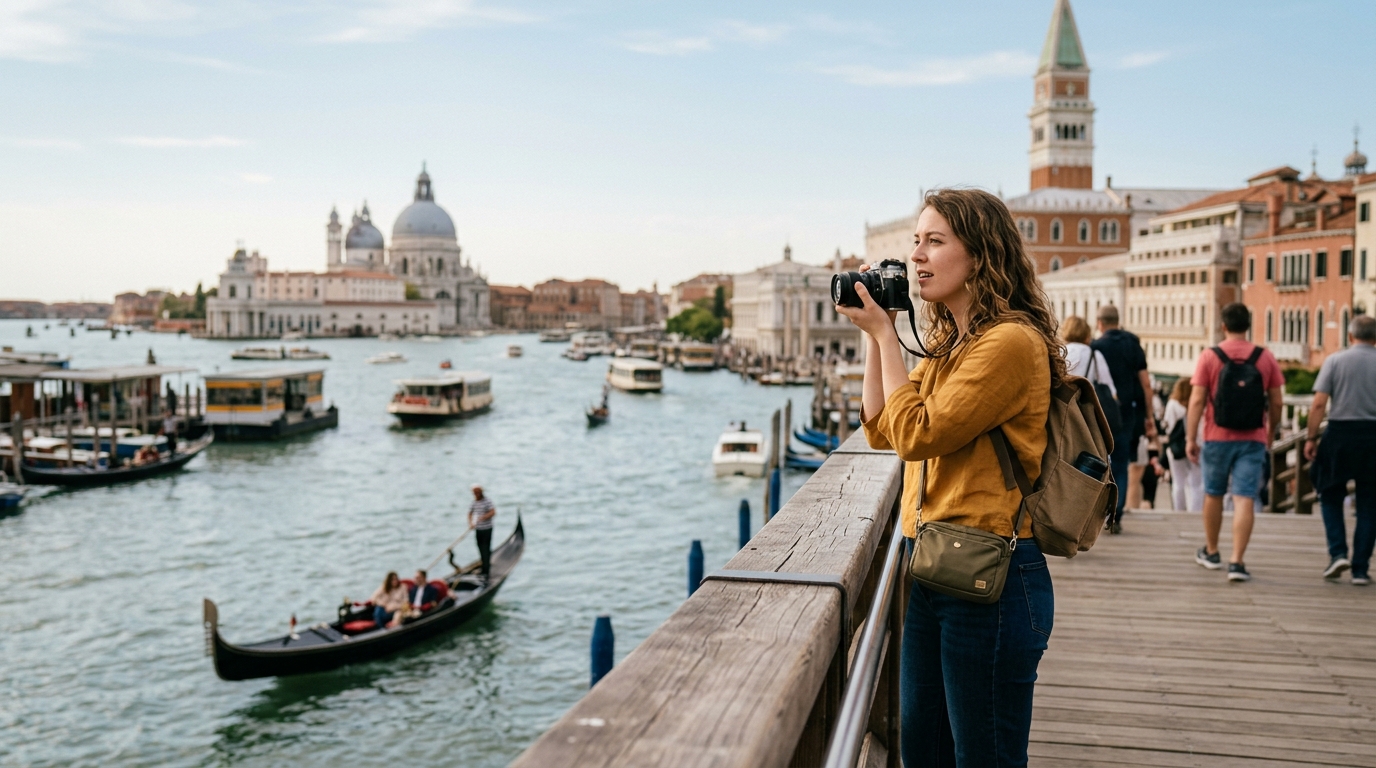
Getting Around
Forget the word “walking distance” and replace it with “vaporetto stop.” The vaporetto (water bus) is Venice’s public transit system. A single ticket costs 9.50 EUR and is valid for 75 minutes. A 24-hour pass costs 25 EUR. A 48-hour pass costs 35 EUR. Buy the pass if you are taking more than two rides. Line 1 runs the full length of the Grand Canal from Piazzale Roma to the Lido, stopping at every major landmark. It is the world’s best sightseeing bus.
The traghetto is a stripped-down gondola that crosses the Grand Canal at seven points where there are no bridges. It costs 2 EUR per crossing. Venetians stand for the 90-second trip. Tourists sit. Both are acceptable.
Boats to the airport run from Fondamente Nove (Alilaguna) and the bus station (ACTV bus to Marco Polo Airport, 8 EUR). The Alilaguna boat takes 50-60 minutes and costs 15 EUR. The bus is faster (20 minutes) and cheaper.
The Day-Tripper Tax
Starting in 2024, Venice charges day visitors 5 EUR on approximately 30 peak dates between April and July. If you are staying overnight, register at cda.ve.it for the exemption. Your hotel will credit the fee. The system is awkward but functional: a QR code emailed to you, spot-checked at major entry points. The fine for non-payment is 50-300 EUR. Do not risk it.
Acqua Alta (High Water)
Acqua alta hits between October and January, when high tides surge into the city. St. Mark’s Square floods first because it sits at the lowest point on the island. The city sets up raised wooden walkways. The MOSE flood barrier system, completed in 2020, has largely eliminated the most destructive flooding that used to submerge the city several times per winter. Check the tide forecast at comune.venezia.it/maree. An acqua alta above 110 cm floods about 14% of the city.
Stay connected with Airalo Italy eSIM from $6 for 3GB. For more European inspiration, read our Rome travel guide and Amalfi Coast guide.
How to Visit Venice Without Overspending
Venice has a reputation for emptying wallets. The reputation is earned but avoidable.
Accommodation Hack: Stay on the Mainland
Sleeping in Venice proper costs 200-400 EUR per night for a mid-range hotel. Sleeping in Mestre, the mainland town connected to Venice by a 10-minute train ride (1.45 EUR each way, trains every 10-15 minutes until midnight), costs 80-120 EUR per night for comparable quality. The savings over three nights exceed 500 EUR.
The trade-off is real: you cannot walk out of your hotel and immediately be in Venice. You ride the train. But for budget-conscious travelers, the math is undeniable.
Food Strategy
Venice has two dining tracks. Track A (tourist): a gondola-view table, 25 EUR pasta, 6 EUR cover charge, 12% service added. Track B (local): a cicheto (Venetian tapas, 1-3 EUR each) and an ombra (small glass of wine, 2 EUR) standing at a bar counter in Cannaregio.
For cicchetti, go to Cantina do Mori (established 1462, possibly the oldest wine bar in the world), All’Arco near the Rialto Market (closes at 3:00 PM, go for lunch), or Al Timon on the Cannaregio canal where you eat cicchetti on a wooden boat parked against the quay.
A proper dinner in Venice costs 25-35 EUR per person at a mid-range restaurant. The menu turistico (tourist menu) for 15 EUR is never worth it. Walk three streets inland from any major landmark before choosing a restaurant.
Skip These
Skip the gondola if your budget is tight. The 80 EUR buys four vaporetto day passes or eight excellent cicchetti crawls. Skip Caffe Florian on St. Mark’s Square (18 EUR for a cappuccino you drink standing at the counter). The square is free. The view is free. The coffee at a bar two streets away costs 1.50 EUR.
Find your Venice hotel on the map
Live prices from Booking & Airbnb — tap a pin to compare stays around San Marco and Cannaregio and beyond.
Where to Stay
Ca’ Sagredo — Luxury Grand Canal Palace
Location: Grand Canal, Cannaregio | From 400 EUR ($430 USD) | Rating 4.8/5
A 15th-century palazzo converted into a 42-room hotel. The grand staircase has Tiepolo frescoes. Half the rooms have Grand Canal views. The rooftop terrace overlooking the Rialto markets is open to guests only.
Best for: The once-in-a-lifetime splurge. Even one night here feels like a different century.
Locanda ai Santi Apostoli — Mid-Range Cannaregio
Location: Strada Nova, Cannaregio | From 140 EUR ($150 USD) | Rating 4.5/5
A small hotel on the third floor of a palazzo near the Ca’ d’Oro vaporetto stop. Some rooms have canal views. The breakfast room overlooks the Grand Canal. The location puts you 10 minutes from the Rialto and 15 from St. Mark’s.
Best for: Couples who want comfort and location without the five-star price. Book a canal-view room.
Generator Venice — Budget Giudecca
Location: Giudecca Island | From 25 EUR ($27 USD) dorm, 80 EUR private | Rating 4.2/5
A converted grain warehouse on Giudecca Island, directly across from St. Mark’s Square. The bar occupies the former warehouse loading dock with a view of the San Marco skyline that budget accommodations have no right to deliver. The vaporetto to San Marco takes 5 minutes.
Best for: Backpackers and solo travelers. The dorm beds have privacy curtains and reading lights. The view from the bar at sunset rivals hotels charging 10 times the price.
Book all properties: Check live hotel prices has the broadest Venice selection.
Frequently Asked Questions
How many days do I need in Venice?
Three days is the sweet spot. One day for San Marco, the Rialto, and the Grand Canal. One day for Burano and Torcello. One day for Cannaregio, Dorsoduro, and getting lost. Two days feels rushed. Four days allows a day trip to Verona or Padua.
Is Venice sinking?
Venice is sinking at roughly 1-2 mm per year, and sea level is rising at about 2 mm per year. The combined effect means the city experiences more frequent flooding. The MOSE flood barrier system has been largely effective since 2020 at preventing the catastrophic floods that used to submerge 70% of the city.
Is Venice expensive?
Yes, but manageable. Budget 150-200 EUR ($160-215 USD) per day per person including mid-range hotel, three meals, vaporetto passes, and attraction tickets. Backpackers can survive on 70-90 EUR/day by staying on the mainland and eating cicchetti. The gondola adds 80 EUR if you do it.
What is the best month to visit Venice?
April, May, September, and October are ideal. Temperatures range from 15-22 degrees C (59-72 F). Venice is less crowded than June-July and the light for photography has a soft, golden quality. February brings Carnevale and higher prices. November brings fog, which is atmospheric until acqua alta starts.
Can you swim in the Venice canals?
No. The canals are a sewage system, a transport network, and a UNESCO site. Swimming is illegal and unsanitary. The Lido beach, 20 minutes by vaporetto, offers clean Adriatic swimming from May through September.
Do I need to book attractions in advance?
Yes. St. Mark’s Basilica skip-the-line, the Doge’s Palace Secret Itineraries tour, and the Campanile all benefit from advance booking. The Doge’s Palace (25 EUR) is the second most important site after the Basilica. Book at palazzoducale.visitmuve.it. The Secret Itineraries tour (32 EUR) takes you into Casanova’s prison cell.
Venice Awaits
Venice at 7:00 AM, before the day-trippers arrive, is a different city than Venice at noon. The light reflects off the canals in silence. The only sound is the slap of water against stone and the distant rumble of a delivery boat. This is the Venice worth crossing an ocean for.
Wake up early. Walk everywhere. Eat cicchetti standing up. Skip the gondola if the budget demands it. Ride the Line 1 vaporetto at sunset instead. And when San Marco Square becomes unbearable, which it will by 11:00 AM, get on a boat to Torcello.
Now, go find that hidden campo with the well in the center and the cat sleeping on the marble steps. And if Italy is calling you further, our Rome travel guide and Barcelona guide are ready.
For more Italian travel guides, browse our Amalfi Coast guide, Lake Como guide, and Positano guide.