Madrid or Seville? Which Spanish City to Pick (2026)
Disclosure: Some links in this guide are affiliate links. If you book or buy through them, we may earn a small commission at no extra cost to you — it helps keep our guides free.
You want world-class art, a big-city food scene and easy arrival.
See hotels in Madrid →You want orange trees, flamenco and Moorish palaces in a walkable old town.
See hotels in Seville →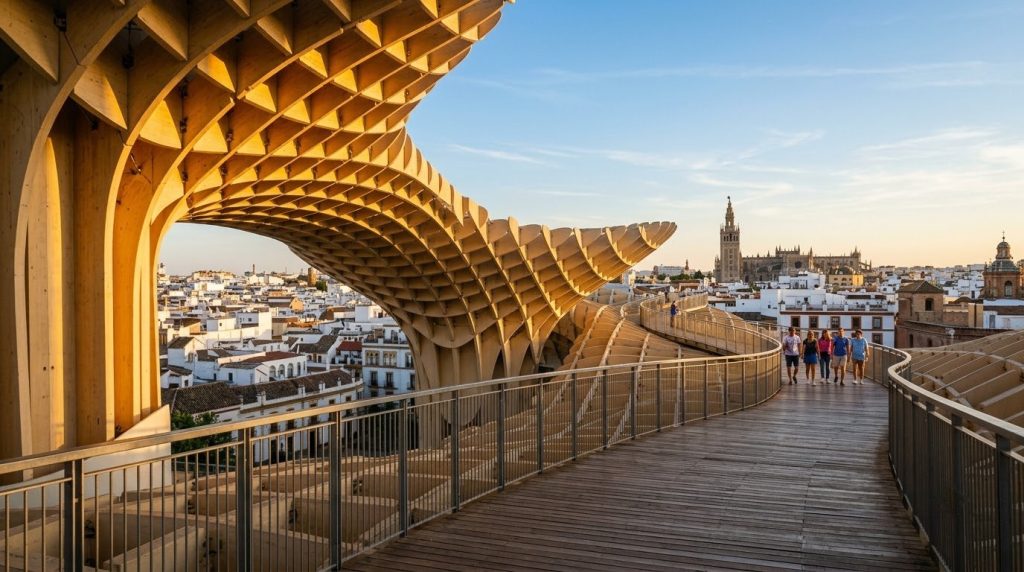
Pick Seville if you have only 2 or 3 days and want the Spain of postcards: orange trees, flamenco, Moorish palaces and a walkable old town. Pick Madrid if you want world-class art, a big-city food scene and the easiest arrival from the US.
Our verdict for most first-timers: fly into Madrid, then take the high-speed train south, because the two cities sit about 2 hours 40 minutes apart and doing both beats choosing.
| Factor | Madrid | Seville |
|---|---|---|
| Best for | Art, food, nightlife, first arrival | Romance, flamenco, history, walking |
| Nonstop flights from the US | Yes (New York and other hubs) | None; connect via Madrid or another hub |
| Signature sight | Prado Museum, EUR 15 (USD 17) | Real Alcázar, EUR 15.50 (USD 17.50) |
| July average high (AEMET) | 90°F (32.1°C) | 97°F (36.0°C) |
| January average high (AEMET) | 50°F (9.8°C) | 61°F (16.0°C) |
| Ideal stay | 3 days | 2–3 days |
| Feel | Sprawling modern capital | Compact, traditional Andalusian city |
The short verdict by traveler type
First-timers: Madrid as your landing city, Seville as the trip you remember. If you can only do one, do Seville, since it delivers more “this is Spain” per hour.
Couples: Seville, clearly. Evening walks through Santa Cruz, rooftop bars facing the cathedral and a tablao flamenco show are the reason people fall for Spain.
Families: Madrid. Retiro Park, wide sidewalks, more hotel room types and milder summers make it easier with kids. Seville in July and August is genuinely hard on small children.
Budget travelers: A tie on daily costs, but Seville wins on value because almost everything is walkable, so you rarely pay for transit. Madrid wins on free museum hours.
Art and museum lovers: Madrid, with no contest.
Getting between them: the AVE high-speed train
The Madrid–Seville high-speed line is the easiest leg of any Spain trip. Trains run from Madrid Puerta de Atocha to Sevilla Santa Justa, which sits in the city itself, so you skip airport security and transfers entirely.
– Time: the fastest trains take about 2 hours 38 minutes; the average is around 2 hours 45 minutes for the 390 km (242 miles). – Frequency: booking sites list roughly 24 to 27 direct trains a day, from early morning to around 9 pm. – Operators: Renfe runs the premium AVE and its low-cost Avlo brand; private rivals iryo and OUIGO compete on the same line, which keeps prices down. – Fares: advance promo fares start around EUR 7 (USD 8), while typical tickets fall between EUR 30 and EUR 70 (USD 34–79) depending on date and class. Walk-up fares on busy days sit at the top of that range.
Book 3 to 6 weeks out and compare all four operators on one screen. Prices in this article are converted at EUR 1 = USD 1.13, the ECB reference rate on 1 October 2026.
Seville’s summer heat is a real dealbreaker
Do not underestimate this. AEMET’s long-term normals for Seville Airport put the average July high at 36.0°C (97°F) and August at 35.5°C (96°F), with average lows above 20°C (68°F), so nights barely cool off. Heat waves push well past those averages. Madrid is hot too, at 32.1°C (90°F) in July.
From mid-June to early September, Seville sightseeing happens before 1 pm and after 8 pm, with a siesta in between. If summer is your only window, Madrid is the safer pick, or plan Seville for 2 nights, not 4.
The flip side: Seville is wonderful from October through May. Its average January high is 16.0°C (61°F) versus Madrid’s 9.8°C (50°F), so winter visitors get sunshine in the south while the capital needs a coat.
What you actually do in each city
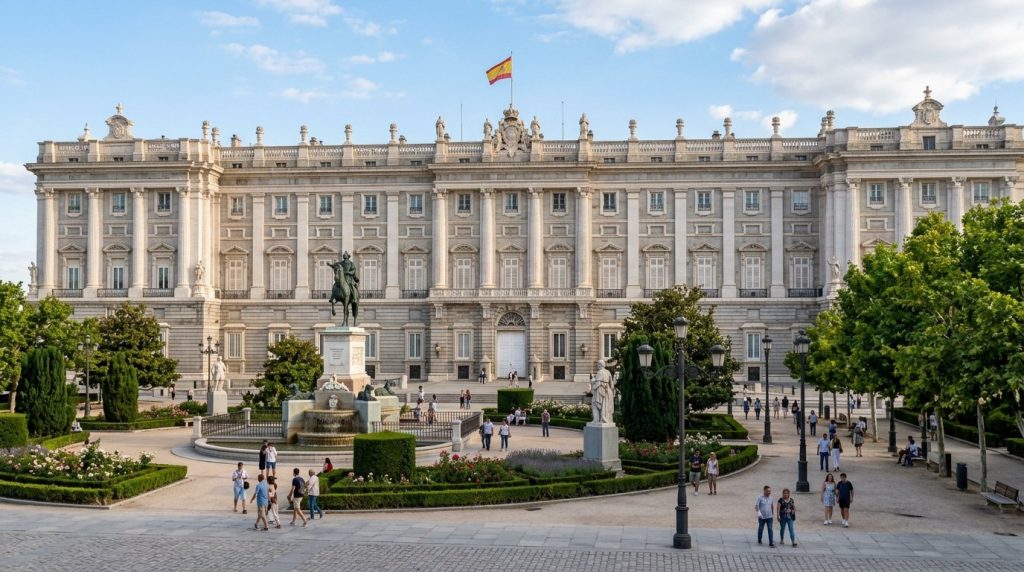
Madrid is a museum city first. The Prado charges EUR 15 (USD 17) but is free Monday to Saturday from 6 pm to 8 pm and Sundays from 5 pm to 7 pm, according to the city’s official tourism site, esMadrid. Add the Reina Sofía for Guernica, the Royal Palace, Retiro Park and late-night tapas crawls in La Latina. Dinner before 9 pm will feel early to locals.
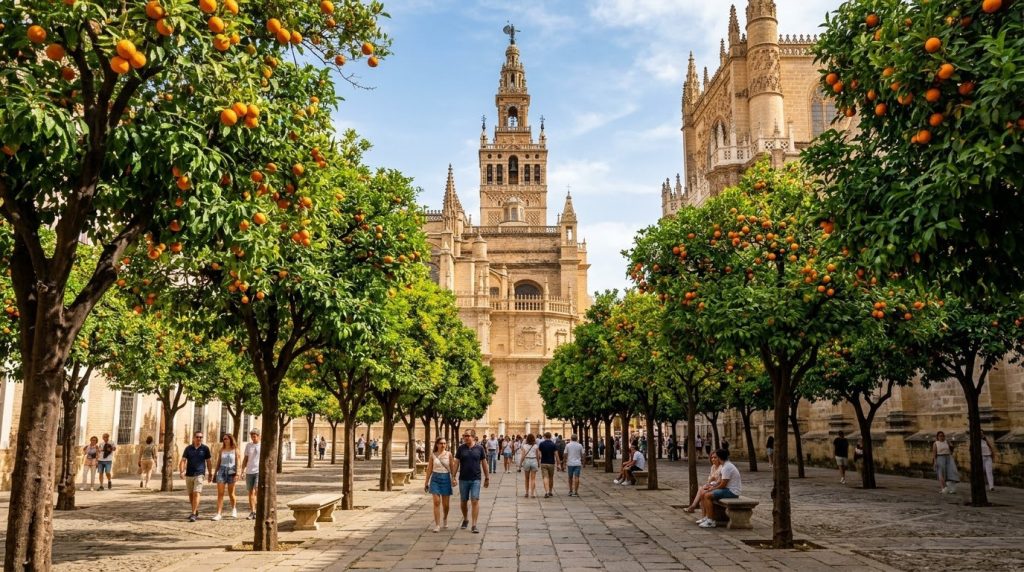
Seville is about atmosphere. The Real Alcázar costs EUR 15.50 and sells out in spring, so buy timed tickets ahead. The cathedral and Giralda tower cost EUR 13 (USD 14.70) online on the cathedral’s official site. Then add Plaza de España, the Metropol Parasol, a flamenco show and an evening in Triana across the river.
Getting there from the US
Madrid-Barajas has nonstop flights from New York and other US hubs, at roughly 7 to 7.5 hours eastbound from JFK. Seville has no nonstop service from the United States, so you will connect through Madrid, Lisbon or another European hub anyway. That is the practical argument for starting in Madrid and riding the train south.
US passport holders currently enter Spain visa-free for up to 90 days in any 180-day period. The EU’s ETIAS travel authorization is not live yet; the EU says it will announce the start date several months before launch. The US State Department rates Spain at Level 2, “Exercise Increased Caution” (updated 12 May 2025), mainly for terrorism risk; pickpocketing in crowded areas is the realistic daily concern in both cities.
Timing around Semana Santa and the Feria
Seville’s two big festivals change the trip. Holy Week (Semana Santa) runs 21 to 28 March 2027, and the Feria de Abril follows from 13 to 18 April 2027. Hotel prices spike and central streets close for processions, so book months ahead or avoid those weeks.
Building a Spain trip with Barcelona too
A classic 10-day route is Barcelona, Madrid and Seville, linked by fast trains. If Barcelona is on your list, start with our complete Barcelona travel guide, then use the 3-day Barcelona itinerary to plan your days there. Still undecided whether it earns a spot over a second night in Seville?
Our honest take on whether Barcelona is worth visiting covers the crowds and the pickpocket problem, and our breakdown of where to stay in Barcelona compares the neighborhoods.
A realistic split for 7 nights: 3 in Madrid, 3 in Seville, plus a day trip to Toledo or Córdoba. With 4 nights total, do 2 and 2.
Where to stay
Madrid, Sol and Gran Vía: the most central base for first-timers, with walking access to the Royal Palace and Plaza Mayor. Expect noise at night.
Madrid, Barrio de las Letras: next to the Prado, full of tapas bars, and calmer than Sol. Best for couples and art lovers.
In Seville, pick Santa Cruz or El Arenal to walk everywhere, or Triana for a more local feel across the river.
Find your Madrid hotel on the map
Live prices from Booking, Airbnb and more — move the map or change dates to compare stays across Madrid.
Frequently Asked Questions
Is Seville or Madrid nicer?
Seville is prettier and more romantic, with a compact old town of whitewashed lanes, the Real Alcázar and orange-lined plazas. Madrid is grander and more varied, with better museums, food and nightlife. Couples and first-time visitors chasing classic Spanish atmosphere usually prefer Seville, while art lovers, families and city-break travelers tend to prefer Madrid.
How long is the train from Madrid to Seville?
The fastest high-speed trains take about 2 hours 38 minutes, and most run around 2 hours 45 minutes. Renfe AVE, Avlo, iryo and OUIGO all serve the route from Madrid Atocha to Sevilla Santa Justa, with roughly two dozen daily departures. Advance fares start near EUR 7, though typical tickets cost EUR 30 to EUR 70.
Is Seville worth visiting in summer?
Only with a plan. AEMET normals put Seville’s average July high at 36°C (97°F), and heat waves go higher. Sightsee early in the morning and after 8 pm, rest midday, and book a hotel with a pool. If you dislike heat, visit between October and May, when Seville is one of Europe’s best city breaks.
How many days do you need in Madrid and Seville?
Three days in Madrid covers the Prado, the Royal Palace, Retiro Park and a day trip to Toledo. Two to three days in Seville covers the Alcázar, the cathedral, Plaza de España and Triana. With one week, split it evenly and add Córdoba, which sits on the same high-speed line between them.