
Disclosure: Some links in this guide are affiliate links. If you book or buy through them, we may earn a small commission at no extra cost to you — it helps keep our guides free.
Lauterbrunnen Valley Guide 2026: 72 Waterfalls
The Lauterbrunnen valley is a glacial trough in the Bernese Oberland where 72 waterfalls pour off cliffs that rise nearly a kilometer straight up from the valley floor. The headline sight, Staubbach Falls, drops 297 meters in a single free-falling ribbon and costs nothing to see (Switzerland Tourism, 2026). The valley sits about a 22-minute train ride from Interlaken Ost, which makes it one of the easiest big-payoff day trips in the Swiss Alps.
This guide covers what actually matters when you plan a visit in 2026: the two waterfalls worth building your day around, how the car-free villages of Murren and Wengen work, exactly how to get here from Interlaken, where to sleep, and the viewpoints that earn the photos you have seen. We spent three days basing out of the valley last summer, so the timings and prices below come from what we paid and walked ourselves.
Key Takeaways
– Staubbach Falls is free and drops 297 meters, among the highest free-falling waterfalls in Europe; a summer viewing gallery lets you stand behind the water (Switzerland Tourism, 2026).
– Trummelbach Falls costs from CHF 18 for adults and CHF 8 for children aged 6 to 15, open early April to early November; a tunnel lift carries you inside the mountain to ten glacier-fed cascades.
– The train from Interlaken Ost takes about 22 minutes, runs roughly every 30 minutes, and starts from CHF 7.80 one way.
– Murren and Wengen are fully car-free with no road access; Murren sits at 1,639 meters and is reached only by cable car and mountain railway.
– The valley holds 72 waterfalls, most fed by snowmelt, so flow peaks from late May through July.[PERSONAL EXPERIENCE] We stayed two nights in Lauterbrunnen village and one up in Murren, and the contrast is the whole point of the valley. Down on the floor you are underneath the waterfalls looking up; from Murren you are level with the Jungfrau across the gorge. On our last visit in June the Staubbach spray drifted across the main street every time the wind shifted, which no photo really prepares you for.
Find your Interlaken hotel on the map
Live prices from Booking & Airbnb — tap a pin to compare stays around Interlaken and the Jungfrau region and beyond.
Where Is Lauterbrunnen Valley and Why 72 Waterfalls?
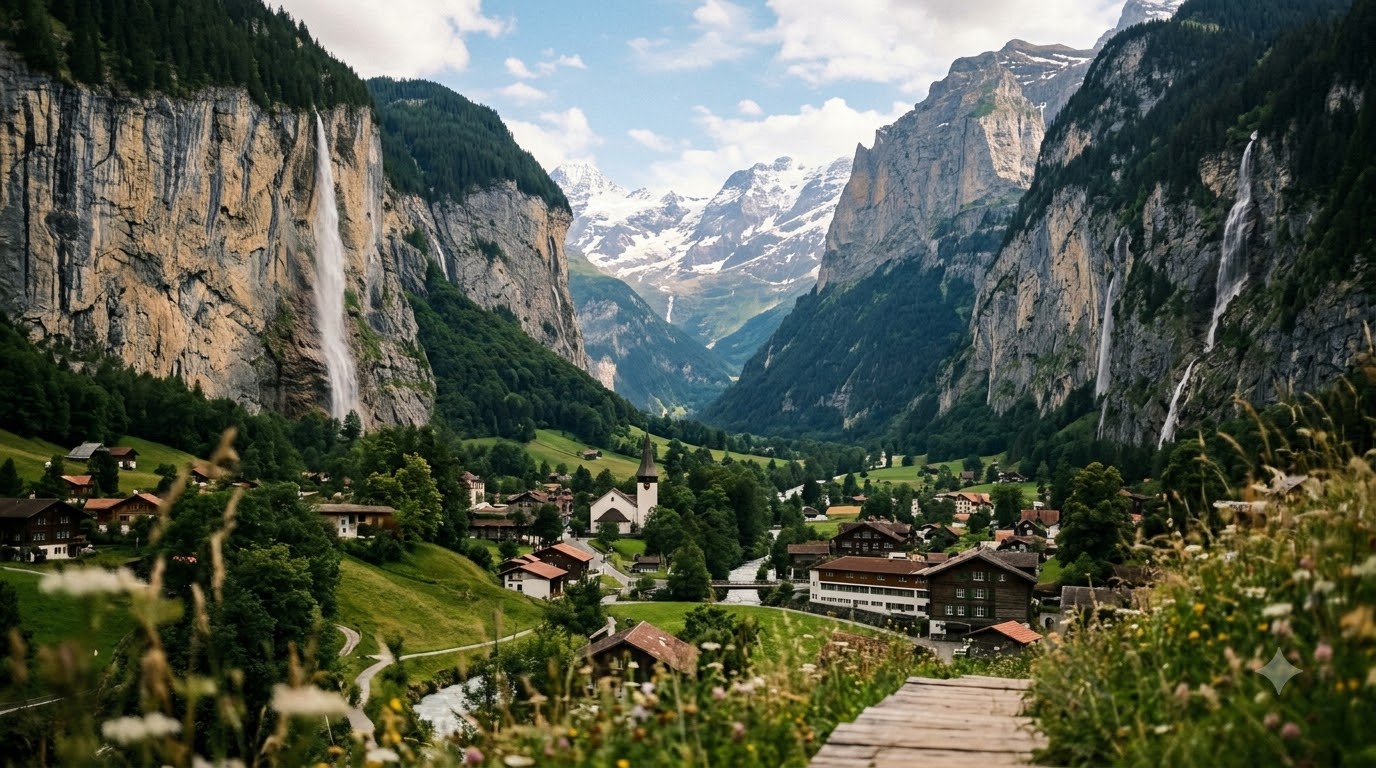
Lauterbrunnen valley is a U-shaped glacial valley in Switzerland’s Bernese Oberland, part of the UNESCO-listed Swiss Alps Jungfrau-Aletsch region. The name roughly means “many fountains,” and the geography explains the count: near-vertical rock walls up to 1,000 meters high catch snowmelt and glacier runoff from the peaks above, then release it over the edge as dozens of separate falls.
Here is what shapes a visit:
- The valley floor sits at roughly 800 meters, with cliff walls rising close to 1,000 meters on either side.
- Of the 72 waterfalls, most are seasonal and run hardest during snowmelt from late May through July.
- The two you can visit up close are Staubbach Falls (free, western wall) and Trummelbach Falls (paid, eastern wall).
- The village of Lauterbrunnen is the transport hub; trains and cable cars fan out from here to Murren, Wengen, Grindelwald, and Jungfraujoch.
- The poet Goethe visited in 1779 and wrote “Song of the Spirits over the Waters” after seeing Staubbach, which tells you the valley has been a headline sight for over 240 years.
The valley works as a base or a day trip. If you are still deciding on your hub, our complete Interlaken travel guide breaks down when to stay in town versus up in the mountains.

The 3-Day Interlaken Itinerary
The plan we use ourselves — sent straight to your inbox.
- Day-by-day route
- Where to stay
- Real 2026 costs
Free · No spam · Unsubscribe anytime
Staubbach Falls: Europe’s Free 297-Meter Waterfall
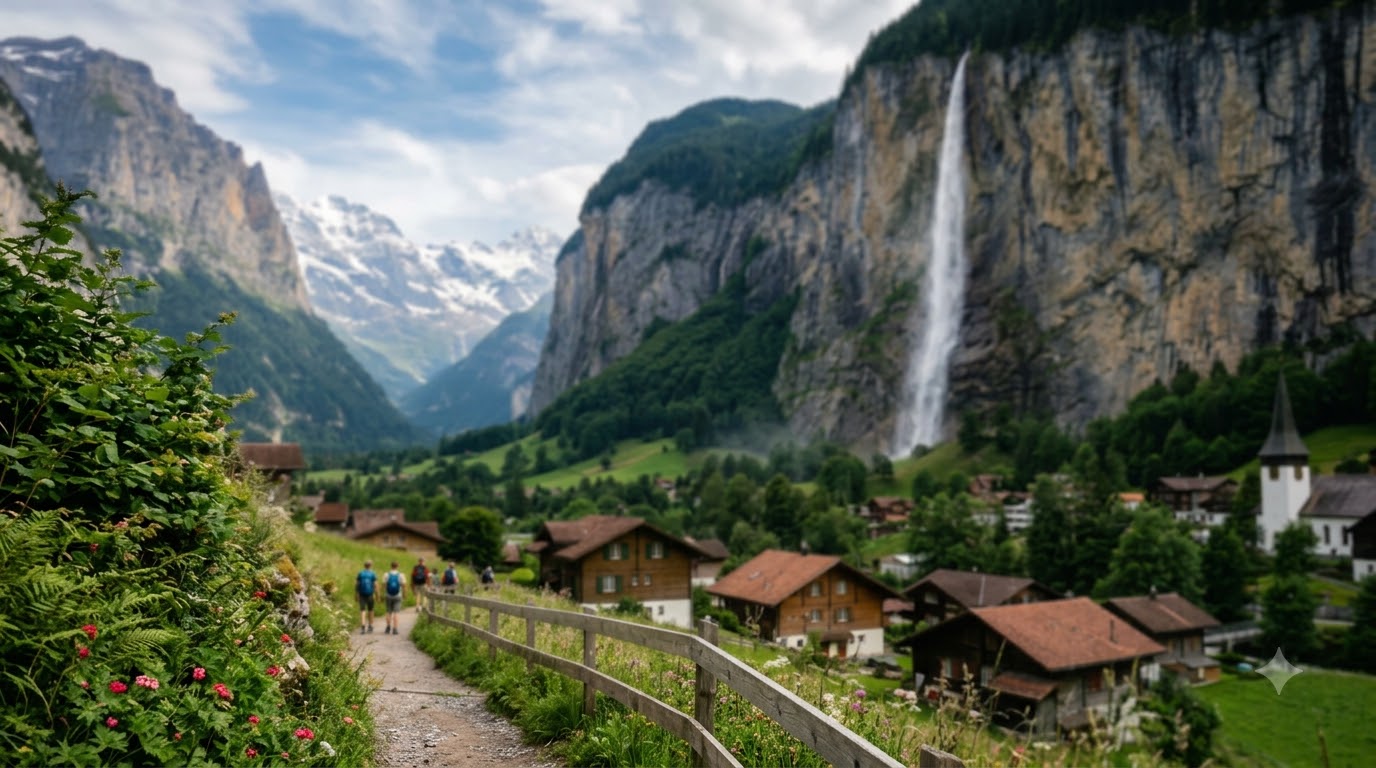
Staubbach Falls is the free, unmissable one, plunging 297 meters off the western cliff directly above Lauterbrunnen village. Because the drop is so long, the water breaks into mist before it lands, which is where the name (roughly “dust stream”) comes from. You can see it from the main street the moment you step off the train.
Quick facts before you go:
- Entry is free; the falls are a 10 to 15 minute walk from Lauterbrunnen station.
- A summer viewing gallery, carved into the rock, lets you walk up behind the falling water; it is usually open from June through October, weather permitting.
- The tunnel path up to the gallery is steep and gets slick with spray, so grippy shoes matter more than you would expect.
- Flow is strongest in late spring and early summer; by late August in a dry year it can thin to a wisp.
- Early morning light hits the falls best, and the village is emptiest before the first day-trip trains arrive around 9:30 a.m.
We walked up to the gallery twice, and the honest verdict is that the view from the base is the iconic one, while the gallery is more of an experience than a photo op.
Trummelbach Falls: CHF 18 to Walk Inside a Glacier
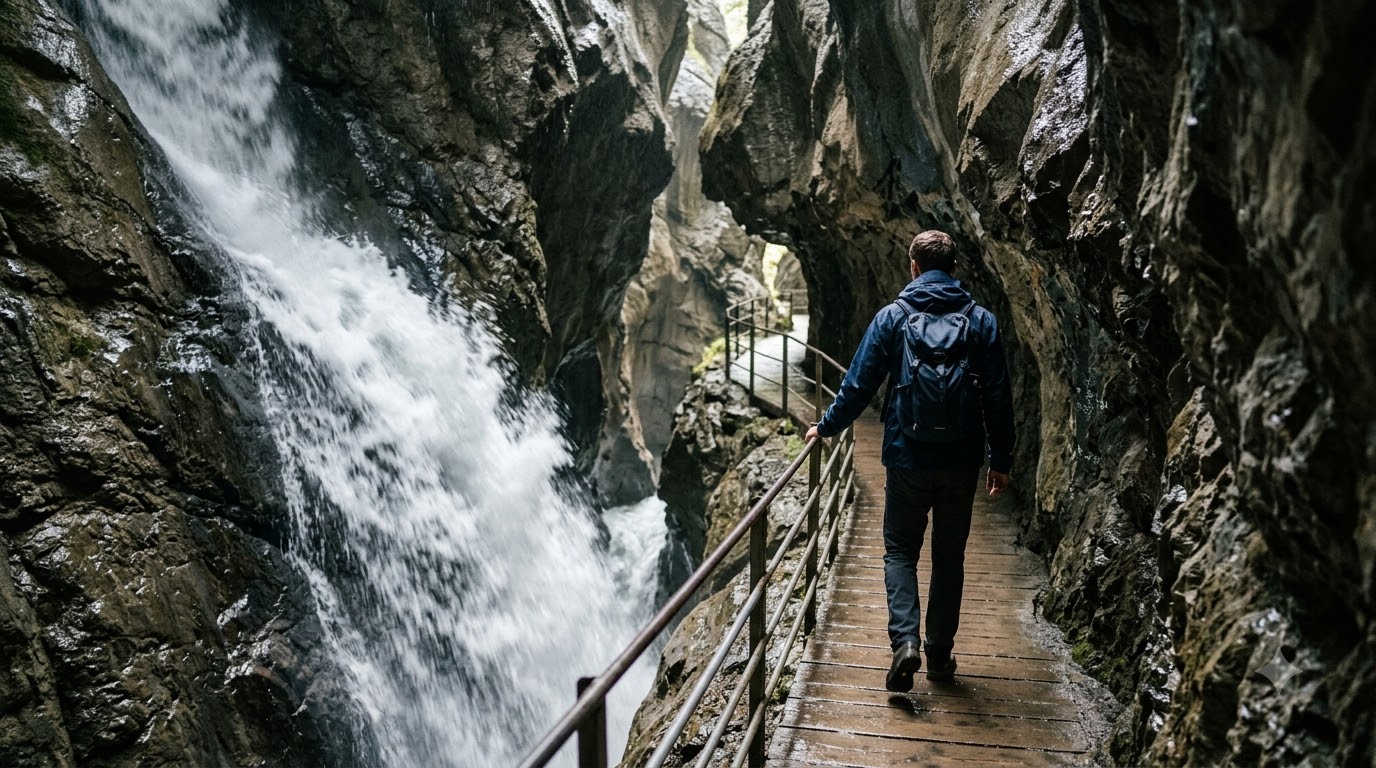
Trummelbach Falls is the paid highlight and completely different from Staubbach: it is a series of ten glacier-fed waterfalls hidden inside the mountain, reached by a tunnel lift built into the rock. The falls drain the meltwater of the Eiger, Monch, and Jungfrau, carrying huge volumes of grey glacial water through carved gorges you walk alongside on lit galleries and stairs.
| Ticket (2026) | Price | Notes |
|---|---|---|
| Adult | from CHF 18 | Includes the tunnel funicular lift |
| Child (6-15) | from CHF 8 | Under 4 not admitted for safety |
| Opening season | Apr to early Nov | Closed in winter |
| Hours (Jul-Aug) | 8:30 a.m. to 6:00 p.m. | Apr-Jun and Sep-Nov: 9:00 a.m. to 5:00 p.m. |
Plan your visit with these points:
- Trummelbach is about 3.5 km up-valley from Lauterbrunnen village; take the postbus (roughly 10 minutes) or walk about 45 minutes along the valley floor.
- The funicular lift does the hard climbing, then you continue on foot up stairs and walkways between the cascades.
- It is cold, wet, and loud inside the mountain, so bring a light layer even on a hot day.
- Allow 60 to 90 minutes to see all ten falls without rushing.
- Dogs and children under 4 are not permitted, and the metal stairs can be slippery.
Prices here have climbed in recent years, so budget the current CHF 18 adult rate rather than the older figures you will still find on some blogs.
The 3-Day Interlaken Itinerary
Hour-by-hour plan, where to stay and what it really costs — free PDF.
Free · No spam · Unsubscribe anytime
The 72 Waterfalls: Which Ones Are Worth Your Time
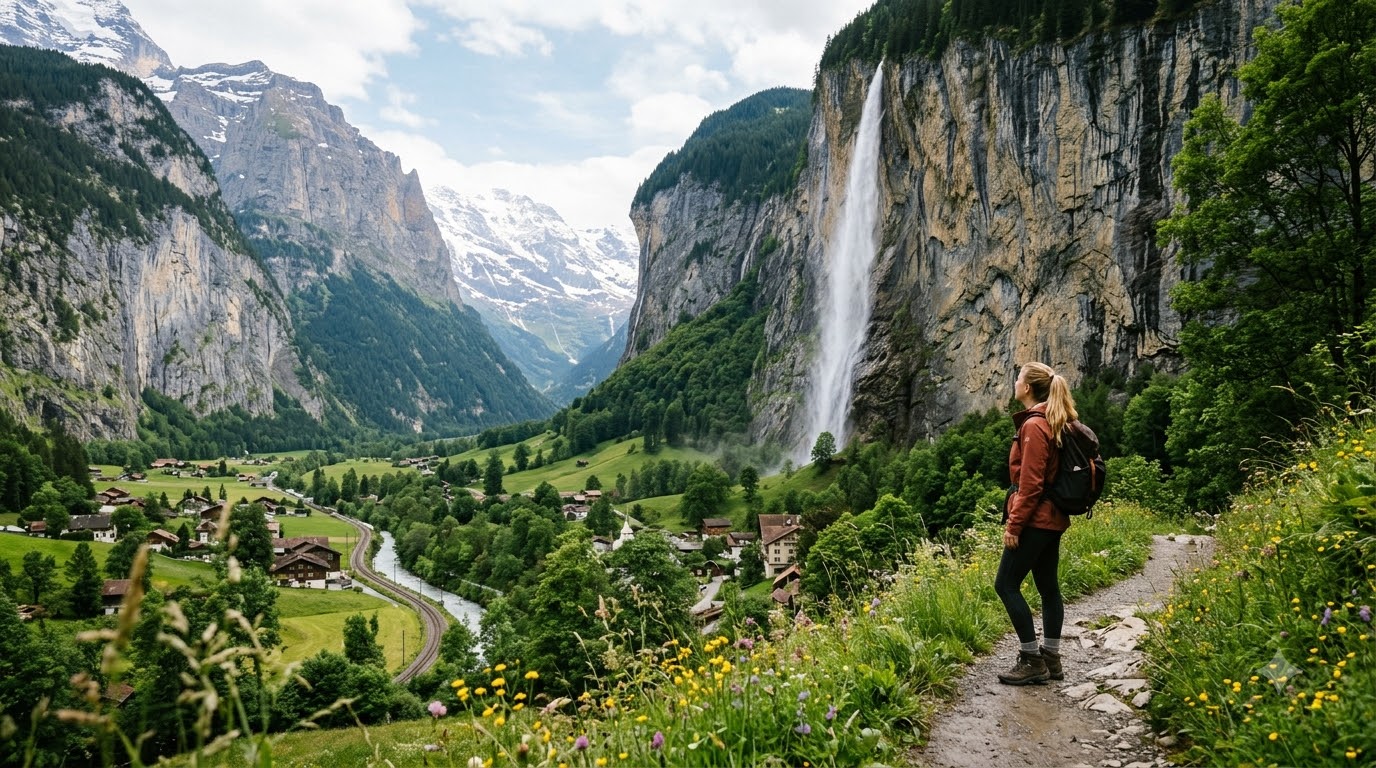
Beyond the famous two, most of the 72 waterfalls are seasonal streaks you spot from the valley trail rather than named attractions. If your time is limited, prioritize like this:
- Staubbach Falls (free): the 297-meter signature drop above the village, best in the morning.
- Trummelbach Falls (from CHF 18): the underground glacier cascades, best on a hot afternoon when the cool is welcome.
- Murrenbachfall: visible from the valley near Stechelberg, one of the tallest at over 400 meters when running full.
- Sprutzbach and the valley wall streaks: dozens of ribbon falls you pass on the flat walking and cycling path between Lauterbrunnen and Stechelberg.
- The full-flow window: visit between late May and mid-July to see the most falls active at once.
The 5-kilometer valley-floor path from Lauterbrunnen to Stechelberg is the single best way to see the volume of waterfalls, and it is flat, paved, and stroller-friendly.
Murren and Wengen: The Car-Free Villages Above the Valley
Murren and Wengen are the two car-free villages perched on the cliff shelves above Lauterbrunnen, and neither has any road connection to the outside world. Everything, from groceries to building materials, arrives by rail or cable car. They are where you go for the wide panoramic views back across the gorge toward the Jungfrau.
| Village | Elevation | How you reach it | Vibe |
|---|---|---|---|
| Wengen | ~1,274 m | Wengernalbahn cogwheel from Lauterbrunnen (~15 min) | Sunny terrace, bigger, family-friendly |
| Murren | 1,639 m | Cable car to Grutschalp then railway (~20 min total) | Higher, quieter, Schilthorn access |
What to know about each:
- The Lauterbrunnen-Murren cable car climbs 686 meters in about 4 minutes to Grutschalp, then a narrow-gauge railway runs 12 minutes on to Murren.
- Wengen is reached by the Wengernalbahn cogwheel railway, the same line that continues up to Kleine Scheidegg and connects toward Jungfraujoch.
- Murren is the launch point for the Schilthorn and its revolving Piz Gloria restaurant, plus the classic North Face trail toward Gimmelwald.
- Both villages are quieter after the last day-trippers leave in late afternoon, which is the argument for sleeping up top at least one night.
- From either village you are well placed for the higher peaks; see our Jungfraujoch guide for the Top of Europe excursion and our Grindelwald travel guide for the neighboring valley.
How to Get to Lauterbrunnen from Interlaken
The fastest route is the direct train from Interlaken Ost, which takes about 22 minutes and runs roughly every half hour. This is the way most visitors arrive, and you do not need to pre-book; buy at the machine or the SBB app and board.
| Route | Time | From (2026) | Frequency |
|---|---|---|---|
| Interlaken Ost to Lauterbrunnen (train) | ~22 min | CHF 7.80 | ~every 30 min |
| Lauterbrunnen to Wengen (cogwheel) | ~15 min | included on rail passes | frequent |
| Lauterbrunnen to Murren (cable car + rail) | ~20 min | included on many passes | frequent |
| Lauterbrunnen to Trummelbach (postbus) | ~10 min | local fare | hourly-ish |
Getting-around tips:
- Trains to Lauterbrunnen usually leave from Platform 2 at Interlaken Ost on the R62 service.
- A Swiss Travel Pass, Jungfrau Travel Pass, or Berner Oberland Pass covers most of these legs; check which pass matches your days before buying single tickets.
- The valley floor between Lauterbrunnen and Stechelberg is served by a local postbus if you do not want to walk it.
- Parking in Lauterbrunnen village is limited and paid, so arriving by train is genuinely easier than driving.
- For the full arrival logistics into the region, see our roundup of the best things to do in Interlaken, which shares the same rail hub.
Where to Stay in Lauterbrunnen Valley
Your best base depends on whether you want to be under the waterfalls or above them. The valley floor is cheaper and central for trains; the cliff villages are pricier but deliver the panoramic views and evening quiet.
| Area | Best for | Trade-off |
|---|---|---|
| Lauterbrunnen village | First-timers, train access, budget | Loses sun early behind the cliffs |
| Wengen | Sunny views, families, easy Jungfrau access | Pricier, day-trip crowds midday |
| Murren | Quiet, highest views, Schilthorn | Longest transfer, fewest shops |
| Stechelberg | Hikers, drivers, Schilthorn cable car | Smallest, least central |
Booking notes from our stays:
- Lauterbrunnen village books out fastest in July and August; reserve a month ahead for summer weekends.
- The valley floor sits in shadow by late afternoon in shoulder seasons, so if you want evening sun on your balcony, choose Wengen.
- Murren has the fewest restaurants, so half-board at your hotel is often the practical call up there.
- Budget travelers cluster in Lauterbrunnen for the campground and guesthouses; the famous valley campsite is walkable from the station.
- Stechelberg suits drivers, since it has more parking and sits at the Schilthorn cable-car base.
Best Viewpoints and Photo Spots in Lauterbrunnen
The single most photographed view is from the main street of Lauterbrunnen village looking toward Staubbach Falls and the chalets beneath it. But the valley rewards a bit of climbing for the wider angles.
Our shortlist of viewpoints:
- Lauterbrunnen main street, looking up at Staubbach Falls, is the classic postcard frame, best in soft morning light.
- The Staubbach viewing gallery puts you behind the water in summer for a different, mistier perspective.
- Murren gives the eye-level panorama across the gorge to the Eiger, Monch, and Jungfrau.
- Grutschalp, the cable-car mid-station, opens up a clean valley overlook without the full climb to Murren.
- The North Face trail from Murren toward Gimmelwald strings together several of the best cliff-edge views in the region.
- Wengen’s terrace catches afternoon and evening sun on the peaks when the valley floor has already gone dark.
We found the light is kindest early and late; midday flattens the cliffs and fills the village with day groups.
Frequently Asked Questions
Is Lauterbrunnen worth visiting?
Yes. With 72 waterfalls, a free 297-meter signature fall, and two car-free villages a short cable car away, the Lauterbrunnen valley delivers one of the highest scenery-to-effort ratios in the Alps. Even a half-day trip from Interlaken is worth it, and a night or two lets you see it without the midday crowds.
How much does Trummelbach Falls cost in 2026?
Adult tickets start from CHF 18 and children aged 6 to 15 from CHF 8, with the price including the tunnel funicular lift. The falls are open from early April to early November; children under 4 and dogs are not admitted for safety reasons.
How do you get from Interlaken to Lauterbrunnen?
Take the direct train from Interlaken Ost, which takes about 22 minutes, runs roughly every 30 minutes, and costs from CHF 7.80 one way. It usually departs from Platform 2, and no advance booking is needed.
Should I stay in Lauterbrunnen, Wengen, or Murren?
Stay in Lauterbrunnen village for the cheapest, most central base with the best train access. Choose Wengen for sunny Jungfrau views and easy family access, or Murren for the highest, quietest setting and Schilthorn trips. All three connect within about 20 minutes.
When is the best time to see the waterfalls?
Flow is strongest from late May through mid-July, when snowmelt feeds the most falls at once, including seasonal streaks along the valley walls. Staubbach can thin by late August in a dry year, while Trummelbach, being glacier-fed, runs reliably all season until it closes in November.
Final Word
Lauterbrunnen packs an outsized amount of scenery into a valley you can cross in an afternoon. If you only have time for two stops, make them free Staubbach Falls in the morning and Trummelbach Falls in the afternoon, then ride the cable car up to Murren for the wide view before the last train down. Base yourself here or day-trip from Interlaken; either way, the waterfalls do the work.