Is Zurich Worth Visiting? An Honest Verdict on Cost vs Payoff (2026)
Disclosure: Some links in this guide are affiliate links. If you book or buy through them, we may earn a small commission at no extra cost to you — it helps keep our guides free.
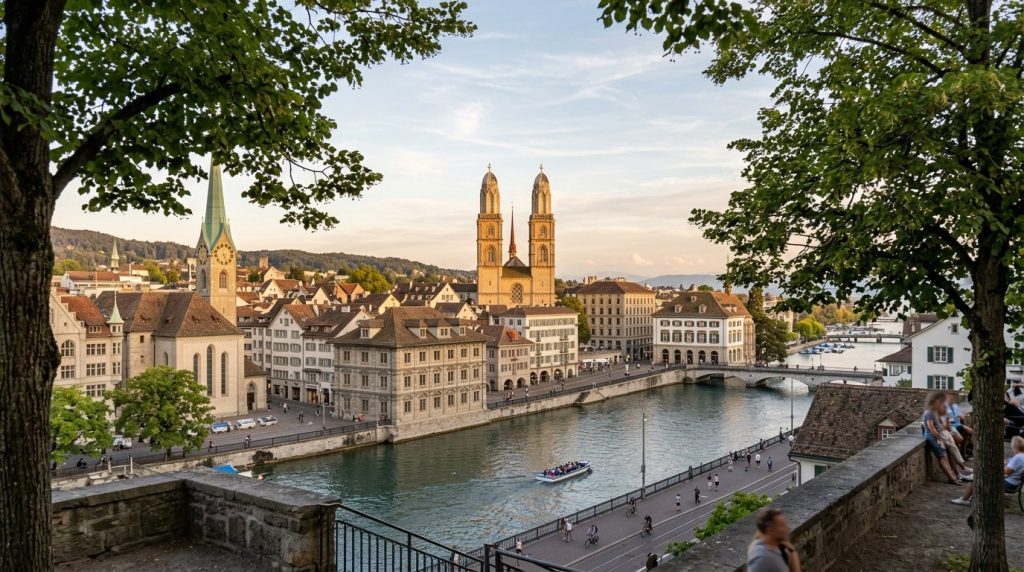
Yes, Zurich is worth visiting for 1 to 2 days, mostly as a base: the fastest train reaches Lucerne in 41 minutes and Rhine Falls in about an hour, but Numbeo’s mid-2026 index ranks Zurich the most expensive city on earth (123.1, against New York’s 100). Come for the lake, the compact Old Town and the rail connections.
Don’t come expecting Paris-level landmarks, and don’t budget for a long stay in the city itself.
| Factor | The reality | What it means for you |
|---|---|---|
| Cost | Numbeo index 123.1, number 1 worldwide | Expect New York prices or higher for food and rooms |
| Sights | Old Town, lake, 2 major museums, Uetliberg | 1 full day covers the highlights |
| Day trips | Lucerne 41–52 min, Rhine Falls about 1 hour | Excellent base for 2–3 nights |
| Getting there | SWISS nonstops from 7 US airports | Easy arrival with no connection needed |
| Who wins | Rail-trip planners, short city breakers | Weak choice for budget or nightlife-first trips |
The short answer: one great day, then use it as a hub
Zurich’s problem is not quality. The city is clean, the lake is swimmable in summer, and the Old Town on both banks of the Limmat is pleasant to wander. The problem is that its headline sights are quiet ones. A Rick Steves forum regular put it well: a 2 to 3 hour stroll, lake swim included, can be very rewarding. Zurich rewards a day, maybe two, not a week.
Where it earns a bigger slot in your trip is as a base. Zurich HB has direct trains to most of the country, and the airport has its own station, so you can land, drop bags and be on a train to the mountains or the lakes without changing cities.
If you are building a first Switzerland trip, our 3-day Zurich itinerary shows how to split a city day from two rail days.
What you actually get for your money in the city
Here is what a first day realistically looks like, with prices converted at USD 1 = CHF 0.83:
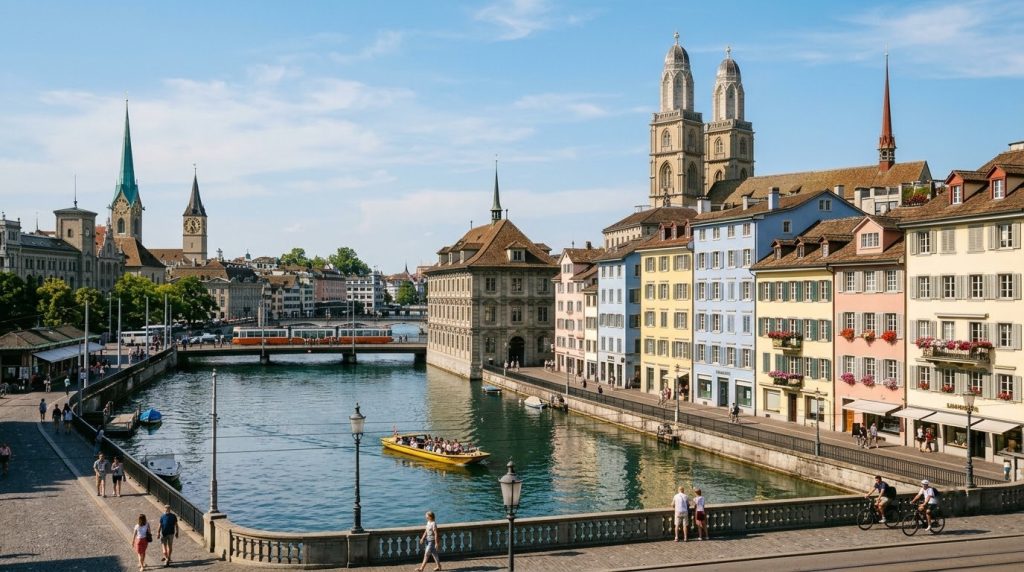
– Old Town and Lindenhof: free. The hilltop square gives the classic view across the Limmat to the Grossmünster towers. – Swiss National Museum (Landesmuseum): USD 16 (CHF 13) for adults, free under 16, closed Mondays.
The castle-style building sits right next to the main station. – Kunsthaus Zurich: USD 29 (CHF 24) for the collection, and the permanent collection is free on Wednesdays.
It is the largest art museum in Switzerland. – Uetliberg: the S10 train climbs from Zurich HB in about 20 minutes to a ridge with views over the city and lake, and on clear days to the Alps. – Lake swimming: in summer, the lakeside badis (swimming baths) like Seebad Enge are the most local thing you can do.
The money saver is the Zürich Card: USD 35 (CHF 29) for 24 hours or USD 67 (CHF 56) for 72 hours. It covers unlimited 2nd-class public transport in the city and region, the airport transfer, the Uetliberg train, short lake cruises and free entry to the Kunsthaus collection and the National Museum. If you visit both museums and ride to the airport, the 24-hour card pays for itself.
Zurich as a day-trip base: the real reason to stay
Trainline counts around 41 trains a day to Lucerne, the fastest at 41 minutes. Rhine Falls, which SBB bills as Europe’s largest waterfall, is about an hour by train to Schloss Laufen am Rheinfall or Neuhausen Rheinfall station. Both are easy half-day trips that leave your evening free back in the city.
If you plan three or more rail days, price the Swiss Travel Pass against single tickets. SBB lists 3 consecutive days in 2nd class at USD 306 (CHF 254) and 8 days at USD 529 (CHF 439), prices valid until 31 December 2026.
It only makes sense if you ride a lot; for one Lucerne round trip, a point-to-point ticket booked early is cheaper. Our list of day trips from Zurich ranks the options by travel time and cost.
Who should skip Zurich (or cut it to a few hours)
– Budget travelers. Numbeo’s mid-2026 cost-of-living ranking puts Zurich first in the world, and Lucerne (112.7), Basel and Geneva fill out the top five. Switzerland is expensive everywhere, but Zurich is the peak. If your daily budget is tight, sleep elsewhere and visit Zurich on a day ticket. – Landmark hunters. There is no Eiffel Tower moment.
Zurich is a great place to live and a good place to visit, not a bucket-list sight. – Alps-first travelers. If snow peaks are the point, base yourself in the mountains or in Lucerne and treat Zurich as your airport.
Lucerne puts you closer to Rigi and Pilatus. – Anyone with only 4 or 5 days in Switzerland. Give Zurich your arrival afternoon or departure morning, not a full day.
If you are still deciding between the two big Swiss cities, our Geneva vs Zurich comparison covers flights, costs and day trips side by side.
Getting there from the US, and entry rules
SWISS flies nonstop to Zurich from New York JFK, Newark, Boston, Chicago O’Hare, Miami, Los Angeles and San Francisco, so most Americans can arrive without a connection. US passport holders can visit Switzerland visa-free as a Schengen country, and the State Department rates Switzerland at Level 1, Exercise Normal Precautions (advisory dated 20 May 2025).
The EU’s ETIAS travel authorization is not in operation yet and has no confirmed start date, so check the official EU travel site before you book.

Weather matters more than usual here, because so much of the payoff is the lake and the views. Summer gives you swimming and long evenings; late fall can be gray for days. See the best time to visit Zurich for a month-by-month breakdown.
What to eat in Zurich
Zürcher Geschnetzeltes is the dish to order at least once: thin strips of veal in a white-wine and cream sauce with mushrooms, traditionally served alongside rösti, the city’s answer to hash browns. It shows up on menus from casual Stübli to formal dining rooms, and most restaurants make their own version, so it is worth comparing more than one if you are in Zurich for a few days.
For something different, Haus Hiltl, founded in 1898, holds the Guinness World Record for the oldest continuously operating vegetarian restaurant on earth, serving more than a hundred vegetarian and vegan dishes in the heart of the city. It works for travelers of any diet, not just vegetarians, and it is a reasonable way to break up a few days of veal and cheese with something lighter.
Chocolate is the other local specialty worth budgeting time for, whether a bar picked up at a grocery store or a stop at the Lindt Home of Chocolate across the lake.
If you only have one full day in the city, as this guide assumes for most visitors, pick one sit-down meal rather than trying to fit in both Hiltl and a traditional Swiss restaurant, since the point of a short Zurich stop is the lake and the Old Town, not an eating marathon.
Local etiquette worth knowing
Punctuality matters more in Switzerland than in most of Europe. If a museum says it closes at 6pm or a train leaves at 10:04, treat that as exact rather than approximate, since Swiss trains are famous for leaving on time rather than waiting for stragglers.
Quiet hours are a real rule, not just a courtesy. Switzerland observes designated quiet periods, typically from around 10pm to 6am, during which loud activity in residential buildings is discouraged by custom and sometimes by local regulation, so keep hotel room noise down late at night, especially in older buildings with thin walls.
Jaywalking is also enforced more strictly than visitors expect. Crossing against a red pedestrian signal or away from a marked crossing is against the law in Switzerland, and police can and do issue on-the-spot fines.
Wait for the green light even when a street looks empty, since the habit of jaywalking that works fine in many cities will stand out, and occasionally cost you, in Zurich.
A quiet nod or a brief greeting when entering a small shop or a quiet train compartment is also normal here, and skipping it can come across as brusque even though nothing is actually required of you by law.
Where to stay
Location decides how much value you get from Zurich, because you want to walk to the station.
– Altstadt (Old Town): the most atmospheric option, on both banks of the Limmat. Best for couples and first-timers on a 1 to 2 night stop. – Around Zurich HB / Kreis 1: the practical pick for day-trippers, since every train leaves from here.
Good for families moving with luggage. – Zurich West (Kreis 5): former industrial district with bars and restaurants, a short tram ride from HB. Suits younger travelers and night owls.
For specific properties by budget, see our picks for the best hotels in Zurich.
Find your Zurich hotel on the map
Live prices from Booking, Airbnb and more — move the map or change dates to compare stays across Zurich.
Frequently Asked Questions
Is Zurich or Lucerne better to visit?
For a first trip focused on scenery, Lucerne wins: it has the lake-and-mountain setting most people picture in Switzerland and sits closer to Rigi and Pilatus. Zurich wins on flights, museums, restaurants and rail connections. Many travelers fly into Zurich, spend one night, then move to Lucerne, which is only 41 to 52 minutes away by train.
How many days do you need in Zurich?
One full day covers the Old Town, Lindenhof, a museum and the lakefront. Two to three nights make sense only if you use Zurich as a base for day trips such as Lucerne or Rhine Falls. Beyond three nights, most visitors get better value moving on to the mountains or another lake town.
Is Zurich too expensive for tourists?
It is the most expensive city in Numbeo’s mid-2026 cost-of-living ranking, with an index of 123.1 against New York’s 100. You can soften the cost with the Zürich Card (USD 35 for 24 hours), free sights like Lindenhof and the lakefront, free Wednesdays at the Kunsthaus collection, and supermarket picnics by the water.
Are Americans welcome in Switzerland?
Yes. US passport holders visit visa-free under Schengen rules, English is widely spoken in Zurich, and the US State Department rates Switzerland at Level 1, the lowest advisory level. SWISS runs nonstop flights from 7 US airports, including New York, Chicago, Los Angeles and Miami, so it is one of the easier European arrivals for Americans.
Planning the whole trip? Start with our Zurich travel guide for the overview, then use this page for the details.