Is Lisbon Safe? (2026)
Disclosure: Some links in this guide are affiliate links. If you book or buy through them, we may earn a small commission at no extra cost to you — it helps keep our guides free.
Yes — Lisbon is safe to visit, and Portugal sits at Level 1 of the US State Department’s 4-tier advisory scale, “exercise normal precautions,” the lowest risk category the agency issues, last reissued on March 3, 2025. Portugal also ranks as the world’s 7th-safest country in the most recent Global Peace Index.
The real issue in Lisbon is not violent crime but pickpocketing on the tram network and a persistent, non-violent street scam involving fake drugs — both nuisances, neither dangerous if you know what to watch for.
| Risk | How likely | How serious | What actually prevents it |
|---|---|---|---|
| Pickpocketing on tram 28 and the 15E | Common in peak season, especially boarding | Financial, rarely violent | Bag worn in front, phone in a zipped pocket, extra caution boarding |
| Metro pickpocketing at Baixa-Chiado | Occasional, worse during rush hour | Financial | Keep valuables off the platform side, avoid phone use mid-crowd |
| Fake-drug touts in Baixa and Bairro Alto | Very common, especially after dark | Annoying, non-violent | A firm “não, obrigado” and keep walking, never hand over cash |
| Slippery calçada pavement and steep hills | Constant, worse when wet | Falls, sprains, occasionally fractures | Flat rubber-soled shoes, extra care on Alfama and Bairro Alto slopes |
| Bairro Alto and Cais do Sodré nightlife | Occasional, late-night hours | Petty theft, rarely worse | Normal city awareness, watch your drink, share a ride back |
| Airport taxi overcharging | Common if you skip the official rank | Financial | Use the metered taxi rank or the Bolt/Uber app |
| Violent crime | Rare | Can be severe if it happens | Portugal ranks 7th globally on the 2026 Global Peace Index |
Tram 28 pickpocketing is the real issue, not crime
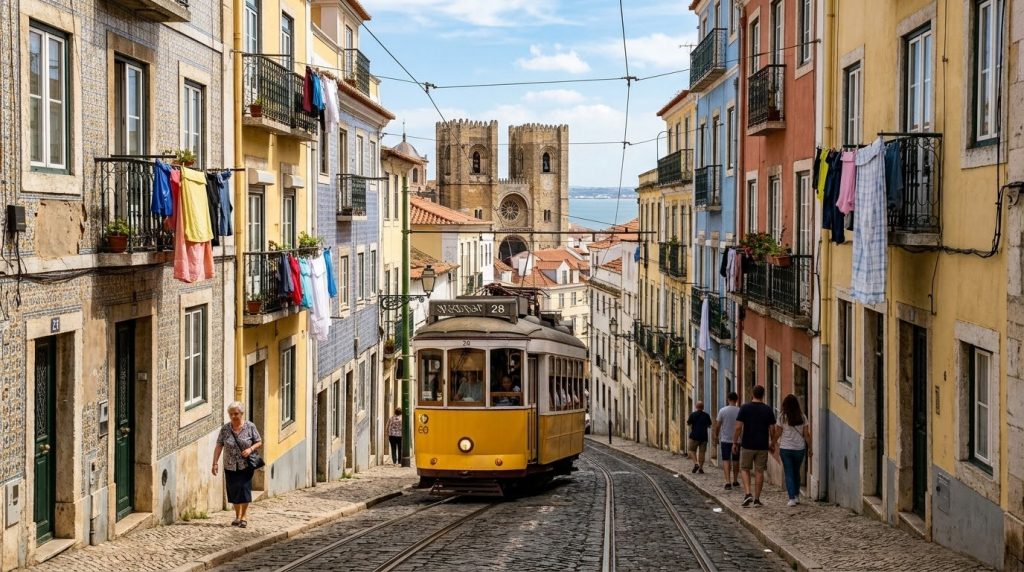
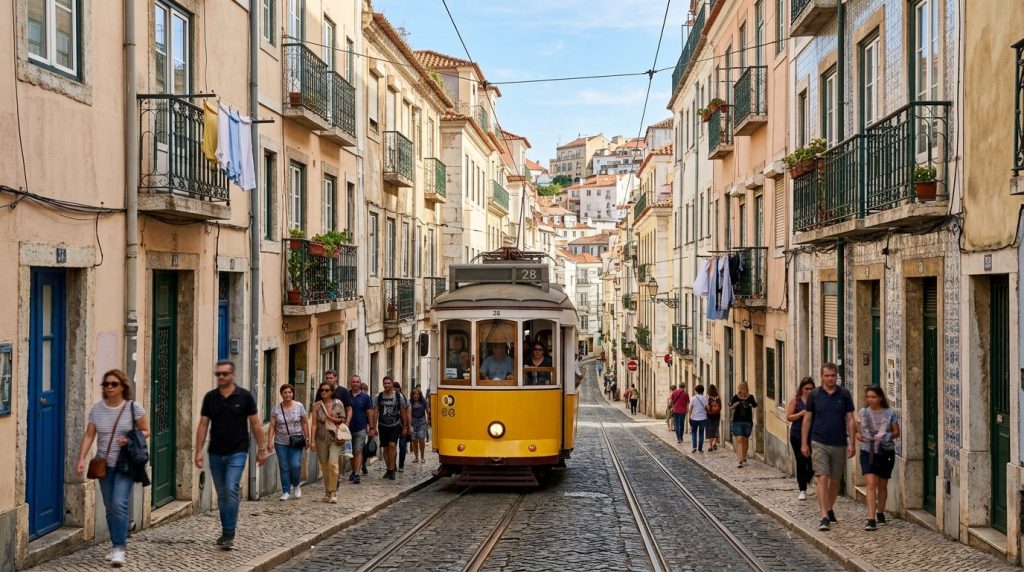
Tram 28, Lisbon’s famous yellow funicular-style tram through Alfama and Graça, is the single most-flagged safety problem in the city, and it has nothing to do with violence.
The tram is old, narrow and often packed shoulder-to-shoulder with tourists, which makes it the easiest possible workplace for a pickpocket team: a bump while boarding, a distraction while the doors are jammed, and a phone or wallet is gone before the tram even leaves the stop.
The 15E tram out to Belém and the queues at the Santa Justa lift carry the same risk for the same reason, dense, slow-moving crowds funneled through a narrow space. Rossio and the rest of Baixa’s pedestrian streets see the same pattern at a lower intensity throughout the day.
None of this is a Lisbon-specific crime wave; it is the standard tourist-tram problem found in Rome, Prague or Barcelona.
Wear a crossbody bag in front of you, keep your phone zipped away rather than in a back pocket, and be most alert in the ten seconds around boarding, when the crowd is tightest and a team has the best cover.
Baixa-Chiado metro station
The Baixa-Chiado metro interchange, Lisbon’s busiest transfer point between the Blue and Green lines, sees the same pickpocket pattern as the trams above ground, concentrated around rush hour when the platforms and escalators are packed.
It is not a dangerous station, just a crowded one, and the same rules apply: keep bags zipped and worn to the front, and skip pulling your phone out for photos or directions while you’re moving through the tightest part of the crowd.
If you’re planning day trips that route through this station, a day trips from Lisbon guide is worth checking before you go, since several regional trains to Sintra and Cascais connect through Baixa-Chiado during peak hours.
The fake-drug touts are annoying, not dangerous
This is the most-asked follow-up question about Lisbon safety, and the honest answer is that it is a nuisance, not a threat. In Rossio Square, along Rua Augusta and up into Bairro Alto after dark, men will approach with a quiet “hashish, cocaine, good price” offer.
The product, if you ever actually bought it, is typically oregano or another inert substance, and the entire interaction is designed to separate a curious or intoxicated tourist from cash, not to threaten anyone.
It is not physically dangerous, it does not escalate to violence, and ignoring it entirely, a flat “não, obrigado” without breaking stride, ends it within a few steps.
It is one of the most consistent daily-life irritations Lisbon has, which is exactly why guides underexplain what to actually do about it: walk on, don’t engage, don’t reach for your wallet to prove a point.
Calçada pavement is the injury risk most guides skip
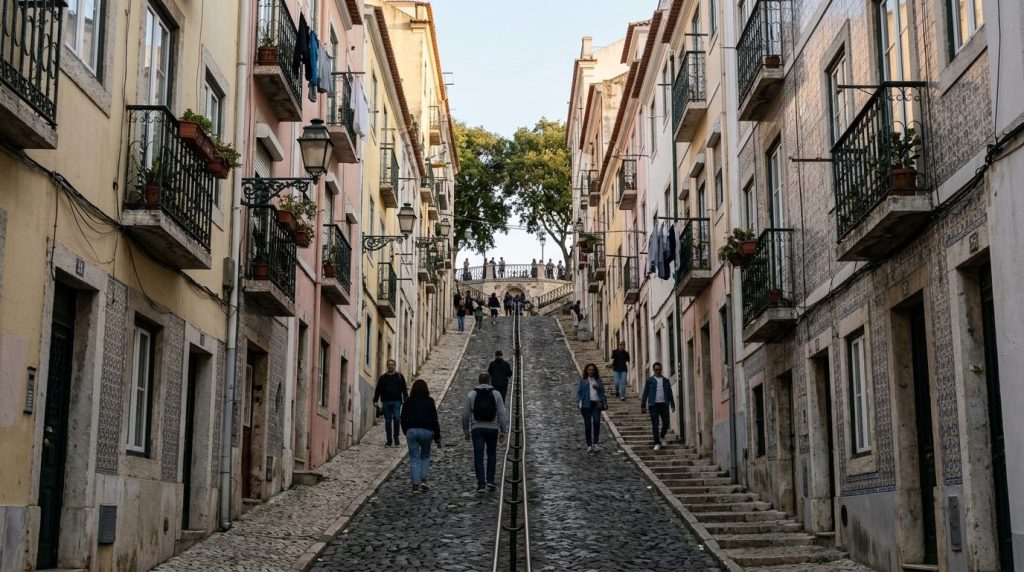
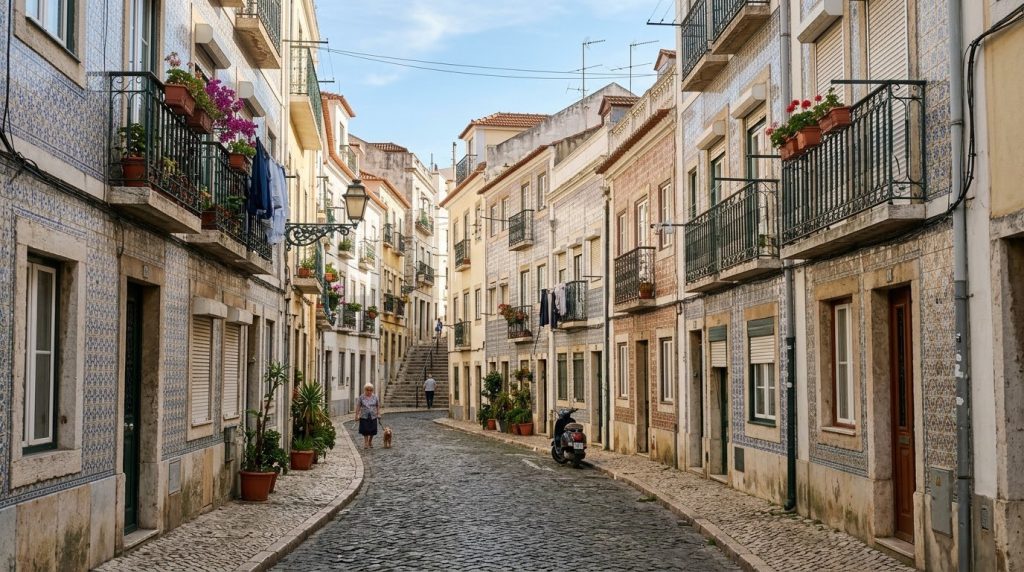
Lisbon’s traditional black-and-white calçada portuguesa, the mosaic limestone paving that covers most of the historic center, looks beautiful and becomes genuinely slick the moment it rains, and it’s laid over some of the steepest streets in Western Europe.
Alfama and Bairro Alto in particular combine narrow, uneven stone underfoot with a real gradient, and twisted ankles and hard falls are a routine, if under-discussed, source of injury for visitors, especially in sandals or smooth-soled shoes. This is a bigger practical risk on a typical Lisbon trip than crime is.
Pack flat, rubber-soled shoes, slow down on wet or freshly cleaned stone, and hold the handrail on the steeper Alfama staircases rather than trusting the surface.
Bairro Alto and Cais do Sodré after dark
Lisbon’s two main nightlife districts, Bairro Alto for bars and Cais do Sodré’s Pink Street for clubs, are safe by the standards of any major European capital and do not require special precautions beyond the ones you’d use in any city at 2am: watch your drink, know how you’re getting back to your hotel before you’ve had a few, and travel with people you trust rather than alone through empty side streets.
Petty theft ticks up slightly in these areas late at night, the same crowded-space pickpocket pattern as the trams, but the reported incidents of anything worse are rare.
Chiado, Príncipe Real and Alfama by day are comfortably safe with no extra caution needed; Intendente and the stretch around Martim Moniz warrant the same normal-city awareness after dark that any capital’s transitional neighborhoods do.
Airport taxis vs Bolt and Uber
The most common way visitors lose money in Lisbon isn’t theft, it’s an unmetered taxi from Humberto Delgado Airport quoting a flat “tourist rate” well above the metered fare, roughly USD 23 (EUR 20) for a legitimate metered ride into central Lisbon versus considerably more from a tout working the arrivals hall.
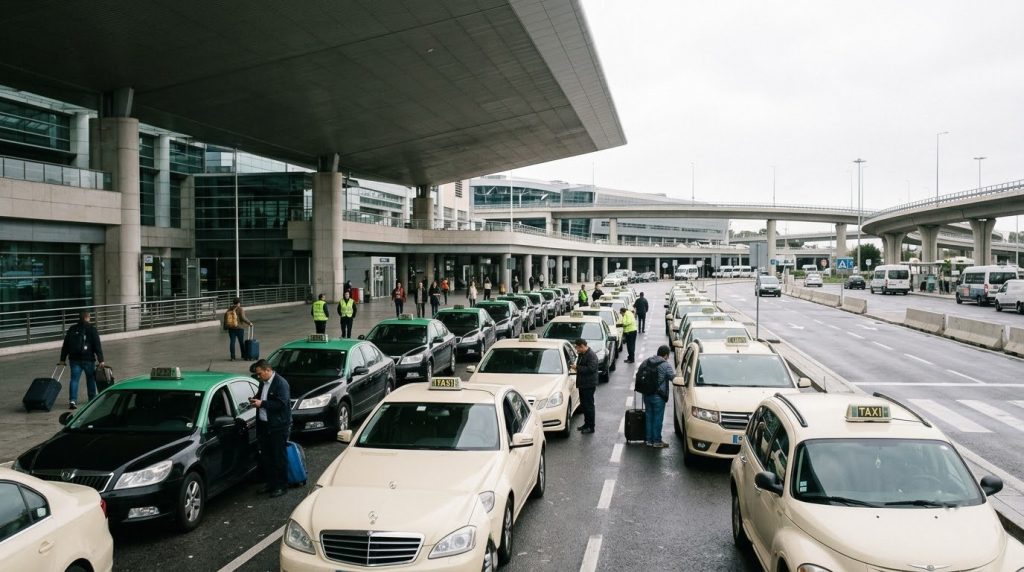
Skip anyone approaching you inside the terminal and either join the official taxi rank queue, where meters are required by law, or use the Bolt or Uber app, which typically runs USD 12-17 (EUR 10-15) for the same route and removes the negotiation entirely.
The same advice applies to taxi ranks outside major tourist sites, agree on the meter before the car moves.
Other scams worth knowing about
Beyond the fake-drug touts and tram pickpockets, a handful of other tourist-targeted scams come up often enough in traveler reports to be worth a mention, though all of them cost money rather than pose any real danger.
The first is a distraction approach: someone stops you with a petition to sign, an unsolicited bracelet or small gift, or a persistent sales pitch, while a second person works the crowd around you. The response is the same as with the drug touts: a flat no, and keep walking, since stopping to engage is the point of the approach.
The second is the Portuguese couvert, the bread, olives, cheese or small appetizers brought unprompted to a restaurant table. These are not complimentary, and eating from them without asking the price is treated as an order; ask the server to remove anything you do not want before touching it.
An unmarked “catch of the day” that turns out to cost several times more than a menu item is the related version of this at busier harborfront restaurants, and checking prices before ordering avoids both.
A third is buying attraction tickets, city tours or transport passes from a street vendor instead of the official ticket office, app or window. These sellers often charge a markup, and in some cases the ticket itself is invalid or more restricted than promised.
Booking the same ticket through the official site, the venue itself, or an established platform removes the risk and usually costs the same or less. None of these tactics are specific to Lisbon; they are the same patterns found in most major European tourist cities, and all three are avoidable by simply not transacting with anyone who approaches first.
Who should think twice about Lisbon
Lisbon is a poor fit for a narrow set of travelers, not for cautious people generally. Anyone who plans to carry a phone or wallet loose in an outside pocket on tram 28 during peak season is choosing an easy pickpocket target regardless of the city.
Travelers with mobility limitations or anyone unsteady on uneven ground should plan routes carefully around Alfama and Bairro Alto’s steepest calçada streets, or budget extra time and consider taxis over walking those specific stretches.
Solo travelers who intend to engage with street touts, out of curiosity or to see what happens, are inviting a scam that a simple “no thanks” avoids entirely.
If your trip also includes a wider look at the country, a is Portugal safe guide covers the national picture, and best time to visit Portugal is worth checking since calçada footing and tram crowding both get worse in the peak July-August season.
Choosing a safer base
Where you stay changes your daily exposure to Lisbon’s actual risks more than anything else on this list. A base in Chiado, Príncipe Real or Baixa itself keeps you within walking distance of most sights without relying heavily on tram 28, while a stay further out in Alfama means navigating its steepest, slickest calçada streets every day rather than occasionally.
If Porto is also on the itinerary, a Porto travel guide covers the same tram-and-hills safety pattern that applies a few hours north by train. If you are still choosing between the two cities, our Lisbon versus Porto comparison explains why Porto is the cheaper, more compact short break.
Find your Lisbon hotel on the map
Live prices from Booking, Airbnb and more — move the map or change dates to compare stays across Lisbon.