
Disclosure: Some links in this guide are affiliate links. If you book or buy through them, we may earn a small commission at no extra cost to you — it helps keep our guides free.
Hoi An vs Da Nang 2026: Which Is Better for Your Trip?
Hoi An and Da Nang sit just 30 km apart on Vietnam’s central coast, yet they deliver completely different travel experiences. We’ve broken down both cities across costs, beaches, food, nightlife, and practicality so you can stop second-guessing and start booking.
Key Takeaways
– Da Nang is Vietnam’s third-largest city with 1.2 million residents; Hoi An’s ancient town has just 2,000 permanent residents inside the UNESCO zone (UNESCO, 2025)
– Average hotel in Hoi An’s old town runs USD 45-90/night in 2026; Da Nang beachfront hotels average USD 55-110/night
– Da Nang International Airport handled 9.8 million passengers in 2025 — the closest major gateway for both cities (VNAT, 2025)
– Hoi An’s An Bang Beach was ranked among Southeast Asia’s top 10 beaches by Condé Nast in 2025
– The Da Nang–Hoi An taxi ride takes 35-45 minutes and costs USD 10-14 in 2026 (Grab app)
Location and Getting There: Da Nang Wins on Access
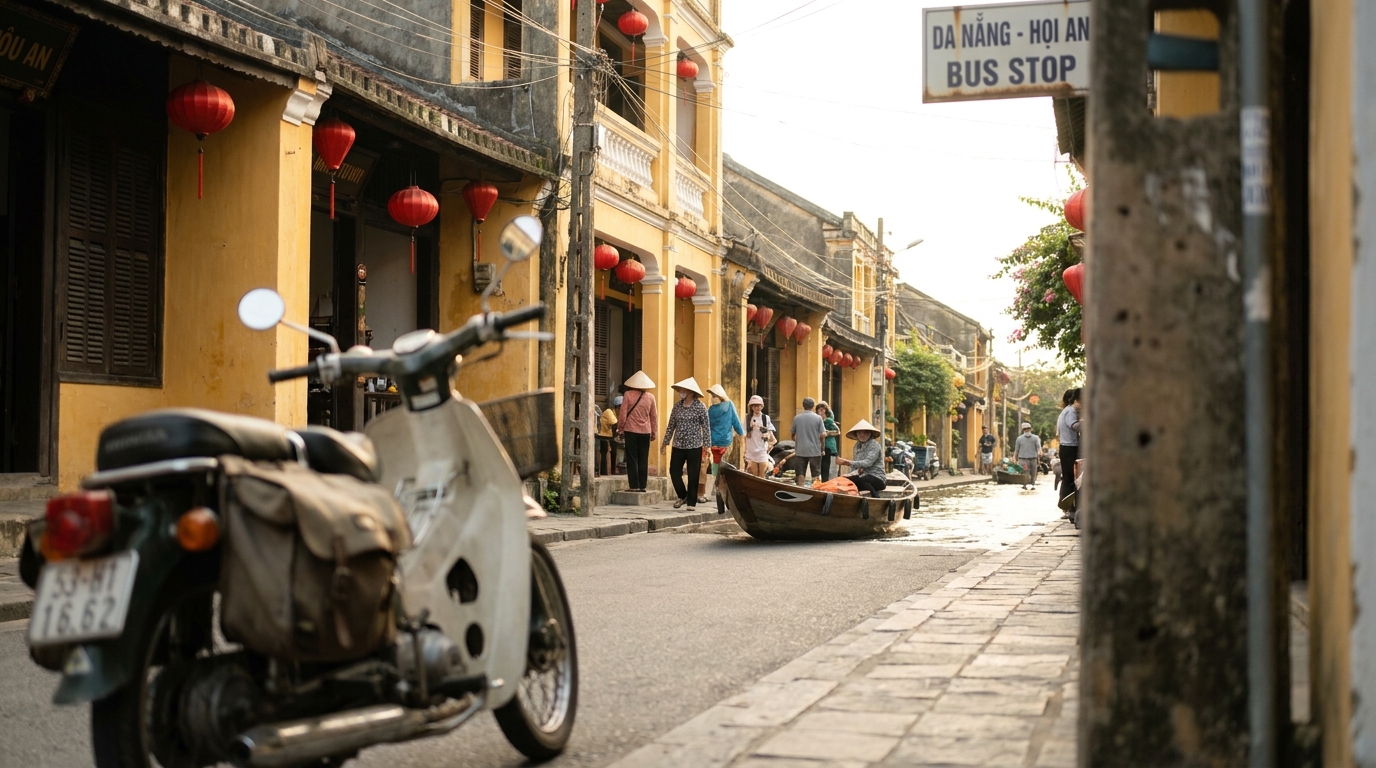
Da Nang is the clear winner for arrivals. It has an international airport with direct flights from Singapore, Bangkok, Kuala Lumpur, Seoul, and Tokyo, plus a central train station on the North–South line. Hoi An has no airport and no train station — every visitor comes through Da Nang first.
Flights into Da Nang from Singapore start at USD 60 one-way with Vietjet and Scoot in 2026 peak season. From Bangkok, budget fares hover around USD 80-110. Once you land, a Grab taxi to Da Nang city center costs USD 3-5; the same Grab to Hoi An runs USD 10-14. Shared airport shuttles to Hoi An cost USD 5-7 per person and run on fixed schedules every two hours.
If you need a local SIM for Grab and maps, grab an Airalo Vietnam eSIM before you board — 5 GB costs around USD 8 and activates before you touch down.
We recommend spending at least one night in Da Nang before heading to Hoi An if you arrive late, since nighttime navigation in the ancient town can be confusing with luggage.
Atmosphere and Vibe: Completely Different Cities
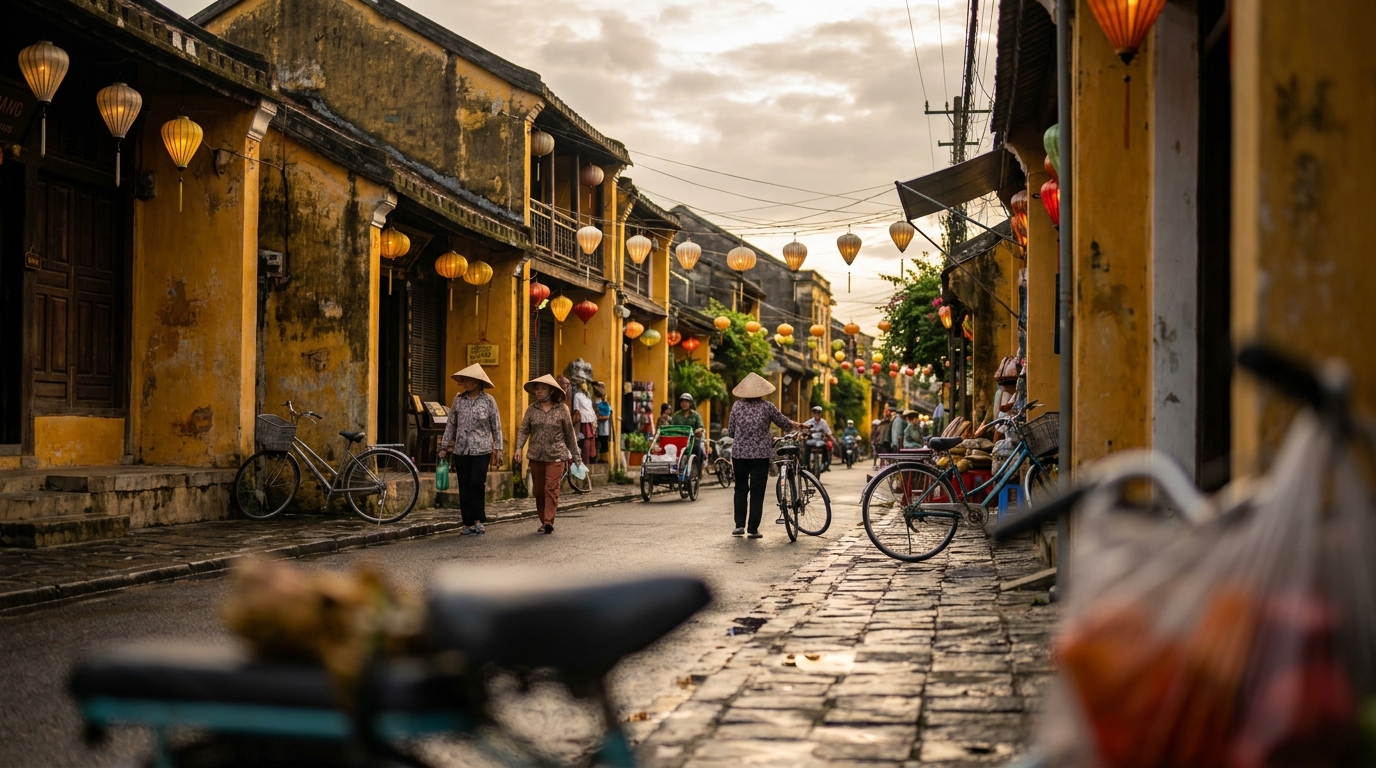
Hoi An and Da Nang don’t compete — they complement. Picking between them depends entirely on what kind of trip you want.
Hoi An’s UNESCO-listed ancient town is a preserved 15th-century trading port. Lantern-lit streets, yellow colonial walls, tailor shops, and heritage houses create an atmosphere unlike anywhere else in Vietnam. It’s walkable, bicycle-friendly, and deliberately low-rise — buildings inside the core zone cannot exceed 7.5 metres. Evening at the Japanese Covered Bridge with paper lanterns reflecting on the Thu Bon River is genuinely atmospheric.
Da Nang is a modern Vietnamese city in full expansion mode. Glass towers, beachfront hotels, the Dragon Bridge (which breathes real fire on weekend nights), and a skyline that’s tripled in size since 2015. It’s noisier, faster, and cheaper for everyday expenses like pho and bia hoi. If you want rooftop bars, air-conditioned malls, and a buzzing local scene, Da Nang delivers.
Many travelers split the difference: base in Hoi An for charm, day-trip to Da Nang for the beach clubs and infrastructure.
Beaches: Hoi An and Da Nang Both Deliver, Differently
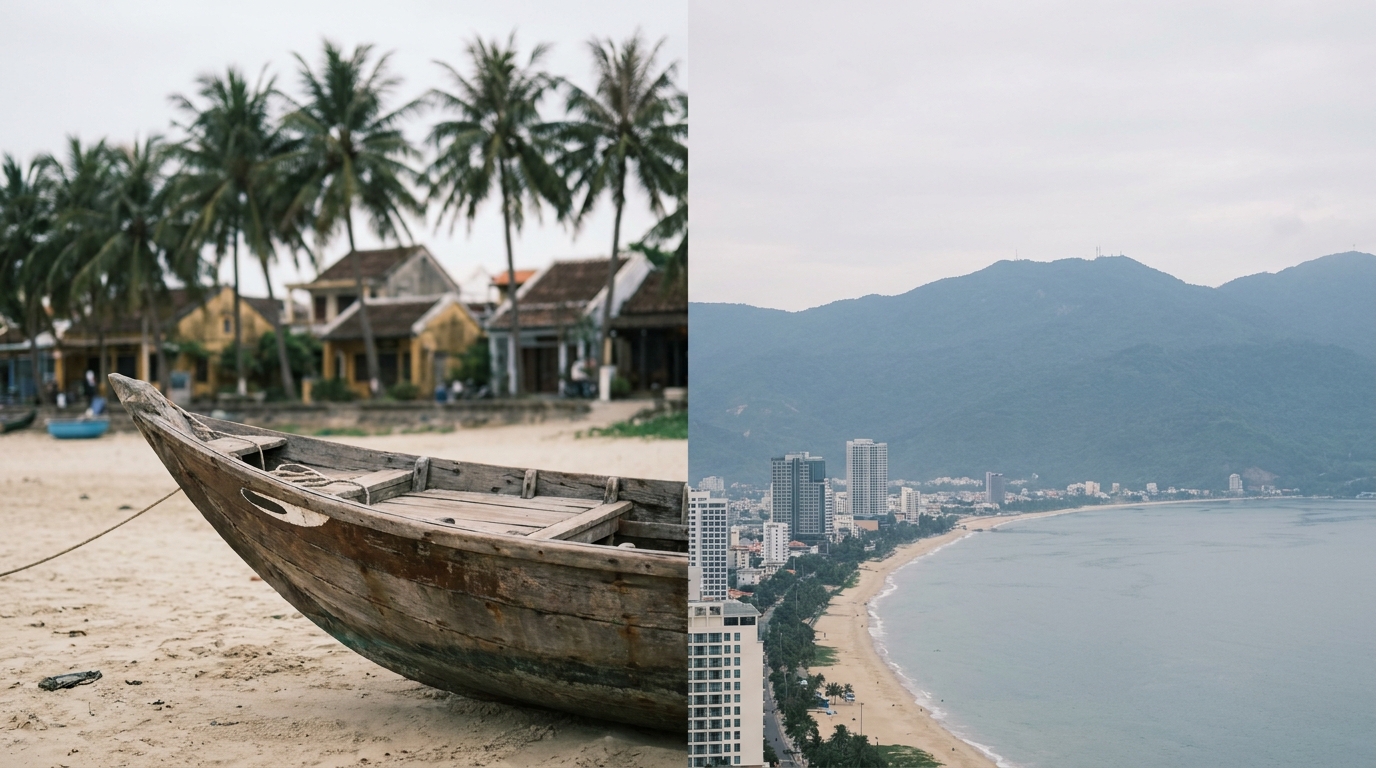
Both cities give you excellent beach access, but the beach experience is meaningfully different. Da Nang’s My Khe Beach stretches 30 km and sits directly behind the main hotel strip — you walk out the hotel door and you’re on sand. An Bang Beach near Hoi An (4 km from the old town by bicycle) is quieter, less developed, and backed by beach bars rather than resort towers.
My Khe is larger and cleaner in terms of infrastructure — the city council invested VND 200 billion (approx. USD 8 million) in beach facilities between 2023 and 2025. Sunbed rental on My Khe runs VND 30,000-50,000 (USD 1.20-2) per day. An Bang sunbed prices at beach bars range from free with a food/drink minimum spend to VND 50,000 flat.
Water sports are more developed in Da Nang: jet skiing (USD 15/15 minutes), parasailing (USD 25), and kitesurfing lessons (USD 60/2 hours) are all bookable on-site. Hoi An’s An Bang focuses more on paddleboarding and swimming.
Between June and August, both beaches face strong swells from the South China Sea — red-flag days are common and swimming can be restricted.
Food Scene: Hoi An Is One of Asia’s Best Eating Cities

Hoi An punches well above its size for food. It’s widely regarded as one of the best street food cities in Asia — Lonely Planet named it a top food destination in 2024, and the city has two dishes you genuinely can’t get better anywhere else: cao lau (thick rice noodles with char siu pork, unique to Hoi An because it uses water from a specific local well) and white rose dumplings (banh bao vac).
A bowl of cao lau at a local stall in the market costs VND 40,000-60,000 (USD 1.60-2.40). A full meal at a mid-range restaurant in Hoi An’s old town runs USD 8-15 per person including drinks. Cooking classes — you shop at the market then cook four dishes — cost USD 25-35 per person and are bookable on Klook.
Da Nang has excellent food too, particularly for mi quang (turmeric noodles with pork and shrimp) and banh mi. Prices are lower at local spots: pho for VND 35,000 (USD 1.40), banh mi for VND 25,000 (USD 1). The Han Market and Con Market are the best spots for local eating. Da Nang also has a growing international restaurant scene around the beachfront, with Japanese, Korean, and Italian restaurants serving USD 10-20 mains.
For serious food travelers, Hoi An wins this category without question. For budget everyday eating in a Vietnamese context, Da Nang is marginally cheaper.
| Category | Hoi An | Da Nang |
|---|---|---|
| Street food meal | USD 1.60-2.40 | USD 1.20-1.80 |
| Mid-range restaurant (per person) | USD 8-15 | USD 6-12 |
| Cooking class | USD 25-35 | USD 20-28 |
| Beer at a local bar | USD 1-2 | USD 0.80-1.50 |
| Coffee at a cafe | USD 1.50-3 | USD 1-2.50 |
Find your Hoi An hotel on the map
Live prices from Booking & Airbnb — tap a pin to compare stays around the Ancient Town and An Bang Beach and beyond.
Accommodation and Cost: Da Nang Is Cheaper, Hoi An Is More Atmospheric
Budget stretches further in Da Nang, but Hoi An’s mid-range options offer exceptional value for atmosphere. The price gap narrows once you move out of Hoi An’s old town core.
In Hoi An’s ancient town, budget guesthouses start at USD 18-25/night for a clean double room with air-con. Mid-range boutique hotels in restored colonial buildings run USD 45-80/night on Check live hotel prices, and these are genuinely charming properties with courtyard pools and lantern-decorated hallways. Luxury resorts on Hoi An’s beach (Four Seasons, Anantara, Naman Retreat) start at USD 200-350/night.
Da Nang has more variety at the budget-to-mid end: hostels from USD 10/night, three-star hotels from USD 25/night, and beachfront four-star hotels from USD 55-90/night. The Dragon Bridge area and My Khe beachfront have the highest concentration of options. Search check live hotel prices for beachfront Da Nang — you’ll regularly find four-star rooms at USD 60-70 that would cost USD 120+ in equivalent beach towns across Thailand.
Our recommendation: if your budget is under USD 40/night, Da Nang. If you can stretch to USD 50-80, Hoi An’s boutique accommodation scene is one of the best in Southeast Asia at that price point. Check where to stay in hoi an for our full hotel breakdown.
Nightlife and Activities: Da Nang Has More, Hoi An Has Better
Da Nang’s nightlife runs later and louder. Sky36 rooftop bar (36th floor of the Novotel) offers panoramic city and sea views — cocktails run USD 7-10. The beachfront clubs on My Khe are busy from 10 PM to 3 AM on weekends. The Dragon Bridge fire-and-water show happens every Saturday and Sunday at 9 PM and is free to watch from the riverbank.
Hoi An doesn’t do loud clubs — the ancient town has a noise curfew that keeps music levels down after 11 PM. What it offers instead: atmospheric lantern-lit bars on Nguyen Hoang street, rooftop spots overlooking the old town, and the famous Full Moon Lantern Festival on the 14th of each lunar month when electricity is cut and the streets fill with candlelight. The festival is free and genuinely one of the best free experiences in Southeast Asia.
Day trip options are strong from both cities. From Da Nang: the Marble Mountains (USD 2 entry, 20 minutes from city center), Ba Na Hills cable car and French Village (USD 35-45 entry), and Son Tra Peninsula. From Hoi An: My Son Sanctuary ruins (USD 12 entry, bookable via best day trips from hoi an), the Cham Island snorkeling tour (USD 25-35 via GetYourGuide), and the bicycle rice paddy cycling routes.
Book the Cham Island day trip in advance in peak season (May–August) — boats are limited and slots fill up 3-5 days ahead.
Which Should You Choose? Our Verdict
Most travelers spending 5-7 days in the region should base in Hoi An and day-trip to Da Nang — not the reverse. Here’s our decision framework:
Choose Hoi An if: You prioritize atmosphere over convenience, love food and culture, travel as a couple or solo, and don’t need a major airport on your doorstep.
Choose Da Nang if: You’re traveling with family and need more space and infrastructure, you want a beach holiday with a lively scene, you’re on a tighter budget, or you’re using it as a transit hub for flights.
Choose both if: You have 7+ days. Spend 4-5 nights in Hoi An, then 2 nights in Da Nang before your flight out. This is the most common and most satisfying itinerary. See our hoi an itinerary 3 days for a detailed day-by-day plan.
The 30 km distance means you’re never locked into one place — Grab taxis run reliably between the two cities at any hour, and the journey takes 35-45 minutes depending on traffic. There’s no wrong answer here, only different priorities.
For more context on what to do once you’ve decided, read our best things to do in hoi an and our hoi an travel guide for the full picture on the ancient town.
Frequently Asked Questions
Is Hoi An or Da Nang better for first-time visitors?
For first-time visitors to Vietnam, Hoi An delivers a more memorable experience. The ancient town’s preserved architecture, world-class street food, and manageable scale make it easier to orient yourself and absorb Vietnamese culture. Da Nang is better if you need an international-standard city with airports and hospitals close by.
How far is Hoi An from Da Nang?
Hoi An is 30 km south of Da Nang. A Grab taxi takes 35-45 minutes and costs USD 10-14 in 2026. Shared shuttles cost USD 5-7 per person. There is no direct bus route connecting the city centers conveniently, so Grab is the standard option for most travelers.
Can you stay in Hoi An and visit Da Nang as a day trip?
Yes, and this is what we recommend. The 35-45 minute Grab ride is affordable and reliable. You can visit My Khe Beach, the Marble Mountains, and the Da Nang city center all in one day from a Hoi An base. Return by 9 PM to catch the Dragon Bridge show on weekends and still be back in Hoi An by 10 PM.
Which city is cheaper to stay in?
Da Nang is generally 15-25% cheaper for accommodation, food, and transport. Budget travelers can manage on USD 30-40/day in Da Nang. In Hoi An, budget travel is possible from USD 35-50/day, though the mid-range experience (USD 60-90/day) is significantly better value relative to comparable cities in Thailand.
Is Hoi An worth visiting despite the tourist crowds?
Yes. Hoi An’s ancient town is genuinely unlike anywhere else in Southeast Asia, and even at peak season the experience inside the heritage zone is walkable and manageable. The crowds are concentrated on a few streets — walk two blocks off Tran Phu Street and you’ll find quiet lanes that feel completely local. We cover this in detail at hoi an travel guide.
What is the best time of year to visit both cities?
February to May is the best window: dry season, lower humidity, and sea conditions suitable for swimming. June to August brings strong swells and occasional typhoon risk. September to November is wet season — heavy rainfall but fewer tourists and lower prices. December to January is dry but cooler, with temperatures around 20-23C.
Do I need a Vietnam eSIM or SIM card?
Yes — Grab works entirely via app and mobile data is essential for navigation, translation, and payments. An Airalo Vietnam eSIM (5 GB for USD 8) is the fastest option; you activate it before departure and it connects automatically on landing. Local SIMs (Viettel, Mobifone) are cheaper for longer stays — USD 5-8 for 30 days of data — and available at the Da Nang airport arrivals hall.
Conclusion: Two Cities, One Perfect Itinerary
Hoi An and Da Nang aren’t rivals — they’re the best double act in Vietnam. Hoi An delivers atmosphere, food culture, and a sense of place that stays with you long after the trip. Da Nang delivers modern infrastructure, competitive beach hotels, and a lively city energy. Used together, they cover nearly every travel preference.
Our final recommendation: fly into Da Nang, transfer immediately to Hoi An, spend 4-5 nights absorbing the ancient town and its beaches, then end with 2 nights in Da Nang before your outbound flight. Book your Hoi An stays on Check live hotel prices now — boutique rooms under USD 70 sell out fast in peak season, and the best properties often show 6-8 weeks of advance bookings.