Dubai Travel Guide 2026: Everything First-Timers Need
Disclosure: Some links in this guide are affiliate links. If you book or buy through them, we may earn a small commission at no extra cost to you — it helps keep our guides free.
- Dubai hit 19.59 million international overnight visitors in 2025 (+5% YoY), with hotel occupancy averaging 80.7% across 154,000+ rooms (Dubai Department of Economy and Tourism, 2026).
- A Silver Nol card costs AED 25 (about USD 6.80) and single metro rides run AED 3 to AED 7.50 depending on zones, capped at AED 14 per day.
- The metro from the airport to Burj Khalifa/Dubai Mall takes about 30 minutes and costs roughly AED 8 to AED 10 with a Nol card, versus AED 45 to AED 70 for a taxi.
- The legal drinking age is 21 and alcohol is sold only in licensed hotels, bars, and restaurants; a 30% alcohol tax returned in January 2025.
- November through March is the best window, with daytime highs of 24 to 30 degrees Celsius, while July and August regularly exceed 42 degrees Celsius.
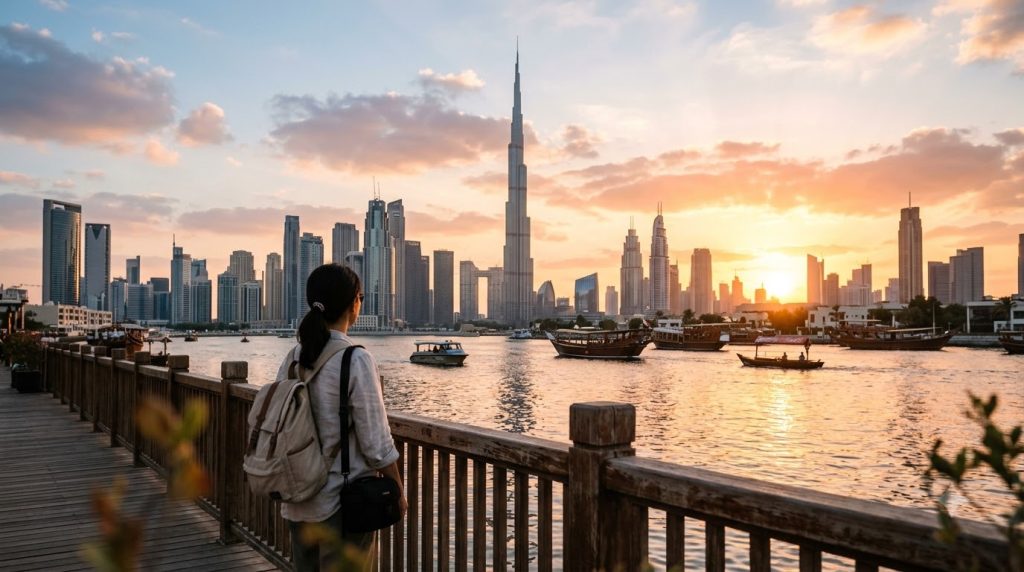
This Dubai travel guide is built for one person: the first-timer who wants the practical answers before booking flights. What areas to stay in, how the metro and Nol card work, what to wear, the real alcohol rules, how much a day actually costs, and the smartest way from the airport to your hotel.
Dubai welcomed a record 19.59 million international overnight visitors in 2025, up 5% year on year and its third straight record year (Dubai Department of Economy and Tourism, 2026), so you will not be alone figuring this out.
The good news: Dubai is one of the easiest big cities in the world to visit for the first time. English is spoken almost everywhere, the metro is clean and cheap, taxis are metered, and most nationalities get a visa on arrival.
This guide covers the seven decisions that trip up first-timers, plus a full breakdown of costs and the best months to go. Winter is a good time to visit Dubai; a July trip is much harder going.
A simple plan works well: base near a Red Line metro station, buy a Silver Nol card at the airport, and treat taxis as a backup rather than the default. On our most recent February visit we crossed the whole city for under AED 20 a day on the metro, and the only time we regretted not taking a taxi was hauling luggage up a station ramp in the heat.
First-Timer’s Dubai Travel Guide: How to Plan the Trip
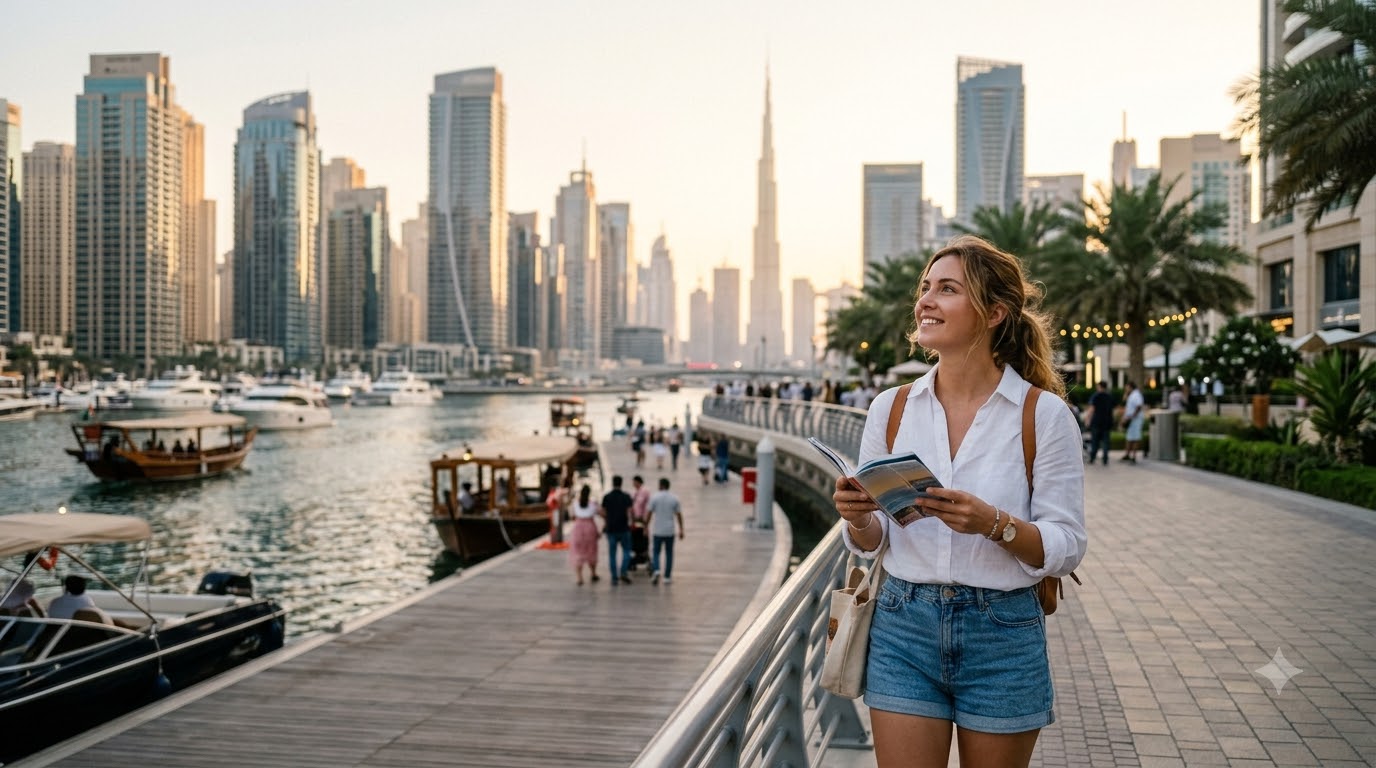
Start by deciding your season, your base neighborhood, and your transport, in that order. Those three choices shape everything else, and this Dubai travel guide is organized around them. Most first-timers need three to four full days to cover the headline sights without rushing, and a metro-anchored base makes those days far cheaper than relying on taxis.
Before you book, sort your visa. Most Western nationalities receive a free visa on arrival: US passport holders get 30 days, while UK, EU, Australian, Canadian, New Zealand, Japanese, and South Korean passport holders typically get 90 days (Emirates, 2026). Citizens of Saudi Arabia, Kuwait, Bahrain, Oman, and Qatar enter without a visa.
Rules shift, so confirm your specific passport with the UAE Federal Authority for Identity and Citizenship (ICP) before flying.
Here is the planning order we recommend for a first Dubai trip:
- Pick your month first: aim for November to March for comfortable weather, or accept 40-plus-degree heat and lower hotel rates in summer.
- Choose one base neighborhood: Downtown for sights, Marina for beach and nightlife, Deira for budget and old-town character.
- Set your transport default: buy a Silver Nol card and use the metro; keep the Careem app installed for taxis after midnight when trains stop.
- Budget realistically: plan around USD 90 to USD 180 per day for mid-range travel, excluding flights.
- Book timed-entry attractions early: Burj Khalifa’s At the Top and desert safaris sell out on peak weekends.
How Do You Get from Dubai Airport to the City?
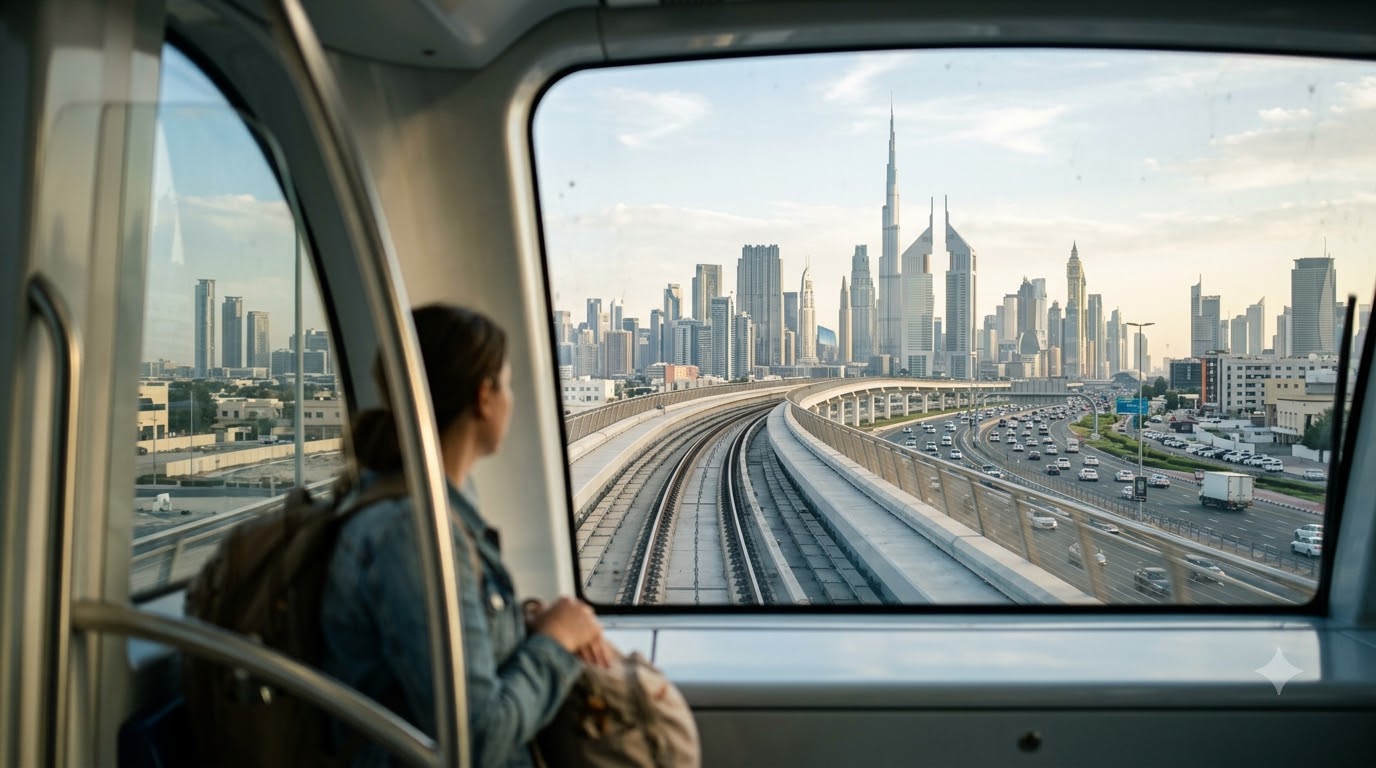
Take the metro if you are traveling light, and a taxi if you have luggage or land after midnight. Dubai International Airport (DXB) sits about 5 km from Deira and 15 km from Downtown, and it stayed the world’s busiest airport for international passengers for the 11th straight year in 2025 (Dubai Airports, 2026). Terminals 1 and 3 connect directly to the Red Line metro.
The metro is the cheapest route by far. From the airport, the Red Line reaches the Burj Khalifa/Dubai Mall station in roughly 30 minutes for about AED 8 to AED 10 with a Nol card, including the airport-station surcharge. The catch: the metro does not run 24 hours, and dragging suitcases through interchange stations is genuinely tiring.
Your realistic airport-to-city options in 2026:
- Red Line metro: about AED 8 to AED 10 with a Nol card, roughly 30 minutes to Downtown, but no service in the early-morning hours.
- Official RTA taxi: roughly AED 45 to AED 70 to Downtown, with a starting fare around AED 25 plus a AED 20 to AED 25 airport pickup surcharge.
- Careem or Uber: similar to metered taxi fares, easier if you want a fixed price and a tracked ride at night.
- Hotel or pre-booked transfer: typically AED 90 to AED 200 for a private car, worth it only for groups or very late arrivals.
We took the metro in on our last two trips and a taxi only once, after a 2 a.m. landing. For that hour the AED 60 taxi was the obvious call.
Find your Dubai hotel on the map
Live prices from Booking & Airbnb — tap a pin to compare stays around Downtown and Marina and beyond.
Where Should First-Timers Stay in Dubai?
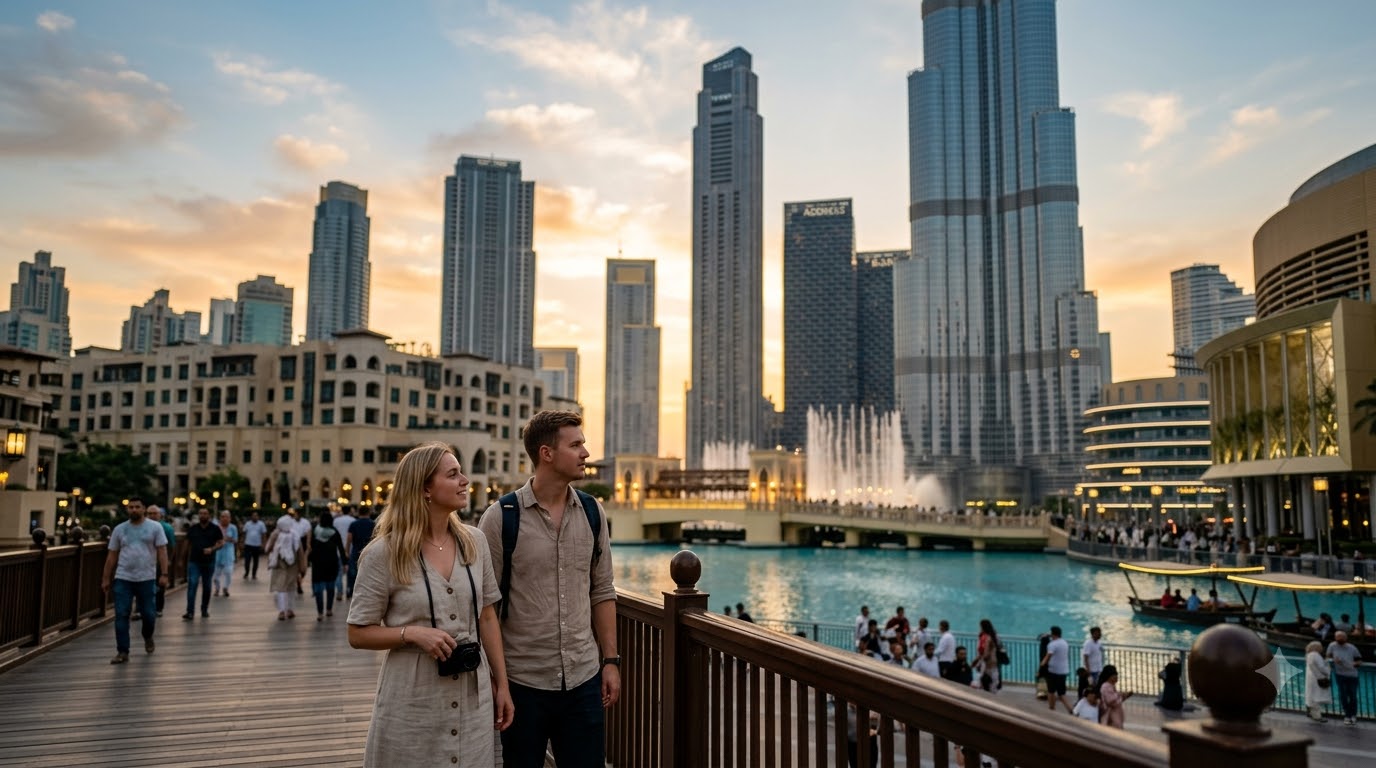
Base yourself in Downtown Dubai if it is your first visit, because it puts the Burj Khalifa, Dubai Mall, and the fountains within walking distance and sits on the Red Line. Dubai’s hotel inventory passed 154,000 rooms across 827 establishments by the end of 2025 (Dubai Department of Economy and Tourism, 2026), so the real challenge is narrowing down, not finding availability.
Each area trades off differently on price, beach access, and atmosphere. Our short version: Downtown for sightseeing, Marina or JBR for the beach-and-nightlife holiday, Deira or Bur Dubai for budget and the older, more textured side of the city. Splitting a stay between Downtown and Marina offers a worthwhile contrast.
| Neighborhood | Best for | Metro line | Typical mid-range rate/night |
|---|---|---|---|
| Downtown Dubai | First-timers, sights | Red Line | USD 120 to USD 250 |
| Dubai Marina / JBR | Beach, nightlife | Red Line | USD 110 to USD 220 |
| Deira | Budget, old-town souks | Red & Green | USD 45 to USD 90 |
| Bur Dubai | Culture, value | Red & Green | USD 55 to USD 110 |
| Palm Jumeirah | Resorts, honeymoons | Monorail | USD 250 to USD 700 |
Note that Dubai adds a Tourism Dirham fee to every hotel night: AED 10 per room per night for 3-star, AED 15 for 4-star, and AED 20 for 5-star, charged for up to 30 consecutive nights (Dubai Department of Economy and Tourism, 2026). Budget for it separately, because many booking sites quote it as a payable-at-hotel extra.
For a full breakdown by area, see our guide to where to stay in Dubai.
How Does the Dubai Metro and Nol Card Work?
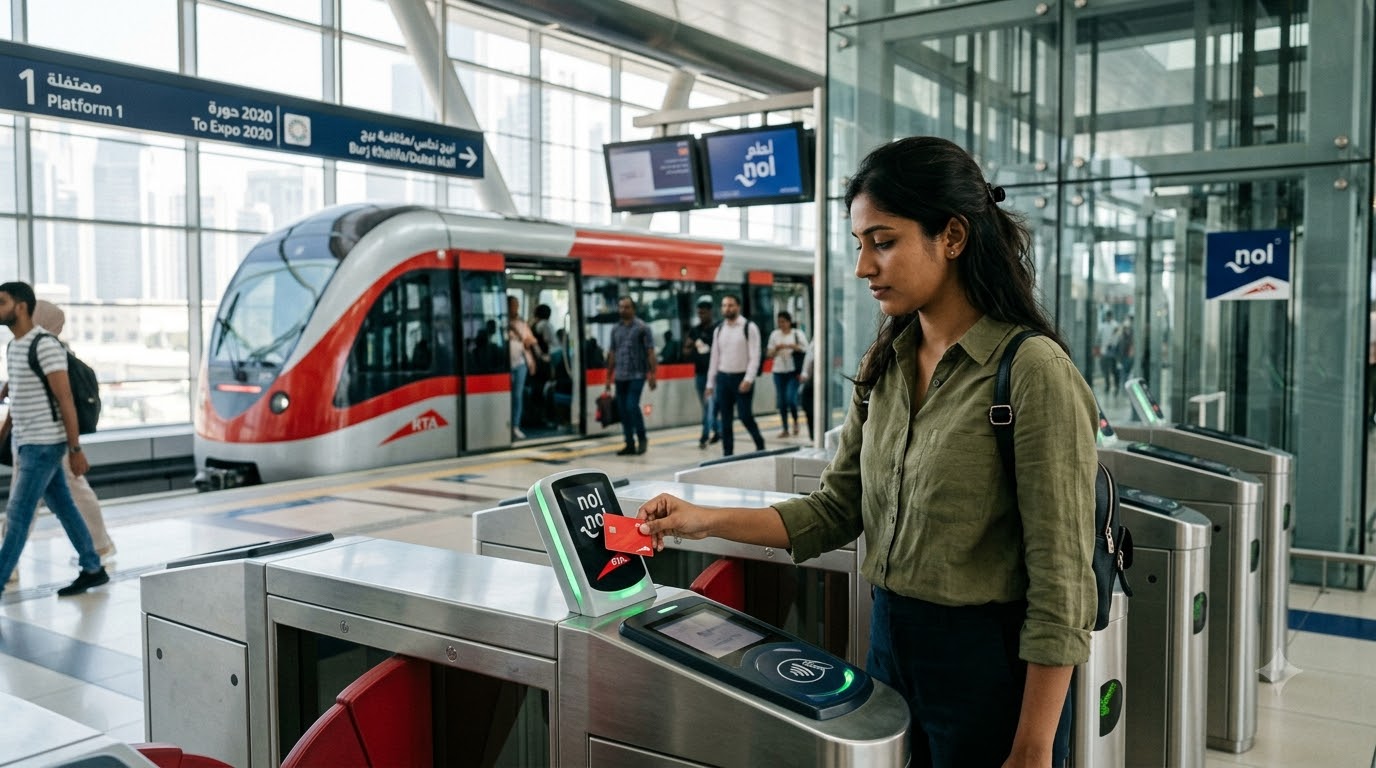
Buy a Silver Nol card the moment you land, tap in and out at every station, and you have solved Dubai transport. The Nol card is a rechargeable smart card that works on the metro, trams, buses, and water buses, and it is far cheaper than buying single paper tickets. A Silver card costs AED 25, which includes AED 19 of preloaded travel credit.
Fares are zone-based and genuinely cheap. With a Silver Nol card, a one-zone ride is AED 3, two zones is AED 5, and three or more zones is AED 7.50, with a daily spend cap of AED 14 after which travel is free until midnight.
The metro runs two lines that matter to tourists, the Red and the Green, and trains are air-conditioned with a women-and-children-only carriage plus a Gold Class carriage at the front.
| Nol card type | Price | Best for | Notes |
|---|---|---|---|
| Silver | AED 25 (AED 19 credit) | Most tourists | Standard fares, works on all RTA transport |
| Gold | AED 25 (AED 19 credit) | Comfort seekers | Access to Gold Class carriage at double fare |
| Red (paper) | AED 2 per card | Very short stays | Single trips at higher per-ride cost |
| Blue | AED 70 | Students, seniors | 50% discount, requires registration |
A few things we learned the hard way about the metro:
- The metro does not run all night: service generally stops around midnight and restarts early morning, later on weekends, so plan late nights around taxis.
- The daily AED 14 cap only applies within one Nol card, so do not split a group across cards if you want the cap to help you.
- Friday is the Islamic day of prayer, and trains start later that day, typically around 10 a.m.
- Keep at least AED 7.50 of credit on the card to tap in, or the gate will reject you even mid-journey.
What Should You Wear in Dubai?
Dress modestly in public and you will never have a problem, because Dubai is a Muslim city that is relaxed with tourists but expects covered shoulders and knees in everyday public spaces. Beachwear is fine at the beach and pool; it is not fine in malls, souks, or the metro. This is the single rule first-timers most often get wrong.
Malls and government buildings post signage asking for shoulders and knees covered, and staff will occasionally ask visitors to adjust. Mosques require more: women need a headscarf and loose clothing covering arms and legs, and the Sheikh Mohammed Centre for Cultural Understanding and Jumeirah Mosque provide abayas for visitors.
Lightweight long trousers and a light layer are comfortable for the 24 to 30 degree days and the fiercely air-conditioned malls alike.
Practical dress notes for tourists:
- Cover shoulders and knees in malls, souks, and the metro, regardless of the outside temperature.
- Beachwear stays at the beach or pool, including at Marina and JBR public beaches.
- Women should carry a scarf for mosque visits and more traditional neighborhoods like Deira.
- Pack breathable, loose fabrics in summer; direct sun at 42 degrees makes tight synthetics miserable.
- Public displays of affection are frowned upon, so keep it discreet even though the city feels cosmopolitan.
What Are Dubai’s Alcohol Rules for Tourists?
You can drink in Dubai, but only in licensed venues, and only if you are 21 or older. Alcohol is legal for non-Muslims aged 21 and up and is served in licensed hotel bars, restaurants, and clubs across the city. Tourists no longer need a personal liquor license to drink at these venues; you simply show your passport as proof of age when asked.
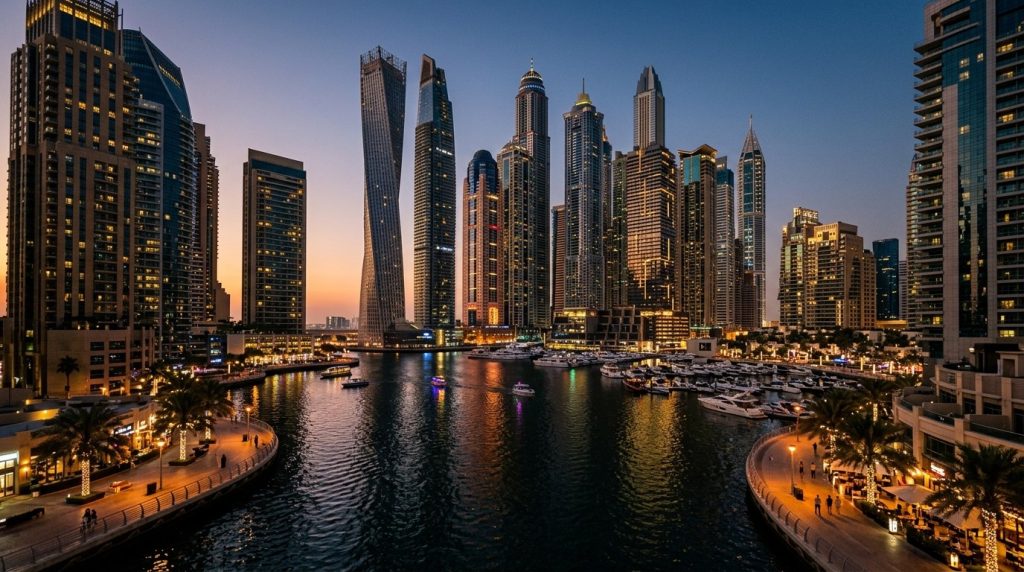
Two rules matter most. First, public drinking is illegal: buying a drink legally at a bar does not let you carry it onto the street, a beach, or the Marina promenade, and being visibly drunk in public is an offense.
Second, a 30% tax on alcohol sales returned in January 2025 after a two-year suspension, which is part of why a beer in a Dubai bar often lands around AED 45 to AED 60. Tourists can also buy takeaway alcohol from licensed shops such as MMI and African + Eastern by showing a passport at checkout.
What first-timers should keep in mind about alcohol:
- The legal drinking age is 21, enforced with passport checks at bars and bottle shops.
- Drink only in licensed venues: hotels, licensed restaurants, bars, and clubs, never in public spaces.
- Never drive after any alcohol, as the UAE enforces a zero-tolerance blood-alcohol limit with severe penalties.
- Expect higher prices, with the 30% tax back since January 2025 pushing a bar beer toward AED 45 to AED 60.
How Much Does a Dubai Trip Cost in 2026?
Budget roughly USD 90 to USD 180 per day for mid-range travel, excluding flights, because Dubai spans backpacker hostels and USD 1,000 suites in the same skyline. The biggest lever is your hotel; food and transport can both be surprisingly affordable if you eat where residents eat and ride the metro.
Average hotel occupancy of 80.7% in 2025 means rooms hold their price, especially in the November-to-March peak (Dubai Department of Economy and Tourism, 2026).
Here is how the three tiers break down for a first-timer.
| Expense (per day) | Budget | Mid-range | Comfort |
|---|---|---|---|
| Hotel | USD 45 to USD 80 | USD 120 to USD 200 | USD 300+ |
| Food | USD 15 to USD 25 | USD 35 to USD 70 | USD 100+ |
| Transport | USD 4 to USD 8 (metro) | USD 15 to USD 30 (taxi mix) | USD 50+ (private car) |
| Attractions | USD 10 to USD 25 | USD 30 to USD 60 | USD 80+ |
| Daily total | USD 75 to USD 140 | USD 200 to USD 360 | USD 530+ |
A few ways we consistently kept costs down:
- Eat at Deira and Karama curry houses and Lebanese cafes, where a filling meal runs AED 20 to AED 40 versus AED 150-plus in Downtown.
- Use the metro and its AED 14 daily cap instead of taxis, saving AED 100 or more on a busy sightseeing day.
- Visit free attractions, including the Dubai Fountain shows, JBR beach, and the Al Fahidi historical district.
- Book Burj Khalifa’s At the Top for a non-prime time slot, which is cheaper than sunset tickets that can double the price.
If you want a full money-saving plan, our Dubai on a budget guide goes deeper, and the 4-day Dubai itinerary shows how to sequence paid and free days.
When Is the Best Time to Visit Dubai?
Go between November and March, when daytime highs sit at a comfortable 24 to 30 degrees Celsius and the humidity drops. This is peak season for a reason: warm sunny days, cool evenings, and every outdoor attraction, from desert safaris to beach clubs, at its best.
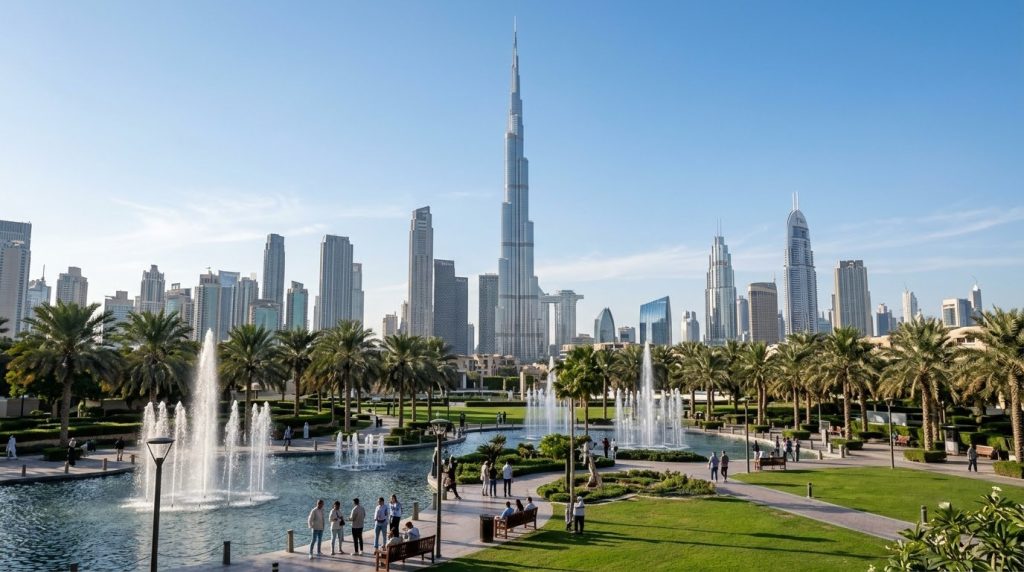
It is also when hotel prices climb and December sells out, as the city crossed 2 million visitors in a single month for the first time in December 2025 (Dubai Department of Economy and Tourism, 2026).
Summer is the trade-off season. From June through September, highs regularly pass 42 degrees Celsius and humidity can feel oppressive, but hotel rates fall sharply and indoor attractions, malls, and the Dubai Shopping scene run air-conditioned all day. In July, expect to spend most of the day moving between air-conditioned spaces; pools can feel warm as a bath by noon.
| Season | Months | Daytime high | Crowds | Hotel rates |
|---|---|---|---|---|
| Peak (best weather) | Nov to Mar | 24 to 30 degrees C | High | Highest |
| Shoulder | Apr and Oct | 32 to 38 degrees C | Medium | Medium |
| Low (very hot) | May to Sep | 40 to 45 degrees C | Low | Lowest |
For a month-by-month breakdown including Ramadan timing and event calendars, see our best time to visit Dubai guide.
What to Do Once You Are Settled
With logistics sorted, the fun part is easy to plan. First-timers usually build days around the Burj Khalifa and Dubai Mall, a desert safari, the old town and souks of Deira and Bur Dubai, and a half-day at the beach in Marina or JBR.
Our full rundown of sights, tickets, and timing lives in best things to do in Dubai, and if you want to see beyond the city, day trips from Dubai covers Abu Dhabi, the Hajar Mountains, and the desert oasis town of Al Ain.
Frequently Asked Questions
How many days do you need in Dubai?
Three to four full days cover the essentials for a first visit: one day for Downtown and the Burj Khalifa, one for a desert safari, one for the old town and souks, and a half-day at the beach. Add a fifth day if you want a day trip to Abu Dhabi or the mountains. Our 4-day Dubai itinerary maps this out hour by hour.
Is Dubai expensive to visit?
It can be, but it does not have to be. Budget travelers manage on USD 75 to USD 140 per day by staying in Deira, eating at local cafes, and riding the metro, while mid-range travel runs USD 200 to USD 360 per day. Hotels are the single biggest cost, so your neighborhood choice matters more than anything else.
Do you need a visa to visit Dubai?
Most Western nationalities receive a free visa on arrival: US passport holders get 30 days, and UK, EU, Australian, Canadian, and several other passport holders typically get 90 days. Always confirm your specific passport with the UAE ICP authority before flying, since rules change periodically.
Can tourists drink alcohol in Dubai?
Yes, tourists aged 21 and over can drink at licensed hotels, bars, and restaurants, and can buy takeaway alcohol from licensed shops with a passport. Public drinking and being intoxicated in public are illegal, and there is zero tolerance for drink-driving.
Is the Dubai Metro enough to get around as a tourist?
For most first-timers, yes. The Red Line connects the airport, Downtown, Marina, and the malls, and a Silver Nol card makes rides cheap at AED 3 to AED 7.50 with a AED 14 daily cap. Keep a taxi app installed for late nights after the metro stops and for areas the line does not reach, like Palm Jumeirah’s interior.
Final Thoughts
Dubai is far simpler for a first-timer than its skyline suggests. Sort your visa, pick a season, base near a Red Line station, and buy a Nol card, and the rest of the trip falls into place. The city runs on clear systems, from metered taxis to a spotless metro, and a little planning stretches a modest budget a long way.
Use the linked guides above to go deeper on where to stay, when to go, and what to see, and you will arrive already knowing how Dubai works.