The Best Day Trips from Florence (2026)
Disclosure: Some links in this guide are affiliate links. If you book or buy through them, we may earn a small commission at no extra cost to you — it helps keep our guides free.
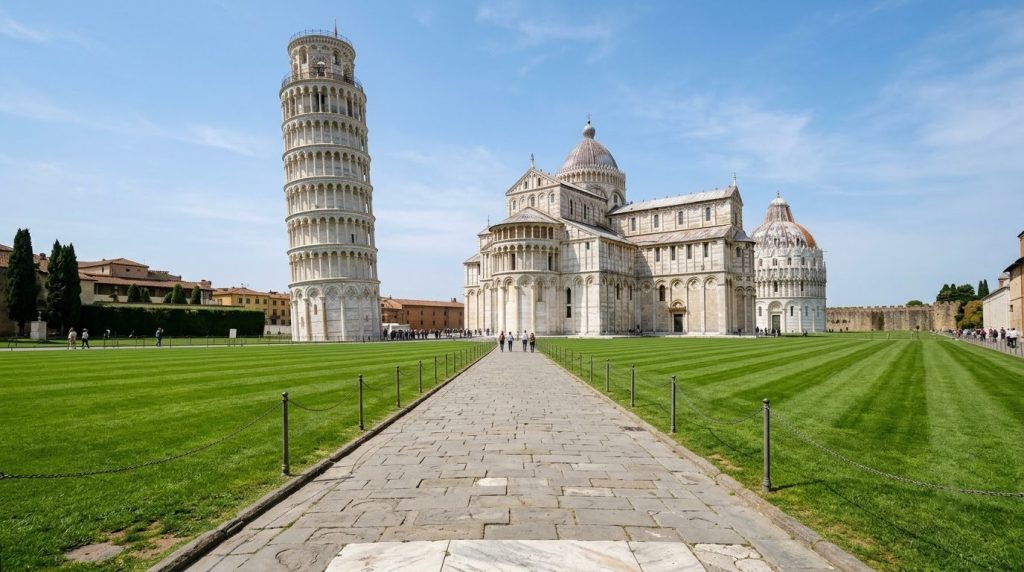
The best day trips from Florence range from a 37-minute high-speed train to Bologna to a 90-minute bus connection to San Gimignano, with Pisa, Lucca and Siena all close enough to visit and return the same night.
Some of these destinations sit directly on Italy’s high-speed rail line while the classic Tuscan hill towns have no direct train at all, so the trip you can do easily by train is a different list from the trip that needs a car or a tour.
Prices below convert at today’s rate of EUR 1 = USD 1.164.
| Destination | Travel time | By | Best for |
|---|---|---|---|
| Pisa | About 55 minutes | Direct regional train | The Leaning Tower, a half-day trip |
| Lucca | About 75 minutes | Direct regional train | Walking the Renaissance city walls |
| Siena | 75-90 minutes | Bus (131R) or train, one change | The Duomo and Piazza del Campo |
| Bologna | 37 minutes | High-speed train | Food, porticoes, a university city |
| Venice | About 1 hour 50 minutes | High-speed train | Canals and Piazza San Marco |
| Cinque Terre | About 1 hour 50 minutes to 2 hours | Train to La Spezia, then local train | Coastal villages, hiking trails |
| San Gimignano | About 90 minutes | Bus, one change at Poggibonsi | Medieval towers, no train station |
| Chianti and Val d’Orcia | No train option | Car or guided tour only | Vineyards, cypress-lined countryside |
Easy by train – Pisa, Lucca and Siena
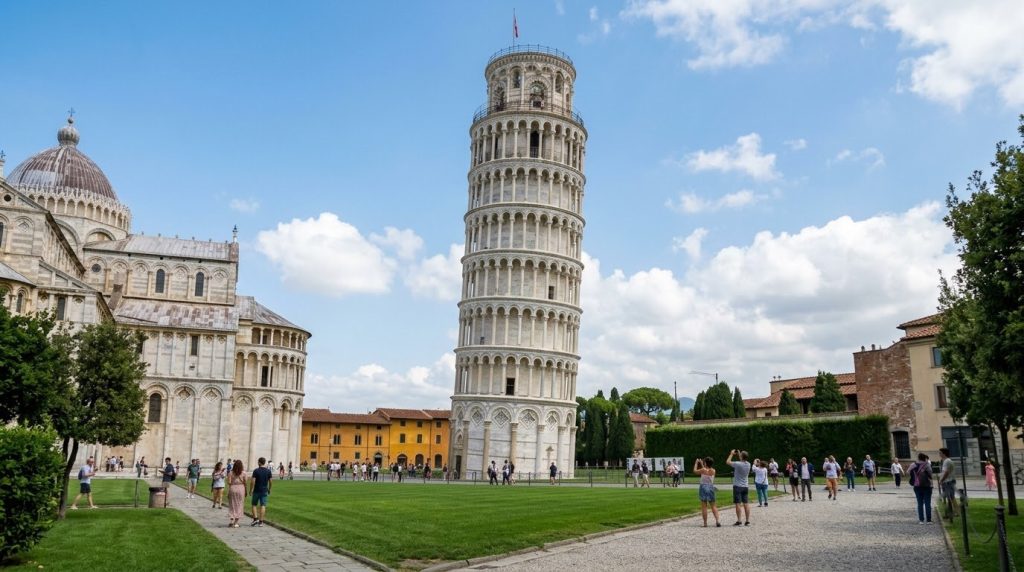
Pisa, Lucca and Siena are the three closest classic day trips from Florence, and each is reachable in under 90 minutes without a car.
Trenitalia’s Regionale Veloce runs from Firenze Santa Maria Novella to Pisa Centrale in about 55 minutes for a fixed fare of EUR 8.50 (USD 9.89), with departures every 15 to 30 minutes, so there is no need to book ahead.
Lucca sits about 75 minutes from Florence on a direct regional train, and its flat Renaissance walls make it the easiest half-day walk of the three towns.
Siena has two options: a direct Tiemme 131R bus that takes about 75 minutes, or a regional train that runs 1 hour 20 minutes to 1 hour 45 minutes depending on whether it requires a change at Empoli.
The bus is both faster and cheaper for Siena, so most travelers without a rail pass should take it from the bus terminal next to Santa Maria Novella. Any one of these three towns fits into a single day with a mid-morning departure and an early-evening return.
The under-2-hour cities – Bologna, Venice and Cinque Terre
Bologna, Venice and Cinque Terre push past the one-hour mark but still fit into a single day if the trip starts early. Bologna is the fastest of the three: Italo’s high-speed service covers the 91 km route in as little as 37 minutes, with fares starting around EUR 9.90 (USD 11.52) when booked ahead, and Frecciarossa runs a comparable schedule.
That speed makes Bologna the strongest food-focused day trip from Florence, leaving enough time for both a market lunch and a walk under the porticoes.
Venice takes longer: the fastest Frecciarossa or Italo service runs about 1 hour 51 minutes each way, and advance fares start near EUR 19 (USD 22.12), though walk-up tickets bought on the day often run EUR 45 to 60.
A Venice day trip works, but with roughly 3 hours 40 minutes lost to trains alone, it leaves a shorter window in the city than Bologna does.
Cinque Terre takes about the same total time as Venice once the connection is counted: the fastest train reaches La Spezia Centrale in 1 hour 31 minutes, and a second, more frequent local train covers the final stretch to Monterosso or Vernazza in roughly 20 minutes.
Both Venice and Cinque Terre reward an early start over a late one, since the return trip alone eats into the evening.
The hill towns that need a car or a tour
San Gimignano, Chianti and the Val d’Orcia sit off the rail network entirely, so none of them can be reached by a single direct train the way Pisa or Bologna can.
San Gimignano is the closest of the three and the only one with any public transit option: a Florence-to-Poggibonsi bus takes about 50 minutes, then a second bus covers the final stretch to San Gimignano in roughly 25 minutes, for a total journey near 90 minutes each way with one change.
Chianti has no train station serving its vineyards at all, so seeing Chianti in a day means either a rental car or a guided wine tour departing from Florence.
The Val d’Orcia, home to Pienza and Montepulciano, sits further still and is effectively car-only for a day trip, since the region’s slow country roads are the point of visiting rather than an obstacle to route around.
Travelers who want the countryside loop through all three, rather than a single stop, are better served by planning a multi-day Tuscany road trip than forcing it into one day from Florence.
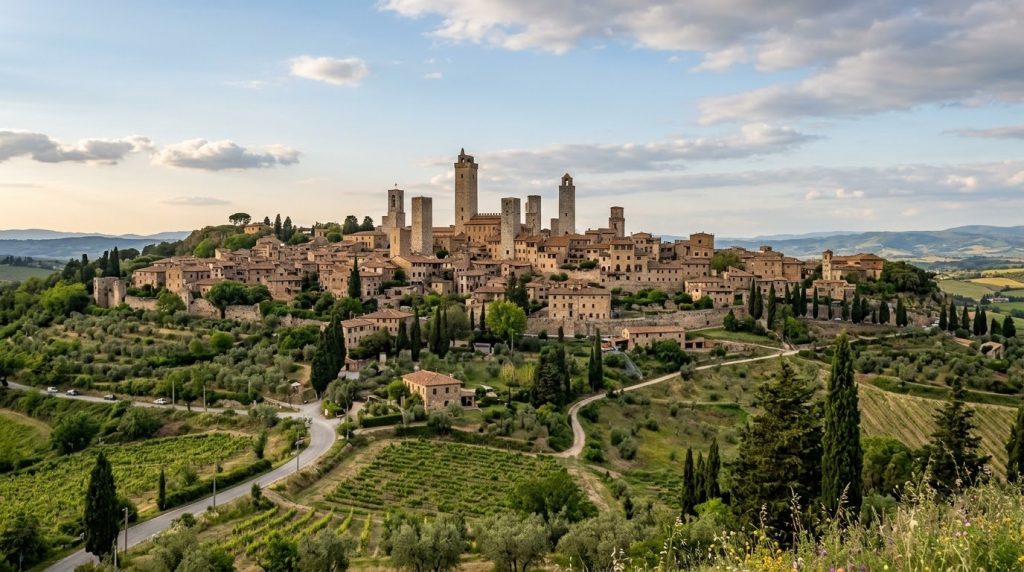
Cortona – a hilltop town reachable without a car
Cortona sits in eastern Tuscany, and unlike Chianti or the Val d’Orcia it is served by a direct regional train from Firenze Santa Maria Novella to the Camucia-Cortona station, with the ride taking about 1 hour 30 minutes to just under 2 hours depending on the service, and one-way fares running roughly USD 15 to 23 (EUR 13 to 20) in 2026.
The station sits in the valley below the historic center, so the final stretch into Cortona’s hilltop streets needs a short connecting local bus or a taxi, a climb that most day-trippers handle by timing the connecting bus to meet an arriving train.
Once up top, Cortona’s draw is a walled medieval center built on a steep slope, with narrow stone streets, the Etruscan and Roman museum known as MAEC, and views over the Val di Chiana that reach toward Lake Trasimeno on a clear day.
The historic center itself is compact enough to cover on foot in a few hours, built around Piazza della Repubblica and the Palazzo Comunale, with a climb up to the Medici fortress at the top of town rewarding the walk with the widest view over the valley below.
The town has no single must-see monument on the scale of Siena’s Duomo or Lucca’s walls, so it rewards travelers who want a few unhurried hours of walking and a lunch stop over a checklist of sights.
Because the train-plus-bus route takes longer than a straight train to Pisa or Lucca, Cortona tends to see fewer organized coach tours than San Gimignano, which sits closer to the budget-tour circuit running out of Florence.
Because the train runs direct from Florence, Cortona is a practical fourth stop for travelers who have already covered Pisa, Lucca and Siena and want another easy-by-train option without a car or a tour.
Reaching Cortona and returning to Florence the same day is realistic with a mid-morning departure, though the valley-to-hilltop connection adds extra time at each end that a trip straight to Pisa or Lucca does not require, so it is worth checking the last evening connection back before setting out.
A midday stop in Cortona typically means lunch built around Tuscan staples such as pici pasta or grilled meats, the same style of cooking found across the region rather than anything specific to the town, so travelers are not giving up a culinary highlight by picking Cortona over a stop with a bigger food reputation like Bologna.
Montepulciano and Pienza – Val d’Orcia on a longer day
Montepulciano and Pienza sit roughly 110 to 125 km southeast of Florence in the Val d’Orcia, and neither town has a train station of its own.
The nearest rail stop is Chiusi, on the Florence-Rome line, from which a local bus covers the final distance into Montepulciano; a separate bus route also runs from Florence toward Pienza by way of Siena and Buonconvento, but it operates only a couple of times a week, which is part of why this stretch of Tuscany is effectively car-only for a single day trip.
Driving is the realistic option, with the trip running about 90 minutes to just over 2 hours each way depending on the route taken through the Val d’Orcia’s hill roads.
A short drive connects the two towns themselves, so most itineraries treat them as a single loop rather than two separate day trips, starting in whichever one sits closer to the entry point on the Val d’Orcia’s back roads.
Montepulciano is built around a steep main street, the Corso, lined with wine shops pouring Vino Nobile di Montepulciano, the town’s DOCG red, above cellars cut into the hillside below the historic center. Pienza, a short drive away, is smaller and quieter, known for its pecorino cheese and for a Renaissance-era rebuilding of its town center.
Travelers who want a third stop sometimes continue on to Montalcino, home to the stronger Brunello di Montalcino red, though adding a third town on top of Montepulciano and Pienza leaves little time for more than a quick walk through each.
Both towns sit on ridgelines above the cypress-lined countryside that put the Val d’Orcia on UNESCO’s World Heritage list, a landscape that reads differently on foot or from a hilltop terrace than through a car window on the drive in.
Together Montepulciano and Pienza make roughly half a day each, so combining them into a single Florence day trip means an early start and limited time in either place. Travelers without a car are better served booking a guided day tour that covers both towns in one run than attempting the public bus connection through Chiusi or Siena.
Which day trip to pick for your one free day
Pick Bologna if speed and food matter most, since the 37-minute train leaves the most time in the destination of any option on this list. Pick Pisa or Lucca for a relaxed half-day rather than a full one, since both are back in Florence well before dinner.
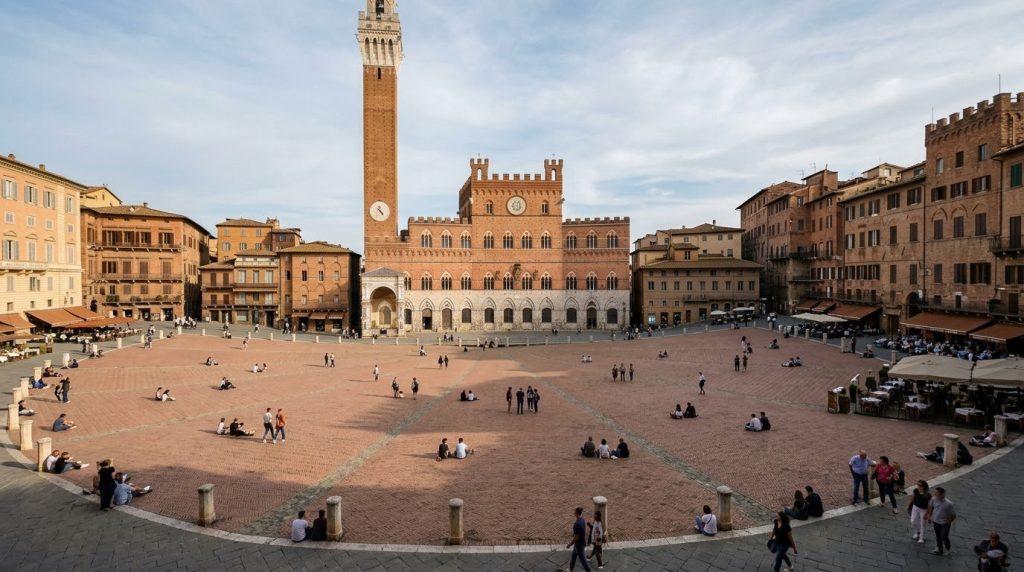
Pick Siena if a Gothic cathedral and a medieval piazza matter more than saving time, and take the 131R bus rather than the train. Pick San Gimignano only if a car or a tour is already part of the plan, since the bus connection through Poggibonsi is the slowest option among the easier destinations.
Skip Venice and Cinque Terre unless the schedule allows a genuinely early departure, since both lose more than three hours to trains alone.
When a day trip is the wrong call
A day trip is the wrong call before Florence itself has been properly covered, since most first-time visitors need at least two full days in the city before adding an outside trip.
Anyone still deciding how many days to spend in Florence should settle that question first, because a day trip taken too early usually means skipping a major Florence sight to make the train. Once the core Florence itinerary is mapped out, a day trip becomes a one-day extension rather than a replacement for time in the city.
A day trip is also the wrong call on a short visit of two nights or less, when every day lost to a train ride is a day not spent in the Uffizi, the Duomo or the Oltrarno.
Booking trains and tours for your day trip
Ticket type changes what boarding looks like. Trenitalia’s and Italo’s high-speed trains, the kind used for Bologna or Venice, come with an assigned seat tied to a specific date and departure time, so they do not need to be validated before boarding.
Regional trains work differently: a single paper ticket for a route like Florence to Pisa, Lucca or Camucia-Cortona has no fixed departure time and must be validated at one of the green or yellow machines on the station platform before the train leaves. That stamp starts a window, commonly four hours, during which the ticket is valid for travel.
Skipping it is one of the most common ways visitors get fined on Italian regional trains, since conductors check tickets on board and an unvalidated paper ticket is treated the same as having no ticket at all.
Tickets bought through the Trenitalia or Italo phone apps are tied to the booking itself rather than a paper slip, which removes the validation-machine step for that journey entirely, while a paper ticket can still be bought at the station’s ticket counter or at a tobacco shop near the platforms for travelers who prefer not to book on a phone.
For the destinations with no train option at all, Chianti, the Val d’Orcia and a combined Montepulciano-Pienza day, a guided tour from Florence is the practical alternative to renting a car, running as a small-group minivan that covers two or three stops with a driver who also handles navigation on the region’s narrow hill roads.
A guided tour bundles transport, parking and commentary into a single price, while the independent route of a train plus a taxi up to Cortona or a rental car through the Val d’Orcia means paying for each leg separately, a trade-off that tends to favor the tour for a solo traveler and the rental car for a group splitting the cost of fuel and tolls across more than two or three people.
Nearly every option on this list starts from Firenze Santa Maria Novella or the adjacent bus terminal, so a hotel near that hub keeps the morning simple regardless of which destination or booking method ends up chosen.
Where to stay for easy day trips
Staying within a 10-minute walk of Santa Maria Novella station keeps every train and bus connection on this list short, since nearly all of them depart from there or the adjacent bus terminal.
The Santa Maria Novella and San Lorenzo neighborhoods put a hotel closest to the platforms, while the historic center around the Duomo adds a slightly longer walk but keeps sightseeing convenient on non-day-trip days. A full round-up of where to stay in Florence breaks down neighborhoods and price ranges in more detail.
Find your Florence hotel on the map
Live prices from Booking, Airbnb and more — move the map or change dates to compare stays across Florence.