Is Verona Worth Visiting? (2026)
Disclosure: Some links in this guide are affiliate links. If you book or buy through them, we may earn a small commission at no extra cost to you — it helps keep our guides free.
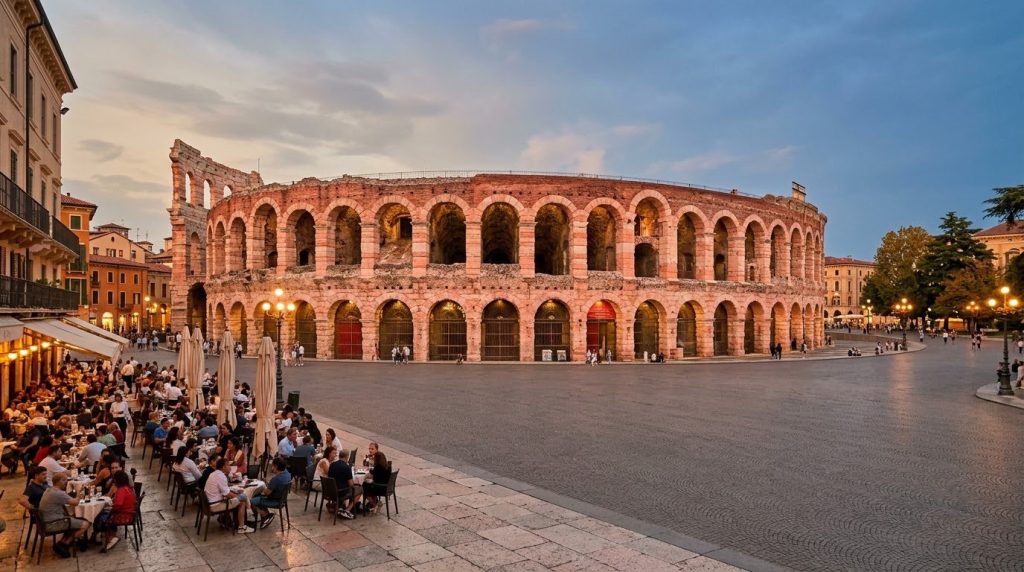
Verona is worth visiting for one to two nights, anchored by a Roman Arena that still seats 15,000 people for summer opera and a UNESCO-listed old town just 55 minutes by train from Venice. Skip it if you are only stopping for Juliet’s balcony or have less than half a day free between trains, because the balcony alone will not justify the detour.
| Traveller type | Worth it? | Nights to give it | Why |
|---|---|---|---|
| Venice-to-Milan train travellers | Yes | 0 (day trip) | Arena and old town fit into a 4-5 hour gap between trains |
| First-timers routing Venice to Lake Garda | Yes | 1-2 nights | Sits directly on that route, no backtracking needed |
| Opera and classical music fans | Yes, June-September only | 2 nights | Arena opera festival runs June 12 to September 12, 2026 |
| Romantic-getaway seekers chasing Juliet’s balcony | No | 0 | The balcony is a 1930s addition, not a real Shakespeare site |
| Repeat Italy visitors on a tight itinerary | Skip | 0 | Milan, Bologna and Padua compete for the same time slot |
| Budget travellers needing a rail hub | Maybe | 1 night | Cheaper beds than Venice, but thin nightlife after 10pm |
What Verona genuinely has
Verona’s case for a visit rests on two real assets, not marketing copy. The Arena di Verona is the third-largest Roman amphitheatre still standing in Europe, built around 30 CE with room for roughly 30,000 spectators originally; modern concerts and opera fill it to 15,000-17,000 today.
General daytime admission runs EUR 12, or USD 14 at today’s rate (EUR/USD 1.16), rising to EUR 15 (USD 17) for entry-only visits during festival weeks.
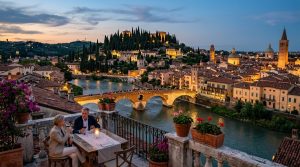
Step out of the Arena and you are already inside Verona’s historic centre, a UNESCO World Heritage Site since 2000, compact enough that the Roman amphitheatre, the Adige river bridges and Piazza delle Erbe all sit within a short walk of each other.
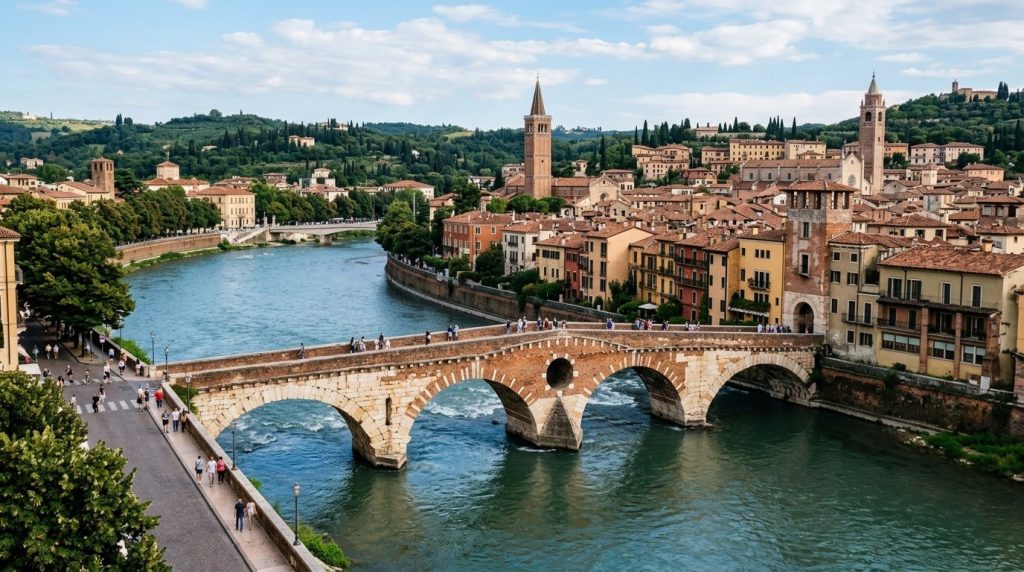
Piazza delle Erbe, the old Roman forum, still functions as a working market square each morning, and the Ponte Pietra footbridge across the Adige gives the best free view back toward the old town. That density is Verona’s real advantage over Venice: fewer boats, fewer maps, fewer wrong turns.
The Juliet’s balcony trap, honestly
Juliet’s balcony is Verona’s most visited attraction and its weakest argument for coming. The building on Via Cappello belonged to the Cappello family, not a fictional Capulet, and Shakespeare’s lovers never existed outside his play.
The balcony itself was not part of the original medieval house; city museum director Antonio Avena added it during a 1939 renovation, built from a repurposed medieval marble slab, specifically to give tourists a photo backdrop. Verona has never hidden this.
What you get in person is a small courtyard, walls layered in love-note graffiti, and a crowd waiting to photograph a balcony that is younger than the Golden Gate Bridge. Standing in the courtyard costs nothing; going inside the house is a separate paid ticket.
The one genuinely charming layer to the myth is the Juliet Club, a volunteer group founded in 1972 by Giulio Tamassia that continues a tradition dating to the 1930s, when the guardian of Juliet’s tomb began writing back to visitors who left notes behind.
Its “Juliet’s secretaries” still answer thousands of letters a year addressed simply to “Juliet, Verona, Italy,” which is a more sincere story than the balcony photo queue suggests. Travellers who build their entire Verona stop around the balcony itself, rather than this wider tradition, are the ones who leave disappointed and call the city overrated.
The opera festival that transforms a summer visit
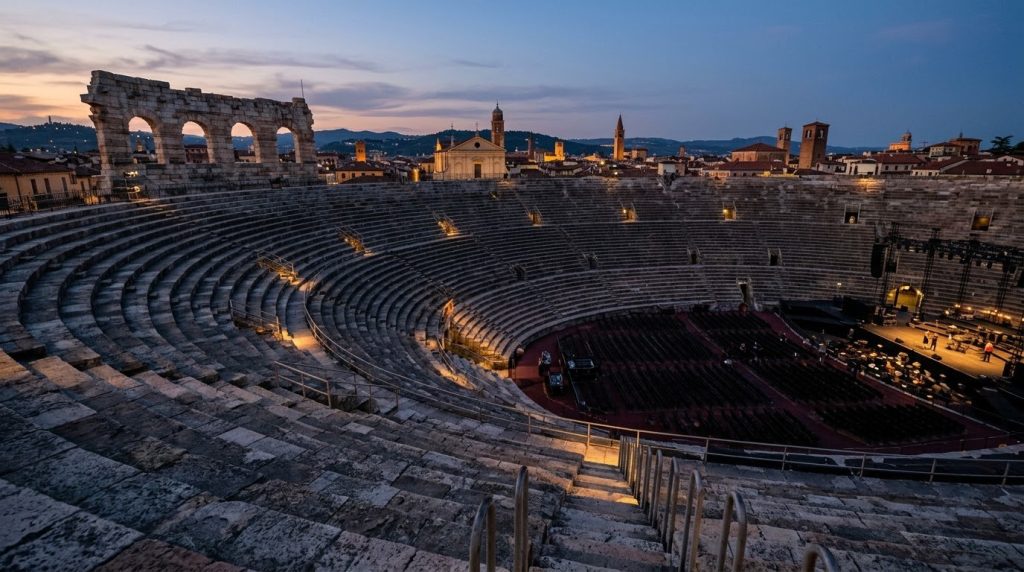
The Arena opera festival is the one reason to build a Verona trip around a specific date. The 2026 season runs June 12 to September 12, its 103rd consecutive edition, with productions including La Traviata and Aida staged inside the Roman amphitheatre after dark.
Unnumbered stone seating costs EUR 25-40 (USD 29-46); numbered seats on the arena floor cost EUR 120-250 (USD 139-290). The trade-off is access: on performance days during the festival, the Arena closes to general sightseeing by early-to-mid afternoon and the interior is obscured by staging, so it stops functioning as an open monument and becomes a concert venue.
Visit outside those months, or earlier in the day before a performance, if you want to see the Arena as Roman architecture rather than a stage set.
Day trip or nights of its own
Whether Verona earns its own nights depends on what else is on your route. High-speed trains connect Venice Santa Lucia and Verona Porta Nuova in as little as 55 minutes, with fares starting around EUR 9 (USD 10), which makes a day trip genuinely workable if Venice is your base; pair it with our two-day Venice itinerary and Verona slots into a free afternoon.
Verona also sits on the direct line toward Lake Garda and onward to Milan, so travellers already moving that direction lose nothing by sleeping here for a night instead of doubling back to where to stay in Venice a second time.
The Garda connection is short enough to change the calculus again: Peschiera del Garda is about 12 minutes from Verona Porta Nuova and Desenzano del Garda about 19, both direct, no transfer required. That makes Verona a workable one-night hinge between Venice and the lake rather than a place you pass through twice.
Travellers extending further into the lakes region can compare notes in our Lake Como travel guide before deciding how many nights to split between the two.
Who should skip Verona
Skip Verona if you are visiting Italy for the second or third time and your itinerary is already full, because Milan, Bologna and Padua sit on the same rail lines and offer more to see per hour.
Skip it too if your only interest is standing on Juliet’s balcony for a photo, since that experience is over in ten minutes and the fabricated history behind it tends to sour people on the rest of the city unfairly. Families travelling with young children who want splashy, kid-focused attractions will find Verona quiet and monument-heavy rather than entertaining.
And if your window between Venice and Milan is under three hours, the Arena and old town will not comfortably fit; you are better off staying on the train. Travellers chasing nightlife or a late-night food scene should also temper expectations, since Verona’s old town quiets down well before midnight outside the festival weeks.
Where to stay if you decide to go
Base yourself inside the Adige river loop, within walking distance of the Arena and Piazza delle Erbe, so you are not relying on buses for a city this size.
Rooms here book up fast during the opera festival months, so lock in dates as soon as you know your travel window, and expect a premium on performance nights compared with the rest of the season.
Our guide to the best hotels in Verona breaks down specific properties by neighbourhood and budget; use the map below to compare live prices before you commit.
Find your Verona hotel on the map
Live prices from Booking, Airbnb and more — move the map or change dates to compare stays across Verona.