Where to Stay in New York City 2026: Best Areas & Hotels
Disclosure: Some links in this guide are affiliate links. If you book or buy through them, we may earn a small commission at no extra cost to you — it helps keep our guides free.
- Midtown Manhattan remains the most-visited base for first-timers, with 65+ museums and attractions within a 20-minute walk
- Brooklyn hotel room rates average $165/night — 43% cheaper than comparable Manhattan options
- The NYC subway runs 24/7, meaning outer-borough stays rarely sacrifice convenience once you know your lines
- Short-term rental availability tightened after Local Law 18 enforcement; licensed hotel rooms are now the easiest compliant option for visitors
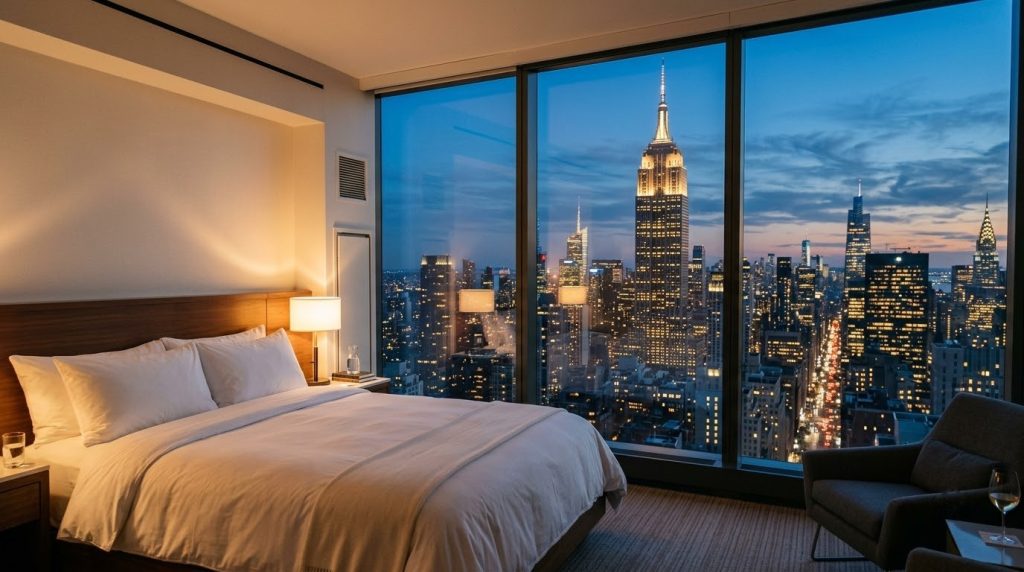
Pick your area
Picking where to stay in New York City shapes your entire trip — the right neighborhood puts you steps from the things you care about, while the wrong one costs you hours of subway time every day. We’ve pulled together the best areas and hotels for 2026, with real nightly rates and honest trade-offs so you can book with confidence.
Quick answer: First-timers do best in Midtown Manhattan, where rooms cost $220-$420 a night, while Brooklyn averages $165 a night and the 24/7 subway keeps outer-borough stays convenient.
Midtown Manhattan: Best for First-Timers and Business Travelers
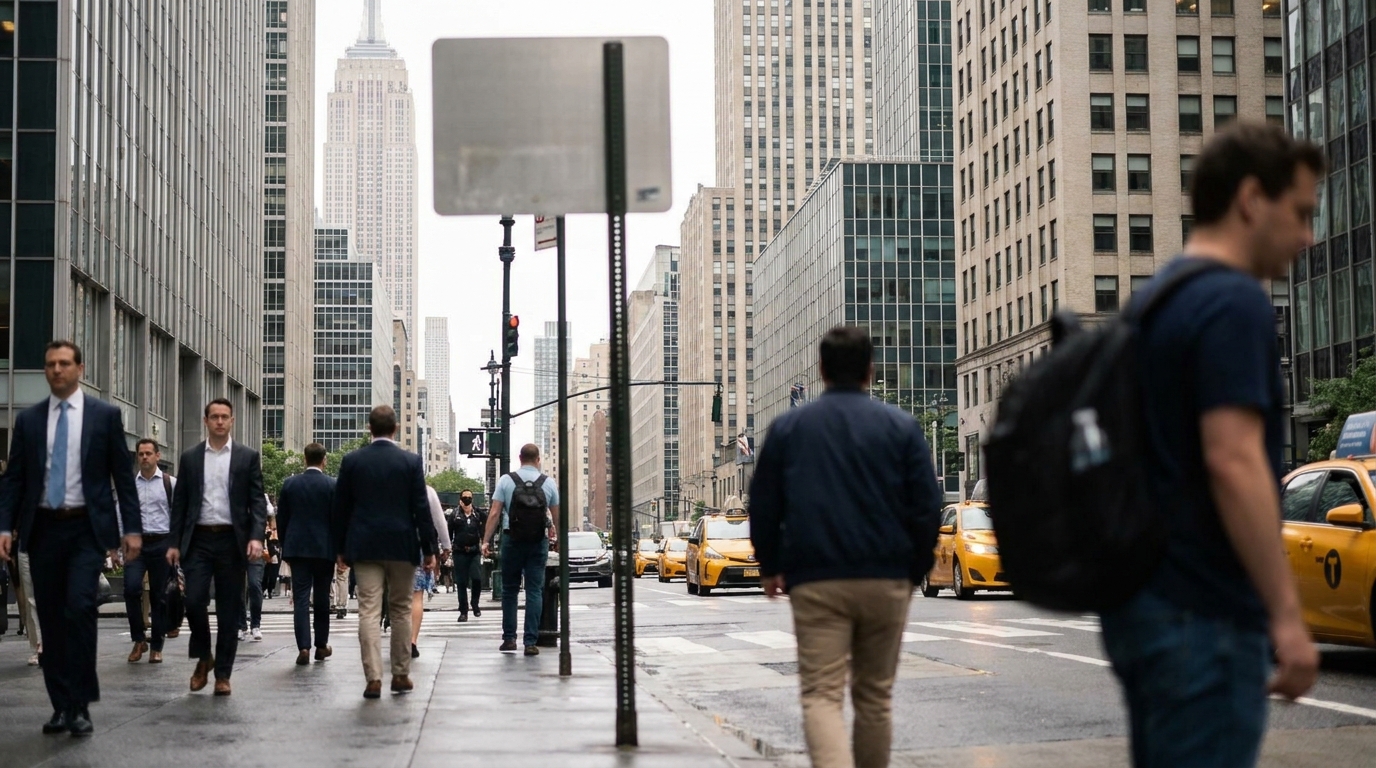
Midtown is the right base if you want Times Square, Central Park, and the Empire State Building within walking distance without planning a commute. The trade-off is price: expect to pay $220-$420/night for a standard room in 2026, with peak summer weekends pushing higher. That said, you won’t spend money on taxis, and the sheer convenience often justifies the premium for a short city break.
The neighborhood runs from roughly 34th Street to 59th Street, covering Koreatown, Hell’s Kitchen, and the Theater District. It’s dense, loud, and genuinely never quiet — which some travelers love and others find exhausting by day three.
Best hotels in Midtown Manhattan:
| Hotel | Style | Avg. Nightly Rate (2026) | Best For |
|---|---|---|---|
| The New Yorker, A Wyndham Hotel | Historic Art Deco | $189-$260 | Value-seekers, history buffs |
| citizenM New York Times Square | Compact modern | $185-$245 | Solo travelers, couples |
| Park Hyatt New York | Luxury | $595-$900 | Splurge stays |
| Row NYC | Midscale | $175-$235 | Groups, families |
Book your Midtown hotel on Check live hotel prices to compare real-time rates and filter by free cancellation — essential when transatlantic flights can shift.
We recommend targeting the west side of Midtown (Hell’s Kitchen / 9th Avenue corridor) for better value and a more neighborhood feel while staying central. See our things to do in new york city guide for what to prioritize once you’re there. Readers piecing together a schedule frequently reference this things to do in New York City before deciding which attractions are worth the time on a short visit.
Find your New York City hotel on the map
Live prices from Booking & Airbnb — tap a pin to compare stays around Midtown Manhattan and beyond.
Check hotels in Midtown Manhattan →
Lower Manhattan and the Financial District: Best for History and Waterfront Views
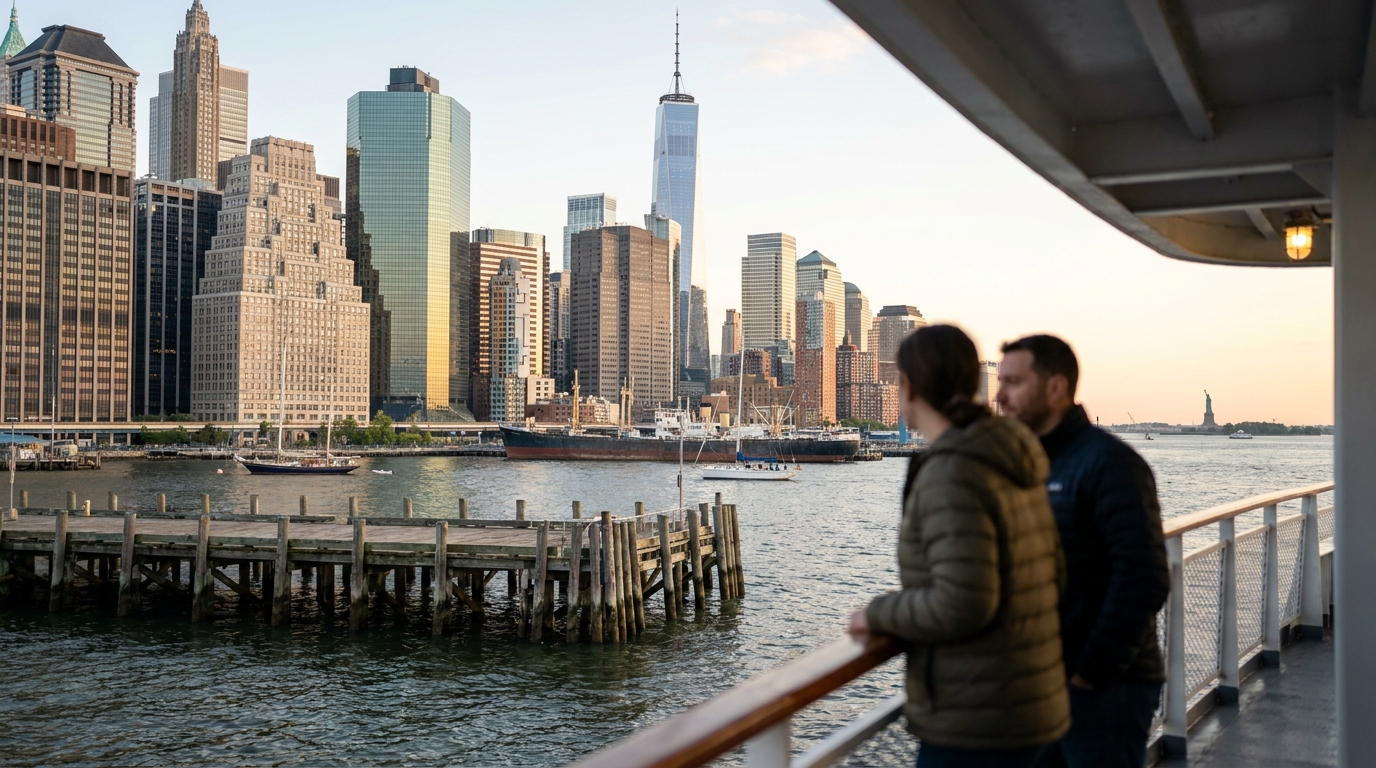
Lower Manhattan rewards travelers who want to combine Wall Street history, Brooklyn Bridge walks, and Hudson River sunsets without the Midtown crowds. Hotels here dropped in price compared to Midtown, averaging $185-$290/night in 2026, and the area is significantly quieter after 6pm — a genuine plus for light sleepers.
The Financial District (FiDi) is walkable to the 9/11 Memorial, the Oculus transportation hub, and the Staten Island Ferry (free, with iconic Statue of Liberty views). The area has transformed dramatically over the past decade, with serious restaurant and bar options lining Stone Street and the waterfront.
What to know before booking FiDi:
The neighborhood empties on weekends — that’s not a flaw if you like uncrowded streets, but it means fewer brunch spots and limited Sunday foot traffic. The 2/3, 4/5, A/C, and 1 subway lines all converge here, so reaching anywhere in Manhattan takes 20-30 minutes.
Standout options include the Millennium Downtown New York ($175-$240/night) and the Aloft Manhattan Downtown – Financial District ($165-$225/night), both with solid Booking.com ratings above 8.2.
For travelers also planning a day trip across the water, check our things to do in brooklyn post — the ferry from Pier 11 runs every 30 minutes.
Check hotels in Lower Manhattan and the Financial District →
Brooklyn: Best for Value, Local Vibes, and the Creative Scene
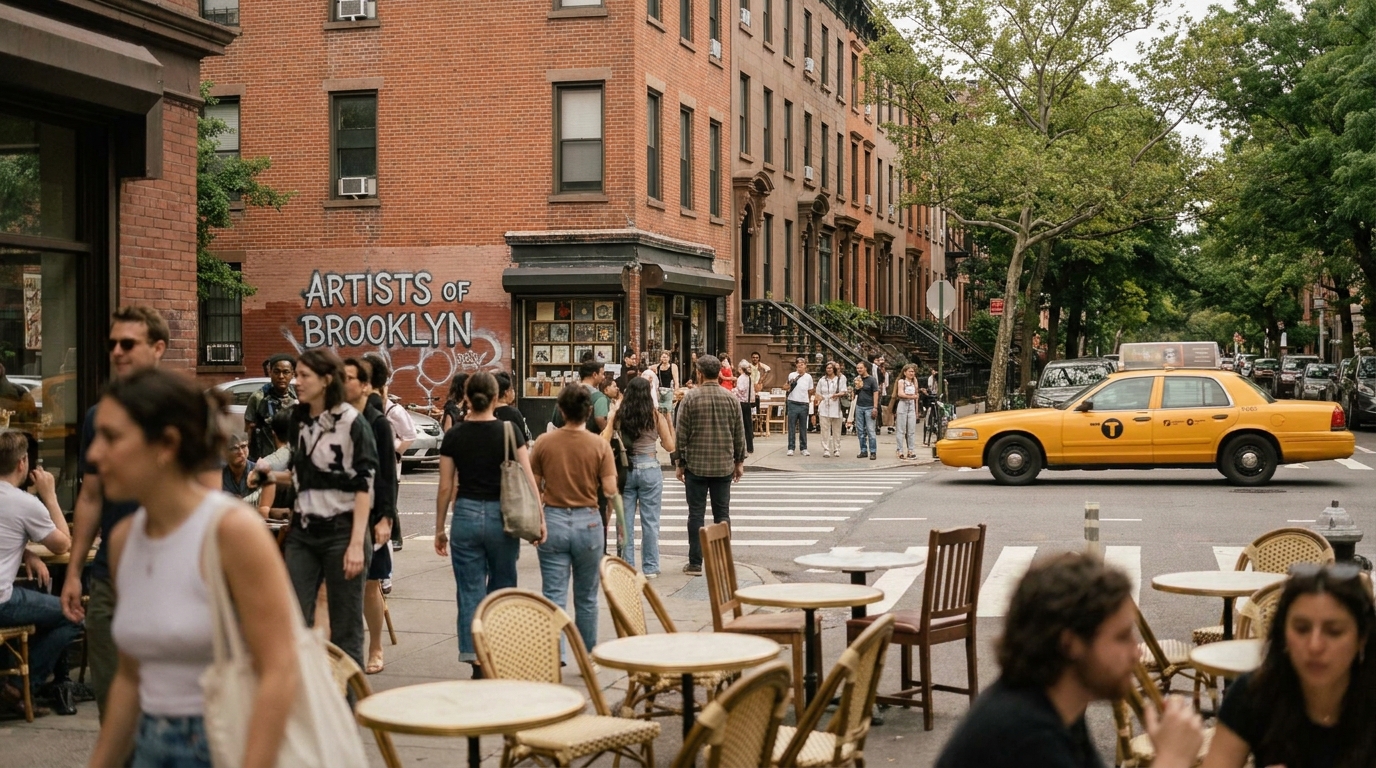
Brooklyn is where we’d send anyone staying more than four nights who wants to eat better, spend less, and feel less like a tourist. Williamsburg, DUMBO, and Prospect Heights each offer distinct characters, and hotel rates average $155-$210/night — a meaningful saving over Midtown for a week-long trip.
DUMBO (Down Under the Manhattan Bridge Overpass) gives you the Manhattan skyline framed by the bridge — that photo is real and free from Washington Street. Williamsburg delivers rooftop bars, Brooklyn Brewery, and some of the city’s most interesting independent restaurants. Prospect Heights puts you two blocks from the Brooklyn Museum and a short walk to Prospect Park.
Brooklyn neighborhood comparison:
| Area | Vibe | Manhattan Commute | Avg. Hotel Rate |
|---|---|---|---|
| Williamsburg | Hipster, bars, food markets | 15 min (L train) | $155-$200/night |
| DUMBO | Cobblestone, views, galleries | 20 min (A/C or F) | $175-$230/night |
| Prospect Heights | Local, cultural, leafy | 25 min (2/3 or B/Q) | $140-$180/night |
| Brooklyn Heights | Brownstones, quiet, family | 20 min (2/3) | $160-$210/night |
The 1 Hotel Brooklyn Bridge ($320-$420/night) is Brooklyn’s splurge option with unmatched skyline views; for mid-range, the Ace Hotel Brooklyn ($195-$250/night) in Boerum Hill consistently scores well on Booking.com.
Upper West Side and Upper East Side: Best for Families and Museum Lovers
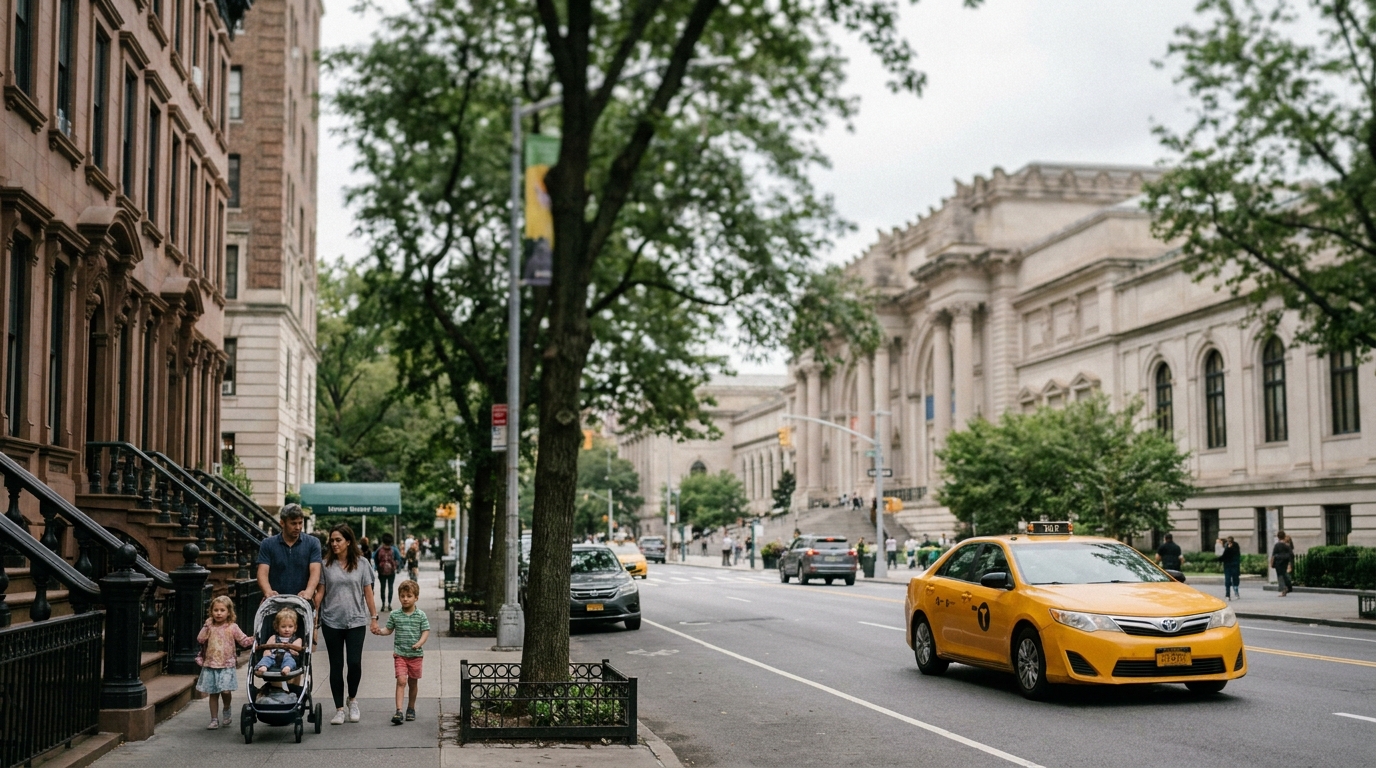
The Upper West and Upper East Sides are New York at its most residential — tree-lined streets, brownstone apartments, and a pace that’s genuinely easier on families with children or travelers who want culture without chaos. The American Museum of Natural History (UWS) and the Metropolitan Museum of Art (UES) are your anchors, and Central Park runs between both sides like a shared backyard.
Hotels here run $195-$320/night on average in 2026, slightly cheaper than Midtown while remaining very central. The 1/2/3 (UWS) and 4/5/6 (UES) subway lines deliver you to Times Square in under 15 minutes.
Families should look at the Hotel Beacon on the Upper West Side ($185-$240/night) — it offers suite-style rooms with kitchenettes, which cuts food costs significantly. For the Upper East Side, the The Surrey ($310-$450/night) is a genuine luxury boutique option, while the Warwick New York provides a mid-range entry point around $195-$260/night.
If the Met or MoMA are high on your list, read our new york city museums guide before you book — timed entry slots for several major institutions now fill two to three weeks in advance.
Check hotels in Upper West Side and Upper East Side →
SoHo, Greenwich Village, and the West Village: Best for Shopping and Food Culture
SoHo and the Village neighborhoods attract travelers who want to shop Nolita boutiques, eat at restaurants that don’t take walk-ins, and feel like they’ve stepped off the tourist path. Hotel inventory here is smaller than Midtown, which means you’ll pay a slight premium for the experience — rates range from $210-$370/night in 2026 — but the dining and nightlife density is unmatched.
SoHo runs roughly from Canal Street to Houston, with cast-iron architecture lining streets that transition from art galleries to high-end retail. The West Village is quieter and more residential, with some of the city’s most celebrated small restaurants tucked into converted townhouses.
The Soho Grand Hotel ($275-$380/night) remains the neighborhood’s most storied option. For something more intimate, The Marlton Hotel in Greenwich Village ($195-$260/night) punches well above its price point on atmosphere. Both list on Booking.com with real guest reviews you can filter by traveler type.
Proximity to the High Line (a 15-minute walk through the Meatpacking District) makes this area ideal for travelers combining our new york city itinerary 3 days route. Those comparing neighborhoods and activities tend to open this New York City itinerary before sketching out a day-by-day plan for the trip.
Check hotels in SoHo, Greenwich Village, and the West Village →
Long Island City and Astoria, Queens: Best for Budget Travelers
Queens is the borough most travelers overlook and it’s genuinely one of New York’s best-kept practical secrets. Long Island City (LIC) sits directly across the East River from Midtown Manhattan — the skyline view from Gantry Plaza State Park is as good as anything you’ll pay for at a rooftop bar — and subway connections on the 7 and E/M/G lines put you in Midtown in 10-15 minutes.
Hotel rates in LIC average $125-$175/night in 2026, and Astoria (two stops further on the N/W) gives you even more options in the $110-$150/night range. Astoria’s Greek and Middle Eastern restaurant scene on 31st and Steinway Streets rivals anything in Manhattan for quality at a fraction of the price.
The Boro Hotel in LIC ($145-$195/night) is the standout property — rooftop bar, Manhattan views, solid Booking.com score. For travelers on a tighter budget, several well-reviewed independent hotels on the LIC waterfront come in under $130/night for a standard double.
Check hotels in Long Island City and Astoria, Queens →
Chelsea and Hell’s Kitchen: Best for Art, Theater, and LGBTQ+ Travelers
Chelsea is New York’s gallery district — over 200 commercial art galleries cluster between 20th and 29th Streets west of 8th Avenue — and Hell’s Kitchen (also called Clinton, roughly 34th to 59th on the west side) is the city’s densest theater-going neighborhood and one of its most welcoming for LGBTQ+ visitors year-round.
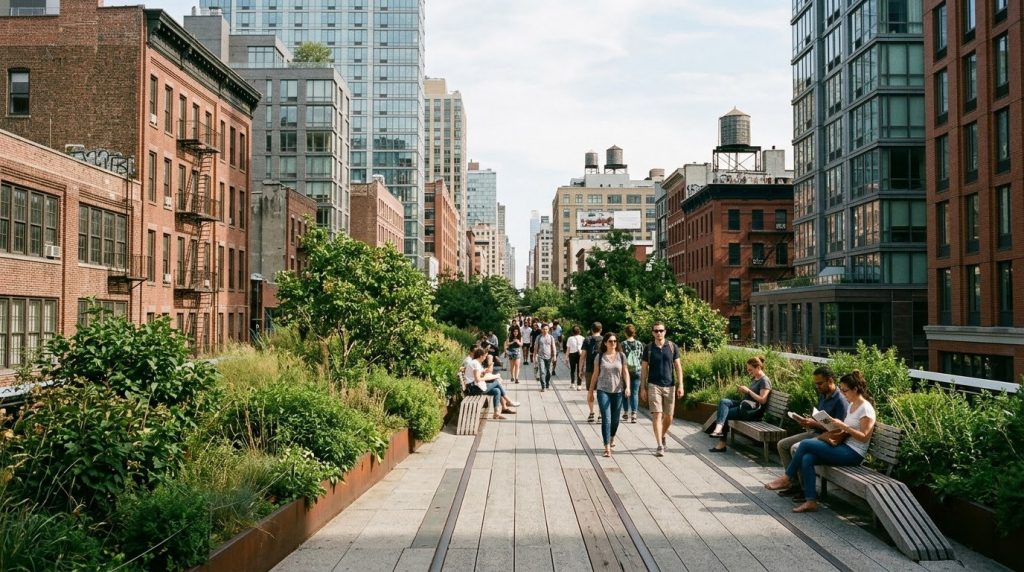
Both neighborhoods offer strong value relative to Midtown East and the Upper West Side. Chelsea hotel rates run $185-$280/night; Hell’s Kitchen typically comes in at $160-$250/night in 2026. You’re also within walking distance of the High Line’s southern entrance, Chelsea Market, and the Jacob K. Javits Convention Center — useful for business travelers attending trade shows.
The Hotel Americano in Chelsea ($240-$320/night) is one of the city’s more design-forward properties. The Ink48 hotel in Hell’s Kitchen ($195-$265/night) offers a rooftop pool and Hudson River views at a competitive rate for the location. Both appear on Booking.com with flexible cancellation options worth checking.
For Broadway show planning alongside your accommodation search, our new york city broadway guide covers booking timing and the best discount-ticket strategies for 2026.
Check hotels in Chelsea and Hell’s Kitchen →
Harlem and Gramercy: Two Quieter Alternatives to Midtown
If Midtown feels too loud and the outer boroughs feel too far, two Manhattan areas are worth a look. Neither has the hotel density of Midtown, so compare rates and reviews before you commit.
Harlem
Harlem sits at the north end of Central Park and is known for gospel music, soul food, the Apollo Theater and the Studio Museum area along 125th Street. Several subway lines stop in the neighborhood, including the A, B, C, D, 2, 3, 4, 5 and 6, so reaching Midtown does not take long.
It suits travelers who want a residential feel, restaurants that locals use and a base that is easy to reach from the Upper West Side museums.
Gramercy, Murray Hill and Flatiron
These neighborhoods sit between Midtown and the Village. They are walkable, mostly residential, and noticeably calmer at night than Times Square. Union Square is a major transit hub, with the 4, 5, 6, N, Q, R, W and L lines, which makes it easy to get to Brooklyn, Midtown and downtown.
Business travelers and couples who want a central base without the crowds tend to like this part of the city. Expect fewer sightseeing landmarks right outside the door.
Check hotels in Harlem and Gramercy →
From the Airports to Your Neighborhood
New York has three major airports, and the one you land at can influence which area is easiest to reach. Transfer prices change and sources disagree on exact totals, so confirm current fares on the Port Authority and MTA sites before you travel.
JFK
The cheapest route is the AirTrain to Jamaica or Howard Beach, then the subway. Jamaica also connects to the Long Island Rail Road, which is faster to Manhattan but costs more. Expect roughly an hour to Midtown by AirTrain and subway. Brooklyn and Queens hotels, especially in LIC, are the most direct fit from JFK.
LaGuardia
LaGuardia has no AirTrain. The free Q70 LaGuardia Link bus runs from the terminals to the Jackson Heights-Roosevelt Avenue station, where you can connect to several subway lines. Taxis and ride-hail are the fastest option, often 20 to 40 minutes depending on traffic. Astoria and Long Island City are the closest hotel areas.
Newark
Newark Liberty is in New Jersey. The usual route is the AirTrain to a NJ Transit train that reaches Penn Station in Midtown. Reports about the AirTrain status in 2026 conflict, so verify service with the Port Authority before you rely on it. Midtown West and Chelsea are easiest from Penn Station.
With heavy luggage, avoid transferring through several subway lines. Choose a base near a station on the line you ride from the airport.
Getting Around New York City: OMNY, Fare Caps, and What Counts
New York’s subways and buses use OMNY, which lets you tap a phone, watch, or contactless card at the turnstile. A tap-in example on the OMNY site uses a USD 3.00 per-ride fare. Your first tap starts a seven-day cap period, and once you spend the cap amount you ride free for the rest of that period.
Weekly cap amounts
- USD 35 for subways and local buses.
- USD 67 for subways, local buses, and express buses.
- USD 17.50 for Reduced-Fare OMNY users.
To earn the cap, use the same card or device for every tap. Group trips and transfers do not count toward it.
How it affects your hotel choice
The cap runs seven days from the first tap, so a Monday arrival fits a full week better than a Thursday one. For a short stay, you may never reach the cap, and pay-per-ride is fine.
Pick a base within a few blocks of a subway entrance, ideally one with several lines. That avoids long walks with luggage and gives you more route options when a line is delayed.
Staying in Jersey City or Hoboken: Is the Cross-River Discount Worth It?
Hotels on the New Jersey waterfront face Lower Manhattan across the Hudson, and travelers sometimes consider them to avoid Manhattan rates. The link is the PATH train, which runs between New Jersey and stations in Manhattan, including the World Trade Center and 33rd Street near Midtown.
PATH charges a flat fare per ride regardless of distance. Reports put the fare at USD 3.00, with a planned increase to USD 3.25 during 2026 and further annual increases toward USD 4.00 by 2029. Sources disagree on the exact date of the 2026 increase, so check the Port Authority fare page before you travel.
Where the idea works
- You arrive through Newark and want a short rail connection rather than a long Manhattan transfer.
- Your plans center on Lower Manhattan, Midtown West or the Financial District, which PATH reaches directly.
Where it falls short
PATH is a separate system from the subway. Your OMNY fare cap does not apply to it, so every crossing is an extra cost. Evening return trips depend on train frequency, which is lower late at night, so a theater evening or a late dinner needs a plan for the last ride home.
Compare the total cost, not only the room rate. Add two PATH rides per person per day, and compare it with a Queens or Brooklyn hotel that stays on the subway and inside the fare cap.
Choose a Block, Not Just a Neighborhood
In New York, two hotels in the same neighborhood can offer very different stays. A few checks help before you book.
- Distance to the subway: measure the walk to the nearest station that serves several lines. A five-minute walk is convenient. A fifteen-minute walk in rain or heat becomes a daily chore.
- Express versus local stops: stations on express lines save time on longer trips. Check which lines stop at the station nearest your hotel.
- Noise: rooms facing avenues, bars or construction can be loud. Read recent reviews for the words “noise” and “street,” and ask for a higher floor or a courtyard-facing room.
- Room size: Manhattan rooms are often compact. If you are traveling with a family or staying a week, look for suites or kitchenettes.
- Late arrivals: confirm the front desk is staffed if your flight lands after midnight.
Look at the map view when you compare, and focus on the walk to the subway and to the places you plan to visit most.
Hotel Rates by Month in New York City
When you visit usually affects the price more than how early you book. One dataset of public hotel rates for searches made 10 to 180 days ahead, covering May 2024 to April 2026, reports a citywide average of USD 336 per night.
The monthly averages in that dataset vary widely.
- January: about USD 196, the lowest of the year.
- February: about USD 202.
- March: about USD 277, then April USD 335 and May USD 372.
- June to August: roughly USD 268 to 327.
- September: about USD 458, the second-highest month. The same source links this to United Nations General Assembly week and the start of the fall conference season.
- October: about USD 429, November about USD 352.
- December: about USD 541, the highest month.
These are citywide averages, not Midtown rates or rates for a specific hotel. Use them as a guide for timing. A trip in late January or February can cost far less than the same room in September or December. If your dates are flexible, summer and early March are often cheaper than fall.
Hotel Fees in New York City That Raise the Nightly Rate
Quoted rates in New York often exclude government charges. The New York City Department of Finance page on hotel taxes lists a state hotel unit fee of USD 1.50 per unit per day. The city also charges a per-room, per-day amount that rises with the nightly rate.
| Nightly room rent | City charge per room per day |
|---|---|
| USD 10 to under USD 20 | USD 0.50 |
| USD 20 to under USD 30 | USD 1.00 |
| USD 30 to under USD 40 | USD 1.50 |
| USD 40 or more | USD 2.00 |
For suites, the USD 2.00 amount applies to each room in the suite. State and city sales taxes and the occupancy tax are collected on top. The Finance page does not list the percentages, so confirm the final total at checkout.
How to compare prices fairly
Compare the full amount due at checkout, not the first number on the results page. A hotel that looks cheaper can cost more once taxes and any property fees are added.
Reading the Total Price: Resort Fees and Mandatory Charges
Government taxes are only part of the gap between the rate you see and the amount you pay. Some New York hotels also add a daily destination or resort fee for services such as Wi-Fi, fitness access or amenities. Since May 12, 2025, a federal Federal Trade Commission rule covers how short-term lodging prices must be shown.
Under the FTC’s guidance, the displayed total must include every charge the business knows about and can calculate up front. A fee counts as mandatory if you must pay it, cannot reasonably avoid it, or cannot effectively opt out. The FTC’s own example is a USD 199 room with a mandatory USD 39 daily fee, where the fee has to be part of the total price.
What can still appear later
Taxes and other government charges can be left out of the headline total. Optional extras you choose to add, such as parking or breakfast, can also be shown separately. Those charges must be disclosed clearly before you are asked to pay.
A three-step price check
- Open the final payment screen and compare it with the first price on the results page.
- Search the listing’s fine print for the words “resort fee,” “destination fee” and “facility fee.”
- Screenshot the total before you pay, and compare the receipt at check-in. Raise any difference with the front desk before you give a card.
Two rooms with the same headline rate can end up far apart once mandatory fees are included, so compare totals, not teasers.
When to Stay in New York City: Weather and Seasons
Central Park averages for 1991-2020 show a true four-season climate. January highs average about 40 F (4.3 C) with lows near 27 F (-2.7 C). July highs average about 85 F (29.5 C), and heat waves can push temperatures to 95-100 F (35-38 C).
Precipitation
Rain or snow is spread evenly, about 1,260 mm (49.5 in) a year over roughly 125 days. Average annual snowfall is about 76 cm (30 in). Snow is possible in March and sometimes early April.
Best months for a hotel stay
- May and mid-September to mid-October are the best times according to one climate guide.
- Late October is usually when fall foliage peaks.
- June can be pleasant but hot.
- Early September can be humid.
In summer heat, choose a hotel with strong air conditioning and a short walk to a subway entrance. In winter, a base near your daily destinations saves time outdoors.
Hotel Room or Short-Term Rental? What NYC Law Means for Visitors
New York City regulates short-term rentals more tightly than most US cities. Under Local Law 18, hosts who rent a home for fewer than 30 days must register with the Mayor’s Office of Special Enforcement. Booking platforms are barred from processing payments for unregistered units.
Rentals of 30 consecutive days or more are exempt from that registration rule. So are units in buildings approved for legal short-term occupancy, which the city calls Class B multiple dwellings. Most apartments in ordinary residential buildings do not qualify.
What to check before you book an apartment
- Look for a city registration number on the listing. A listing without one is a warning sign for a stay under 30 days.
- Ask whether the host lives in the unit and whether the building allows short stays. A building can enforce its own rules even when the city law is satisfied.
- Read the cancellation terms. If a booking is cancelled by the platform or the host, you may be left searching for a room at peak-season rates.
When a hotel is the simpler choice
For stays of a few nights, a hotel avoids the registration question, offers a staffed front desk, and holds your bags on arrival day. An apartment makes more sense for a week or longer, or for a family that needs a kitchen.
Common Mistakes When Booking a New York Hotel
Most booking regrets come from a handful of avoidable choices. Check these before you pay.
- Choosing by price alone: a cheap rate near an airport or in another borough can cost more in time and fares than a mid-range room closer to your plans.
- Misreading “near Manhattan”: listings in New Jersey, near JFK or near LaGuardia may be labeled as close to the city. Check the minutes to the nearest subway or train station.
- Skipping the cancellation terms: choose a refundable rate if your plans may change, and note the deadline in your calendar.
- Ignoring the final price: compare the total with taxes and any mandatory daily fees, not the nightly headline rate.
- Booking Times Square for quiet: the area is lit and crowded late into the night. Ask for a higher floor, or choose a nearby side street.
- Overpacking the schedule: a base with a long commute turns a three-night stay into hours on trains. Cluster your sightseeing near your base.
If you travel during a major event, such as the fall conference season, book early. Rates rise and the best-located rooms sell out first.
Noise, Night Safety and Scams Around Popular Bases
Most of the areas in this guide see heavy pedestrian traffic well into the evening. The practical risks are noise and petty street sales tactics, not hotel safety. A few habits help in any neighborhood.
Times Square and Midtown
This is the loudest and most crowded base. Request a room above the lower floors and away from the street, and ask whether the hotel faces the avenue or a side street. Crowds also make pickpocketing more likely, so keep phones and wallets in front pockets or a zipped bag.
Costumed characters in Times Square ask for tips after a photo. Performers are not licensed to demand payment, so a polite no is fine. If you take a photo, decide beforehand what, if anything, you will pay.
Tickets sold on the street
Sellers near theaters offer cheap or discounted Broadway tickets that can be counterfeit or marked up. Buy from the theater box office, the official show website, or the TKTS booth in Times Square for same-day discounts. A seller who will not let you check the ticket details is not worth the risk.
Late-night travel
- Choose a hotel close to a subway entrance so your late walk stays short and well lit.
- Use a licensed yellow cab or a ride-hail app with a visible trip record rather than an unmarked car offering a ride at the curb.
Which New York Area Fits Your Trip Type?
This shortlist links the areas above to common trip styles.
- First visit, three or four nights: Midtown, especially the western side near Hell’s Kitchen.
- Families: the Upper West Side for the American Museum of Natural History and Central Park, or a hotel with a kitchenette.
- Couples: the West Village, SoHo or Brooklyn Heights for walkable evenings.
- Budget: Long Island City or Astoria, a short ride from Midtown.
- History and waterfront: the Financial District.
- Long stays: Brooklyn or Queens, where rates and restaurant prices are often lower.
- Nightlife: Williamsburg, the Lower East Side or Chelsea.
When in doubt, choose the area with the best subway access to the places you will visit on day one and day two. Everything else can be a short ride.
Holiday Weeks, Late Arrivals and Luggage
Late November and December are the most expensive and crowded stretch for New York hotels, as the monthly averages earlier in this guide show. Thanksgiving falls on Thursday, November 26, 2026, and the Macy’s Thanksgiving Day Parade takes place that morning in Manhattan. Rockefeller Center’s tree lighting is typically held on the Wednesday after Thanksgiving, and Midtown crowds stay heavy through the holiday weeks.
Street closures around big events can slow taxis and rides back to the hotel. If your hotel is in Midtown, plan to walk in and out of the area, and leave extra time for airport trips on those days.
Late flights and early departures
- Tell the hotel your arrival time. Small properties may not staff the desk all night, so confirm late check-in in writing.
- For a flight before 8 AM, plan the route the evening before and choose a base on the line you will ride, or arrange a car in advance.
- Subway service runs around the clock, but late-night trains are less frequent, so check the trip planner before you rely on it.
Before check-in and after check-out
Standard hotel check-in often starts mid-afternoon. Most hotels will hold your bags at the front desk before check-in and after check-out, so you can start sightseeing on arrival day without hauling suitcases. Ask whether there is a fee and whether you will get a claim ticket.
A Three-Night Plan from Midtown or Brooklyn
This outline shows how different bases change your days. It is a pacing guide, so check opening hours and ticket rules for each attraction before you go.
Midtown base
- Day 1: walk Midtown, see Central Park and the Theater District, and keep Times Square for the evening.
- Day 2: ride downtown for the Financial District, the 9/11 Memorial and a free Staten Island Ferry round trip.
- Day 3: take the subway to Brooklyn for a Brooklyn Bridge walk and DUMBO, then dinner in the Village.
Brooklyn base
- Day 1: start with Brooklyn Bridge Park and the skyline views, then cross into lower Manhattan.
- Day 2: head to the Upper West Side or Upper East Side for a museum morning, followed by Central Park.
- Day 3: return to Williamsburg for food and shopping, and leave Manhattan evening shows for an optional night.
Plan about an hour of travel per day when you stay outside Midtown, and keep one flexible block in the afternoon for rest.
Frequently Asked Questions
What is the best area to stay in New York City for first-time visitors?
Midtown Manhattan is the most practical base for a first trip. You’re walking distance to Times Square, Central Park, the Empire State Building, and major transport hubs. It costs more — budget $220-$350/night for a solid midrange hotel — but you’ll save on taxis and time, which matters when your trip is only three to five days.
How much does a hotel in New York City cost per night in 2026?
Average nightly rates vary widely by borough and season. Midtown Manhattan averages $289/night; Brooklyn averages $165/night; Queens averages $135/night. Summer (June-August) and the holiday period (Thanksgiving through New Year) are peak periods with rates 20-35% higher than shoulder season.
Is Brooklyn a good place to stay in New York City?
Brooklyn is an excellent base, especially for stays of four nights or longer. Williamsburg and DUMBO are 15-20 minutes from Midtown by subway, and you’ll pay 30-45% less for comparable hotel quality. The food and bar scene in Brooklyn rivals Manhattan, and the neighborhood feel is a genuine draw for travelers who’ve already done Midtown before.
How do I get around New York City if I’m staying outside Manhattan?
The NYC subway runs 24 hours a day, seven days a week, making outer-borough stays very workable. The 30-day MetroCard was discontinued after 2025; single rides are $3.00 and OMNY caps weekly spending at $35. Long Island City to Midtown is 10-12 minutes on the 7 train. Brooklyn to Midtown varies from 15-30 minutes depending on your line and destination. Citi Bike (city bike-share) supplements the subway well for short cross-neighborhood trips.
What neighborhoods should I avoid for accommodation in New York City?
There aren’t neighborhoods we’d call outright unsafe for hotels in 2026, but a few areas deserve practical caution. Parts of the South Bronx and East New York in Brooklyn have higher crime rates; budget hotels in these areas sacrifice location convenience along with safety context. For most travelers, sticking to the neighborhoods covered in this guide delivers the right balance of access and comfort.
When is the cheapest time to book hotels in New York City?
January through early March is consistently the cheapest period for NYC hotels — winter cold keeps demand lower, and you’ll find rates 25-40% below summer peaks. November (excluding Thanksgiving week) and late August after Labor Day also offer solid value windows. Booking 6-8 weeks in advance on Booking.com with free cancellation lets you lock in rates and re-book if prices drop.
Do I need a car in New York City?
No. A car actively makes New York City harder. Parking averages $40-$65/day in Midtown garages, traffic is consistently dense, and the subway connects every major attraction faster than a taxi during most daylight hours. If you’re planning a day trip to the Hamptons, Hudson Valley, or the New Jersey Shore, rent via Discover Cars for the specific days you need it rather than keeping a car for your full stay.
Final Thoughts: Choosing Your NYC Base in 2026
The best area to stay in New York City comes down to what you’re optimizing for. First trip, limited time, want everything walkable? Book Midtown and pay the premium. Returning visitor, longer stay, value matters? Brooklyn or Queens will serve you better. Art, food, and gallery culture are your priorities? Chelsea and SoHo hit differently than anywhere else in the city.
Whatever neighborhood you land on, use check live hotel prices to compare current rates, read verified guest reviews filtered to your traveler type, and lock in free-cancellation rates before your flights are confirmed. NYC hotel inventory moves fast in summer and around holidays.
Check our full new york city travel guide for visa information, airport transfers, and a day-by-day itinerary framework that works with any of the neighborhoods above.