Disclosure: Some links in this guide are affiliate links. If you book or buy through them, we may earn a small commission at no extra cost to you — it helps keep our guides free.
The 30-second version
Size: Tuscany covers 22,987.04 km2 and had 3,659,222 residents (Wikipedia, 2026).
UNESCO: The region has eight listings, from Florence (1982) to Montecatini Terme (2021) (Wikipedia, 2026).
Wine: Chianti Classico covers about 260 km2 between Florence and Siena (Wikipedia: Chianti, 2026).
Pisa: The Leaning Tower is about 55.9 m tall and leans roughly 3.97 degrees after the 1993-2001 stabilization (Wikipedia, 2026).
Siena: The Palio is run twice a year, on 2 July and 16 August (Wikipedia: Siena, 2026).
Region size22,987 km2nine provinces, one metropolitan city
Trip lengthSeven daysFlorence, Siena, Val d'Orcia; four: Florence
Palio of Siena2 July, 16 Augustrun twice a year
UNESCOEight listingsFlorence (1982) to Montecatini Terme (2021)
Tuscany is a region, not a single destination, and that is the first thing to plan around. It covers 22,987 square kilometers (8,875 square miles), holds nine provinces and one metropolitan city, and mixes art cities, hill towns, vineyards and a coastline (Wikipedia, 2026). You cannot see all of it in one trip, so choosing a focus matters.
This guide gives the overview: what the region offers, when to go, how to get around, where to base yourself and how to build a week. Each topic links to a deeper guide.
Affiliate Disclosure: Some links in this guide are affiliate links. If you book through them, we earn a small commission at no extra cost to you. We only recommend services we genuinely trust. Learn more.
Is Tuscany Worth Visiting?
Tuscany combines a dense cluster of cultural sites with the kind of landscape people picture when they imagine rural Italy. The region lists eight UNESCO World Heritage entries: the Historic Centre of Florence (1982), the Piazza del Duomo in Pisa (1987), San Gimignano (1990), Siena (1995), Pienza (1996), the Val d’Orcia (2004), the Medici Villas and Gardens (2013) and Montecatini Terme as part of the Great Spa Towns of Europe (2021) (Wikipedia, 2026).
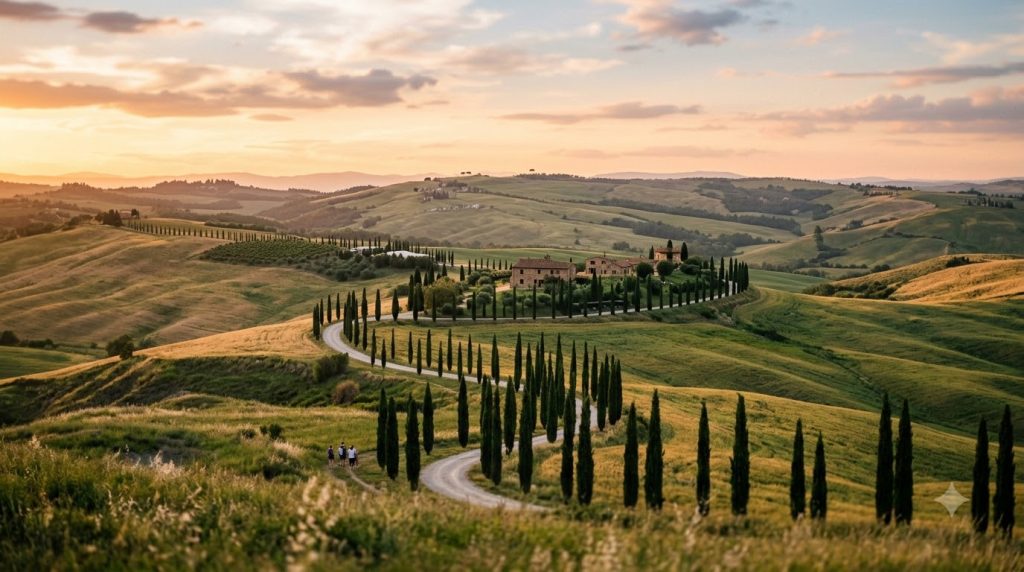
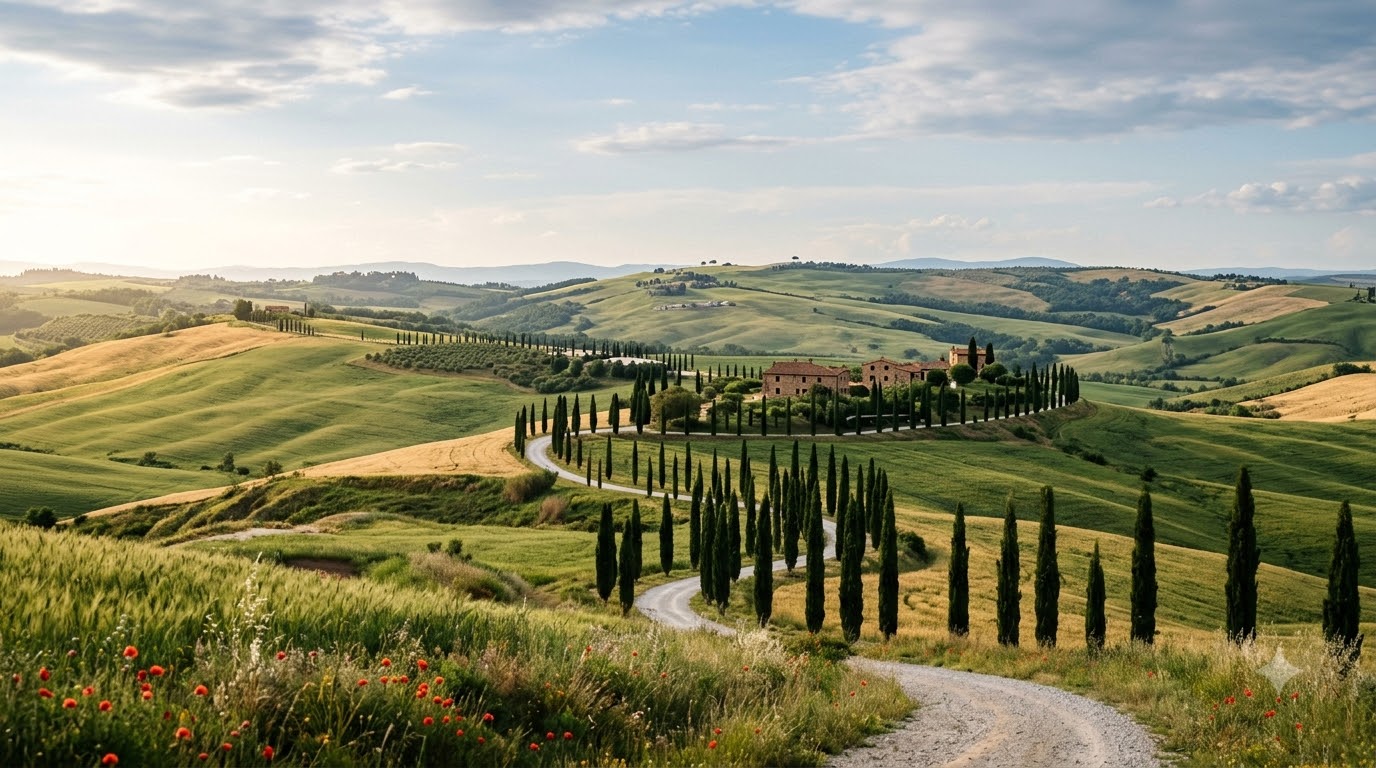
Most of those entries are city centers, squares and gardens. The Val d’Orcia stands apart as a rural landscape, which is why it appears on so many covers and itineraries.
That list shows the range. You can spend a week on art and architecture, a week on food and wine, or a week driving between small towns. The region rewards slow travel, and it is less satisfying if you try to cover too much in too few days.
The main drawback is logistics. Hill towns are not well served by trains, and public transport thins out in the countryside. Many visitors rent a car for at least part of the trip. The full assessment is in is Tuscany worth visiting.
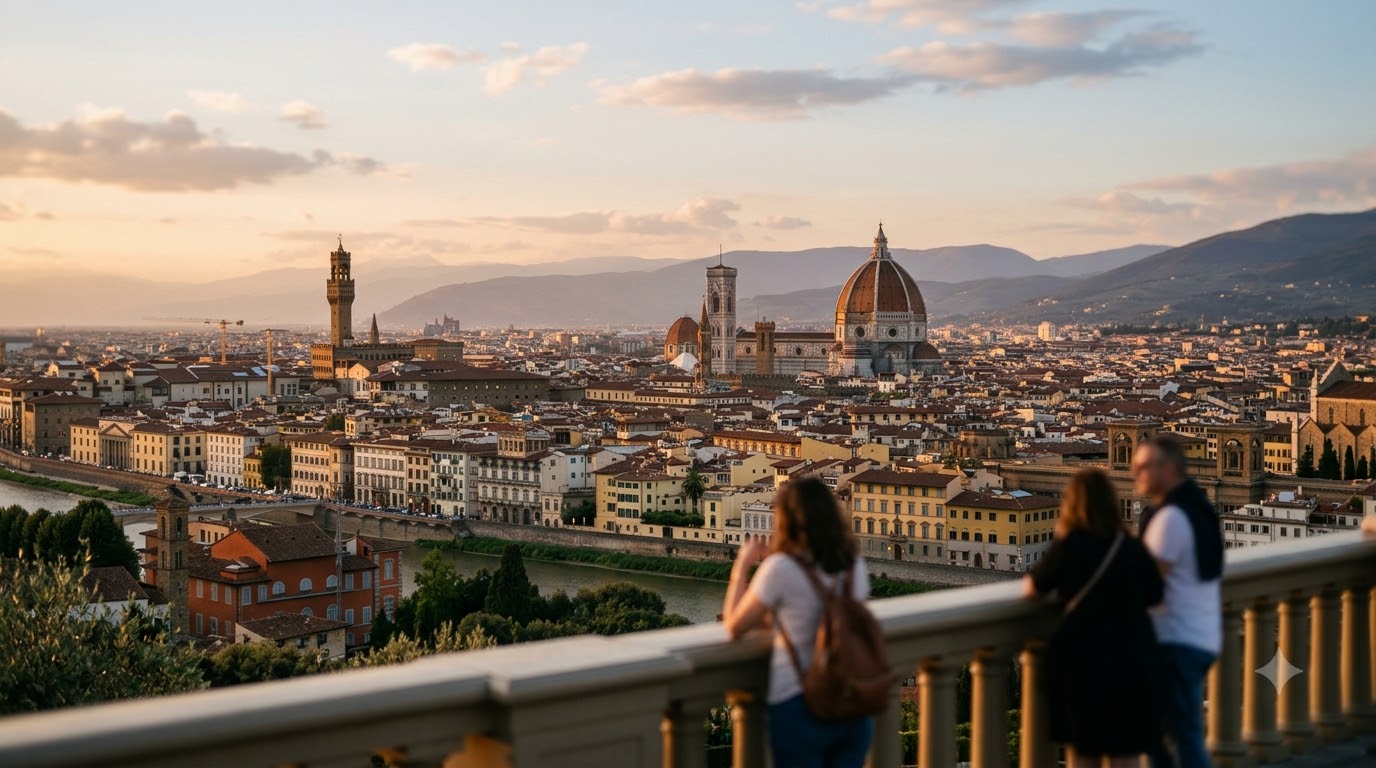
Florence is the regional capital and the usual entry point. Our Florence travel guide covers the city in detail.
Best Time to Visit Tuscany
Tuscany’s climate varies by location. Coastal areas are mild, while the interior is harsher and rainier, with large seasonal temperature swings (Wikipedia, 2026). Florence, in the Arno valley, shows the pattern: a July mean maximum of 32.3 C (90.1 F) and a January mean maximum of 11.2 C (52.2 F) (Wikipedia: Florence, 1991-2020 normals).
Season
General feel
Good for
Spring
Mild, green landscape
Walking, hill towns
Summer
Hot, busy
Coast, early starts
Autumn
Comfortable, harvest season
Wine, food, driving
Winter
Cool, quiet
Cities, thermal spas
These ratings are planning guidance based on the climate data. Event dates also matter. The Siena Palio takes place on 2 July and 16 August, which makes Siena crowded and expensive on those days (Wikipedia: Siena, 2026). If you want the quieter version of the town, avoid those dates.
Most visitors arrive through Florence or Pisa. Florence Airport handled 3,847,658 passengers in 2025, and its light-rail network has a terminal at the airport (Wikipedia, 2025). Pisa has its own international airport, which is convenient for the coast and for Lucca.
Fast trains reach Florence from other major Italian cities, and regional trains link Florence with Pisa, Siena and several smaller towns. If you plan to stay in the countryside, check where the nearest station is before you book, because some villages are far from rail.
A common pattern is to fly into one airport and leave from another, which avoids doubling back. Check one-way car rental drop fees if you plan this.
Getting Around Tuscany
Your transport choice shapes the trip.
By train and bus. Florence, Pisa, Lucca, Siena and Arezzo connect by regional rail or bus, so a city-focused trip works without a car. Services thin out on Sundays and in the evening, so check timetables.
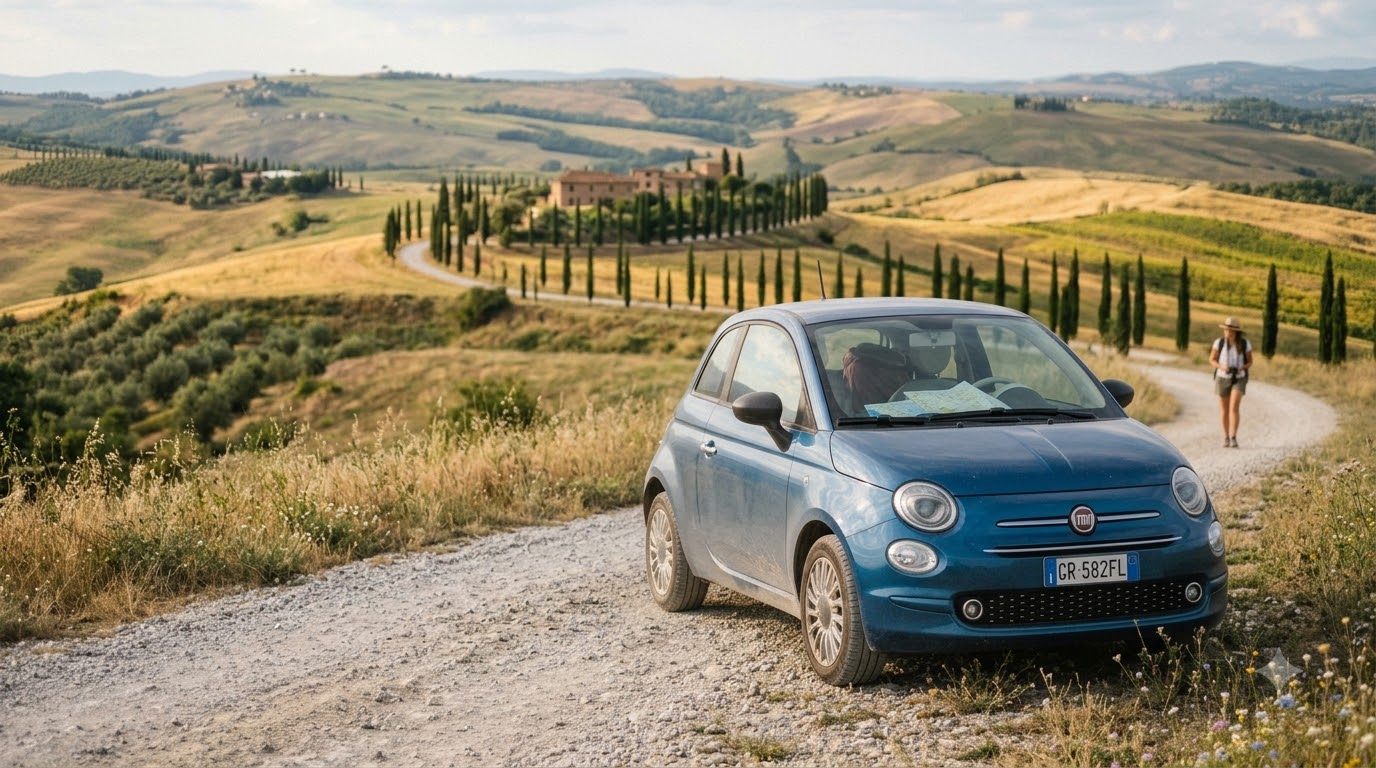
By car. A rental car gives you access to the Chianti road, the Val d’Orcia and small hill towns. Roads are narrow in places, and many historic centers restrict traffic to residents. Use car parks outside the walls and walk in.
By organized tour. Small-group tours from Florence and Siena cover Chianti and San Gimignano without a car. They suit travelers who do not want to drive after wine tastings.
Mix the modes: use trains for city legs and rent a car only for the countryside days.
Plan for slower travel times than the map suggests. Country roads wind through hills, towns sit on ridges, and a short distance on paper can take far longer once you add parking and a walk uphill. Limit yourself to one main drive per day and leave time for a long lunch.
If you drive, check the rules for limited traffic zones before entering any historic center. Many Tuscan towns use cameras to fine vehicles that enter restricted streets, and rental companies usually pass the fine on to the driver. Park outside the walls, follow the signs to the central car park and walk in.
Top Things to Do in Tuscany
Florence. The regional capital holds the Uffizi, the cathedral and the Oltrarno. See the Florence travel guide for details.
Pisa. The Leaning Tower was begun on 14 August 1173 and was closed from January 1990 until it reopened on 15 December 2001. Engineers removed about 70 metric tons of soil from beneath the raised end, reducing the lean by 45 cm. The tower has 296 steps and was inscribed by UNESCO in 1987 as part of the Piazza del Duomo (Wikipedia, 2026). A half day is usually enough.
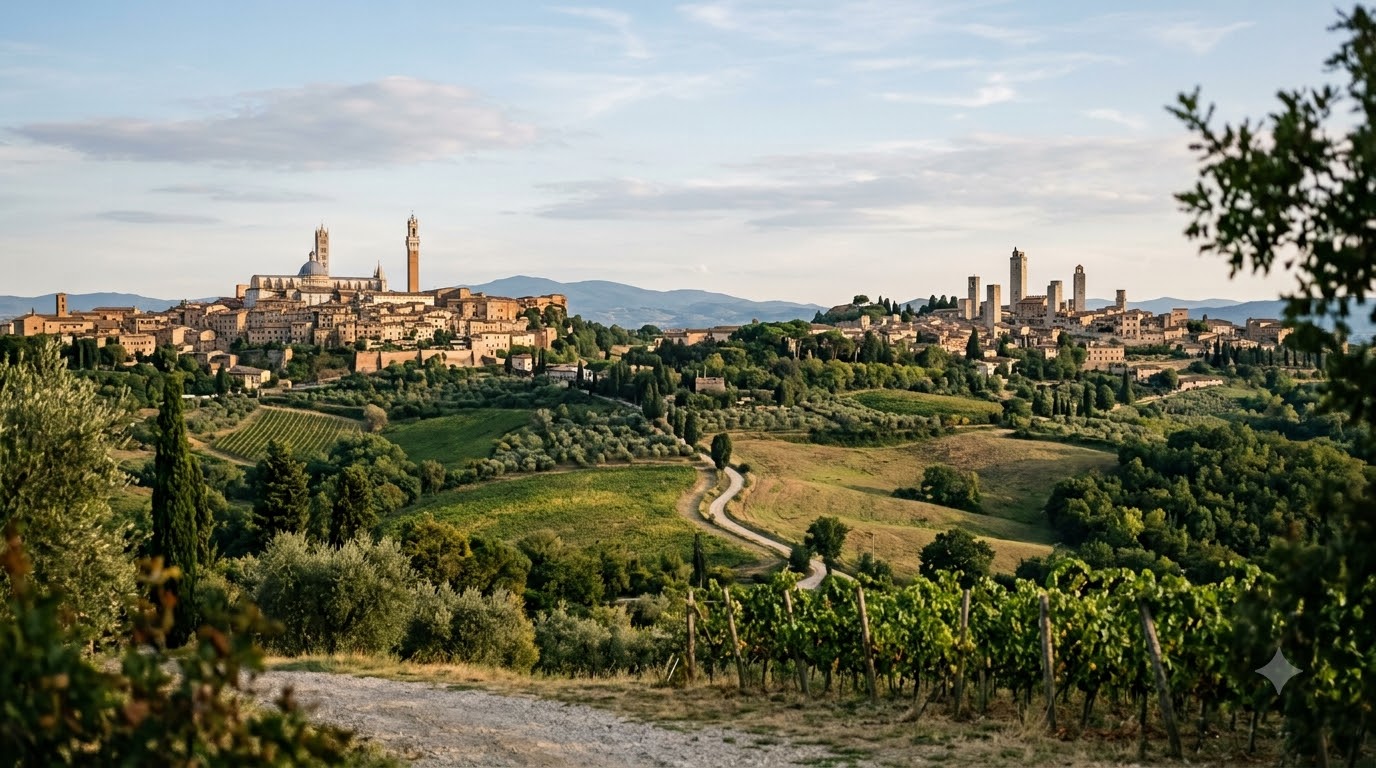
Siena. The historic center was inscribed in 1995 and the town has 53,180 residents. Piazza del Campo is the shell-shaped square in front of the Palazzo Pubblico (Wikipedia: Siena, 2026).
Val d’Orcia and Pienza. The Val d’Orcia was inscribed in 2004 and covers 61,188 hectares. Pienza was rebuilt in the 15th century as an ideal town under Pope Pius II (Wikipedia: Val d’Orcia, 2026). This is the landscape most people picture when they imagine Tuscany.
San Gimignano and Lucca. San Gimignano is known for its medieval tower skyline and the white Vernaccia wine. Lucca is a walled city that suits cycling.
Wine country. Chianti Classico lies between Florence and Siena, and Montalcino is known for Brunello (Wikipedia: Val d’Orcia, 2026). Book tastings ahead, and arrange a driver or a tour if you plan to taste.
Booking the Big Sights: Uffizi and the Leaning Tower
Two Tuscan sights run on strict entry rules, and both reward booking ahead. Treat them as fixed points in the day and plan the rest around them.
Uffizi Gallery, Florence
The Uffizi’s own ticket page lists a single ticket at EUR 25 (about USD 28) when bought on the day of entry and EUR 29 (about USD 32) when bought before the entry date. From 1 January 2026 it also lists an afternoon rate of EUR 16 (about USD 18) for entry from 4 p.m. Conversions here are approximate and use a rate of roughly EUR 1 to USD 1.12.
Free admission applies on the first Sunday of each month. State museums in Italy are ordinarily closed on Mondays, so build your Florence days around that.
Leaning Tower, Pisa
The tower ticket is tied to a date and time slot. The Opera della Primaziale Pisana says that if you are late you will not be admitted or refunded, although you can change the time (not the date) up to 2 hours before your slot. Online sales open 90 days before the visit.
Children who will be 8 or younger by the end of the current year cannot enter, and visitors under 18 need an adult.
Large bags and luggage must go to the cloakroom. Only small bags or backpacks up to 20 x 30 x 38 cm are allowed in the monument area.
The climb is on foot, has 251 steps, and the visit takes about 30 minutes.
Choose your time slot first, then build the rest of the Pisa day around it.
Where to Stay in Tuscany
Pick a base by trip style rather than by town name.
Florence: Best for first-time visitors who want art, restaurants and train connections. Use it as a base for Pisa and Siena day trips.
Siena: A compact medieval center, useful for Chianti and the southern hills.
Lucca: A walled city with an easy pace, close to Pisa and the coast.
Chianti countryside: Farm stays and villas suit a car-based trip with wine focus. Expect to drive for dinner.
Val d’Orcia: Quiet and scenic, ideal for a slow stay of three or four nights. Book early for spring and autumn.
Pisa: Practical for late flights or early departures, but most visitors spend one night at most.
Rural stays often have minimum night requirements and limited public transport. Confirm parking, check-in hours and distance to the nearest restaurant. For ranked options by area and budget, see best hotels in Tuscany.
Chianti Classico Basics Before You Taste
Chianti is a label with rules, not just a scenic road. The Chianti Classico consortium describes a production zone of 71,800 hectares (177,500 acres) shared between the provinces of Siena and Florence. It includes the entire municipalities of Castellina in Chianti, Gaiole in Chianti, Greve in Chianti, and Radda in Chianti.
The black rooster emblem, the Gallo Nero, traces to a meeting in Radda in Chianti on 14 May 1924, which the consortium treats as the start of its history. A bottle with the rooster is the quickest sign you are buying from this core zone.
The consortium names three labels: Annata, Riserva, and Gran Selezione. Ask your host to explain how they differ, since the pour and the price both change with the tier.
Timing a wine day
Harvest runs from the first half of September to the second half of October, depending on the vineyard’s location and altitude. That is the busiest period for estates, so book tastings early if you travel then.
Book directly with an estate. The consortium’s site has an Estates directory and a Visit section for finding producers.
Choose one or two tastings per day, not four.
Name a designated driver, or hire a driver or join a small-group tour.
Where to Eat in Tuscany
Tuscan food is built on bread, olive oil, beans, vegetables and grilled meat. Look for ribollita (bread and vegetable soup), pappa al pomodoro, pici pasta in the Siena area, wild boar ragu and bistecca alla fiorentina.
Wine is central. Chianti is made mainly from Sangiovese, and Chianti Classico bottles carry the black rooster (gallo nero) seal that marks membership of the producer consortium (Wikipedia: Chianti, 2026). Brunello di Montalcino is among the region’s most prestigious wines, and Vernaccia di San Gimignano is the white to know.
Tips for eating well:
Choose small family-run trattorias a few streets from main squares.
Expect set lunch hours and quieter kitchens between lunch and dinner.
Reserve in smaller towns, where a handful of places serve a large number of visitors.
Ask for the house wine, which is often local and priced fairly.
Sample 7-Day Route
This route keeps driving manageable and uses three bases. For variations, including a 4-day and a 10-day version, see the Tuscany itinerary guide.
Days 1-2: Florence. See the cathedral, the Uffizi and the Oltrarno. Pick up a rental car on the morning of day 3, not before.
Day 3: Chianti to Siena. Drive the Chianti Classico area between Florence and Siena, stop for a tasting, and arrive in Siena in the afternoon.
Day 4: Siena. Walk the historic center and Piazza del Campo. Dinner in a contrada neighborhood.
Days 5-6: Val d’Orcia. Visit Pienza and Montalcino, and take a slow drive through the valley.
Day 7: Return. Drive to Pisa for the tower and a flight, or return to Florence for the train.
If you have only four days, base in Florence and use day trips. If you have ten or more, add Lucca, the coast and Arezzo.
Frequently Asked Questions
How many days do you need in Tuscany?
Seven days is enough for Florence, Siena and the Val d’Orcia at a relaxed pace. Four days works if you focus on Florence plus one or two day trips. The Tuscany itinerary guide offers routes for different lengths.
Do you need a car in Tuscany?
Not for a city-based trip, because trains and buses connect Florence, Pisa, Lucca and Siena. A car becomes useful for the Val d’Orcia, Chianti and small hill towns where public transport is limited.
What is the best month to visit Tuscany?
Spring and autumn are the usual favorites for mild weather and landscape. Summer is hot in the interior, with Florence’s July maximum averaging 32.3 C (90.1 F) (Wikipedia, 1991-2020 normals). See best time to visit Tuscany.
Is Tuscany expensive?
Costs vary widely. Florence and the wine areas tend to cost more, while smaller towns and inland stays are often cheaper. Compare areas in best hotels in Tuscany.
Is Tuscany worth it for a first trip to Italy?
Yes, if you value landscape, food and wine alongside cities. If your priority is ancient ruins or canals, Rome or Venice may fit better. See is Tuscany worth visiting for the full trade-offs.