Where to Stay in Cape Town 2026: Best Areas & Hotels
Disclosure: Some links in this guide are affiliate links. If you book or buy through them, we may earn a small commission at no extra cost to you — it helps keep our guides free.
- The V&A Waterfront area commands the highest hotel rates, averaging $180-$320/night for 4-star properties in 2026 (Booking.com, 2026)
- Sea Point and De Waterkant offer the best value-to-location ratio, with quality guesthouses from $60-$120/night
- The City Bowl sits within 15 minutes of Table Mountain, the V&A Waterfront, and Long Street nightlife
- Camps Bay beach-facing hotels charge a 35-50% premium over comparable inland properties
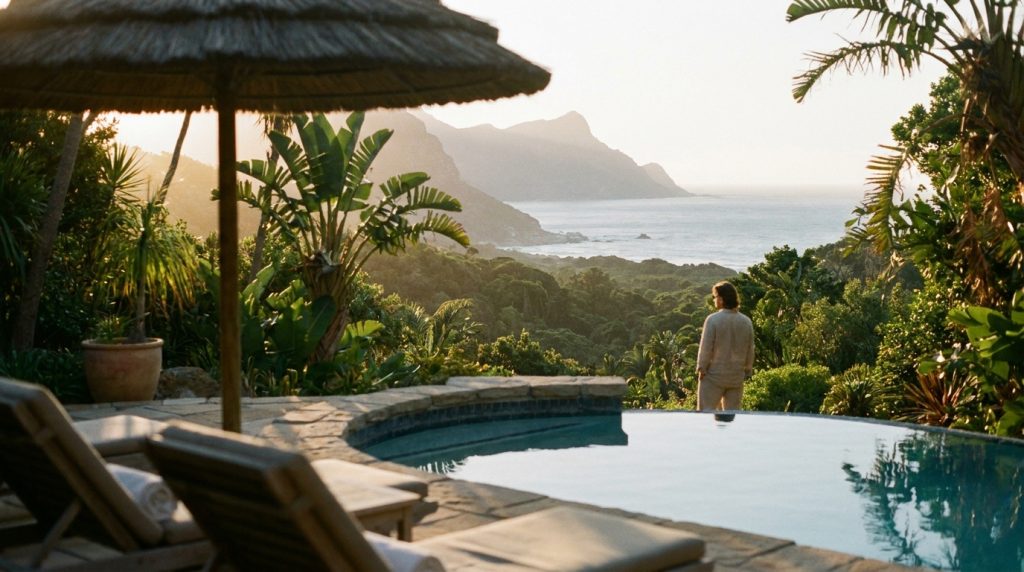
Pick your area
Cape Town is one of Africa’s most rewarding cities to visit, and choosing the right neighborhood shapes your entire trip. We’ve broken down the best areas by traveler type — budget backpacker, beach lover, food obsessive, or luxury seeker — so you can book with confidence. Before finalizing plans, it helps to check this things to do in Cape Town before deciding which attractions are worth the time on a short visit.
Quick answer: Families and first-timers do best at the V&A Waterfront, Sea Point and De Waterkant offer the best value from about $60-$120 a night, and Camps Bay suits beach glamour at a 35-50% premium.
Find your Cape Town hotel on the map
Live prices from Booking & Airbnb — tap a pin to compare stays around the V&A Waterfront and beyond.
Which Area of Cape Town Should You Stay In?
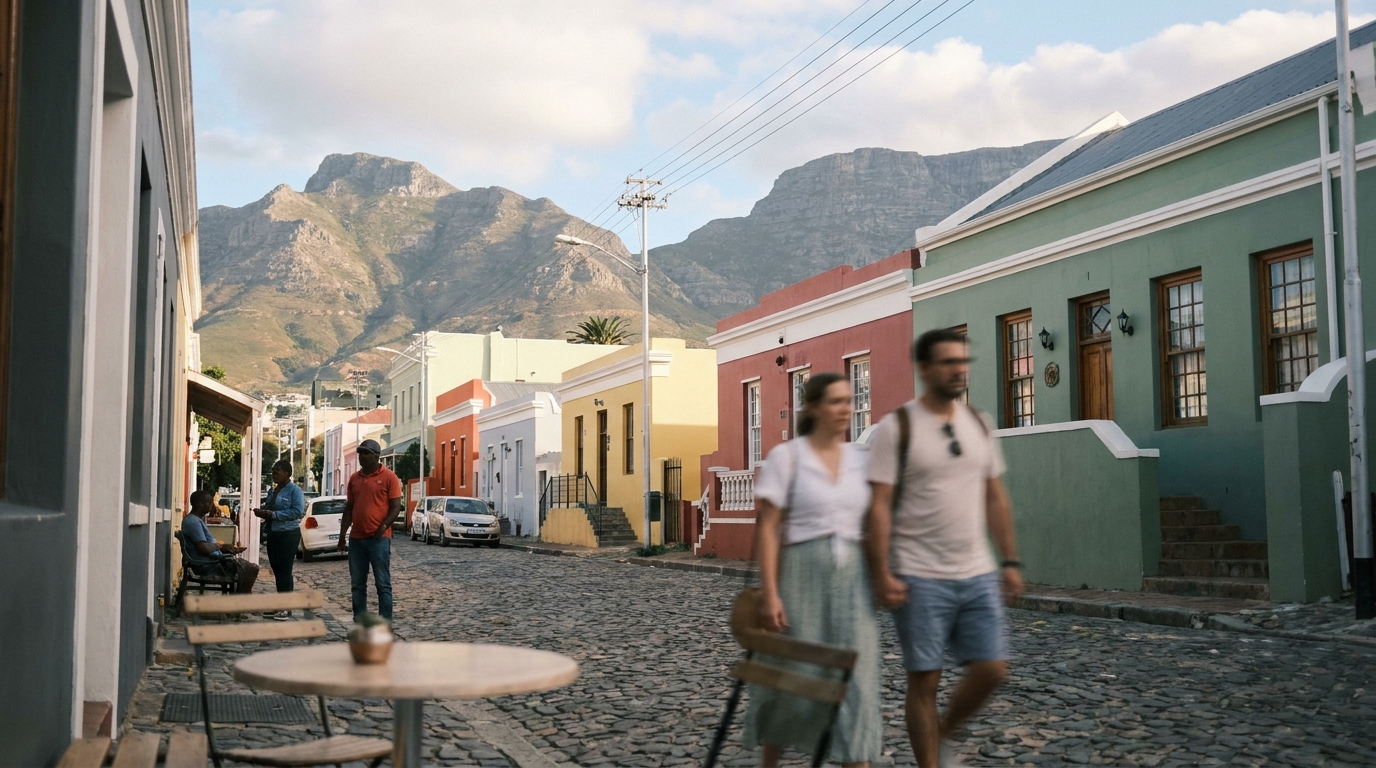
The right neighborhood depends entirely on your priorities. Families and first-timers do best at the V&A Waterfront for safety and convenience, while budget travelers get more space in Sea Point or the City Bowl. Beach-focused visitors should look at Camps Bay or Clifton, and design-hotel fans will prefer the compact, walkable streets of De Waterkant.
Cape Town’s layout is more spread out than most European cities. The Atlantic Seaboard (Sea Point, Camps Bay, Clifton) faces west toward the ocean. The City Bowl and V&A Waterfront are central and connect most areas. The Southern Suburbs (Constantia, Newlands) sit inland near wine estates. Each zone has a genuinely different personality.
| Area | Best For | Avg Nightly Rate (2026) | Safety Rating |
|---|---|---|---|
| V&A Waterfront | Families, first-timers | $180-$320 | Very High |
| City Bowl | Culture, nightlife, value | $70-$160 | High (stay central) |
| Sea Point | Beach access, budget | $60-$130 | High |
| Camps Bay | Beach glamour, splurges | $150-$400 | High |
| De Waterkant | Design hotels, LGBTQ+ travel | $90-$200 | Very High |
| Green Point | Sports events, mid-range | $80-$150 | High |
| Constantia | Wine farms, families, quiet | $100-$250 | Very High |
Staying at the V&A Waterfront: Safe, Central, and Pricey
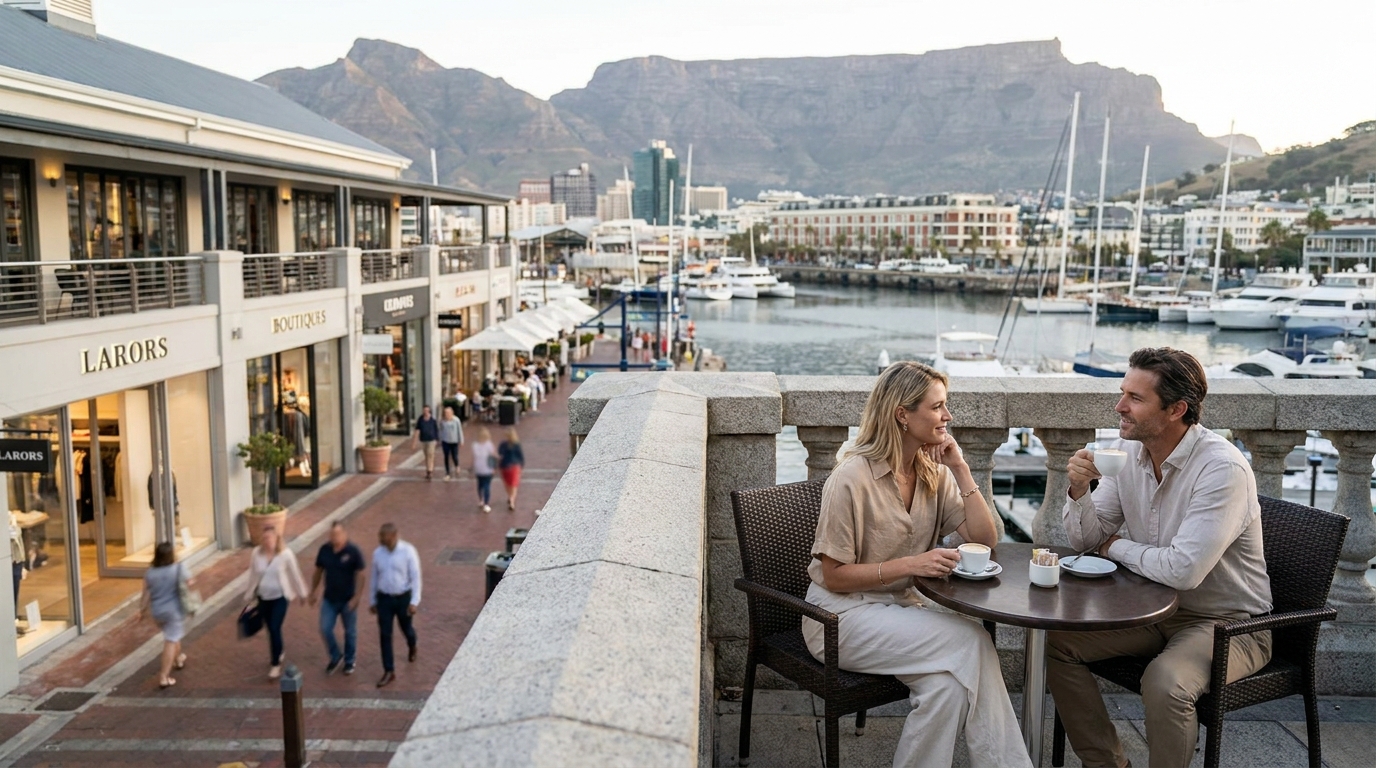
The V&A Waterfront is Cape Town’s safest and most visited precinct, and it’s the default choice for first-time visitors who want everything within walking distance. You’ll pay a premium — budget at least $180/night for a decent 3-star — but you’re getting gated security, direct access to 450+ shops and restaurants, and the easiest ferry connections to Robben Island.
Top picks on Check live hotel prices include the Radisson Blu Hotel Waterfront (from $195/night), which puts you steps from the Two Oceans Aquarium, and the One&Only Cape Town (from $420/night) for a full luxury experience with a spa and three restaurants. The DoubleTree by Hilton Cape Town (from $160/night) hits a solid sweet spot for business travelers.
The main drawback: you’re a $12-$18 Uber ride from Table Mountain’s lower cable car station, and the area can feel sanitized compared to the grittier, more local parts of the city.
Check hotels in V&A Waterfront →
City Bowl: The Beating Heart of Cape Town
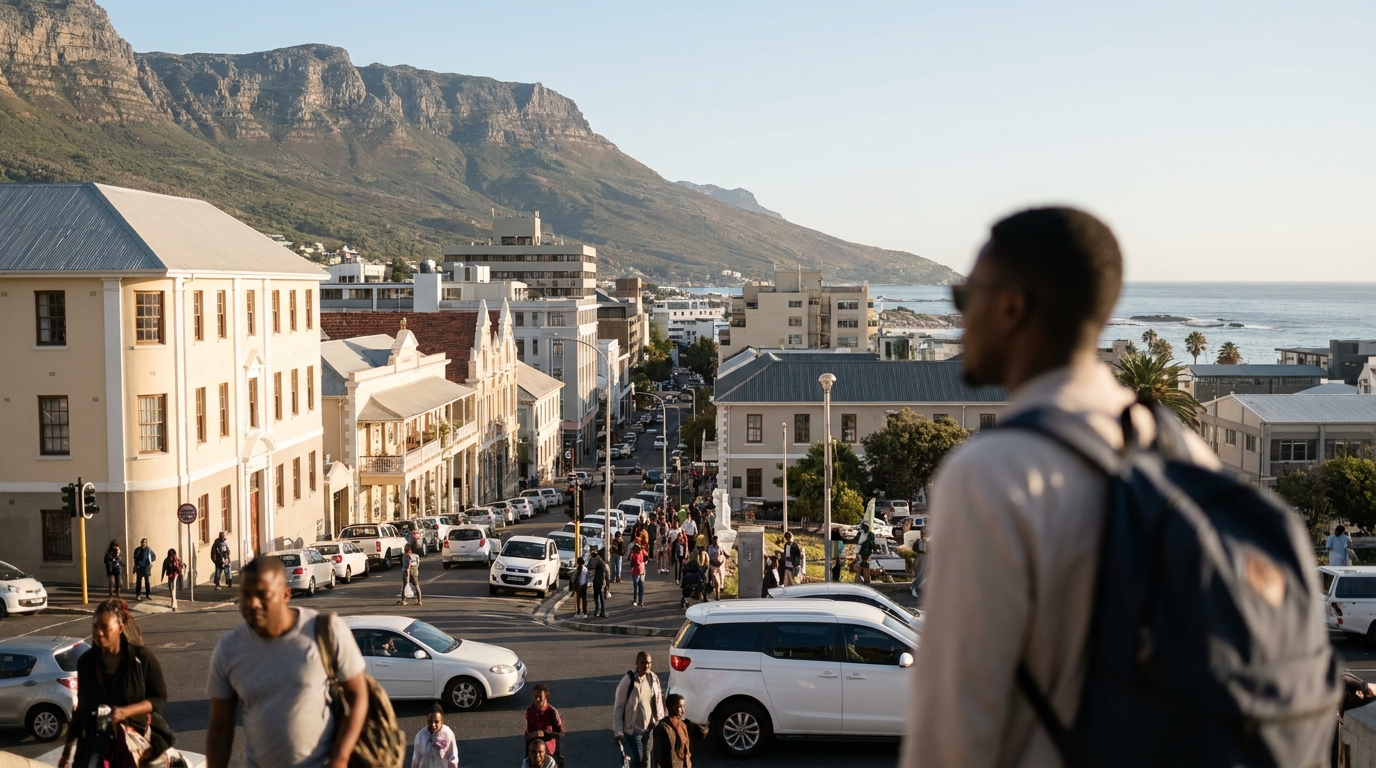
The City Bowl — covering the CBD, Gardens, Tamboerskloof, and De Waterkant — is where Cape Town’s creative and culinary scene concentrates. Long Street runs through the middle with bars, hostels, and mid-range hotels. Kloof Street, a 10-minute walk uphill, has some of South Africa’s best restaurants per square kilometer.
For accommodation, The Daddy Long Legs Boutique Hotel on Long Street (from $85/night) remains one of Africa’s most distinctive design stays, with each room styled by a different artist. The Protea Hotel Fire & Ice! (from $110/night) suits couples and solo travelers who want social energy without hostel dorms.
Safety tip: the City Bowl is safe during daylight and evening in the main strip areas. Avoid walking east toward the Foreshore alone at night — take an Uber instead. The /cape-town-safety-tips/ article covers this in detail.
Sea Point: Best Value on the Atlantic Seaboard
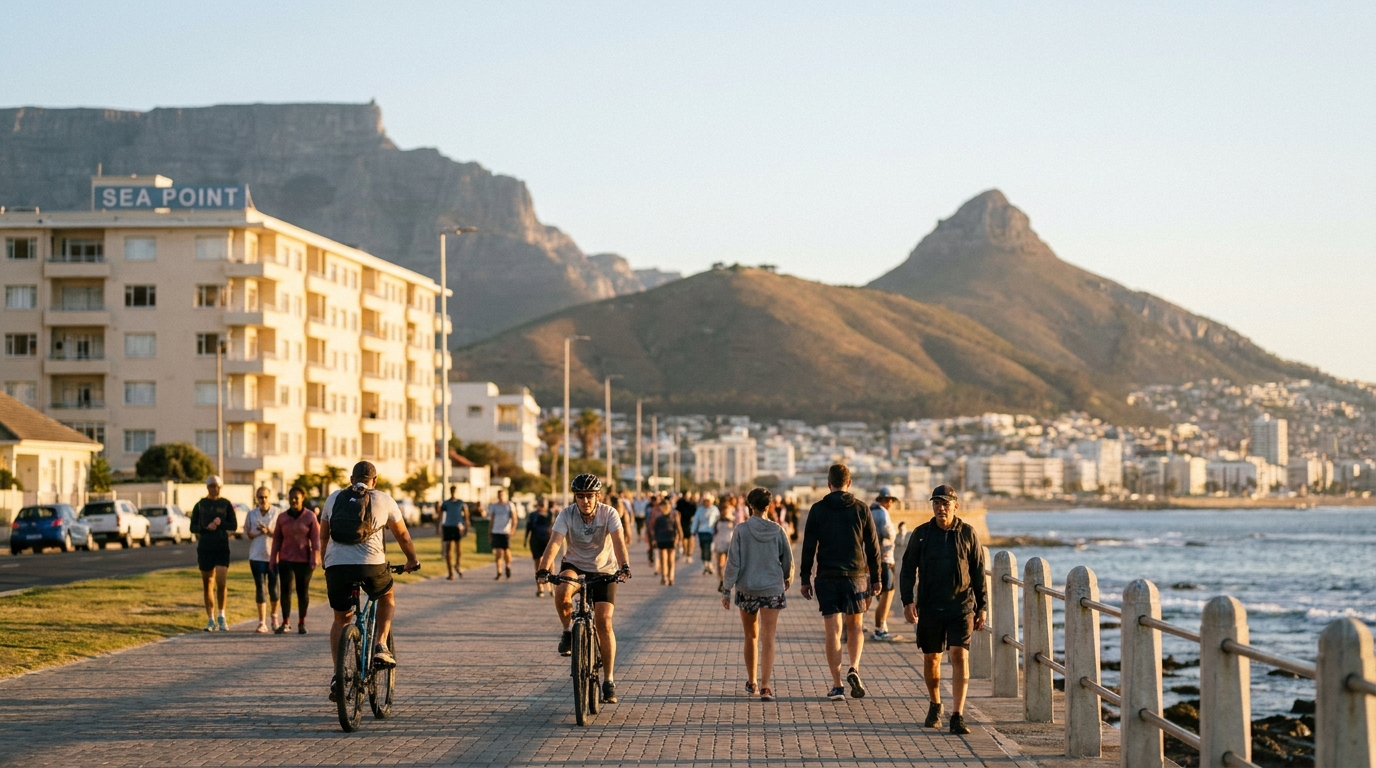
Sea Point is where Capetonians actually live — a dense, lively suburb running along the Atlantic coast between Green Point and Bantry Bay. It’s our top pick for value-conscious travelers who still want beach access, because the Sea Point Promenade (a 3km ocean-side walkway) is free, the tidal pools are swimmable year-round, and guesthouses here cost 40-50% less than equivalent properties in Camps Bay.
Expect to pay $60-$130/night for a solid guesthouse or self-catering apartment. The Winchester Mansions Hotel (from $110/night) is the area’s standout heritage property, with a pool and Sunday jazz brunch that draws locals. For self-catering, Sea Point has dozens of Booking.com apartment options from $55/night that suit families and longer stays.
Supermarkets, pharmacies, coffee shops, and Cape Town’s best sushi restaurants are all within walking distance. The 102 bus connects Sea Point to the City Bowl in 20 minutes for under $1. See our /cape-town-public-transport/ guide for full route details.
Camps Bay: Glamour, Beaches, and Steep Prices
Camps Bay is the postcard version of Cape Town — white sand, the Twelve Apostles mountain backdrop, and a strip of upscale restaurants and beach bars that fill up from noon onwards in summer. If that visual is why you’re visiting, it’s worth the premium. If you just want a bed near a beach, Sea Point delivers 80% of the experience at half the cost.
Hotel rates in Camps Bay run $150-$400/night for decent 4-star properties in peak season (December-February). The Camissa House (from $180/night) and Bay Hotel Camps Bay (from $210/night) are consistently rated highest on Booking.com. Self-catering villas and apartments — searchable on Booking.com — often offer better value for groups, with private pools from $300/night split three or four ways.
Note that Camps Bay has no supermarket and limited public transport. You’ll need a rental car or rely on Uber, which adds $8-$15 per trip into the city. Discover Cars lists local rental options from $35/day — worth comparing before you book. /cape-town-car-rental/
De Waterkant: Boutique Hotels and Village Energy
De Waterkant is Cape Town’s most walkable village-within-a-city: cobblestone streets, restored Cape Dutch cottages painted in candy colors, and a concentration of boutique guesthouses that punch above their price point. It sits between the V&A Waterfront and the City Bowl, making it equally convenient for both.
The neighborhood is known as Cape Town’s LGBTQ+ hub and draws a cosmopolitan crowd year-round. Rates run $90-$200/night, notably below the Waterfront for a comparable quality level. Village and Life De Waterkant (from $95/night) offers well-designed suites with kitchenettes. The Loader Street House (from $130/night) is a popular choice for couples who want privacy and character in equal measure.
De Waterkant’s main street, Somerset Road, connects directly to Green Point Stadium and the fan walks — useful if you’re visiting during a Stormers rugby game or the Cape Town 7s. /cape-town-events-calendar/
Check hotels in De Waterkant →
Green Point and the Stadium District
Green Point sits between De Waterkant and Sea Point, anchored by Cape Town Stadium (built for the 2010 FIFA World Cup) and the Green Point Urban Park. It’s a practical choice for travelers who want mid-range hotels without the tourist-tax pricing of the Waterfront.

The Holiday Inn Express Cape Town City Centre (from $80/night) and Radisson RED Cape Town (from $105/night) both sit in this zone and offer solid chain reliability with easy access to the MyCiTi bus network. Green Point’s restaurant scene has expanded sharply since 2023, with the Chiappini Street strip now rivaling Kloof Street for quality.
It’s also a short walk from the Sea Point Promenade and the Saturday Green Point Market, which runs weekly. /cape-town-markets/
Constantia and the Southern Suburbs: Wine Country Calm
If you’re visiting Cape Town primarily for the winelands and prefer a quiet, leafy base over urban energy, Constantia is a genuine alternative to the city center. It’s 25-35 minutes by car from the V&A Waterfront but surrounded by working wine estates including Groot Constantia (established 1685) and Steenberg Vineyards.
Accommodation here skews toward boutique guesthouses and farm-style properties. The Steenberg Hotel (from $220/night) is the area’s flagship, with two restaurants and vineyard walks on-site. The Cellars-Hohenort (from $195/night) is a restored Victorian manor with gardens that many guests call the best hotel setting in South Africa. Budget-conscious visitors can find clean guesthouses from $75/night via Booking.com.
The trade-off: you’ll need a car for almost everything. Uber works but adds up fast if you’re making multiple daily trips. The wine-focused traveler who plans to rent a car anyway will find Constantia the most relaxing base in the Cape Town metro. /cape-winelands-day-trip/ covers the full Constantia and Stellenbosch options.
Check hotels in Constantia and the Southern Suburbs →
Which other Cape Town areas are worth a look beyond the main seven?
The main guide covers the areas most visitors choose. Several other bases suit particular trips, and they are often cheaper or quieter.
Bo-Kaap and Gardens
Bo-Kaap is known for its brightly painted houses and steep cobbled streets, and it sits just above the city center. It works for travelers who want a short walk to restaurants and who do not mind hills. Gardens, below Table Mountain, has a mix of guesthouses and cafes.
Woodstock and Salt River
Woodstock is Cape Town’s design and street-art district, with converted warehouses, studios and markets. It is a short ride from the center, but the area is mixed, so look closely at the exact street and read recent reviews.
Hout Bay and the Southern Peninsula
Hout Bay is a harbor village on the Atlantic side, with a beach and a small-town feel. Simon’s Town, further south, is the base for the penguin colony and the peninsula drive. Both need a car or regular rideshares, and they suit travelers on a second visit.
Stellenbosch and the winelands
Stellenbosch is a university town surrounded by wine estates. It works as a base for wine-focused trips of several nights, and it is easy to combine with a few nights on the coast.
For each of these, confirm travel times at the hour you will be traveling, since traffic changes them sharply.
Should You Base Yourself on the False Bay Coast Instead?
The Atlantic side gets most of the attention, but the False Bay coast to the south offers a different kind of stay. Simon’s Town, Kalk Bay and Muizenberg are all on the Cape Peninsula and make sense for travelers who plan to spend most days outside the city center.
Simon’s Town
One regional guide calls Simon’s Town a quaint, quiet yet popular seaside village, with the Boulders Beach penguin colony a short distance away. Travel guides name several guesthouses and hotels there, including places described as steps from the colony, though ratings come from review platforms and should be checked on the day you book.
Seaforth is reported as a quieter spot where penguins also appear, especially in the early morning.
Kalk Bay and Muizenberg
Kalk Bay is described as a good area for families, with harbor restaurants close to the train station. Muizenberg is known as the birthplace of South African surfing and sits beside a long beach. Both are on the Metrorail line from Cape Town.
Trade-offs to weigh
- Distance: you are far from Table Mountain, the Waterfront and the Atlantic beaches, so a car or ride-hailing budget matters.
- Trains: a regional guide says the journey from central Cape Town takes roughly an hour, and an older source says reaching Simon’s Town can require a change at Fish Hoek with poor timetable alignment. Many guides do not recommend that tourists rely on Metrorail, so check current advice.
- Evenings: these are small seaside communities with fewer restaurants and nightlife than Sea Point or the City Bowl.
Who it suits
The False Bay coast suits second-time visitors, families who want calm beaches, and travelers focused on the peninsula drive and penguin viewing. If it is your first trip and you want the main sights on foot, stay in the City Bowl, the Waterfront or Sea Point instead and visit the south by day.
A split stay also works well. Spend the first nights in the city, then move to the coast for the final two.
Best Time to Stay in Cape Town: Seasons, Wind, and Rain
Cape Town has a Mediterranean climate: dry, sunny summers and wetter winters. Seasonal averages from a South African weather guide help set expectations for each area.
| Season | Months | Average high / low | Rainfall per month |
|---|---|---|---|
| Summer | Dec-Feb | 80-83F / 60-62F (26.7-28.4C / 15.4-16.5C) | 0.7-0.9 in (18-22 mm) |
| Winter | Jun-Aug | 66F / 45-46F (18.7-19.1C / 7.2-7.8C) | 3.8-4.9 in (97-125 mm) |
| Spring | Sep-Nov | 69-76F / 49-56F (20.5-24.6C / 9.2-13.3C) | 1.5-2.5 in (37-63 mm) |
February is the hottest month and July the coldest. March stays warm and calm, with temperatures dropping from April and rain returning in May.
The southeaster wind
The southeaster, known locally as the Cape Doctor, is strongest in summer and tends to pick up most afternoons. Beach-facing areas such as Camps Bay and Sea Point feel it, so a sheltered terrace or a hotel with a pool courtyard is worth asking about in December to February.
How timing affects your base
- December to February: the most popular period, with the strongest demand for Camps Bay and Waterfront rooms.
- March and November: good weather with fewer crowds, a smart time for De Waterkant or the City Bowl.
- June to August: the wettest months. Choose a hotel with indoor spaces and a central location, since beach days are unlikely.
What should you ask about power cuts and backup systems?
South Africa’s nationwide rolling blackouts, known as load shedding, shaped hotel choices for years. Some travel sources say the major cuts were suspended in March 2024, but those sources are low quality, and no 2026 confirmation turned up in this research. Check current conditions with local reporting before you arrive.
The City of Cape Town’s tourism guidance and other sources say large hotels usually have generators. Smaller guesthouses and bed-and-breakfasts are the weak point if they do not have solar or battery systems.
Questions to ask before booking
- Does the property have a generator, solar or battery backup?
- Does backup power cover the air conditioning, the lifts and the Wi-Fi, or only lights?
- Is the electric gate and security system on backup?
Practical steps
- Carry a power bank and keep your phone charged during the day.
- Download maps and tickets for offline use.
- For self-catering stays, confirm how the stove and water heater work in an outage.
If power cuts are active during your dates, prioritize central, larger properties.
Table Mountain and Your Hotel Location
The Table Mountain Aerial Cableway operates from 07:30, with the last car up at 19:00 and the last car down at 20:00, according to the operator’s site. Hours can change, and the cableway closes in bad weather such as strong wind or poor visibility, so check the operator’s website or app on the day.
Standard tickets are cheaper when bought online and are valid for 7 days. Fast Track tickets let you skip the queue by booking a timeslot. Because a closure can ruin a fixed plan, the 7-day validity is useful: book a flexible stay and take the first clear morning.
Which area gives you the best shot
- City Bowl and Tamboerskloof: closest to the lower cableway station, so you can decide at breakfast whether the weather is clear and go.
- V&A Waterfront and Green Point: a short ride away, which works if you can go flexibly.
- Camps Bay and Constantia: farther, so a closure costs more time. Treat the mountain as a bonus rather than the fixed center of the trip.
Check the operator’s live status before you leave your hotel, and carry a layer. Conditions at the top can be cold and windy even when the city below is warm.
How do you get from Cape Town airport to your hotel?
Your options are the MyCiTi airport bus, ride-hailing, or a pre-booked transfer. Prices and service status change, so verify them close to your trip.
MyCiTi airport bus
The A01 route runs between the airport and the Civic Centre station in the city center. One April 2026 review reported the airport service as temporarily suspended on the official site, while a mid-2026 guide describes it as operating. Check the live MyCiTi page before counting on it.
Regular MyCiTi fares rose on July 1, 2026. Reports put the increase at 38 to 45 percent for short bands. A transfer guide updated in April 2026 gave a published airport fare of about 25 to 33 rand, plus a card at roughly 35 to 40 rand, but those figures predate the rise.
Ride-hailing and transfers
Estimates for a ride-hail trip to the center range from about 180 to 450 rand, depending on time, vehicle type and demand. Use the app quote at the time of booking. Pre-booked hotel transfers cost more but can include a meet-and-greet.
Which area fits which arrival
- Waterfront and City Bowl: shortest transfer.
- Camps Bay and Constantia: a longer ride and higher cost.
- Late arrival: pre-book a transfer and avoid unmarked taxis.
Getting In and Moving Around Without Surprises
MyCiTi’s A01 route runs between the Cape Town airport bus station and the Civic Centre in the city center, with buses every 20 minutes when operating. The MyCiTi site currently states that the airport service is temporarily suspended, with no reinstatement date given.
Plan on a taxi, a ride-hailing app, a pre-booked hotel transfer, or a rental car for your first leg until the bus is confirmed running. Check the MyCiTi site close to your travel date.
Matching transport to the neighborhood
- V&A Waterfront and De Waterkant: compact and walkable, so you can do without a car for several days.
- Sea Point: good for walking along the Promenade, with buses and ride-hailing for the rest.
- Camps Bay and Constantia: limited transit, so a rental car or ride-hailing budget matters.
Safety basics
The US State Department lists South Africa at Level 2: Exercise Increased Caution, dated May 27, 2025. Check the current advisory before booking.
Common-sense habits help in any area: use ride-hailing at night rather than walking between districts, keep phones out of sight on the street, and leave valuables in the room safe. Ask your hotel which streets it advises avoiding after dark, since guidance varies by block.
How safe is each area at night, and what is the official advisory?
The US State Department lists South Africa at Level 2, Exercise Increased Caution, with the advisory dated May 27, 2025 on the list used for this guide. That level applies to the whole country and reflects crime risk, so it is a reason to plan, not to avoid Cape Town.
General approach
Tourist areas such as the Waterfront, Camps Bay, De Waterkant and Sea Point’s main streets are busy and well-patrolled in the evening. Most problems involve petty theft and phone snatching, particularly in quiet spots or after dark.
Night rules by area
- Waterfront: busy until late, with security throughout.
- City Bowl: stay on the main restaurant streets and take a ride-hail home, as the post suggests.
- Sea Point: stay on the main roads and avoid empty stretches of the promenade after dark.
- Camps Bay: busy on the strip, but quiet side roads need a ride.
Everyday precautions
- Do not leave bags visible in a parked car.
- Keep phones out of sight on the street.
- Use ride-hailing at night rather than walking between districts.
Check the latest advisory and local news before you travel, since conditions change.
Which Ways of Getting Back to Your Hotel Work After Dark?
Where you stay decides how you get home at night. Several Cape Town areas are walkable by day but spread out, so a sensible plan for the evening matters as much as the room.
App rides
Guides consistently recommend ride-hailing apps after dark instead of walking between districts. Uber and Bolt are the two apps named most often. Sources disagree on which is safer, and the common conclusion is that either beats an unmarked taxi. Check the plate and driver name against the app before you get in.
MyCiTi buses
The MyCiTi bus network is described as a safe and reliable option on its routes, with buses typically running until around 11 p.m. according to one guide. That makes it workable for an early dinner but not for a late night. Check the latest timetable, since service changes and fare increases were reported in 2026.
Trains and minibus taxis
- Metrorail trains: most tourist guides advise visitors to avoid them, citing muggings on trains.
- Minibus taxis: described as intimidating for visitors because of fast driving and no fixed schedules.
What this means for choosing an area
- De Waterkant and the Waterfront: you can walk to dinner and take a short app ride home.
- Sea Point: walk along main roads in the evening and use an app for anything beyond them.
- Camps Bay and Constantia: expect to use an app or hire a car for most outings.
Sources warn that the distance between two safe areas can cross a less safe one, so ride between neighborhoods instead of walking. Ask your hotel to order a ride for you if you are not sure about the pickup point.
These notes come from travel blogs and guides, so confirm current conditions with your hotel and official advisories.
How do you choose between a hotel, a guesthouse and a self-catering apartment?
Cape Town offers all three, and the best choice depends on how long you stay and how you get around.
Hotel
A hotel makes sense for a short stay of a few nights. You get a front desk, security, and often backup power. It costs more per room, particularly at the Waterfront and in Camps Bay.
Guesthouse
Guesthouses give you a host who knows the area, breakfast, and a smaller scale. Ask about backup power, parking and noise.
Self-catering apartment
An apartment suits stays of a week or more, families, and groups. You save on meals and laundry. Check the security setup, parking and whether the building has an on-site manager.
What to compare
- Total price including cleaning fees and any taxes.
- Walking distance to restaurants and shops.
- Wind exposure on the Atlantic side, covered in the weather section.
- Cancellation terms that let you move dates when Table Mountain is closed.
Booking time
For December to February, book early, since the best-located rooms go first. For March and November, you have more choice and better prices.
What does a 5-night Cape Town stay look like with two bases?
A two-base plan limits driving while giving you both the city and the coast or the winelands.
Option 1: City then coast
Spend three nights in De Waterkant or the City Bowl, so you can visit Table Mountain and the Waterfront on foot or by short ride. Then spend two nights in Sea Point or Camps Bay for beach time and sunset dinners.
Option 2: City then winelands
Spend three nights in the City Bowl, then two in Constantia or Stellenbosch. This option needs a rental car or pre-booked drivers for the wine days.
Table Mountain tip
The cableway operator lists first departures at 7:30 am, with the last car up at 7 pm and the last car down at 8 pm, and it closes in strong wind. Put Table Mountain on your first clear morning, and keep your second base flexible in case weather delays it.
Booking tips
- Book the first hotel with free cancellation until Table Mountain conditions are clear.
- Check whether the second hotel allows early luggage drop.
- Avoid changing hotels on the day of a timed booking.
What Paperwork Should You Check Before You Book a Stay?
A booking is only useful if you can enter the country smoothly. A few document checks take minutes and save problems at the airport.
Entry basics for US travelers
Several 2026 sources say US citizens do not need a visa for tourism or business visits of up to 90 days. They list a valid passport and a return or onward ticket as the basics. These are secondary sources, so confirm them with the South African government or your embassy.
One source warns that passports without two blank pages may be refused. The official US government page for South Africa could not be opened in this session, so verify the blank-page rule and the passport validity requirement before you fly.
Traveling with children
South Africa has had special rules for minors in the past, including extra documents when a child travels with one parent or without both parents. None of the sources checked confirmed the current rule, so families should check with the South African immigration authorities before booking non-refundable stays.
Accommodation documents to keep handy
- Your hotel or guesthouse confirmation, including the address, phone number and booking reference.
- A return ticket, since immigration may ask for onward travel.
- Travel insurance details, because cancellations can be tied to weather on Table Mountain or to local disruptions.
Booking terms worth reading
Check the cancellation policy, the deposit rule and whether the property needs a copy of your passport at check-in. Guesthouses often ask for a card on file for incidentals. Read how the property handles disputes and refunds before you pay.
If you are arriving late at night, tell the property your flight number, since gated guesthouses may need staff to let you in. Ask for written confirmation of the arrival plan.
How Does a Robben Island Visit Fit Around Where You Stay?
Robben Island is one of the few Cape Town sights that runs on a fixed departure, so it is worth planning your base around it. Ferries leave from the Nelson Mandela Gateway at the V&A Waterfront.
What resellers report
- Arrive about 30 minutes before departure, and one listing asks for an hour.
- Operations depend on the weather, so crossings can be delayed or canceled in rough conditions.
- Refund rules differ by seller. Some offer a refund only if you cancel at least 24 hours ahead, and others are non-refundable.
- Some listings ask for a passport or ID copy for boarding.
Resellers show next available dates rather than a full timetable, and none gave an official 2026 schedule, so confirm times with the Robben Island Museum or your seller.
How it affects your hotel choice
A base at the Waterfront, De Waterkant or Green Point means a short walk or ride to the gateway. From Camps Bay or Constantia, add transfer time and a margin for traffic.
Book the ferry for a day when you have no other fixed plan, because a weather cancellation means you will need a spare day. If Table Mountain and the island both depend on clear weather, leave a gap day in a five-night plan.
Tips
- Bring a warm jacket, since resellers report cold conditions at sea.
- Book a refundable ticket if your dates are fixed by flights.
- Keep the confirmation on your phone, since tickets are usually sent by email or messaging app.
Choosing a hotel with free cancellation gives you the same flexibility on the accommodation side if conditions change.
Frequently Asked Questions
What is the safest area to stay in Cape Town?
The V&A Waterfront is universally considered the safest precinct — it’s privately managed and security-patrolled around the clock. De Waterkant, Sea Point, and Camps Bay are all high-safety residential areas. The City Bowl is safe in its central zones but we recommend taking Ubers at night rather than walking toward the CBD’s eastern edges.
Is Cape Town expensive to visit in 2026?
Cape Town sits in a comfortable mid-range bracket for US, UK, and Australian visitors. The South African rand trades at roughly R19 to $1 (June 2026), which means your dollar stretches significantly on food, local transport, and mid-range accommodation. A solid 3-star hotel in Sea Point costs $60-$90/night, and a full restaurant meal with wine runs $15-$30 per person.
What’s the best area for families with children?
The V&A Waterfront combines security, entertainment (Two Oceans Aquarium, boat trips, playgrounds), and easy restaurant access, making it the top family pick. Sea Point’s tidal pool complex is also excellent for kids and free to use. Both neighborhoods have direct Uber access to Table Mountain, Boulders Penguin Colony, and Cape Point.
When is the best time to visit Cape Town?
Cape Town’s summer runs November through February — warm, dry, and peak-priced. March through May (shoulder season) offers excellent value, with rates 20-30% lower than December peaks, settled weather, and smaller crowds. June-August is Cape Town’s rainy winter, though temperatures rarely drop below 10C and Table Mountain is still accessible most days.
How many nights do I need in Cape Town?
Five nights is the practical minimum to cover the V&A Waterfront, Table Mountain, Cape Point, the winelands, and a beach day at Camps Bay. Seven nights is more relaxed and lets you add Boulders Beach, a township tour, and an evening drive along Chapman’s Peak. See our /cape-town-itinerary-7-days/ for a full day-by-day breakdown.
Do I need a car to get around Cape Town?
Not necessarily. The MyCiTi bus covers Sea Point, Green Point, the V&A Waterfront, and the CBD efficiently for under $1 per trip. Uber is reliable and cheap by international standards — a cross-city ride rarely exceeds $8. However, if you’re planning Constantia, Cape Point, or the Winelands independently, a rental car unlocks considerably more flexibility. /cape-town-getting-around/
Should I book Cape Town hotels in advance?
Yes, especially for December-January and around the Cape Town Jazz Festival (late March). Quality properties in Sea Point and De Waterkant sell out 6-8 weeks ahead in peak season. Our live hotel map’s free-cancellation filter lets you lock in rates early without commitment — we always book refundable rates and monitor for price drops.
The Bottom Line: Where to Stay in Cape Town
For most first-time visitors, we’d suggest splitting your stay: two nights at the V&A Waterfront to orient yourself and use the ferry to Robben Island, then moving to Sea Point or De Waterkant for the remainder. You’ll pay less, eat better, and feel like you’re actually living in the city rather than visiting a well-secured tourist zone.
Wherever you stay, book early — Cape Town’s quality properties at realistic price points do fill up, especially for weekends and public holidays. Search availability on Check live hotel prices across all the neighborhoods above to compare what’s actually available on your dates, and filter by “free cancellation” to keep your options open as your plans develop.
For more on planning your Cape Town trip, read our /cape-town-travel-guide/ complete guide covering transport, day trips, food, safety, and the best time to visit.
Planning the whole trip? Start with our Cape Town travel guide for the overview, then use this page for the details.