Is Zurich Safe? Honest Answers on Crime, Nightlife and Lake Swimming (2026)
Disclosure: Some links in this guide are affiliate links. If you book or buy through them, we may earn a small commission at no extra cost to you — it helps keep our guides free.
Yes, Zurich is safe for nearly every visitor: the US State Department rates Switzerland Level 1 (updated May 20, 2025), its lowest warning, and Zurich city police recorded 44,434 criminal offenses in 2025, 8% fewer than in 2024. Violent crime against tourists is rare.
Your realistic risks are a lifted phone at Zurich HB, a rowdy late night around Langstrasse, and, the one most Americans never consider, underestimating the cold, fast water of the lake and the Limmat river in summer.
| Risk | Reality | What to do |
|---|---|---|
| Pickpocketing | Concentrated at Zurich HB, Bahnhofstrasse and crowded trams | Front pocket for phone, zip bags on trains |
| Langstrasse at night | Red-light and bar district, drug dealing, occasional fights | Fine for a drink, stick to main streets after 1 a.m. |
| Violent crime | Low and falling, clustered at nightlife hotspots | Avoid drunk crowds, leave arguments alone |
| Lake and river swimming | Strong Limmat current, cold water, boat lanes | Use official baths, never swim drunk or alone |
| Phone and fake-police scams | Mostly target residents by phone | Real police never demand payment by card |
What the 2025 Zurich police numbers actually say
The City of Zurich’s 2025 police crime statistics show the trend tourists care about going the right way. Total offenses fell from 48,321 to 44,434. Burglaries dropped 19.5% to 2,266 cases. Assaults and bodily-harm cases also fell, and conventional fraud dropped 14.1%.
Two numbers deserve context. Reported sexual offenses rose 11.9%, which police link mainly to Switzerland’s broader rape law that took effect on July 1, 2024. And local reporting on the same statistics found that about 29% of physical violence happened in just three places: Langstrasse, the main station (HB) and Bellevue.
That tells you exactly where to stay alert late at night. Still choosing a city? Our Geneva vs Zurich comparison weighs safety alongside cost.
Langstrasse, the HB and areas to avoid after dark
Nothing in central Zurich is a no-go zone in daylight. The caution applies to specific streets at specific hours.
– Langstrasse (Kreis 4). Zurich’s old red-light district is now its best bar strip. It is also where street dealing, sex work and drunk crowds meet on Friday and Saturday nights. Locals walk through it without a second thought, but solo women report unwanted comments.
After 1 a.m., stay on the main drag and skip the darker side streets. – Zurich HB and its underpasses. The station is busy and policed around the clock, yet it is the city’s pickpocket hub.
Keep your phone off the café table and your backpack zipped on escalators. – Bellevue late on weekends. A tram hub and party meeting point; arguments flare after closing time. – Street Parade weekend in August. Huge crowds bring the biggest spike in theft and drunken fights.
If you want a calm city, check our guide to the best time to visit Zurich before booking that weekend.
Scams and petty theft that actually happen in Zurich
Zurich is not a scam city. Theft here is quiet and opportunistic: a phone slid off a table, a bag lifted from a luggage rack.
The “fake police” scam does exist in Switzerland, but it mostly works by phone. Callers posing as police or prosecutors accuse residents of a crime and demand card payment. Real Swiss officers will never ask for your PIN or demand cash on the spot. Hang up and dial 117.
The other recurring trick is the “stranded traveler” who claims to have been robbed and asks for cash, sometimes showing a fake bank-transfer screenshot as proof. Say no and point them to the police.
Lake and Limmat swimming: the real risk most visitors miss
This is the bigger danger. Switzerland recorded 43 fatal drownings in 2025, according to the Swiss Lifesaving Society (SLRG): 23 in lakes and 15 in rivers. One of that year’s diving accidents was in the Limmat.
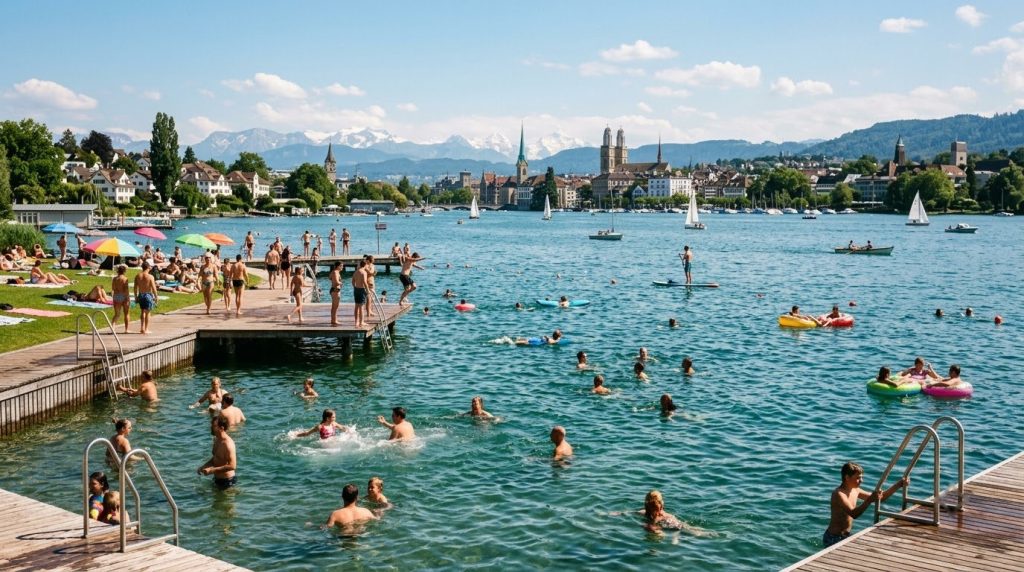
Zurich Tourism’s river-swimming rules are clear:
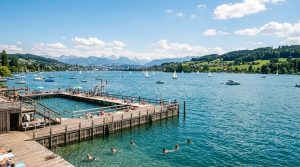
– Swimming is banned between Quaibrücke and Dynamo, near the HB, at boat docks and under bridges. – Never swim drunk, never dive into water you do not know, and never fight the current. – Use the official river baths: Oberer Letten, Unterer Letten (for strong swimmers) or the women-only Frauenbad by day.
The SLRG adds two rules worth memorizing: inflatables do not belong in deep water, and nobody should swim long distances alone.
Getting around at night: trams, night buses and taxis
Public transport is the safest way home. A 24-hour ZVV ticket covering city zone 110 costs USD 11 (CHF 9.40), and an all-zones 24-hour ticket is USD 43 (CHF 36), converted at USD 1 = CHF 0.83. On Friday and Saturday nights, night buses marked “N” run from about 1:15 a.m. to 4:15 a.m. from the HB every 30 minutes, with no night supplement.
Trams are clean and well lit, but crowded rush-hour cars are prime pickpocket territory. Buy your ticket before boarding; inspectors fine fare dodgers. If you plan to head out of the city, our Zurich day trips guide covers train connections.
Solo, female travel and emergencies
Solo travelers, including women, routinely walk central Zurich at night without trouble. Normal city rules apply: watch your drink in clubs, share your location when heading home late, and take a tram or licensed taxi rather than walking alone through Kreis 4 after 2 a.m.
Who should think twice about Zurich? Not anyone worried about crime. It suits travelers on a tight budget least, and weak swimmers who expect lifeguards on every stretch of lakefront. Our 3-day Zurich itinerary balances paid sights with free lakeside time.
Emergency numbers, per Switzerland Tourism:
– Police: 117 – Fire: 118 – Ambulance: 144 – Poison center: 145 – European emergency line: 112
Swiss medical care is excellent but expensive, so buy travel insurance with medical coverage before you fly.
Water, medication rules and getting consular help
Tap water is one thing you do not need to plan around. Switzerland’s drinking water meets strict national standards and can be drunk straight from any tap in Zurich without treatment, according to official guidance from MySwitzerland, the country’s tourism board.
Refill a bottle at a hotel sink or one of the city’s public fountains rather than buying bottled water, which runs about USD 5 (CHF 4.39) for a small bottle at a restaurant, according to this guide’s companion Zurich cost breakdown.
Medication is the area to plan ahead for instead. A directory of Swiss pharmaceutical lawyers notes that importing both prescription and over-the-counter medicines for personal use carries restrictions, and doctors need a specific Swissmedic authorization to import drugs not sold in Switzerland for a patient.
Travel with medication in its original, labeled packaging, bring a copy of the prescription or a doctor’s letter for anything that could be mistaken for a controlled substance, and check Switzerland’s rules before you pack if you take a strong painkiller or a prescribed stimulant, since controlled-substance rules vary by country and are not something to find out about at the border.
If you do need consular help, the full US Embassy sits in Bern at Sulgeneckstrasse 19, reachable at +41 31 357 70 11. Zurich itself has a smaller US Consular Agency, at the Zurich America Center, Dufourstrasse 101, phone +41 43 499 29 60, which can assist with emergency passport and citizen services without the trip to Bern.
Save both numbers before you travel, since a lost passport or a serious medical issue is the wrong moment to be searching for contact details on a phone with no signal.
Minor ailments rarely need a doctor visit. Apotheke pharmacies are common throughout the city center, and staff are generally used to helping visitors find an over-the-counter equivalent for a headache, a cold or stomach upset, which matters if your usual brand from home is not sold under the same name in Switzerland.
Keep a note of the generic or active-ingredient name of anything you rely on regularly, since that is what a pharmacist will ask for rather than a US brand name.
Road and pedestrian safety: trams, crossings and jaywalking rules
Switzerland enforces its crossing rules more strictly than most visitors expect. Crossing against a red pedestrian signal, or crossing away from a marked crosswalk, is against the law, and police do issue on-the-spot fines for jaywalking, according to a Swiss laws and customs guide for travelers.
Locals wait for the green signal even when a street looks empty, and visitors who jog across against traffic stand out immediately, and sometimes pay for it.
The bigger practical risk in Zurich is not cars but trams. They run on tracks embedded in ordinary streets and squares, approach more quietly than traffic, and cannot swerve. Look both ways before stepping off a curb near a tram stop, even on streets that otherwise feel pedestrian-first, and never try to beat a tram across the tracks.
At marked crossings without signals, pedestrians generally have the right of way over cars but not over trams, so treat tram tracks with the same caution you would give a train line.
Drivers visiting by car should also know that Switzerland requires a vignette, a prepaid sticker, to use the motorway network, and that speed and alcohol limits are enforced with on-the-spot fines similar to the jaywalking rule.
Within the city, 30 km/h residential zones are common and well signed, and Zurich’s compact core makes a car largely unnecessary for the sights covered in this guide, which removes most of this risk for visitors who stick to public transport.
Cyclists add a third moving hazard many visitors do not expect. Zurich has an extensive network of marked bike lanes, often running directly alongside a pedestrian path with only a painted line between them, and bikes move fast and quietly enough that stepping into a lane without checking is a common way for a distracted tourist to get clipped.
Look both ways before crossing a bike lane exactly as you would a tram track, and remember that traffic in Switzerland drives on the right, the opposite of a few neighboring countries, if you are renting a car anywhere else on your trip.
Accessibility for travelers with mobility needs
Zurich’s public transit authority, VBZ, states that every tram type currently running on the city network, the Flexity, Cobra and Tram 2000 models, is low-floor, and that the Dolderbahn funicular is also wheelchair accessible. Wheelchair users are advised to board through the third door from the front, where the wheelchair symbol button and a dedicated space are located, according to a wheelchair-access guide published by a Swiss paraplegic community network.
In practice, accessibility still varies by line and by stop. Some older buses and a handful of secondary routes have not been fully converted, and platform height can differ enough from the tram floor to leave a small step at certain stops.
Travelers using a wheelchair, walker or rollator should build in extra time at unfamiliar stops and ask station staff or the tram driver directly if a ramp needs to be extended, since drivers can deploy one manually on request rather than it being automatic.
Zurich’s Old Town is less forgiving than its transit system. Cobblestones on Niederdorf and the lanes around Lindenhof are uneven, and several of the hill’s best viewpoints are reached by stairs rather than ramps.
Travelers who need step-free routes should stick to the lakefront promenade and the flatter streets around Bahnhofstrasse, both of which are wide, paved and easy to navigate with mobility equipment, and both of which still take you past most of the sights worth seeing on a short visit.
Zurich HB and the city’s major museums generally have elevators to platform or gallery level, so the practical barrier in Zurich is usually the street surface rather than the buildings themselves. If a specific sight matters to you, it is worth checking that venue’s own accessibility page before you build your day around it, since lift access inside a building does not guarantee a step-free path to its front door.
Where to stay
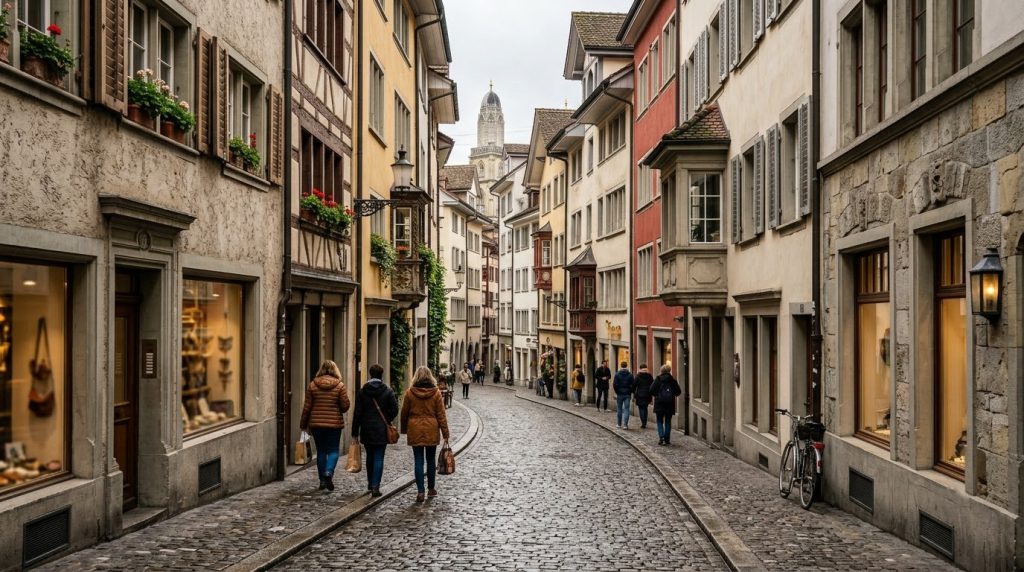
– Altstadt and Niederdorf (Kreis 1). Cobbled lanes, walkable to everything, quiet after midnight except on the Niederdorf bar strip. Best for first-timers. – Enge and Seefeld (Kreis 2 and 8). Lakeside, residential and calm.
Best for couples, families and anyone who wants to swim from a proper lake bath. – Zurich West (Kreis 5). Converted industrial area with good restaurants and nightlife. Suits younger travelers who would rather be near the action than sleep next to Langstrasse.
Compare specific properties in our best hotels in Zurich guide.
Find your Zurich hotel on the map
Live prices from Booking, Airbnb and more — move the map or change dates to compare stays across Zurich.
Frequently Asked Questions
Is it safe to walk in Zurich at night?
Yes. Central Zurich, including the Old Town and the lakefront, is safe to walk at night. The few spots that get rough after midnight on weekends are Langstrasse, the area around Zurich HB and Bellevue, which together accounted for about 29% of physical violence in 2025. Stay on main streets there and take a night bus home.
Is Langstrasse dangerous for tourists?
Not in the way a US red-light district might be. Langstrasse is Zurich’s main bar street and most visitors have a good night there. Expect open drug dealing, sex workers and drunk crowds late on weekends. Keep your phone secured, avoid empty side streets after 1 a.m. and walk away from any argument.
Is pickpocketing common in Zurich?
It is not rampant, but it happens, mainly at Zurich HB, on Bahnhofstrasse and in packed trams. Thieves look for phones on café tables and bags on luggage racks. A zipped bag worn in front and a phone kept in a front pocket solve most of the problem.
Is it safe to swim in Lake Zurich and the Limmat?
The water is clean, but it is cold and the Limmat current is strong. Swim only at official lake baths or river baths, never between Quaibrücke and Dynamo or under bridges, and never after drinking. Switzerland recorded 43 drownings in 2025, most of them in lakes and rivers.
What is the emergency number in Zurich?
Dial 117 for police, 144 for an ambulance and 118 for fire. The European number 112 also works from any phone, and 145 reaches poison control. Save these before you land and carry your travel insurance details, because Swiss hospital bills are high.