Is Positano Worth Visiting? (2026)
Disclosure: Some links in this guide are affiliate links. If you book or buy through them, we may earn a small commission at no extra cost to you — it helps keep our guides free.
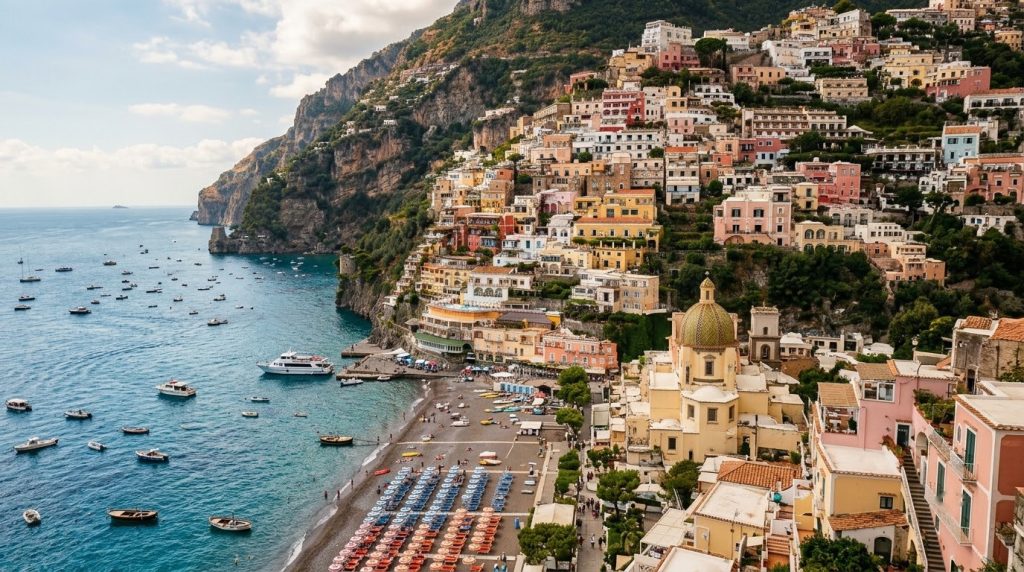
Positano is worth visiting for one or two nights once you accept the trade: a cliffside village with roughly 1,500 steps between the main road and the beach, and beach club sunbeds running USD 35-41 (EUR 30-35) a day, the highest price on the Amalfi Coast.
It stops being worth it the moment you try to see it as a rushed midday stop, because Positano only shows its real character after the estimated 15,000 daily peak-season visitors clear out on the evening ferries.
Quick verdict
| Traveller type | Worth it? | Nights to give it | Why |
|---|---|---|---|
| Couples chasing the postcard view | Yes | 2 nights | Sunset light and empty lanes only appear once the day-trip ferries leave |
| First-time Amalfi Coast visitors on a tight budget | Maybe | 1 night, or a day trip | Positano’s EUR 183 average room rate is the coast’s highest |
| Anyone with mobility limits or heavy luggage | No | 0 | 1,500+ steps and almost no hotel elevators |
| Photographers and slow travelers | Yes | 2-3 nights | The view is genuinely the best on the coast, worth the premium |
| Families with strollers or toddlers | Skip | Day trip only | No flat ground anywhere in town |
| Budget backpackers | Skip | 0 | Beach clubs and hotels both sit well above the coast average |
What Positano delivers that the photos promise
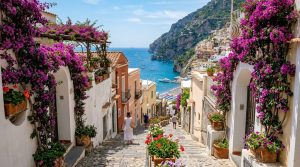
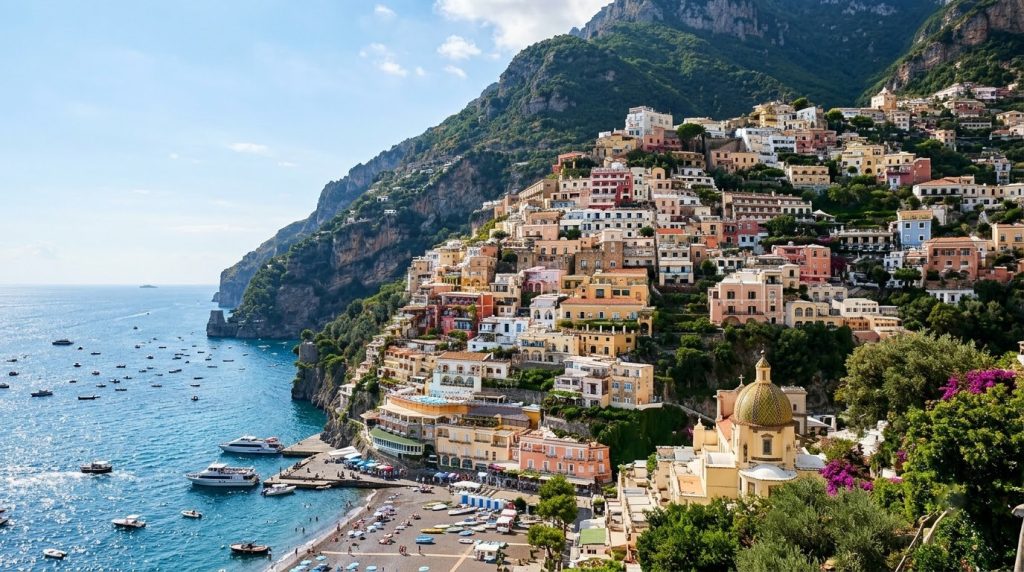
Positano earns its reputation the moment you round the coast road and see the town for the first time. Pastel houses stack vertically down the cliff face to Spiaggia Grande, and the majolica-tiled dome of the Chiesa di Santa Maria Assunta anchors nearly every photo taken from above.
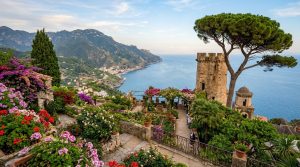
This view has no real substitute on the Amalfi Coast, since Amalfi town and Ravello sit at sea level or on a plateau rather than tumbling down a slope.
The angle changes constantly as you move through town, so the same skyline that looks flat from the water turns into a dense wall of terraces and bougainvillea once you’re climbing through it on foot. For the full layout of the town, how to get here and where the viewpoints are, see the complete Positano travel guide. The postcard is not exaggerated, and that is the entire case for going.
The stairs, honestly
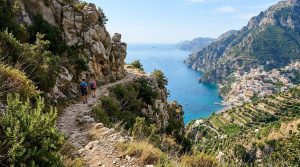
The stairs are not a minor inconvenience. They are the main obstacle to actually enjoying Positano. Over 300 separate stairways lace the cliff, and the main descent from the upper road down to Spiaggia Grande alone runs about 1,500 steps.
There is no flat street anywhere in the historic center, and taxis or the orange minibus only get you to the top or bottom of a given stairway, never door to door.
Elevators are rare enough that the Positano hotels worth checking for one are a short, named list, and everywhere else means carrying your own bags up and down the cliff.
Porter services exist for roughly USD 17 (EUR 15) per bag if your hotel does not have one, and that fee is worth budgeting for anyone bringing more than a backpack.
The historic center alone contains roughly 742 steps, and that count does not include the climb back up from the beach in the first place, so plan on the stairs being part of every single outing, not a one-time obstacle on arrival day.
A water taxi between Positano’s beaches runs about USD 6 (EUR 5) one way, and the orange minibus that loops through town costs roughly USD 3 (EUR 2.50) a ride or USD 12 (EUR 10) for a 24-hour pass, both worth knowing once the stairs have you beaten by midafternoon.
What it actually costs
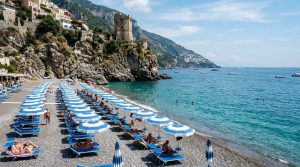
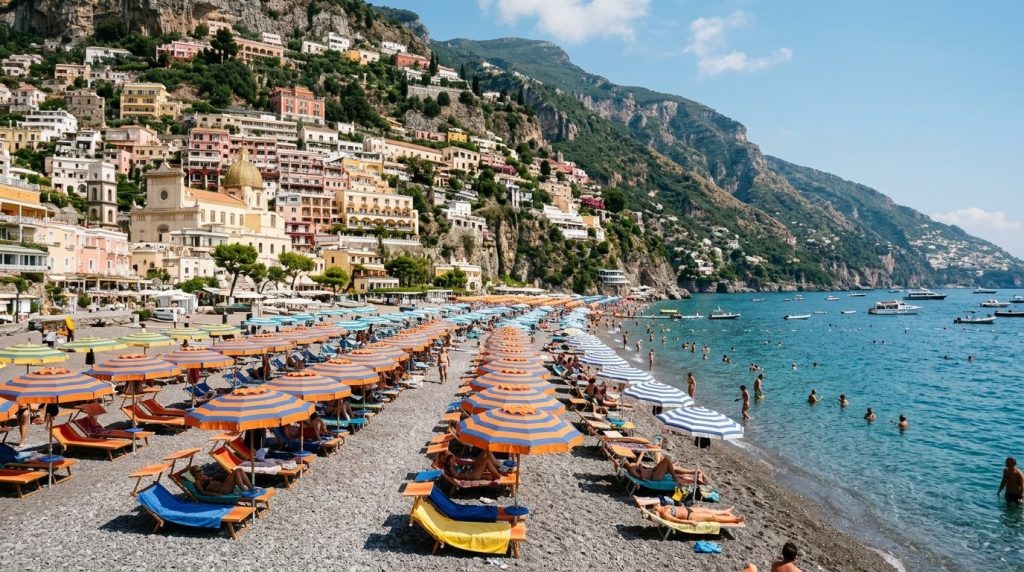
Positano is the most expensive town on the Amalfi Coast, and there is no way around that fact. A sunbed and umbrella at Spiaggia Grande, the main beach, runs USD 35-41 (EUR 30-35) a day at this week’s EUR/USD rate of 1.165, while the smaller Fornillo Beach a ten-minute walk away runs USD 23-29 (EUR 20-25).
Hotel rates follow the same pattern: budget rooms average USD 213 (EUR 183) a night, and mid-range three-star properties average USD 531 (EUR 456), both well above the Amalfi Coast norm.
The sea-view luxury tier, properties like Le Sirenuse and Il San Pietro di Positano, ranks among the priciest hotel addresses in Italy, and getting to town costs more too, since the seasonal hydrofoil from Naples runs USD 23-37 (EUR 19.50-32) for a 90-minute ride. None of this is a scam.
The land is scarce and the view is real, but it means Positano rarely functions as anyone’s budget stop on an Amalfi Coast trip.
Meals and drinks run higher too, simply because every ingredient, every bottle and every piece of furniture has to be carried up the same stairs as the guests, and that logistics cost shows up on the bill whether or not it’s stated anywhere on the menu.
Day trip or overnight, and why it changes the town
A day trip shows you the view, an overnight stay shows you the town. Visitors arriving on the early SITA bus from Sorrento, typically the 7:10 AM departure, get roughly 30 to 40 minutes in the Old Town before the crowds build, then need to leave again by around 4:00 PM to beat the return traffic.
That window covers the main viewpoints and the church, but it leaves no real time for the beach, a boat trip or an unhurried dinner.
Up to 15,000 day-trippers move through Positano on a peak summer day, arriving by bus, car and ferry within a few midday hours, and the town feels exactly as crowded as that number suggests between roughly 11:00 AM and 4:00 PM.
Staying at least two nights, the minimum the Positano itinerary recommends, buys you the town after the last ferries pull out in the early evening, when the lanes empty and Spiaggia Grande is quiet enough to actually enjoy.
Who should skip Positano
Skip Positano, or at least skip sleeping there, if the stairs or the price would make the trip miserable rather than memorable. Budget backpackers should look elsewhere first, since Amalfi town runs 15-25% cheaper for a comparable room and Sorrento has hotels from USD 70 (EUR 60) a night, both detailed in the Positano vs Amalfi Coast comparison.
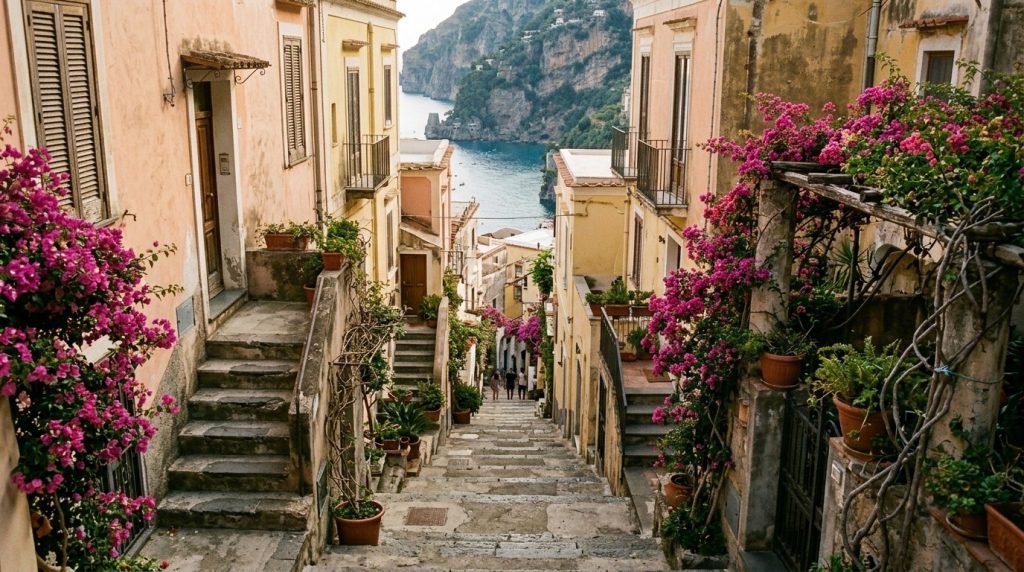
Anyone with a knee injury, a wheelchair, a stroller or simply a heavy suitcase should treat the 1,500-plus steps as a hard constraint, not an inconvenience to push through, because there is no accessible route around them.
Families traveling with toddlers face the same problem for a different reason, since there is no flat ground to let a small child walk safely and no stroller-friendly path between the road and the beach.
Travelers who want more restaurant and shopping variety after dark than a single small village offers are also better served basing themselves in a larger town and visiting Positano for the day. If none of that applies and the budget allows for it, Positano is worth the climb.
Where to stay if you decide to go
Book on or near Via Positanesi d’America or close to Spiaggia Grande if you want the flattest possible walk to the beach and dinner, since every extra block inland usually means another flight of stairs.
Find your Positano hotel on the map
Live prices from Booking, Airbnb and more — move the map or change dates to compare stays across Positano.