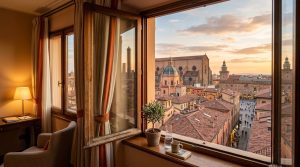
Is Bologna Worth Visiting? (2026)
Disclosure: Some links in this guide are affiliate links. If you book or buy through them, we may earn a small commission at no extra cost to you — it helps keep our guides free.
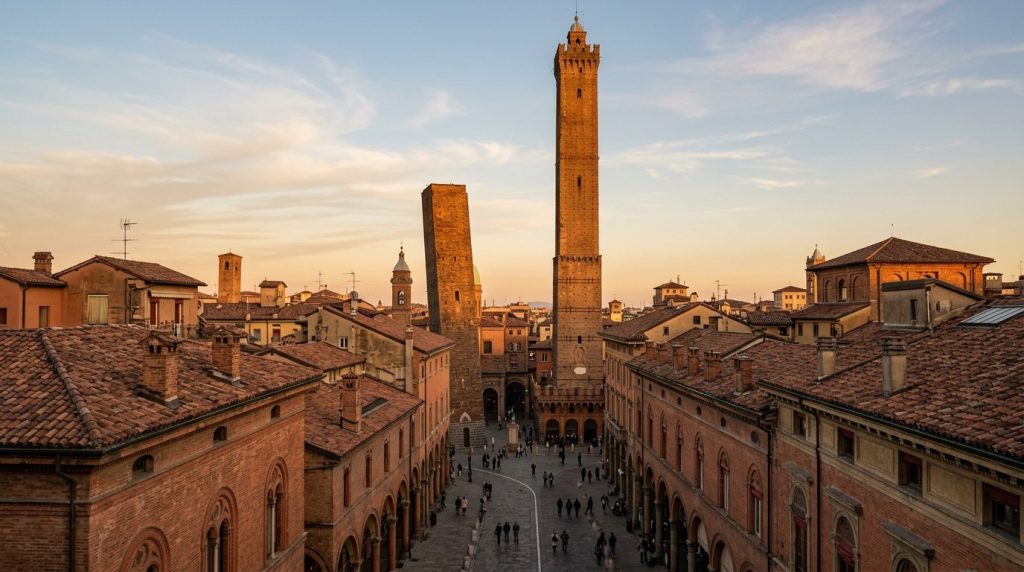
Bologna is worth visiting, and the case is a 62-kilometer network of UNESCO-listed porticoes plus a 37-minute high-speed train to Florence that makes it the most useful base in northern Italy. It is not worth visiting for travelers who need blockbuster monuments to feel satisfied, since Bologna’s sightseeing list is short next to Florence or Venice.
| Traveller type | Worth it? | Nights to give it | Why |
|---|---|---|---|
| Food-focused travelers | Yes | 2-3 nights | Tortellini, tagliatelle, and mortadella are made here, not imported |
| Rail-based Italy trip planners | Yes | 1-2 nights | 37-minute train to Florence, 75-minute train to Venice |
| First-timers with 10 days or less in Italy | Day trip only | 0 nights | Fewer headline sights than Florence or Rome |
| Beach and coastline travelers | No | 0 nights | Landlocked; the coast is a different trip |
| Monument-ticking sightseers | No | 0 nights | Two main piazzas, not a full checklist |
What Bologna has that the tourist-trail cities do not
Bologna has space that Florence and Venice ran out of years ago. The historic center holds 42 of its 62 kilometers of covered porticoes, a UNESCO World Heritage listing since 2021, and they let you walk the entire old city in a downpour without opening an umbrella.
That single feature changes how the city feels at street level: shopfronts, university students, and daily errands share the same covered lane instead of competing with tour groups for sidewalk space.
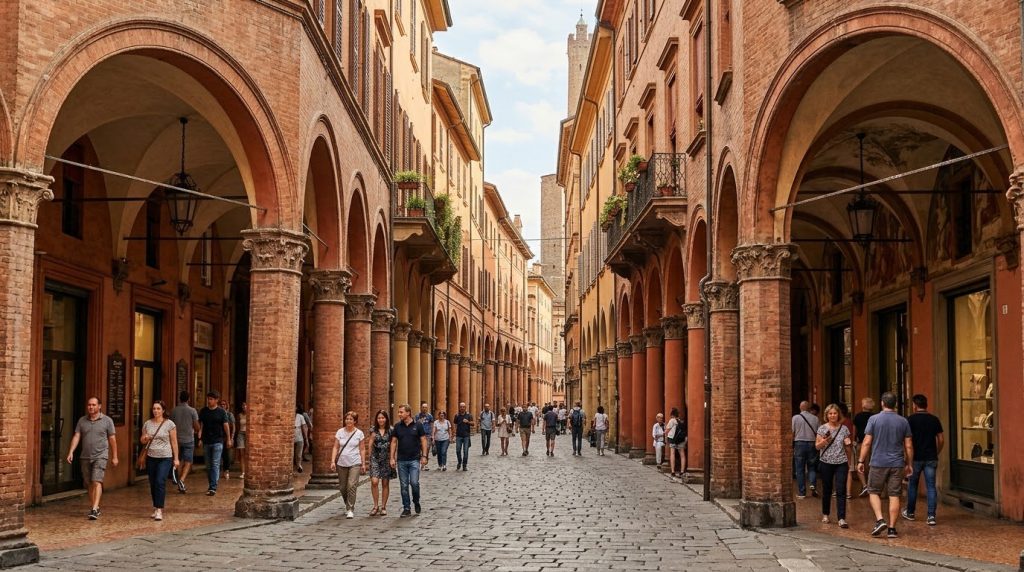
The other difference is who the city is built for. Bologna is a working university city first, home to one of Europe’s oldest universities, so restaurants, markets, and bars run on local rhythm rather than a tourist schedule, and prices reflect that.
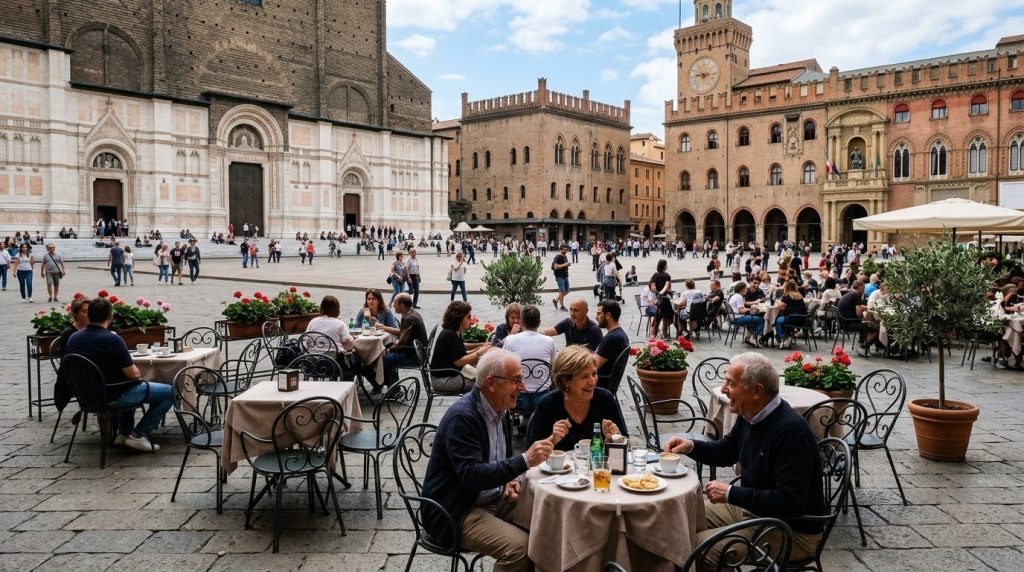
It is quieter than Florence’s Duomo crowds and less staged than Venice’s Piazza San Marco, but it is also less immediately photogenic. Piazza Maggiore fills with students and locals on weekday evenings rather than tour groups posing for photos, and the porticoes make outdoor cafe seating usable even in Bologna’s frequent rain.
What Bologna offers instead is a city that still functions as a city, porticoes included, which is precisely what gets lost once a historic center tips fully into tourism.
The food, and why it is the actual reason to come
The food is the actual reason to book the trip, not a bonus. Bologna is where tortellini in brodo, tagliatelle al ragù, and mortadella originate, and eating them here means eating the versions the exported names were copied from. Tagliatelle al ragù is the dish most travelers know abroad as “spaghetti bolognese,” a version that does not exist on menus in Bologna itself.
The Quadrilatero market district, a few streets east of Piazza Maggiore, is where this plays out daily. Butchers, cheese counters, and pasta shops supply the restaurants a block away rather than sell souvenirs, and the same stalls have been doing it for generations.
Mortadella itself is a protected product tied to the wider Emilia-Romagna region, and tasting it fresh from a Bologna counter is a different food than the pink, rubbery slices sold as “bologna” elsewhere in the world.
This is also the strongest argument against treating Bologna as a quick stopover. A single dinner does not cover it, and travelers who allow only one night usually leave having tried one restaurant instead of the range that makes the reputation.
Two or three nights lets a traveler cycle through a trattoria for tortellini in brodo, a market lunch in the Quadrilatero, and at least one aperitivo stop, which is closer to how the food scene is meant to be experienced.
The best base in northern Italy
Bologna is the best rail base in northern Italy because it sits on the country’s main high-speed line with four major cities inside a 75-minute radius. The fastest Frecciarossa and Italo services reach Florence in 37 minutes, which is closer to a subway ride than an intercity trip, and Venice in 75 minutes on the same high-speed network.
Modena and Parma are even easier, and neither requires the high-speed premium. Regional trains to Modena run three times an hour and take about 25 to 30 minutes, while Parma is a direct 48-minute ride on the faster services, or roughly 57 minutes on the slower regional options.
That combination means a traveler can sleep in Bologna and eat lunch in Parma, see the Uffizi in Florence, or ride a gondola in Venice, all as day trips, without repacking a bag.
No other city on this stretch of the high-speed line offers the same spread. Florence and Venice are both destinations in their own right, which means hotel rates run higher and evenings are built around tourists rather than residents. Bologna’s rail position turns that logic around: sleep somewhere calmer and cheaper, then spend the day where the sights actually are.
Few other Italian cities put that much on a 90-minute radius, and fewer still combine it with a food scene this good.
Where Bologna underwhelms
Bologna underwhelms travelers who came to Italy for a monument checklist. The city’s headline sights amount to two main squares, Piazza Maggiore and Piazza Santo Stefano, plus the leaning Two Towers and the climb up the Asinelli Tower. That list takes half a day, not the two or three days that Florence’s museums or Venice’s canals reasonably demand.
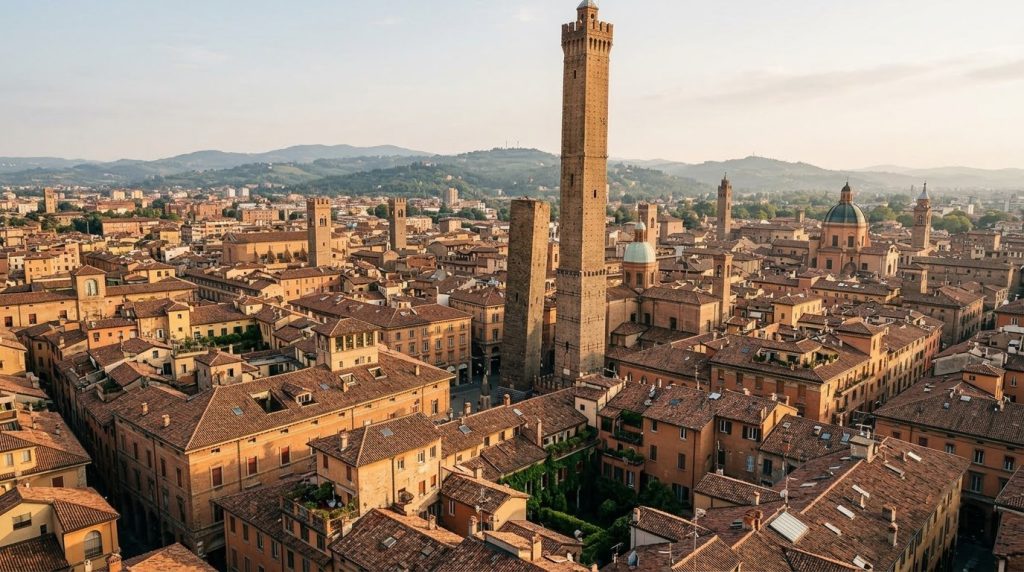
There is no equivalent to the Uffizi Gallery, no canal network, and no single sight that anchors a multi-day stay on its own. The Basilica di San Petronio and the medieval university quarter around Via Zamboni are worth an afternoon, but neither carries the weight of a full day the way Florence’s museums or Venice’s islands do.
Travelers expecting a city built around famous landmarks will run out of things to do quickly, and the porticoes and food scene, while genuinely good, will not replace that for someone counting sights rather than meals.
Who should skip Bologna
Skip Bologna if the trip is short and monument-driven, because the nights are better spent elsewhere. A first-time visitor with 10 days or less in Italy who wants the Colosseum, the Vatican, and the Forum should put those nights into a 3-day Rome itinerary instead, then treat Bologna as a same-day stop between cities if the schedule allows it.
Skip it too if the priority is coastline or village scenery over food and porticoes. Bologna is landlocked, so travelers chasing cliffside towns and sea views should build the trip around the Amalfi Coast instead, and those wanting a slower, walkable village-hopping pace should look at a Cinque Terre itinerary rather than force it into a Bologna stop.
Both regions solve a different problem than Bologna does, and neither substitutes for the other.
Best time of year to visit Bologna
Bologna runs on the same climate as the rest of the Po Valley: hot, humid summers, cold and damp winters, and wetter shoulder seasons in between. Spring brings April and May averages of roughly 57°F to 65°F (13.6°C to 18.4°C), with rainfall easing from about 75mm in April to 60mm in May as the season goes on.
Summer is the hottest and, somewhat counterintuitively, the driest stretch of the year: June averages 73°F (22.8°C), July and August both sit around 77-78°F (25.3-25.4°C), while rainfall drops to 40-55mm a month. The trade-off is that July and August in Bologna feel hot and muggy rather than pleasant, since the porticoes that shelter you from rain do nothing against heat.
Autumn is Bologna’s wettest season, not its driest. September averages 69°F (20.4°C) and October 59°F (15.1°C), but rainfall climbs to 65-70mm a month. Winter, by contrast, is colder but only moderately wet: December, January and February average between 38°F and 42°F (3.5-5.3°C), with 35-50mm of rain a month, drier than autumn even though grey skies make it feel otherwise.
| Season | Average temperature | Rainfall | Verdict |
|---|---|---|---|
| Spring (Apr-May) | 57-65°F (13.6-18.4°C) | 60-75mm/month | Good balance, increasingly sunny |
| Summer (Jun-Aug) | 73-78°F (22.8-25.4°C) | 40-55mm/month | Driest, but hot and muggy |
| Autumn (Sep-Oct) | 59-69°F (15.1-20.4°C) | 65-70mm/month | Wettest season of the year |
| Winter (Dec-Feb) | 38-42°F (3.5-5.3°C) | 35-50mm/month | Cold and dull, but fewer crowds and lower rates |
The practical answer is May or September into early October: temperatures sit in a comfortable range, and the porticoes are genuinely useful rather than essential.
One date worth building a trip around deliberately is Il Cinema Ritrovato, Bologna’s restored-film festival, which runs June 20 to 28, 2026; it fills much of the university district with cinephiles and pushes up hotel demand for that week, so book ahead if those dates overlap a visit.
December brings a different draw. Bologna’s Christmas market fills Piazza Maggiore from late November through Epiphany on January 6, running alongside a wider program of cultural events the city brands as Festivamente, and the porticoes make the market comfortable to browse even in the cold.
Pack layers rather than a single heavy coat for winter, since indoor spaces and trains run warm; for summer, light fabrics and a water bottle matter more than rain protection, since the porticoes already cover that problem.
Getting to Bologna
Bologna Guglielmo Marconi Airport (BLQ) sits a few kilometres from the historic centre, and the fastest way in is the Marconi Express monorail, which covers the route in about 7 minutes with up to 8 departures an hour between 5:40 a.m. and midnight (a shuttle bus covers the overnight gap).
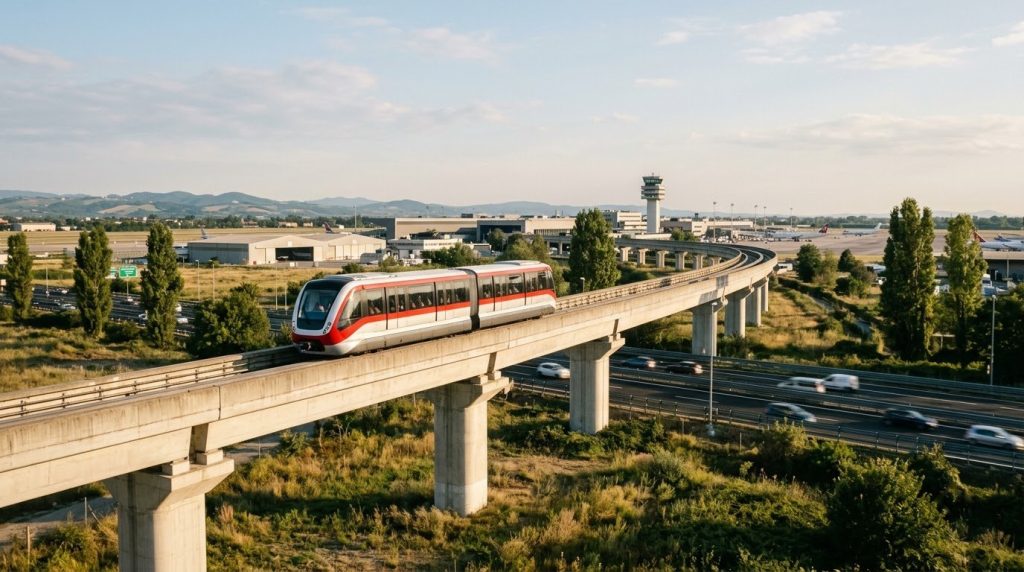
A single ticket costs USD 14 (EUR 12.80) and a return USD 26 (EUR 23.30). A taxi costs roughly USD 16-20 (EUR 15-18) on weekdays, rising toward the top of that range on public holidays and at night, and takes about 15 to 20 minutes depending on traffic.
The airport’s old direct shuttle bus to the station no longer runs; the cheapest option now is a regular city bus with one change, for the standard local fare of about USD 2 (EUR 1.50), though it takes longer than either of the other two options.
From elsewhere in Italy, Bologna’s position on the main north-south high-speed line means Milan and Rome are both comfortably reachable without a flight.
The fastest Frecciarossa and Italo trains cover Milan to Bologna in roughly 1 hour 20 minutes to 1 hour 45 minutes, and Rome to Bologna in roughly 1 hour 50 minutes to 2 hours 40 minutes depending on the specific train and station.
Both routes run multiple times an hour through the day, so there is rarely a need to book more than a few days ahead outside summer and major holidays.
Getting around once you’re there
Once in the centre, walking is the default way to get around. The porticoed core keeps most hotels, restaurants and the Quadrilatero market within a 15 to 20 minute walk of Piazza Maggiore, and the covered walkways make that distance usable in the rain.
For trips beyond walking range, Bologna’s TPER city bus network covers the wider city, and bike-share docks are scattered through the centre for anyone who prefers two wheels to the bus.
Anyone picking up a hire car for day trips should know that most of the historic centre is a ZTL, a limited traffic zone enforced by camera around the clock in its innermost pedestrian areas and from 7 a.m. to 8 p.m. elsewhere.
Driving in without authorization risks a fine of roughly USD 91-364 (EUR 83-332), reduced by about 30 percent if paid within five days.
Guests staying at a hotel inside the zone can usually get free access by giving the hotel their plate number on arrival, so it can register the vehicle with the city; the hotel will confirm which entry routes are allowed.
For a short city stay, it is simpler to park outside the ZTL, or skip the car altogether and rent one only on the day of a specific trip out of town.
Frequently asked questions about visiting Bologna
Is Bologna safe for tourists?
Yes. The U.S. State Department rates Italy as a Level 2 “Exercise Increased Caution” destination (as of 23 May 2025), the same level given to most of Western Europe, and Bologna carries no city-specific warning beyond that baseline. Normal precautions around pickpocketing in train stations and tourist areas apply, as they do in Florence, Venice or Rome.
Is Bologna cheaper than Florence or Venice?
Generally, yes. Because Bologna is a working university city rather than a tourist destination in its own right, hotel rates and restaurant prices run lower than in Florence or Venice, which is also why the sleep-in-Bologna, day-trip-to-the-sights strategy saves money as well as time.
Do I need more than a day in Bologna?
If sightseeing is the only goal, no: the two main piazzas and the Asinelli Tower climb fill half a day. Travelers who came for the food should budget at least two full nights, since a single dinner only covers one restaurant out of the range that makes Bologna’s reputation.
When should I avoid visiting?
July and August are hot and muggy rather than pleasant, and late September through October brings the wettest weather of the year. Neither makes Bologna unworkable, but both change what packing and pacing should look like.
Do I need to speak Italian to get around?
No. Bologna is a university city with a large international student population, and staff at hotels, restaurants near the centre, and the train station generally handle English well enough for booking a room, ordering food, or buying a train ticket. Learning a few basic phrases still helps outside the centre, where tourism is lighter.
Will I need cash, or do cards work everywhere?
Cards are accepted at nearly all hotels, restaurants, and the Marconi Express ticket machines, but it is worth carrying some cash for small bakeries, market stalls in the Quadrilatero, and the occasional older bus ticket machine that card readers have not reached yet.
Where to stay if you decide to go
Base near Via Indipendenza or the university district around Via Zamboni, both close enough to Piazza Maggiore and the Quadrilatero market to walk everywhere on the covered porticoes. The full breakdown of neighborhoods and specific properties is in the best hotels in Bologna guide, which covers options across budget tiers.
Find your Bologna hotel on the map
Live prices from Booking, Airbnb and more — move the map or change dates to compare stays across Bologna.