Vienna or Budapest? Which City to Pick for Your Trip (2026)
Disclosure: Some links in this guide are affiliate links. If you book or buy through them, we may earn a small commission at no extra cost to you — it helps keep our guides free.
You can only do one city, since its thermal baths have no equal.
See hotels in Budapest →Imperial palaces, classical music and old coffeehouses are the point of your trip.
See hotels in Vienna →
Pick Budapest if you can only do one city: a 24-hour transit pass costs USD 8.40 versus USD 11.50 in Vienna, and its thermal baths have no real equal anywhere in Central Europe. Pick Vienna instead if imperial palaces, classical music and old coffeehouses are the point of the trip.
Better still, do both, because the direct train between them takes roughly 2 hours 40 minutes. Prices below are converted at USD 1 = EUR 0.89 = HUF 327.
| Factor | Budapest | Vienna |
|---|---|---|
| Currency | Hungarian forint (HUF) | Euro (EUR) |
| 24-hour transit pass | USD 8.40 (HUF 2,750) | USD 11.50 (EUR 10.20) |
| Signature experience | Thermal baths, Danube views | Palaces, opera, coffeehouses |
| Big-ticket sight | Széchenyi Bath, USD 40–45 | Schönbrunn Palace, USD 47 |
| Nonstop from the US | Seasonal, Philadelphia only | Year-round from several hubs |
| US State Dept level | Level 1 | Level 1 |
| Best for | Budget travelers, couples, nightlife | First-timers, culture lovers, families |
The short verdict by traveler type
– First-timers in Europe: Vienna. It is tidier, easier to navigate, and the fastest way to see the Habsburg grand style in one place. – Couples: Budapest, narrowly. The Danube embankments at night, a soak at Széchenyi and lower restaurant bills make for a better romantic three days. – Families with kids: Vienna.
Children under six ride transit free, and under-15s ride free on Sundays, public holidays and during Vienna school holidays. Add Schönbrunn’s grounds and the Prater. – Budget travelers: Budapest, clearly. Transit, baths and food all cost less, and you do not lose quality doing it. – Nightlife and groups: Budapest. The ruin bars of District VII have no Vienna counterpart.
If Prague is also on your shortlist, our Budapest vs Prague comparison covers the other side of the triangle.
Thermal baths vs coffeehouses: the real difference
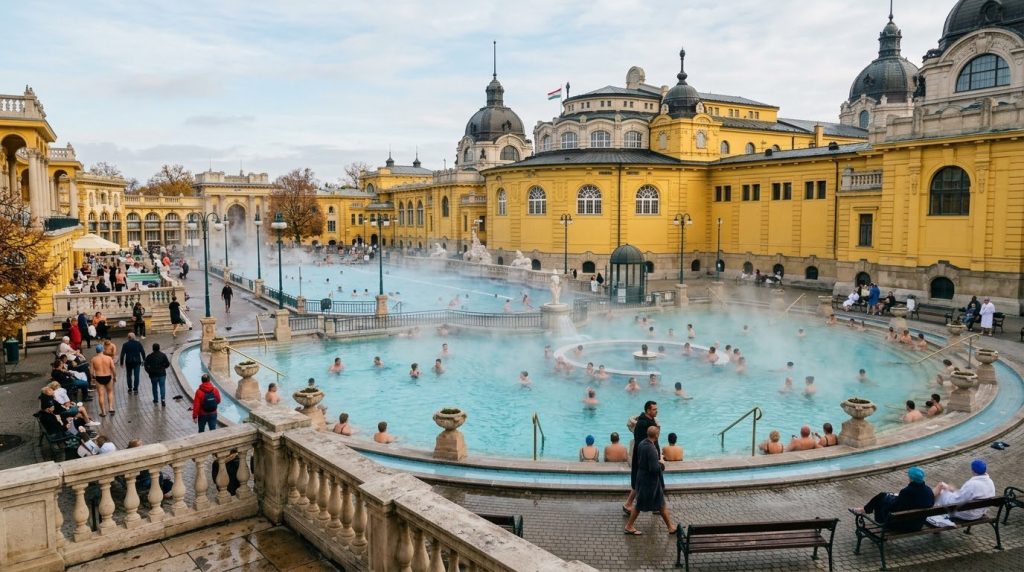
Budapest’s baths are a legacy of the Ottoman era, and Vienna has nothing comparable in the city center. Széchenyi in City Park is the one to book. Its indoor pools run from 30 to 38 degrees Celsius, and a daily ticket with locker costs HUF 13,200 (USD 40) Monday to Thursday and HUF 14,800 (USD 45) Friday to Sunday.
The “Good morning Budapest” ticket, valid for entry before 9 a.m., is HUF 10,500 (USD 32) on weekdays, and it also gets you in before the crowds. One warning: the famous Gellért Bath closed on October 1, 2025 for renovation, with reopening planned for 2028, so ignore any older blog post that sends you there.
Vienna has a modern spa, Therme Wien on the city’s southern edge, where online day tickets start around EUR 34 (USD 38). It feels like a leisure center, not a 19th-century bathhouse.
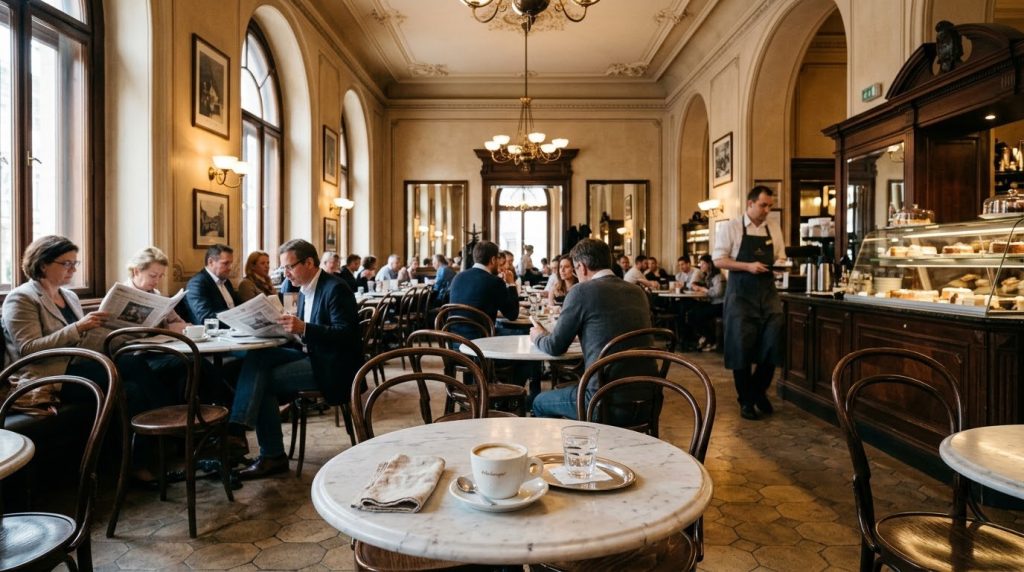
Vienna’s answer is the coffeehouse. Viennese cafe culture survived intact, while Budapest’s grand cafes were nationalized under Communism and today mostly serve tourists. Plan around one closure: Café Central, the most famous name, shut on March 16, 2026 for a full renovation, and its own website gives a reopening of winter 2026. Until then it points guests to its sister location, Decentral, at Freyung 3.
Cost: how much cheaper Budapest really is
Budapest is cheaper on almost every line you will spend money on.
– Transit: a Budapest single ticket is HUF 500 (USD 1.50), and HUF 700 if bought from the driver. The 72-hour travelcard is HUF 5,750 (USD 17.60).
In Vienna a single ride is EUR 3.20 (USD 3.60) and the 24-hour pass EUR 10.20 (USD 11.50). – Airport: Budapest’s 100E airport express bus is HUF 2,500 (USD 7.60) to the center. – Top sights: Schönbrunn’s Palace Ticket, covering the state rooms and the private apartments of Franz Joseph and Elisabeth, costs EUR 42 (USD 47) for adults.
Hungary uses the forint, not the euro. Pay by card in forints and decline “dynamic currency conversion” on card terminals. If you are pricing a three-city loop, our Prague on a budget breakdown gives you the third column.
Sights and atmosphere: grand vs dramatic
Vienna is the richer city and it shows. The art collections, Baroque palaces and music scene are deeper, and traditional restaurants are easier to find. It is also more bike- and pedestrian-friendly. The downside: it can feel reserved and goes quiet early.
Budapest wins on setting. The Danube splits hilly Buda from flat Pest, and the view from Buda across to Parliament is hard to beat. The trade-off is grit: some facades in District VII and VIII are crumbling, and the party crowd on weekends can be loud.
If you are still deciding between Vienna and the Czech capital instead, read our Prague vs Vienna comparison.
Getting there from the US and between the two cities
Vienna is the easier gateway. Austrian Airlines flies nonstop from New York, and other US hubs, year-round. Budapest’s only US nonstop is American Airlines’ seasonal summer flight from Philadelphia, which started May 21, 2026. Otherwise, connect through a European hub.
Between the cities, the train is the obvious choice. Railjet and EuroCity trains connect Vienna and Budapest Keleti, and booking sites list typical times between about 2 hours 25 minutes and 2 hours 55 minutes, with advance fares starting around USD 11–15. Railjet seat reservations are mandatory, so book ahead in summer. A slower regional option takes about 4 hours 15 minutes.
Both countries are in the Schengen area, so there is no border check on the train. US passport holders can visit visa-free. ETIAS, the EU’s planned travel authorization, is not yet in operation, and the EU says it will announce a start date months ahead.
How many days to give each city
Three days in each is the sweet spot. For Vienna, that covers Schönbrunn, the Hofburg, one big museum and an evening concert. For Budapest, it covers Castle Hill, Parliament, a bath morning and a Danube night walk.
With only five days total, do three in Budapest and two in Vienna. Many travelers add Prague to make a week. Our Prague travel guide helps you fit it in after Vienna, which is the logical rail order.
Food and nightlife: Budapest vs Vienna
The two cities split along the same lines as their baths and coffeehouses: Budapest is louder and cheaper after dark, Vienna is calmer and more formal.
Vienna’s classic meal is Wiener schnitzel, a breaded and fried veal or pork cutlet, served at a traditional Beisl tavern or a Heuriger wine garden on the city’s edge.
At a sit-down Beisl or Heuriger, a full schnitzel with sides typically runs USD 19 to 28 (EUR 17 to 25), and the Heuriger experience adds a carafe of the house’s own young wine, usually ordered by the liter rather than the glass.
Vienna’s nightlife leans toward wine taverns, classical concerts and late dinners rather than bars that run past midnight; the city largely winds down earlier than Budapest does.
Budapest’s food scene centers on goulash, a paprika-forward beef stew, and lángós, deep-fried dough topped with sour cream, cheese and garlic, sold from street stalls across the city, both cheaper and more casual than a Viennese sit-down meal. After dinner, District VII’s ruin bars are the main event.
At Szimpla Kert, the best known of them, drinks run roughly USD 10 to 20 (HUF 3,200 to 6,500), and the bar stays loud and crowded well past midnight most nights of the week, a contrast to how early Vienna’s streets empty out.
For a traveler choosing based on evenings alone: pick Vienna for a quieter trip built around a concert and a good dinner, and pick Budapest if a late ruin-bar night with cheaper drinks matters more than an early start the next morning.
Neither city is one-note after dark, though. Budapest also has a growing wine-bar scene built around Hungarian varietals like Fürmint and Egri Bikavér, a quieter alternative to District VII if ruin bars are not your style, and Vienna has its own late options around the Naschmarkt and the university district if you want something livelier than a Heuriger. Pick based on which city’s main character suits the trip, not the exception.
Where to stay
Budapest, District V (Belváros-Lipótváros): the best base for first-timers. You can walk to Parliament, the Chain Bridge and the Danube promenade, and it is quieter at night than District VII.
Budapest, District VII (Erzsébetváros): the old Jewish Quarter and ruin-bar district. It suits nightlife fans and groups. Light sleepers should avoid street-facing rooms on weekends.
Vienna, Innere Stadt or Neubau: stay inside the Ring (1st District) for the shortest walks to the sights, or in Neubau (7th District) for cafes, design shops and somewhat better value.
Find your Budapest hotel on the map
Live prices from Booking, Airbnb and more — move the map or change dates to compare stays across Budapest.
Frequently Asked Questions
Is Vienna or Budapest nicer?
Budapest is more dramatic, with the Danube, hills and a skyline built around Parliament. Vienna is more polished, with grander palaces, better museums and a cleaner, calmer feel. Choose Budapest for scenery, baths and nightlife, and Vienna for art, music and easy sightseeing.
Do you need more time in Vienna or Budapest?
Budapest usually needs slightly more time. Its sights spread across both banks of the Danube, and a bath visit takes half a day. Vienna’s main attractions sit close together inside the Ring. If you have five days, split them three in Budapest and two in Vienna, or give three full days to each with a week.
Is Budapest cheaper than Vienna?
Yes. Transit costs less than half as much per ride: HUF 500 (USD 1.50) for a Budapest single versus EUR 3.20 (USD 3.60) in Vienna. Food and drinks are also cheaper. Big attractions narrow the gap, though, since a Széchenyi Bath ticket runs USD 40–45, close to Schönbrunn’s USD 47 palace ticket.
How long is the train from Vienna to Budapest?
Direct Railjet and EuroCity trains take roughly 2 hours 25 minutes to 2 hours 55 minutes, arriving at Budapest Keleti. Railjet seat reservations are mandatory, and advance fares on booking sites start around USD 11–15. A slower regional train takes about 4 hours 15 minutes but needs no reservation and stops in towns like Győr.