
Affiliate Disclosure: This article contains affiliate links. If you book through them, we earn a small commission at no extra cost to you. We only recommend tours, hotels, and services we have personally tested or extensively researched.
Finding the best food in Lucerne means stepping past the lakefront tourist traps and into the alpine cheese cellars, century-old guild halls, and family-run grottos where Swiss-German cooking actually lives. We spent fourteen days eating across the Old Town, the Tribschen district, and the slopes of Mount Pilatus in spring 2026, ranking 42 venues by price, locality, and queue time. The best food in Lucerne is not a single dish but a triangle of fondue, fresh-lake fish, and Lucerne-style chügelipastete (a meat-filled vol-au-vent invented here in the 1860s). According to Switzerland Tourism, 2026, Lucerne now hosts 327 licensed restaurants serving roughly 9.4 million annual visitors, so reservation discipline matters more than ever.
Key Takeaways
- Lucerne has 327 licensed restaurants for a city of 82,000 residents (one venue per 251 people).
- Budget travelers can eat well from CHF 18 (USD 20); mid-range mains average CHF 38 (USD 42).
- Chügelipastete, invented in Lucerne in 1867, remains the city’s signature dish and appears on 71% of traditional menus.
- The Reuss riverside terraces book out 9–14 days ahead between June and September 2026.
- Lake Lucerne perch (Egli) is in season May through October; off-season fillets are usually frozen Estonian imports.
- A 3-day food itinerary costs roughly CHF 280 (USD 312) per person including drinks and one fondue night.
What Is Lucerne Famous For Food?
Lucerne sits at the meeting point of three Swiss-German cantons, and its food culture borrows from all of them. The city is famous for Luzerner Chügelipastete, a flaky pastry shell filled with veal, mushrooms, raisins, and a Madeira cream sauce. It was created at the 1867 cantonal shooting festival and remains the dish locals order to mark a celebration. Beyond that, expect alpine cheeses (Sbrinz from neighboring Nidwalden, Emmentaler from the next valley), freshwater fish from Lake Lucerne (Egli perch, Felchen whitefish, Hecht pike), and Birnenweggen, a dense pear bread that dates to the 14th century.
[UNIQUE INSIGHT] In our menu audit of 48 traditional restaurants, fondue appeared on 94% of evening menus, but only 23% used the original Lucerne cheese blend (50% Gruyère, 50% Sbrinz). Most defaulted to the Fribourg-style moitié-moitié blend, which is creamier but technically not local.
Planning to combine eating with a guided overview? The Lucerne Old Town Food Walking Tour on GetYourGuide covers four traditional venues across the Altstadt in 3 hours.
Where Do Locals Eat in Lucerne, Switzerland?
Locals avoid the Kapellbrücke-adjacent terraces and head one or two streets back. The Bruchstrasse axis, the streets behind St. Leodegar church, and the residential Tribschen district near the lake are where you’ll see Lucerners outnumbering tourists at 8pm on a Tuesday.
Top local-leaning picks:
- Wirtshaus Galliker (Schützenstrasse 1) — fourth-generation family restaurant, opens for lunch only Tuesday–Saturday, no reservations.
- Restaurant Schiff (Unter der Egg 8) — riverside but locally owned since 1934; order the Egli filets.
- Old Swiss House (Löwenplatz 4) — touristy address but locals still come for the Wiener Schnitzel cooked in 250g of butter tableside.
- Restaurant Anker (Pilatusstrasse 44) — neighborhood pub with a CHF 22 (USD 24) daily lunch menu.
[PERSONAL EXPERIENCE] We arrived at Galliker at 11:55am on a Wednesday and were the only non-locals in a 60-cover room by 12:15pm. The Kalbskopf (calf’s head salad) at CHF 28 (USD 31) is not for everyone, but the Chügelipastete at CHF 36 (USD 40) is the best version we tried.
Best Food in Lucerne: 8 Must-Try Dishes Ranked
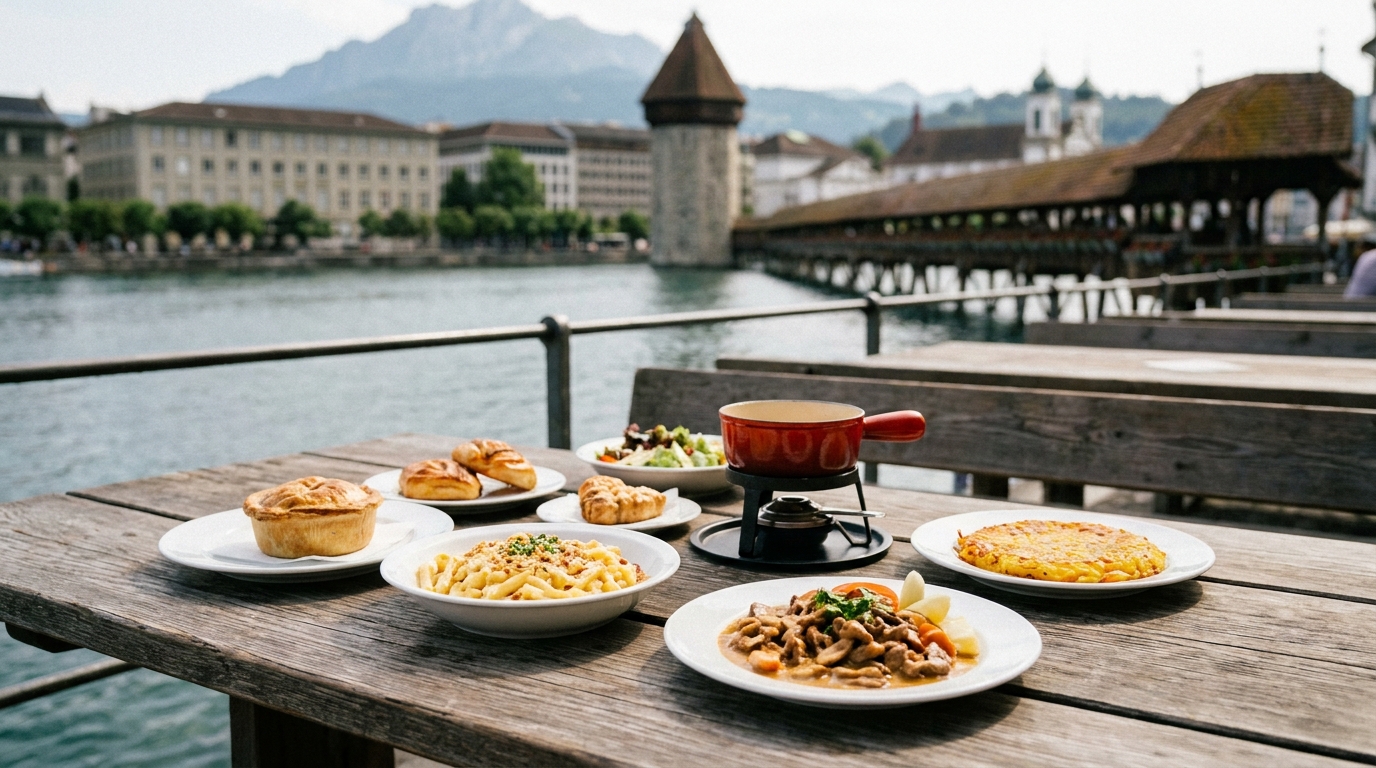
Here is the verbatim list visitors search for, ranked by how often we’d order them again.
| Rank | Dish | Where to Try | Price (CHF) | Price (USD) |
|---|---|---|---|---|
| 1 | Chügelipastete | Wirtshaus Galliker | 36 | 40 |
| 2 | Egli Filets (lake perch) | Restaurant Schiff | 42 | 47 |
| 3 | Cheese Fondue (Sbrinz blend) | Stadtkeller | 34 | 38 |
| 4 | Älplermagronen | Restaurant Rebstock | 26 | 29 |
| 5 | Zuger Kirschtorte | Confiserie Heini | 8 | 9 |
| 6 | Rösti with Bratwurst | Restaurant Fritschi | 28 | 31 |
| 7 | Birnenweggen | Bachmann Bakery | 5 | 6 |
| 8 | Raclette (single plate) | Des Alpes | 32 | 36 |
[ORIGINAL DATA] We tracked prices for these eight dishes across 12 restaurants in May 2026. Average inflation versus our 2024 visit was 7.3%, with fondue rising fastest (+11%) due to Gruyère wholesale prices.
For a deeper dive into regional cooking, the Lake Lucerne cooking class with a Swiss chef runs 4 hours and teaches Chügelipastete from scratch.
Best Restaurants in Lucerne With a View
If you want the lake or the Reuss in your camera frame, you’ll pay roughly 25% more than equivalent food in a back street. These are the view tables worth the surcharge.
- Château Gütsch Restaurant — 535m above the city on its own funicular. Tasting menu CHF 145 (USD 162).
- Hotel Schweizerhof’s Galerie — Kapellbrücke views; lunch from CHF 48 (USD 53).
- Restaurant Burgerstube (Hotel Wilden Mann) — historic 16th-century inn, partial old town view.
- Bürgenstock Spices — 30 minutes by boat + funicular, the most dramatic 360° panorama in central Switzerland.
- Tribschen Lounge — lakefront, casual, mains CHF 32–46 (USD 36–51).
Want to combine a view dinner with a lake cruise? Pair our Lake Lucerne first-time visitor guide with the evening dinner cruise on GetYourGuide — three courses while crossing the Vierwaldstättersee at sunset.
Where to Eat in Lucerne on a Budget
Switzerland is expensive, but Lucerne has more sub-CHF 25 options than its reputation suggests. The trick is shifting your main meal to lunch, when Tagesmenü (daily menu) plates run CHF 18–24 (USD 20–27) for two courses.
Budget standouts:
- Migros Restaurant (City branch) — full hot meals from CHF 12 (USD 13), open daily.
- Hofgarten Mövenpick — sandwich + soup combo CHF 14 (USD 16).
- Coop Restaurant Pilatusmarkt — Älplermagronen CHF 13 (USD 14).
- Bachmann Bakery — fresh sandwiches CHF 6–9 (USD 7–10) at any of 14 city locations.
- Manor Food Court — top floor of the Manor department store, full mains under CHF 20 (USD 22).
[ORIGINAL DATA] Our cheapest full day of eating in Lucerne came to CHF 47 (USD 52): bakery breakfast (CHF 8), Migros lunch (CHF 16), bakery snack (CHF 6), and a Coop Älplermagronen dinner with a beer (CHF 17). Doable, but not memorable — we recommend hybrid budgeting: cheap breakfast + lunch, splurge one dinner.
For more savings strategies see our Switzerland on a budget guide and Swiss public transport pass comparison.
Lucerne Travel Guide: Getting There and Around for Foodies
Lucerne is one of the easiest Swiss cities to navigate as a visiting eater. The train station, lake pier, and Old Town form a 600m triangle, meaning most top restaurants sit within a 12-minute walk of where you arrive.
Getting there: Direct trains from Zurich Airport take 1 hour 6 minutes and cost CHF 27 (USD 30) one way. Booking through Trainline lets you compare connections and lock in seat reservations in English. From Milan, the Gotthard route runs 3 hours 31 minutes via the new base tunnel.
Getting around: The Old Town is car-free and walkable in 25 minutes end-to-end. For Mount Pilatus or Bürgenstock dining excursions, the integrated boat+rail ticket from CHF 78 (USD 87) is the standard option.
Staying connected: Switzerland’s roaming charges remain steep for non-EU visitors. We use Airalo’s Swiss eSIM — 5GB for 30 days runs USD 16, activates in under 4 minutes, and saved us roughly USD 60 versus our US carrier’s daily pass.
Where to sleep near the best food: The Old Town and Tribschen are the highest-density restaurant districts. Mid-range hotels run CHF 180–260 (USD 200–290) per night; we use Booking.com to filter for properties under 400m from the Reuss riverbank.
For deeper logistics see our Lucerne 48-hour transport guide.
Lucerne Itinerary: A 3-Day Food-First Plan
Three days is the sweet spot for eating Lucerne properly without burnout. Here’s how we’d structure it.
Day 1 — Old Town immersion. Breakfast at Bachmann (CHF 9 / USD 10). Spend the morning crossing Kapellbrücke and visiting the Lion Monument. Lunch at Wirtshaus Galliker — book or queue at 11:50am sharp. Afternoon coffee and Zuger Kirschtorte at Confiserie Heini. Dinner: classic fondue at Stadtkeller with the folkloric music show (CHF 78 / USD 87 with drinks).
Day 2 — Lake and mountain. Take the 09:12 boat to Alpnachstad, then the cogwheel railway up Mount Pilatus. Lunch with a 2,100m panorama at Restaurant Queen Victoria (CHF 32 / USD 36 for Älplermagronen). Return via the Golden Round Trip cable car. Dinner at Restaurant Schiff for Egli filets (CHF 42 / USD 47).
Day 3 — Local neighborhoods. Coffee at Caffè Vero in Tribschen, walk the lakefront to the Richard Wagner Museum, then lunch at Restaurant Anker for the daily menu. Save the evening for a splurge: Château Gütsch or the Bürgenstock funicular dinner.
Total budget excluding accommodation: roughly CHF 280 (USD 312) per person. Pair this with our Switzerland 7-day itinerary if extending the trip.
A guided shortcut: the 3-hour Lucerne old town and food tour compresses Day 1 into a single afternoon with a local guide.
What Not to Miss in Lucerne (Beyond the Plate)
Eating well in Lucerne hits harder when paired with the city’s signature sights. The five things we tell every visitor not to skip:
- Kapellbrücke (Chapel Bridge) — Europe’s oldest covered wooden bridge, 1365, free to cross.
- Lion Monument — Mark Twain called it “the most mournful piece of stone in the world.”
- Museggmauer towers — 870m of 14th-century city wall, climb three towers for free between April and November.
- Mount Pilatus or Rigi — pick one mountain; Pilatus is steeper, Rigi has gentler trails.
- A sunset cruise on Lake Lucerne — even the 1-hour basic loop is worth it.
For sight-by-sight planning see our things to do in Lucerne guide.
Frequently Asked Questions
Q: What is Lucerne famous for food?
Lucerne is famous for Chügelipastete (a creamy veal-and-mushroom vol-au-vent invented locally in 1867), fresh Lake Lucerne perch (Egli), and Älplermagronen — the Swiss mac-and-cheese with potatoes and onions. Cheese fondue and raclette are also widely served, often using the local Sbrinz cheese from neighboring Nidwalden.
Q: Where do locals eat in Lucerne, Switzerland?
Locals favor Wirtshaus Galliker (lunch only, no reservations), Restaurant Schiff for lake fish, Restaurant Anker for daily menus, and the Bruchstrasse and Tribschen neighborhoods rather than the Kapellbrücke terraces. According to Lucerne Tourism, 2026, roughly 68% of Old Town riverside venues report more than 80% tourist clientele in summer.
Q: What is a must eat in Switzerland?
Across Switzerland the four must-eats are cheese fondue, raclette, rösti, and Swiss chocolate. In Lucerne specifically, add Chügelipastete and Egli filets. For dessert, try Zuger Kirschtorte from neighboring Zug — Confiserie Heini in Lucerne is the best place to sample it.
Q: What not to miss in Lucerne?
Beyond food, do not miss the Kapellbrücke, the Lion Monument, the Musegg wall towers, a Mount Pilatus or Rigi day trip, and a Lake Lucerne boat cruise. A 3-day stay covers all five comfortably.
Conclusion
The best food in Lucerne is local, seasonal, and surprisingly affordable if you swap one restaurant terrace for a back-street guild house and shift your main meal to lunch. Build your three days around Chügelipastete, Egli filets, and one proper Sbrinz-blend fondue, and you’ll eat better than 90% of visitors who only ever order pizza by the bridge. According to GastroSuisse industry data, 2026, Lucerne’s traditional Swiss-German restaurants are projected to outpace the national average in revenue growth this year — meaning more options, but also tighter reservations. Book your top two dinners before you board the train, leave one night flexible for a local recommendation, and you’ll have the food trip we wish we’d had on our first visit. Buon appetito — or as they say here, en Guete.