Best Time to Visit Galapagos in 2026: Month-by-Month Guide
Disclosure: Some links in this guide are affiliate links. If you book or buy through them, we may earn a small commission at no extra cost to you — it helps keep our guides free.
- Warm season (about Dec-May): calmer seas, warmer water, and the easiest snorkeling, with brief heavy showers and more sun.
- Cool season (about Jun-Nov): richer marine life and active wildlife, but cooler water, choppier crossings, and gray, misty skies in the highlands.
- Entry costs: plan on a national park fee of about $200 for adult non-Ecuadorians plus a $20 transit control card. Confirm both on the official site before you book.
- Cheapest months: shoulder periods such as late January to March (outside holidays) and September to early November usually cost less than July, August, and Christmas.
- Best all-rounder: many travelers pick April-May or late October-November for decent seas, thinner crowds, and good prices.
The best time to visit Galapagos depends on what you want from the trip. December to May brings warm, calm water and easy snorkeling. June to November brings cooler, nutrient-rich water and more active wildlife, but rougher seas. Animals live on the islands all year, so there is no bad month for wildlife.
The Galapagos sits on the equator, so there are no winters or summers in the usual sense. Locals talk about a warm, wetter season and a cool, drier one. Sea conditions, water temperature, crowds, and price shift between them, and those four things are what you’re really choosing between.
A common mistake is booking late June because the cooler season promises more wildlife. The snorkeling was spectacular, but the water felt chilly enough that we rented thicker wetsuits and cut one session short. The speedboat crossing between islands was also bumpier than we expected. On a second visit in spring, the water felt like a bath and the boats barely rocked. Neither trip disappointed. They were just different.
What is the best time to visit Galapagos overall?
For most travelers, the best time to visit Galapagos is the warm season from roughly December to May, especially April and May. Seas are calmer, the water is warmer, and visibility for snorkeling is often good. Sources agree wildlife is present all year, so the choice mostly comes down to comfort and budget.
If you get seasick, hate cold water, or are traveling with kids, lean toward the warm season. If your priority is seeing the most active marine life, the cool season is hard to beat. We’ve found that trying to pick a single “perfect” month only leads to frustration, because each season trades one benefit for another.
Think about the length of your trip too. A week of island-hopping by boat means more time on open water, so sea state matters more. A short stay on one island matters less.
| Season | Approx. months | Sea and weather | Water feel | Best for |
|---|---|---|---|---|
| Warm (wetter) | Dec-May | Calm seas, sunny spells, short heavy showers | Warm, comfortable | Snorkeling, families, nesting and hatching |
| Cool (drier) | Jun-Nov | Rougher seas, gray skies, highland mist | Cool, often needs a wetsuit | Marine life, whale watching, sea lion pups |
Source: national weather service and operator guidance, 2026
What is the warm season like from December to May?
The warm season runs from about December to May, with calmer seas and warmer water that make snorkeling feel effortless. Expect sunnier mornings, hotter air, and short, heavy afternoon showers rather than constant rain. Air temperatures are typically in the 80s F, and ocean water is often comfortable without a thick wetsuit.
This is the season for beach days, gentle boat rides, and hatching. Many nesting events fall here, so you may see baby tortoises, hatchling turtles, or iguanas depending on the month. Visibility can be excellent on calm days, though plankton growth can occasionally cloud the water.
Here is how the warm months break down in practice:
- December to January: festive and busy around Christmas and New Year, with higher prices and early booking needed.
- February to March: often the hottest, calmest stretch, and a good value window once the holidays are over.
- April to May: warm water and calm seas, with fewer crowds. Waved albatross return to Espanola in late March, with courtship displays through April, per one wildlife guide.
Is it hot? Yes, especially midday. Pack a rash guard and reef-safe sunscreen, since the equatorial sun is strong even on cloudy days.
What is the cool season like from June to November?
The cool season runs from about June to November. Cooler, nutrient-rich water pulls in more marine life, so wildlife can feel more active. The tradeoff is rougher seas, choppier boat crossings, and gray skies. Highland areas often get a fine mist locally called garua, which can feel surprisingly chilly.
If you plan to snorkel, rent or bring a proper wetsuit. Thin shortie suits are fine for a warm-season dip but leave many people shivering after twenty minutes in cooler water. Seasickness tablets are worth packing for any inter-island speedboat ride, which can take around two hours each way between Santa Cruz and Isabela.
Wildlife highlights during this stretch include:
- Humpback whales: reported from about July to October, peaking around August and September, per one wildlife site.
- Sea lion pups: the birthing and pup season is generally in the second half of the year, so beaches can be full of playful youngsters.
- Whale sharks: sightings are typically tied to the cooler months, mostly around the far northern islands visited by liveaboard boats.
When can you see which wildlife in Galapagos?
You can see wildlife in Galapagos every month, but certain events cluster in particular seasons. Research sources agree that the animals stay all year, and what changes is conditions. The table below pulls together the commonly cited timing, and exact dates shift from year to year, so treat every month as approximate.
| Month | Wildlife to watch for (approximate) | Sea and comfort |
|---|---|---|
| Jan | Turtle and iguana nesting activity, sea lion pups | Warm, calmer |
| Feb | Hatching begins for some species | Warm, calm, hottest |
| Mar | Waved albatross return to Espanola late in the month | Warm, calm |
| Apr | Albatross courtship, baby tortoises and turtles | Warm, calm |
| May | Blue-footed booby courtship begins to pick up | Warm, transition |
| Jun | Cooler water, active feeding | Cooling, choppier |
| Jul | Humpback whales begin to appear | Cool, rough |
| Aug | Humpback peak, sea lion pups | Cool, rough |
| Sep | Humpback peak, whale shark chances | Cool, rough |
| Oct | Whale watching tails off, quieter beaches | Cool, easing |
| Nov | Sea lion pups, thinner crowds | Cool to warming |
| Dec | Nesting season starts again | Warming, calmer |
Source: operator guidance and park wildlife notes, 2026
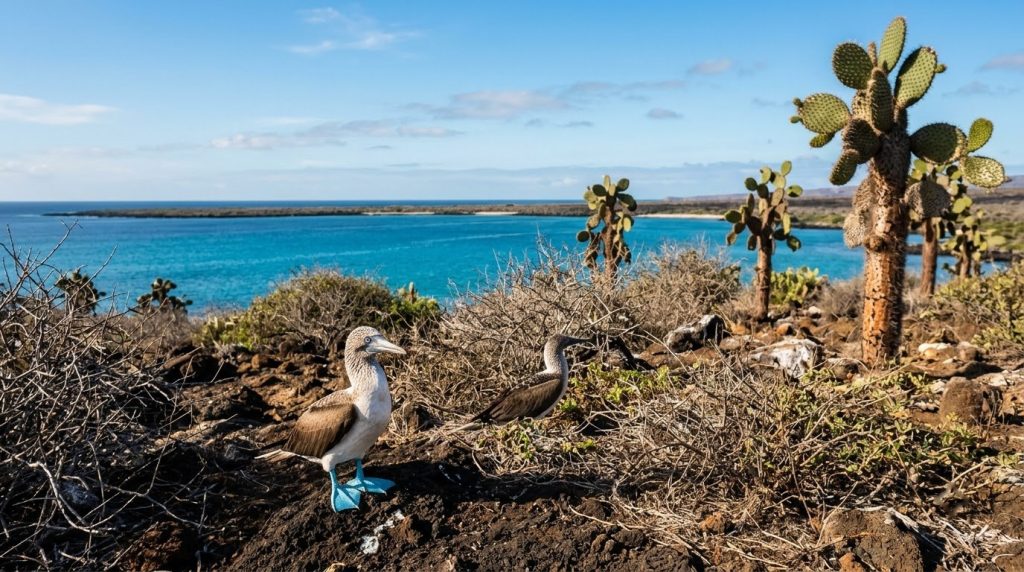
Penguins, marine iguanas, giant tortoises, flightless cormorants, and blue-footed boobies can be found year-round if you visit the right island. Our advice: pick two or three animals you’re desperate to see, then check the timing before you book. Don’t plan around a single event, because breeding timing varies with ocean conditions.
If you want help matching islands to animals, our things to do in Galapagos guide covers the main land-based sights, from the Charles Darwin Research Station to snorkeling off Isabela.
When are Galapagos crowds and prices highest?
Galapagos crowds and prices are highest during the peak travel periods: roughly mid-June through August, plus Christmas and New Year. Operators fill boats and hotels early in these windows, so you’ll pay more and have fewer choices. Prices change often, so always check current rates directly with operators.
The shoulder seasons offer the best balance. Late January to March (once holidays end), April to May, and September to early November tend to feel quieter. Fewer tourists means more room at snorkeling spots and less competition for cabins on cruises.
| Period | Crowds | Price level (approximate) | Tip |
|---|---|---|---|
| Christmas and New Year | High | Highest | Book many months ahead |
| Late Jan-Mar | Moderate | Mid | Good value after holidays |
| Apr-May | Low to moderate | Mid to low | Great weather-to-price ratio |
| Jun-Aug | High | High | Whale season, so book early |
| Sep-early Nov | Low | Low to mid | Cooler water, best deals |
Source: operator pricing patterns, 2026
One planning point many first-timers miss: boats and hotels sell out well before dates open to the public. Flexible travelers can sometimes find last-minute deals once in Puerto Ayora or Puerto Villamil, but that’s a gamble and rarely works during peak weeks.
How much does it cost to enter Galapagos?
Every non-Ecuadorian adult pays a national park entry fee to visit, and a transit control card is required at the airport. Sources such as Galapagos Conservancy and Lonely Planet cite about $200 for adults and $100 for children, paid in cash on arrival. The transit card is commonly reported at $20, bought before check-in.
Fees have changed over the years, and older pages still list lower numbers. Some recent claims about cashless payment and advance card registration also circulate, but we couldn’t verify them. Please confirm the current park fee, accepted payment methods, and transit card rules on the official Galapagos National Park site (galapagos.gob.ec) before you travel.
Budget these costs on top of flights and tours. Land-based trips are generally cheaper than cruises. Approximate operator pricing for some typical activities:
- Charles Darwin Station and tortoise highlands (Santa Cruz): tours about $40 to $85 depending on what’s included.
- Las Tintoreras snorkeling (Isabela): half-day trips around $81 to $90.
- Santa Cruz to Isabela day trips: around $199 to $260, with a speedboat ride of roughly two hours each way.
All of these are approximate and change by operator and season.
How can you save money when visiting Galapagos?
You can save the most by traveling in a shoulder season, staying on land rather than booking a cruise, and booking day tours once you arrive. Park fees and flights are fixed costs, so smart timing and style choices are where your savings come from. Here are tips that have worked for us.
- Choose land-based island hopping. Staying in town and taking day trips is usually cheaper than a multi-day boat cruise.
- Travel in September to early November or April to May. Prices tend to dip, and the weather is still decent.
- Book flights early. Flights from Quito or Guayaquil to the islands are a big expense.
- Compare tour prices in town. Several operators run similar snorkeling trips, and prices can vary.
- Bring your own snorkel gear. Rental fees add up across several days.
- Eat where locals eat. Set lunches in town cost much less than tourist restaurants.
Remember to carry some cash for the park fee, since some sources say it is cash only on arrival. Keep small bills for tips and small purchases too.
What should you pack for each season?
Pack by season rather than by month. For the warm season, bring light clothing, a rash guard, reef-safe sunscreen, a hat, and a thin wetsuit or shortie. For the cool season, add a light fleece, a rain shell, and a thicker wetsuit, since highland mist and open-water boat rides can feel cold.
Some items matter in both seasons: seasickness tablets, a dry bag, sturdy walking shoes for lava rock trails, a reusable water bottle, and a camera with a wrist strap. The islands have strict rules about not touching wildlife and not leaving anything behind, so follow your guide’s instructions closely.
If you’re still planning the rest of your Ecuador trip, remember that the mainland has its own seasons and altitude differences, so check those separately.
Find your Galapagos hotel on the map
Live prices from Booking, Airbnb and more — move the map or change dates to compare stays across Galapagos.
Frequently Asked Questions
What is the cheapest month to visit Galapagos?
There is no single cheapest month, but the lowest prices usually appear in shoulder periods. Late January to March (outside holidays), April to May, and September to early November tend to cost less than July, August, and Christmas. Always check current rates, since operators change pricing often.
Is the water warm enough to snorkel year-round?
Yes, snorkeling is possible in every month. The warm season (about December to May) has the most comfortable water, while the cool season (about June to November) is chillier and benefits from a proper wetsuit. Many snorkelers say the cooler months deliver the most active marine life.
Do I need to book Galapagos far in advance?
For Christmas, New Year, and June to August, book many months ahead, especially for boats and popular hotels. In quieter periods you may find more flexibility, but flights and cruises can still sell out. Booking early also gives you more choice of itineraries and better prices.
How much is the Galapagos national park fee in 2026?
Sources such as Galapagos Conservancy and Lonely Planet say about $200 for adult non-Ecuadorians and $100 for children, paid on arrival. A $20 transit control card is also commonly reported. Fees change, so confirm the amounts and payment rules on the official park website before traveling.
Can I see whales in Galapagos?
Humpback whales are reported from about July to October, peaking around August and September, according to one wildlife site. Whale sharks are typically seen in cooler months near the northern islands, usually from liveaboard boats. Sightings are never guaranteed, so treat them as a bonus.
Pick your season by what matters most: calm warm water, active wildlife, or the lowest price. Then double-check entry fees and card rules on the official park site, book early for peak weeks, and you’ll be set for one of the most memorable trips you can take.