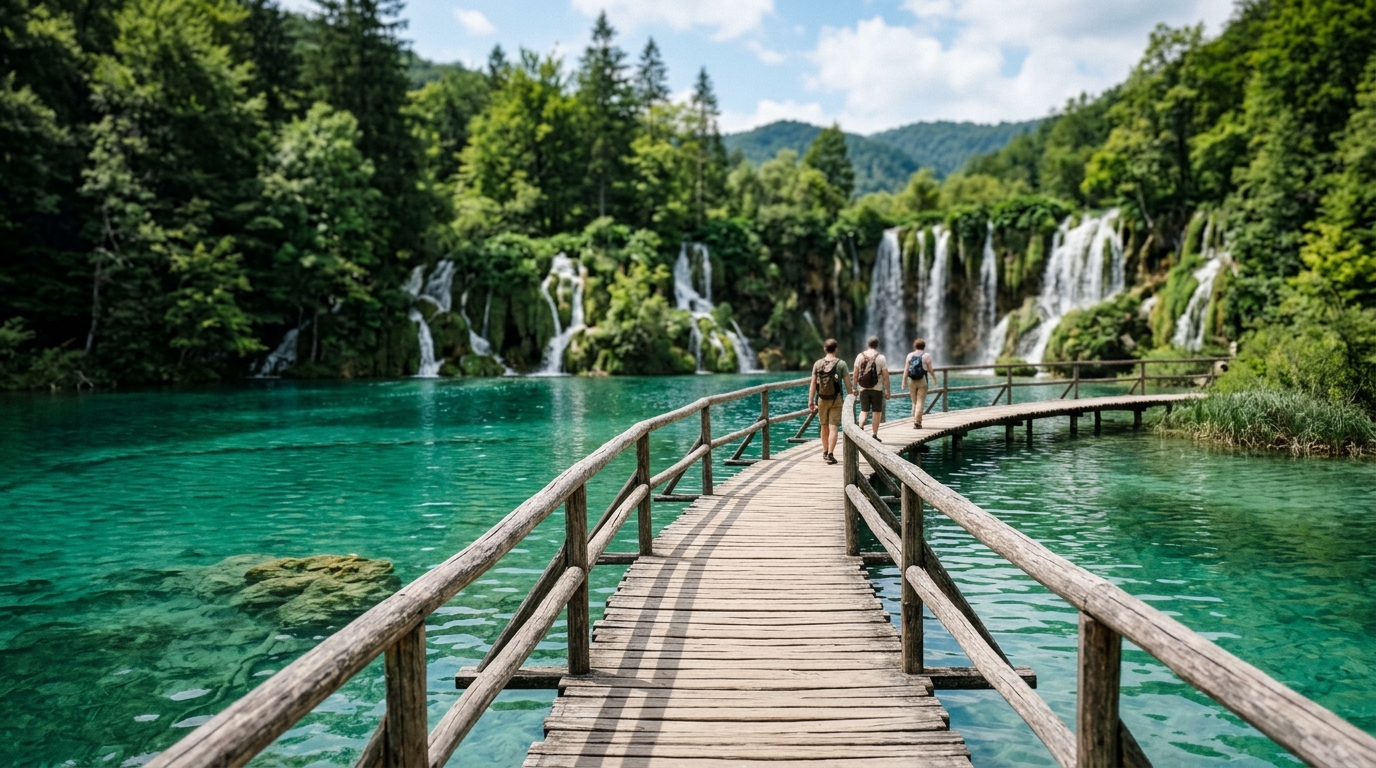
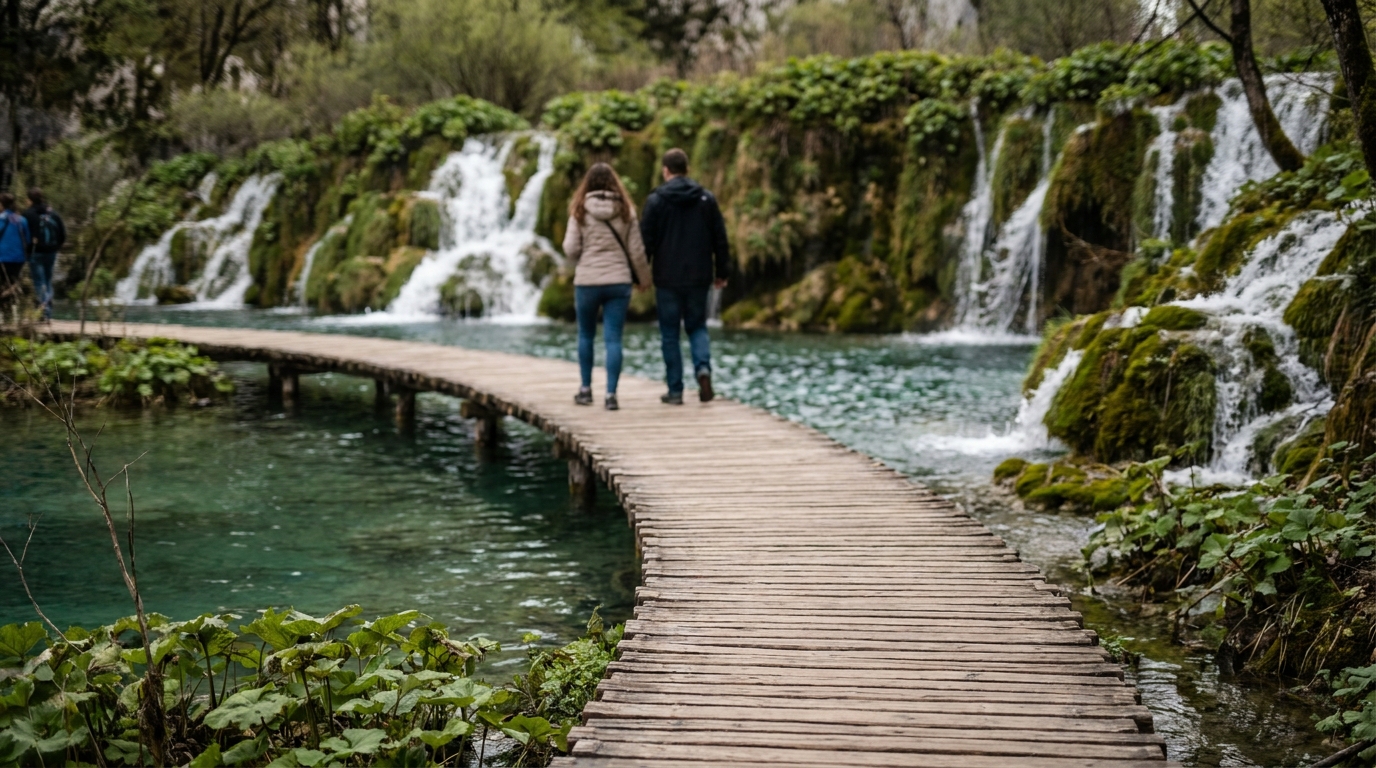
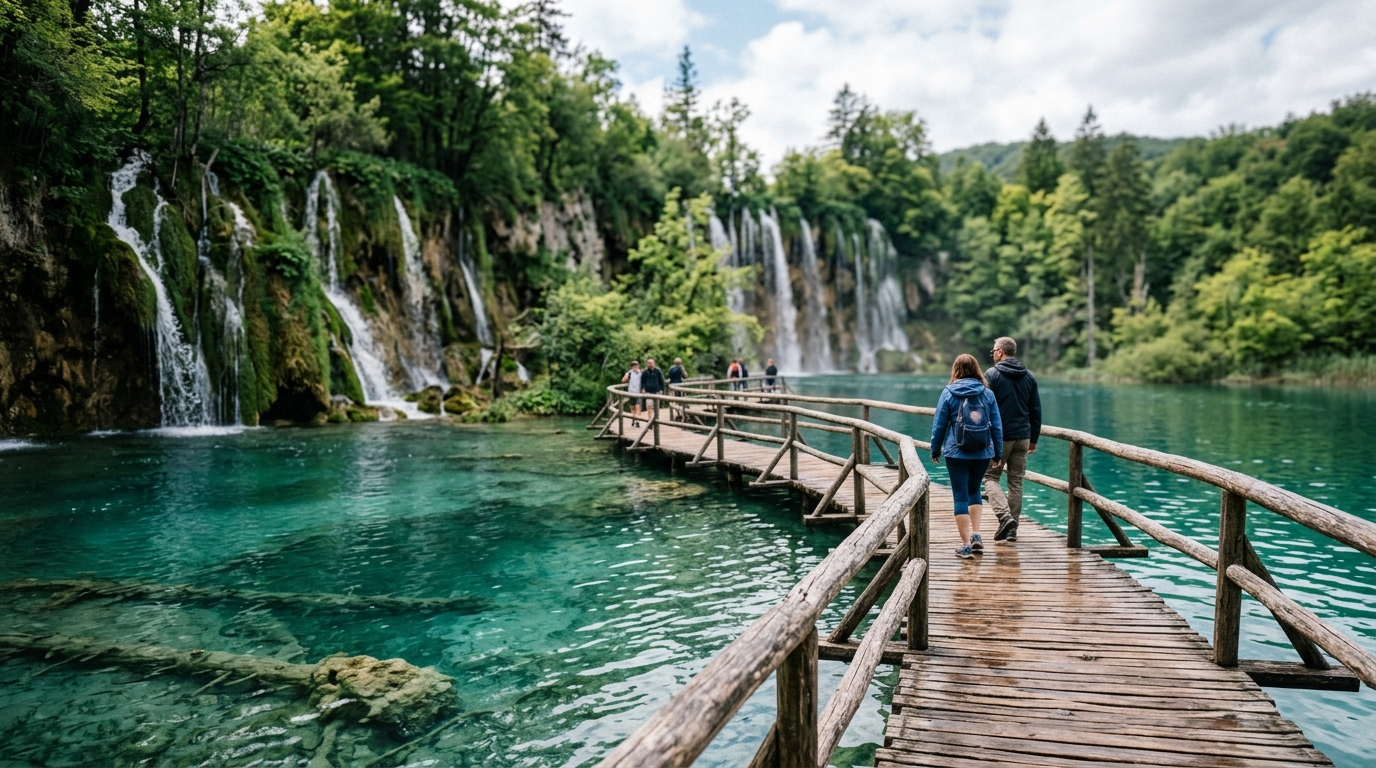
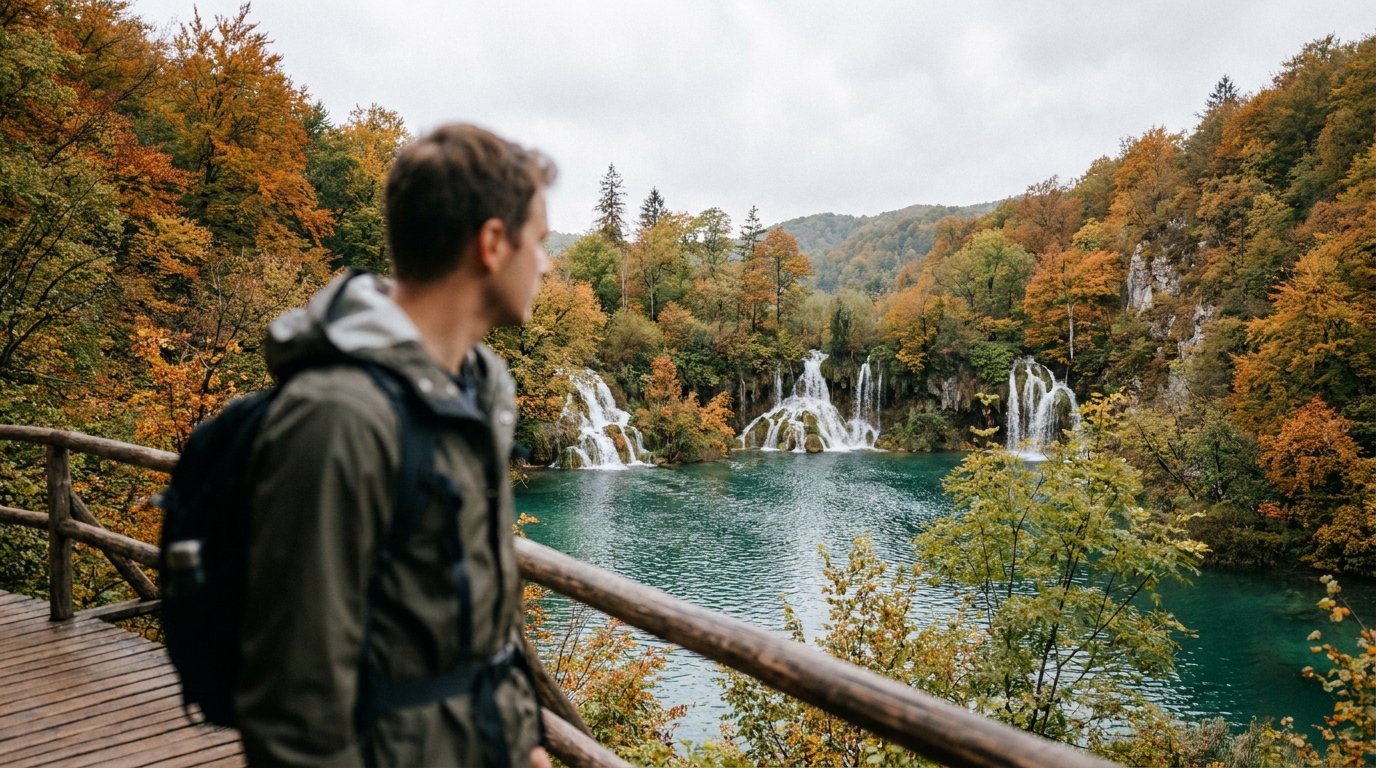
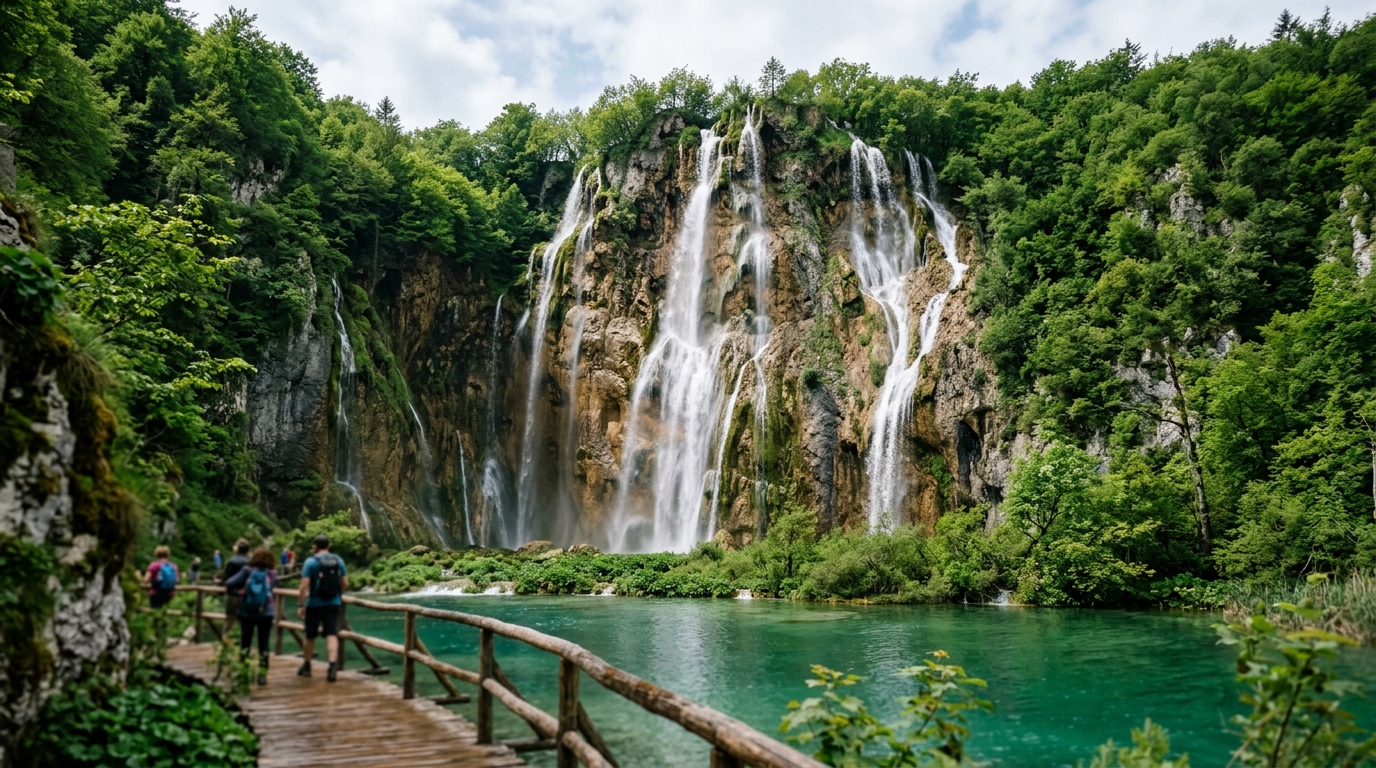
This Plitvice Lakes travel guide covers every practical detail for visiting Croatia’s most famous natural attraction. The park receives over 1.4 million visitors per year (Plitvice Lakes National Park, 2024), with daily caps of up to 40,000 during peak summer. Sixteen terraced lakes, 92 waterfalls, and a wooden boardwalk system unlike anything else in Europe make this one of UNESCO’s most visited World Heritage Sites. Plan carefully: entry sells out weeks ahead in July and August.
Key Takeaways
Plitvice Lakes has 16 interconnected lakes and 92 waterfalls; Veliki Slap at 78m is Croatia’s tallest waterfall
UNESCO World Heritage Site since 1979; receives 1.4M+ visitors per year with summer daily caps of 40,000
Best time to visit: April-June (fullest waterfalls, manageable crowds) or September-October (autumn foliage)
Route A (2-3h) and Route B (3-4h) cover both Upper and Lower Lakes; electric boat and panoramic train are free with entry
Affiliate Disclosure: This article contains affiliate links to tours, hotels, and transport services. If you book through these links, we may earn a small commission at no extra cost to you. We only recommend services we have researched thoroughly.
Plitvice Lakes Travel Guide 2026: What Makes This Park Unique
Plitvice Lakes National Park was inscribed as a UNESCO World Heritage Site in 1979, making it one of the earliest natural sites in Europe to receive that designation (UNESCO World Heritage List, 1979). The park covers 296 square kilometers of karst landscape in central Croatia. What sets it apart from other waterfall parks is the travertine: a natural calcium carbonate mineral deposited by microorganisms in the water that continuously builds new barriers, creating new lakes and waterfalls as older ones shift and change.
The travertine dams are alive in the literal sense. Cyanobacteria, algae, and mosses deposit calcium carbonate at a measurable rate, and the park’s physical shape changes slowly year by year. Barriers that existed 500 years ago still hold today; some new ones are forming now. Scientists study Plitvice not just for its biodiversity — brown bears, wolves, lynx, and over 150 bird species — but as a living model of geomorphological change. That context gives the turquoise water and wooden boardwalks a scientific depth that most visitors don’t expect.
The 16 lakes split into two zones: the Upper Lakes (Gornja Jezera) are more heavily forested with a quieter atmosphere, while the Lower Lakes (Donja Jezera) cluster around the Great Lake (Prošcansko jezero) and concentrate the most dramatic waterfalls, including Veliki Slap. Both zones connect via a system of wooden footbridges built directly over the water, with a free electric boat crossing the Great Lake and a free panoramic train running between Entrance 1 and Entrance 2.
best things to do at plitvice lakes
Which Route Should You Choose at Plitvice Lakes?
The park offers four official hiking routes, and picking the right one saves significant time and frustration. Route B at 3-4 hours covers the most ground and is the most comprehensive option for first-time visitors (Plitvice Lakes National Park official routes, 2026). Route A (2-3 hours) works well for visitors with limited time or mobility challenges, while Routes C and K suit those willing to spend a full day.
Route
Duration
Distance
Covers
Best For
Route A
2-3 hours
~3.5 km
Upper + Lower Lakes loop
First-timers, limited time
Route B
3-4 hours
~4 km
Upper + Lower Lakes, most viewpoints
Most visitors, comprehensive coverage
Route C
3-4 hours
~4 km
Upper Lakes only
Repeat visitors, quieter experience
Route K
4-6 hours
~8 km
Full park circuit
Hikers, full-day visitors
Source: Plitvice Lakes National Park official route descriptions, 2026
The electric boat crossing the Great Lake is free with entry and operates as part of all four routes. The panoramic train connecting Entrance 1 and Entrance 2 (a roughly 15-minute ride) is also free with entry. Both have queues in peak season; arrive at the boat dock early in the morning to avoid 30-minute waits.
Most visitors default to Route A and miss the Upper Lakes entirely. The Upper Lakes are calmer, less crowded, and show the forested karst landscape at its most untouched. The Lower Lakes get the majority of visitor traffic because they’re closer to Entrance 2 and the main facilities. If you have 3-4 hours available, Route B is the better choice: it covers the best of both zones without the full-day commitment of Route K.
When Is the Best Time to Visit Plitvice Lakes?
April through June is the optimal window, combining the highest water flow — and therefore the most impressive waterfall displays — with manageable visitor numbers. September and October are the second-best window, with golden foliage and significantly lower prices compared to peak summer. July and August bring daily visitor caps of up to 40,000 people and entry ticket sellouts weeks in advance (Plitvice Lakes National Park visitor statistics, 2024).
Quiet; some facilities reduce hours; dramatic winter atmosphere
Source: Plitvice Lakes National Park official pricing and visitor data, 2026
One practical note: the park enforces a strict no-swimming rule throughout the entire park, including all 16 lakes and the river sections below Veliki Slap. Rangers patrol actively and fines are issued regularly. This rule has been strictly enforced since 2015 to protect the travertine ecosystem (Croatian Ministry of Environment, 2015). Every summer, a handful of visitors are turned away or fined for ignoring the signs.
How to Get to Plitvice Lakes (Bus, Car, Day Trip)
There is no train station at or near Plitvice Lakes. The two main options are bus from Zagreb or Split, or driving your own vehicle. Bus services from both cities drop off directly at the park entrances, making them the easiest option for visitors without a car (Flixbus Croatia / Croatiabus timetables, 2026).
From Zagreb (Recommended for Most Visitors)
Regular coach services run from Zagreb Bus Station (Autobusni Kolodvor) to Plitvice Lakes Entrance 1. The journey takes approximately 2.5 hours and costs €10-15 each way. Several operators run this route including Samoborček and Autobusni Prijevoz. Buses depart roughly every 1-2 hours through the morning. Check current timetables at the Zagreb Bus Station website; schedules change seasonally.
From Split
Buses from Split Bus Station to Plitvice take approximately 4 hours and cost €15-20. The route runs through Karlovac and follows the A1 motorway north. Fewer departures are available compared to the Zagreb route, so book in advance during summer. Some travelers combine Split with a stop at Plitvice en route to Zagreb, treating it as a one-way transit point.
Driving and Parking
Both Entrance 1 (Upper Lakes side) and Entrance 2 (Lower Lakes side) have parking areas at set hourly rates. Entrance 2 is the most popular starting point since it’s closer to the Lower Lakes and Veliki Slap. Arrive by 7:30am in July and August; the car parks fill before 9am at peak. Navigation apps route correctly to both entrances — use “NP Plitvicka Jezera Ulaz 1” or “Ulaz 2” as search terms.
Plitvice Lakes Entry Costs and What’s Included
Entry prices vary by season and include the electric boat, panoramic train, and use of all marked hiking routes. Prices for 2026 are €10 in low season (January-March, November-December), €23 in shoulder season, and €40 at peak (June-August) (Plitvice Lakes National Park ticket pricing, 2026). Children under 7 enter free; reduced rates apply for ages 7-18 and seniors.
Booking online in advance is strongly recommended from April onward. The official booking portal is the only reliable source; third-party resellers add fees without adding value. For visitors who want a guided experience — particularly useful for understanding the travertine science and wildlife habitats — guided tours from Zagreb and Split are worth considering.
A full day at the park typically costs €50-80 per person all-in: entry ticket (€23-40), food from the park cafeteria (€10-15 for a simple meal), and transport from Zagreb or Split (€20-30 return). Accommodation in nearby villages adds €40-80 per night for a private room.
Where to Stay Near Plitvice Lakes
Accommodation options near Plitvice fall into three categories: inside the park itself, in the surrounding villages of Mukinje and Rastovaca, or in more distant towns like Karlovac. Hotel Jezero sits within the park boundary and is the most convenient option, priced at €120-180 per night in summer (Booking.com rate averages, May 2026) — but it books out 3 or more months ahead for July and August.
Option
Distance to Park
Price/Night
Best For
Hotel Jezero (inside park)
0 km
€120-180
Convenience; book 3+ months ahead for summer
Private rooms, Mukinje village
1-2 km
€40-70
Budget; local guesthouses; easy park access
Private rooms, Rastovaca village
2-3 km
€40-80
Quieter; slight drive to park entrance
Hotels, Karlovac town
~60 km (1h)
€50-90
Budget fallback; broader choice; day-trip basis
Hotels, Slunj village
~30 km
€40-60
Small town; reasonable drive; Rastoke waterfalls nearby
Source: Booking.com rate averages, May 2026
Staying in Mukinje or Rastovaca puts you within walking distance of the park entrances and costs a fraction of Hotel Jezero. Private sobe (rooms) operators in both villages are easy to find on Booking.com. Staying overnight gives you the chance to enter at opening time (7am in summer) before coach groups arrive — the single biggest quality improvement you can make to the visit.
The park is a genuine wildlife habitat, not a groomed garden. Brown bears and wolves are present in the surrounding forest and occasional sightings near the park perimeter are documented. This doesn’t make the park unsafe — the bears are shy and avoid the busy central boardwalk zones — but it does mean the forest sections of Routes C and K feel genuinely wild rather than theme-park curated. That wildness, combined with the silence of the Upper Lakes in the early morning, is what separates Plitvice from its tourist-saturated reputation.
Practical Tips for First-Time Visitors
These points address the most common planning mistakes at Plitvice. plitvice lakes itinerary
1. Book tickets online before you go. From April through October, especially in June, July, and August, tickets sell out. The official portal at np-plitvicka-jezera.hr sells timed-entry slots. Don’t rely on buying at the gate.
2. Arrive at opening time. The park opens at 7am in summer. Arriving at 7am gives you 2 hours before the first coach groups from Zagreb and Split arrive around 9-10am. The difference in experience is enormous.
3. No swimming, no exceptions. The no-swimming rule applies to every body of water in the park. Rangers enforce it actively. The travertine ecosystem is why the water is turquoise; swimming destroys it.
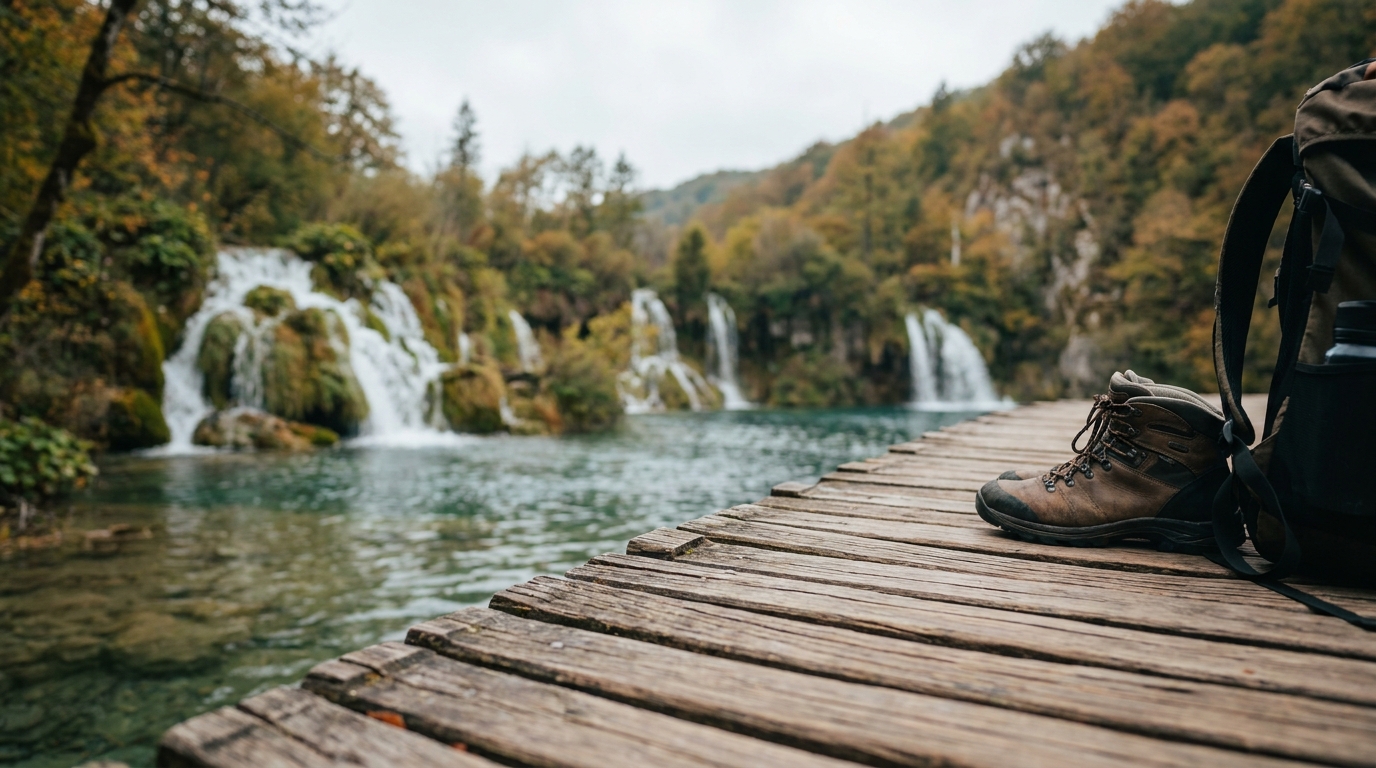
4. Wear non-slip footwear. The wooden boardwalks become slippery when wet. Flip-flops cause injuries every summer. Trail shoes or waterproof walking shoes are the right choice.
5. Carry your own water and snacks. The park cafeteria near Entrance 2 serves food, but prices are elevated and queues are long in summer. Packing lunch cuts both cost and waiting time.
6. Entrance 2 is the busier starting point. Most visitors enter at Entrance 2 (closer to Lower Lakes and Veliki Slap). Starting at Entrance 1 and doing the Upper Lakes first means going against the main tourist flow — a quieter experience for the first two hours.
7. Get a Croatia eSIM before you arrive. The park has patchy mobile coverage in the forest sections. Download offline maps via Maps.me or Google Maps before entering. If you need data connectivity, a Croatian eSIM works reliably in the main zones.
8. Allow for the boat queue. The free electric boat crosses the Great Lake but has limited capacity. In July and August, waits of 20-30 minutes are common. Build this into your route timing.
9. Wheelchair accessibility is partial. Some sections near the Lower Lakes are wheelchair-accessible, but the wooden boardwalks include inclines and steps. The park’s accessibility map (available on the official site) identifies which sections are suitable.
10. Check the weather. The park is enjoyable in light rain — the waterfalls intensify and crowds thin. But heavy rain makes the boardwalks dangerously slippery. Check the forecast the evening before and adjust your start time accordingly.
Plitvice Lakes Travel Guide: Final Verdict
Plitvice Lakes earns its UNESCO status and its reputation as Croatia’s most spectacular natural attraction. The combination of turquoise travertine water, 92 waterfalls, wooden boardwalks built directly over the lakes, and a genuinely wild forest habitat creates an experience unlike anything else in Europe. But it requires preparation: online ticket booking, early arrival, and realistic route planning.
Visit in April, May, or September for the best balance of water levels, crowd management, and weather. Stay overnight in Mukinje to enter at 7am. Choose Route B for the most complete experience in 3-4 hours. Done correctly, Plitvice Lakes is among the finest single-day natural experiences Europe offers.
Route A takes 2-3 hours and covers both Upper and Lower Lakes. Route B, the most popular option, runs 3-4 hours. Factor in 30 minutes for the boat crossing and train ride, plus queue time in peak season. Most visitors spend 4-5 hours total. An overnight stay in Mukinje or Rastovaca allows for a 7am start and a full day without the rush.
Is Plitvice Lakes worth the high summer price of €40?
Yes, for most visitors. The park contains 16 terraced lakes, 92 waterfalls including the 78m Veliki Slap, and a wildlife-rich forest that includes brown bears and wolves (Plitvice Lakes National Park, 2024). The electric boat and panoramic train are included. The experience is genuinely world-class. The price concern is legitimate for budget travelers, who should consider a shoulder-season visit at €23 for essentially the same experience.
Can you swim in Plitvice Lakes?
No. Swimming has been prohibited throughout the entire park since 2015 and the ban is strictly enforced by rangers (Croatian Ministry of Environment, 2015). This applies to all 16 lakes, the river below Veliki Slap, and all other water bodies within park boundaries. The rule protects the travertine-depositing microorganisms that create the park’s distinctive turquoise color. Violators face fines.
What is the best route at Plitvice Lakes for first-timers?
Route B (3-4 hours) is the most comprehensive option and covers the highlights of both the Upper and Lower Lakes. Route A (2-3 hours) is a good alternative if time is limited. Both routes use the free electric boat and panoramic train. The key difference is that Route B includes more of the Upper Lakes and additional waterfall viewpoints that Route A skips.
How do you get from Zagreb to Plitvice Lakes?
Regular coach services run from Zagreb Bus Station to the park entrances, taking approximately 2.5 hours and costing €10-15 each way. Buses depart roughly every 1-2 hours through the morning. No train service runs to the park. Guided day trips from Zagreb include transport and are a practical option for visitors who want to avoid navigating the bus schedule independently. See Book Plitvice Lakes tours from Zagreb on GetYourGuide.
This Plitvice Lakes travel guide was researched and written in May 2026. Prices and schedules are subject to change; verify with official sources before booking.