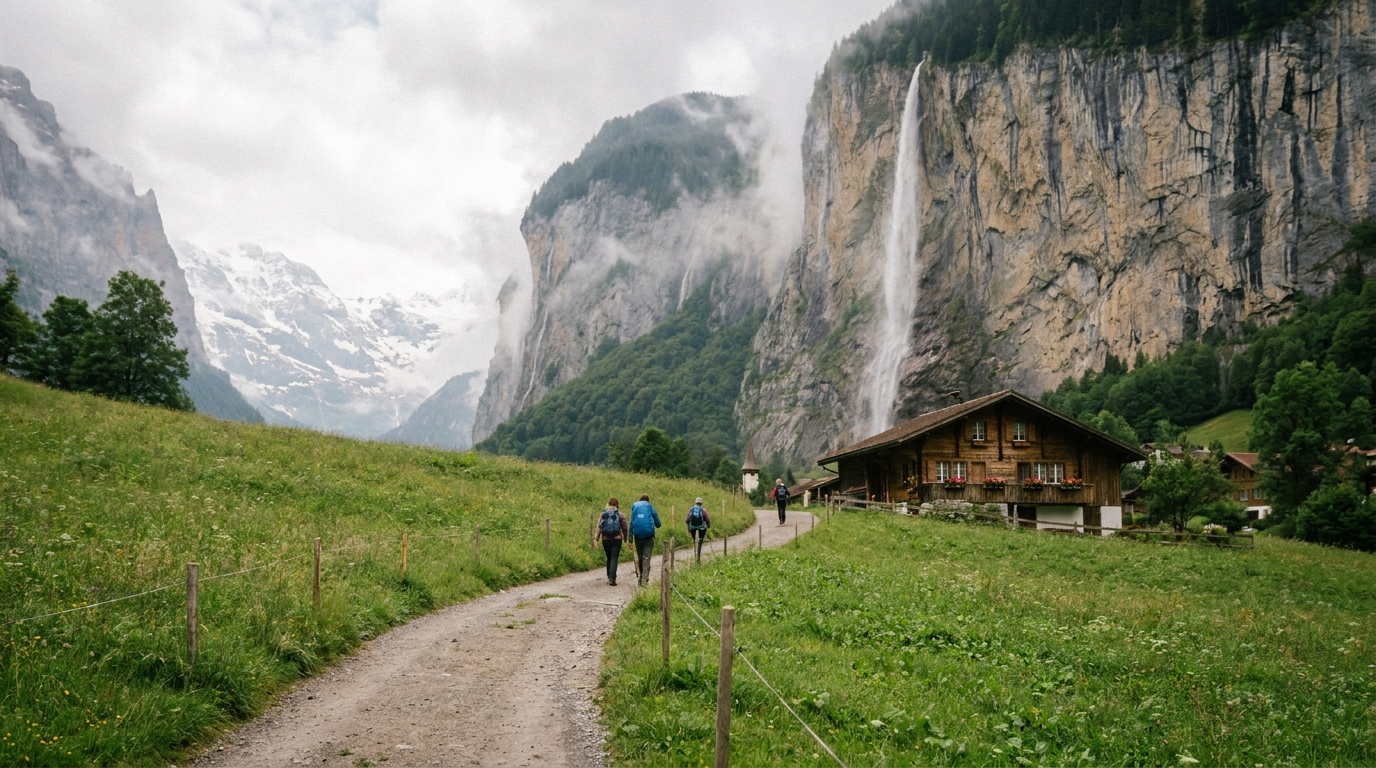
This Lauterbrunnen travel guide covers the full picture for visiting the Swiss Alps’ most dramatic valley. The valley holds 72 waterfalls within a 5-kilometer stretch, and Staubbach Falls drops a free-falling 297 meters directly above the village (Swiss Tourism, 2025). From there, the Jungfraujoch railway ascends to 3,454 meters, the highest train station in Europe. Plan carefully: Switzerland is one of the world’s most expensive destinations, and Lauterbrunnen’s logistics require specific preparation.
Key Takeaways
Lauterbrunnen valley contains 72 waterfalls; Staubbach Falls (297m) is free and visible directly from the village
Jungfraujoch train reaches 3,454m — the highest station in Europe — at CHF 215 round trip from Grindelwald (Jungfrau Railway, 2026)
Trümmelbach Falls costs CHF 11 adult and shows 10 glacier waterfalls carved inside the mountain
Best hiking is June-September; ski season runs December-April in the Jungfrau ski region
Budget CHF 120-180/day backpacker, CHF 200-300/day mid-range; Switzerland is expensive
Affiliate Disclosure: This article contains affiliate links to tours, hotels, and transport services. If you book through these links, we may earn a small commission at no extra cost to you. We only recommend services we have researched thoroughly.
Lauterbrunnen Travel Guide 2026: Why This Valley Stops People in Their Tracks
Lauterbrunnen sits in a glacially carved U-shaped valley in the Swiss Bernese Oberland, and 72 separate waterfalls cascade down its sheer cliff walls (Swiss Tourism, 2025). The valley is part of the UNESCO Jungfrau-Aletsch World Heritage Region, the first Alpine area inscribed on the UNESCO list in 2001 (UNESCO World Heritage List, 2001). That designation reflects the region’s extraordinary concentration of glaciers, peaks, and natural phenomena within a compact, accessible area.
What makes Lauterbrunnen genuinely different from other Alpine valleys is the density of the experience. The village sits at 800 meters altitude. Staubbach Falls drops free-fall right above the main street. Jungfraujoch ascends to 3,454 meters within 2 hours by train. Two completely car-free mountain villages — Wengen and Mürren — perch above the valley walls, each accessible from the valley floor in under 20 minutes. Very few places in Europe pack this range of altitude, scenery, and activity into such a small geographic zone.
The valley sees approximately 1 million visitor arrivals per year, with the highest concentration from late June through August (Berner Oberland Tourismus, 2025). Unlike Hallstatt, Lauterbrunnen is large enough to absorb visitor volume without feeling claustrophobic. The bigger pressure point is rail capacity on the Jungfraujoch line and accommodation pricing across the valley.
[INTERNAL-LINK: best things to do in lauterbrunnen -> /best-things-to-do-in-lauterbrunnen/]
How to Get to Lauterbrunnen (Train from Zurich, Interlaken)
Lauterbrunnen has no car access to the village center and is genuinely best reached by train. From Zurich, the journey takes approximately 2 hours via Interlaken Ost on the InterCity express, then a 20-minute regional train to Lauterbrunnen station. The full route is covered by the Swiss Travel Pass, which pays for itself on a trip combining Jungfraujoch and multiple regional trains (SBB Swiss Federal Railways, 2026).
From Zurich
Take the direct InterCity train from Zurich HB to Interlaken Ost. Trains run every hour and the journey is 1 hour 55 minutes to 2 hours 10 minutes depending on the connection. At Interlaken Ost, change to the Berner Oberland Bahn (BOB) regional train for Lauterbrunnen. This final leg takes 20 minutes. Total door-to-station time from Zurich city center is around 2.5 hours.
From Interlaken
Interlaken Ost is the main hub. The BOB regional train to Lauterbrunnen runs every 30 minutes and takes 20 minutes. Book Swiss train tickets on Trainline or buy through SBB’s website for the best pricing on InterCity connections. The Swiss Travel Pass (from CHF 244 for 3 days) covers all regional Bernese Oberland trains except the Jungfraujoch summit portion.
Driving and Parking
Private cars must park at the large paid car park at the valley entrance (approximately CHF 15/day). The village center and road toward Staubbach Falls are pedestrian and train access only. From the car park, the station and village are a 3-minute walk.
[IMAGE: Staubbach Falls Lauterbrunnen Switzerland village waterfall — search: staubbach falls lauterbrunnen village switzerland]
What to Do in Lauterbrunnen: The Essential Experiences
The valley organizes neatly into three tiers of activity: free village-level sights, paid mid-range excursions (CHF 10-100), and the high-cost summit experience at Jungfraujoch (CHF 215). Combining all three over two or three days gives the full Bernese Oberland experience. Book Jungfraujoch tours on GetYourGuide
Staubbach Falls (Free)
At 297 meters, Staubbach Falls is one of the highest free-falling waterfalls in Europe (Swiss Tourism, 2025). It falls directly behind the village and is visible from anywhere on the main street. A short marked path leads to a viewpoint and a cave behind the lower section of the falls. Allow 30 minutes. The falls run strongest from May through September when snowmelt from the upper plateau peaks.
Trümmelbach Falls (CHF 11)
Trümmelbach is the most technically impressive waterfall experience in the valley, and it’s underrated relative to Jungfraujoch. Ten glacier waterfalls — fed by meltwater from the Eiger, Mönch, and Jungfrau glaciers — thunder through a series of corkscrew gorges carved entirely inside the mountain. An internal lift carries visitors up through the rock. At peak flow, up to 20,000 liters of water pass through per second (Trümmelbach Falls official site, 2026). Entry is CHF 11 adult; the site is 2.5 km from Lauterbrunnen village on the valley path.
Jungfraujoch “Top of Europe” (CHF 215)
The Jungfraujoch railway is the headline experience and the most expensive. The round trip from Grindelwald (reached via the Wengen line from Lauterbrunnen) costs CHF 215 per adult (Jungfrau Railway, 2026). Swiss Travel Pass holders receive a 25% discount. The summit at 3,454 meters holds a research station, the Sphinx Observatory, the Jungfrau Plateau glacier, and the Ice Palace carved into the glacier itself. Allow a full day: travel up takes 1.5 hours from Lauterbrunnen, and altitude adjustment at the summit takes 30 to 60 minutes. Book online in advance, particularly July-August when trains sell out 2 to 3 days ahead. Book Jungfraujoch tours on GetYourGuide
Wengen and Mürren (Car-Free Mountain Villages)
Both villages are car-free and offer dramatically different perspectives on the valley. Wengen sits at 1,274 meters on the eastern valley wall, reached by cog railway from Lauterbrunnen (10 minutes, CHF 9 each way). Mürren at 1,638 meters on the western wall requires a cable car from Grütschalp, then a narrow-gauge train (total 30 minutes, CHF 13 each way). Mürren in particular feels genuinely remote: no cars, direct Eiger views, and access to the Schilthorn cable car above.
Schilthorn/Piz Gloria (CHF 100)
The Schilthorn summit at 2,970 meters is famous as the James Bond filming location from “On Her Majesty’s Secret Service” (1969). The revolving Piz Gloria restaurant sits at the summit. The round trip cable car from Mürren costs approximately CHF 100 per adult (Schilthorn Cableway, 2026). The 360-degree panorama takes in over 200 Alpine peaks. Combined with Mürren, this is a full day excursion.
Paragliding (CHF 170-220)
Tandem paragliding launches from the cliffs above Lauterbrunnen, with flights lasting 15 to 30 minutes over the valley floor. Airtime Paragliding and Paragliding Jungfrau both operate from the valley, charging CHF 170 to 220 per tandem flight depending on duration and launch altitude. No experience is needed. Flights run daily between May and October, weather permitting. Book paragliding on GetYourGuide
Skiing (December-April)
The Jungfrau ski region links Grindelwald, Wengen, and Mürren into one of Switzerland’s largest ski areas, with 213 km of marked runs (Jungfrau Ski Region, 2026). Season runs December through April. Lauterbrunnen itself is the valley base connecting all three ski villages. A one-day ski pass for the full region costs approximately CHF 85 adult.
Best Time to Visit Lauterbrunnen
June through September is the prime hiking and sightseeing window, with long days, open trails, and all mountain infrastructure operating. Staubbach and Trümmelbach Falls run at peak volume through July. July and August bring the most visitors but the valley handles crowds better than smaller Alpine destinations.
Month
Crowd Level
Avg High (C)
Best For
Jan-Mar
Low-Medium
0-5
Skiing; Jungfrau ski region in full operation
Apr-May
Low-Medium
8-14
Shoulder season; waterfalls peak from snowmelt; fewer crowds
Jun
Medium
16-20
Best balance: all trails open, manageable visitor numbers
Jul-Aug
High
21-25
Peak season; all attractions open; Jungfraujoch books ahead
Sep-Oct
Medium-Low
14-18
Excellent second window; autumn color from late September
Nov-Dec
Low
1-5
Quiet; ski season begins December; some cable cars closed Nov
Source: Berner Oberland Tourismus and Swiss Tourism, 2026
May is a strong shoulder choice: Trümmelbach and Staubbach are running hard from snowmelt, hiking trails below 2,000 meters are open, and accommodation prices are 20-30% lower than peak. October brings alpine autumn foliage and near-empty trails above Wengen and Mürren.
[IMAGE: Jungfraujoch Top of Europe train station snow alpine 3454m — search: jungfraujoch top of europe snow alps switzerland]
Lauterbrunnen Travel Costs: Budget by Tier
Switzerland is consistently ranked among the world’s five most expensive countries for travelers. Lauterbrunnen adds the Jungfraujoch premium on top of already high Swiss baseline costs. Budget planning is non-negotiable here.
Budget Tier
Daily Spend (CHF)
Accommodation
Meals
Backpacker
CHF 120-180/day
Camping CHF 30-50 or hostel dorm
Self-catered + 1 pub meal
Mid-Range
CHF 200-300/day
Hotel CHF 100-220/night
2 restaurant meals; main day trip included
Comfort
CHF 300-450/day
Mountain hotel CHF 200-300
All meals out; Jungfraujoch + one activity
Luxury
CHF 450+/day
Boutique/Wengen hotel CHF 300+
Fine dining; private guides; no compromises
Source: Booking.com rate averages and SBB fare data, May 2026
Key Activity Costs at a Glance
Staubbach Falls: free
Trümmelbach Falls: CHF 11 adult
Jungfraujoch round trip from Grindelwald: CHF 215 (25% off with Swiss Travel Pass)
Schilthorn/Piz Gloria round trip from Mürren: approximately CHF 100
Tandem paragliding: CHF 170-220
Ski day pass Jungfrau region: approximately CHF 85
A restaurant lunch in the valley runs CHF 20-35 per person. Coop and Migros supermarkets in Interlaken provide the most cost-effective grocery options before arriving; Lauterbrunnen’s single village shop carries limited stock at premium prices.
Where to Stay in Lauterbrunnen
The valley has accommodation at multiple price points, from camping by the river to mountain hotels in Wengen and Mürren above. Book July-August stays 2 to 3 months in advance; the best-value properties fill quickly. Search Lauterbrunnen hotels on Booking.com
Budget Options
Camping Jungfrau sits at the edge of the village, directly below Staubbach Falls, and costs CHF 30-50 per night for a tent pitch. It is consistently rated one of Europe’s best-located campsites. Facilities include hot showers, a kitchen block, and a small shop. Hotel Staubach in the village center runs CHF 100-150 per night for double rooms and is one of the most affordable hotels in the valley with en-suite options.
Mid-Range Options
Hotel Silberhorn at CHF 150-220 per night offers traditional Swiss decor, valley views, and a restaurant serving Swiss classics. It sits a 3-minute walk from the train station. For the mountain village experience at mid-range prices, several guesthouses in Wengen charge CHF 130-180 per night and include breakfast.
Staying in Mürren instead of Lauterbrunnen valley shifts the entire dynamic of the trip. Mürren has no cars, no through-traffic, and direct views of the Eiger north face from the main street. The price premium over valley-floor options is roughly CHF 40-60 per night, but the experience — waking above the clouds with Jungfrau visible from the bedroom — is categorically different. For a one-night splurge, Mürren justifies it.
[IMAGE: Murren car-free village Switzerland Eiger Jungfrau mountain views — search: murren switzerland mountain village eiger view]
Day Trips from Lauterbrunnen
Lauterbrunnen’s position in the Bernese Oberland makes it an effective base for the region’s most visited destinations.
Grindelwald (30 minutes by train via Wengen or Kleine Scheidegg): gateway village for the Eiger north face; First Mountain cable car; Grindelwald Glacier Gorge
Interlaken (20 minutes by train): the region’s main town; shopping; lake cruises on Thunersee and Brienzersee; adventure sports hub
Wengen (10 minutes by cog railway): car-free village; skiing; summer hiking; access point for Kleine Scheidegg and Jungfraujoch route
Mürren (30 minutes via cable car and train from Lauterbrunnen): Schilthorn access; ski runs; summer via ferrata routes; quieter than Wengen
Iseltwald (45 minutes by bus via Interlaken): small lakeside village on Brienzersee; viral cliff-side jetty viewpoint
Practical Tips for Visiting Lauterbrunnen
These points address the most common planning mistakes for first-time visitors to the valley.
1. Book Jungfraujoch in advance. July-August trains sell out 2 to 3 days ahead. Book on jungfrau.ch the moment your dates are confirmed. The “Good Morning” ticket (first trains, return before 1pm) costs less and avoids peak-time crowds at the summit.
2. Get an eSIM before arriving. Switzerland is not in the EU, so roaming charges apply for EU SIM cards. Get Europe eSIM on Airalo for a Switzerland-compatible data plan before departure.
3. Swiss Travel Pass math. A 3-day Swiss Travel Pass costs CHF 244 and covers all regional BOB/WAB trains, the boat from Interlaken, and Trümmelbach Falls (free with pass). It does not cover the Jungfraujoch summit surcharge (CHF 160 after pass discount) or Schilthorn. Run the numbers against your planned activities before buying.
4. Check summit weather. The Jungfraujoch plateau regularly sits in cloud below the summit. Check the Jungfrau Railway webcam the morning of your trip. Clear mornings in the valley often mean clear summits; the weather can shift rapidly by noon.
5. Pack for altitude difference. The valley floor at 800m may be 20C in July. Jungfraujoch at 3,454m will be -5C to -10C with wind. Bring a proper insulating layer, gloves, and sunglasses for any summit trip regardless of season.
6. Trümmelbach is worth the detour. Many visitors skip it for Jungfraujoch. That is a mistake. At CHF 11, Trümmelbach offers a completely different and viscerally impressive waterfall experience that no summit view replaces.
7. Carry some cash. Card acceptance is high in Switzerland but some mountain huts, trail-side kiosks, and smaller accommodation providers prefer cash. The ATM in Lauterbrunnen village is the last reliable cash point before going up to Wengen or Mürren.
8. Walk the valley path. The 5-km flat path from Lauterbrunnen south to Trümmelbach and Stechelberg passes under multiple waterfalls, through meadows, and along the river. It is free, takes 1.5 to 2 hours one way, and is one of the best low-effort experiences in the entire valley.
Lauterbrunnen Travel Guide: Final Verdict
Lauterbrunnen delivers. The combination of 72 waterfalls, a free-climbing 297-meter cascade above the village street, and the world’s highest train station 90 minutes away by rail is genuinely unmatched in Europe. Switzerland’s cost is real, and the Jungfraujoch line is expensive. But the valley itself — the path walk, Trümmelbach, Staubbach at dusk — costs almost nothing.
Go in June or September for the best weather-to-crowd ratio. Book Jungfraujoch early. Stay at least two nights to get Wengen or Mürren into the itinerary alongside the valley floor. Done with that foundation, Lauterbrunnen ranks among the finest Alpine destinations on the continent.
For accommodation options with current pricing and availability, see the Lauterbrunnen hotels guide. For a structured day-by-day plan covering Jungfraujoch timing, Trümmelbach, and the mountain villages, see the Lauterbrunnen itinerary.
Frequently Asked Questions
How many days do you need in Lauterbrunnen?
Two to three days covers the valley well. Day one: Staubbach Falls, valley walk to Trümmelbach (CHF 11), Wengen for sunset. Day two: Jungfraujoch full day (CHF 215). Day three: Mürren and Schilthorn (CHF 100) or paragliding (CHF 170-220). One night works for a focused Jungfraujoch-only trip from Zurich, but you miss the mountain villages.
Is Lauterbrunnen worth the cost?
Yes, with realistic expectations about Switzerland’s prices. The valley itself is largely free — Staubbach, the path walk, and Wengen are low-cost. Jungfraujoch is expensive at CHF 215 but is a genuinely unique experience. Budget CHF 200-300/day mid-range and you’ll cover the major experiences without compromise. The Swiss Travel Pass reduces rail costs significantly if you’re combining multiple destinations.
What is the best way to visit Lauterbrunnen from Zurich?
Direct InterCity train from Zurich HB to Interlaken Ost (2 hours), then BOB regional train to Lauterbrunnen (20 minutes). Total journey approximately 2.5 hours. The Swiss Travel Pass covers both legs. Book Swiss train tickets on Trainline for InterCity reservations, or use SBB.ch for same-day regional connections.
Can you drive to Lauterbrunnen?
You can drive to the valley entrance, where a large paid car park (approximately CHF 15/day) sits near the station. The village center and road toward the falls are pedestrian-only. For day visitors arriving by car, parking at Interlaken and taking the 20-minute train is often more convenient than navigating the valley car park in peak season.
When is Lauterbrunnen best for waterfalls?
May through July, when snowmelt from the Eiger, Mönch, and Jungfrau glaciers is at maximum volume. Trümmelbach Falls runs at up to 20,000 liters per second during peak melt (Trümmelbach Falls official site, 2026). Staubbach Falls is strongest May through August. By October, flows are reduced but still impressive. Winter visits see frozen waterfall formations on some of the smaller falls.
This Lauterbrunnen travel guide was researched and written in May 2026. Prices and schedules are subject to change; verify with official sources before booking.