Tulum vs Playa del Carmen: Which Riviera Maya Base Wins? (2026)
Disclosure: Some links in this guide are affiliate links. If you book or buy through them, we may earn a small commission at no extra cost to you — it helps keep our guides free.
You want an easy airport transfer and cheaper hotels nearby.
See hotels in Playa del Carmen →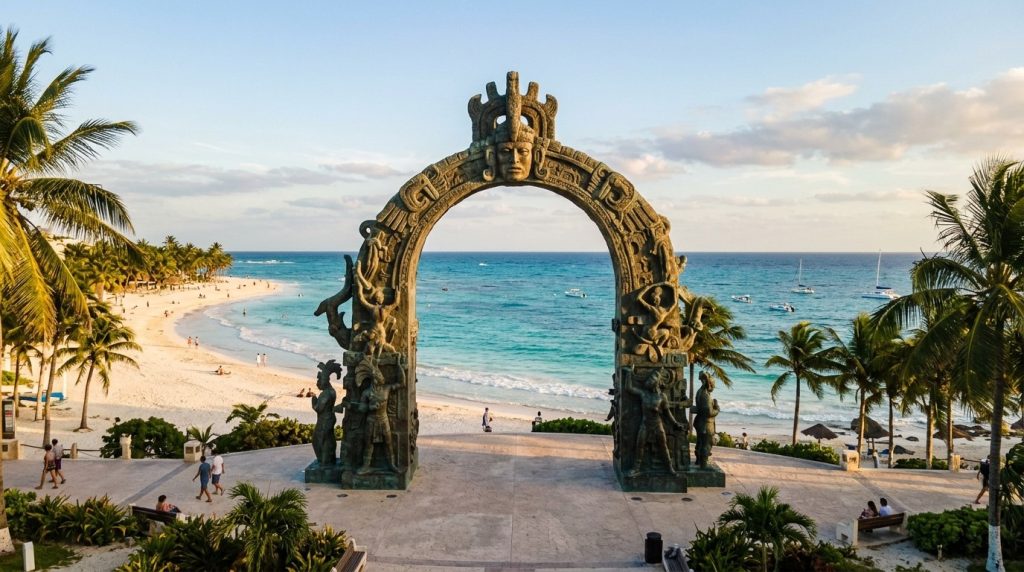
Playa del Carmen wins for most first-timers, families and budget travelers because it sits about 1 hour from Cancun airport and its mid-range hotels run USD 110–180 a night versus USD 180–320 in Tulum. Tulum wins for couples who want boutique stays, the clifftop Maya ruins and cenotes within about 25 km (15 miles).
The two towns are only 60–65 km (37–40 miles) apart on Highway 307, so you can base in one and day-trip the other.
| Factor | Playa del Carmen | Tulum |
|---|---|---|
| Vibe | Walkable beach town built around 5th Avenue | Spread-out town plus a separate beach-and-jungle strip |
| Mid-range hotel | USD 110–180 a night | USD 180–320 a night |
| Dinner for two (local spot) | USD 25–40 | USD 40–70 |
| Nearest airport | Cancun (CUN), about 1 hr | Tulum (TQO) or Cancun, about 1.5 hrs |
| Cenotes and ruins | Day trips | On the doorstep |
| Nightlife | Bars and clubs most nights | Beach-club parties, fewer options |
| Best for | First-timers, families, budget, nightlife | Couples, wellness, cenote divers |
How the two towns feel on the ground
Playa del Carmen is a real small city. Its pedestrian spine, Quinta Avenida (5th Avenue), runs parallel to the beach, so coffee, the sand and the Cozumel ferry pier are all on foot. The trade-off: it is commercial and loud on weekends.
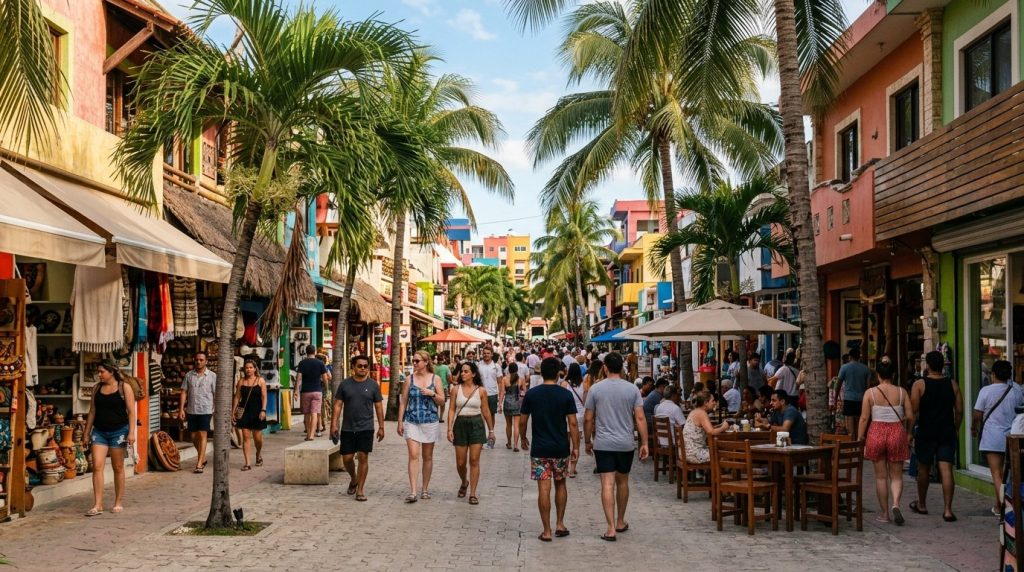
Tulum is two places. Tulum town (the pueblo) has the cheaper rooms, taquerias and bus station. The beach zone is a narrow road of design hotels and beach clubs between jungle and sea, several kilometers away.
You need a bike, taxi or rental car to move between them, and Tulum taxis cost more: sources put a short ride at MXN 180–280 (USD 10–15) versus MXN 100–150 (USD 5–8) in Playa. All conversions here use USD 1 = MXN 18.3.
Cost: Playa is cheaper at every tier
The gap is widest at the top. Boutique and design hotels run USD 180–350 a night in Playa but USD 350–900 in Tulum, and that upper band is mostly the beach zone. A beach-club day pass costs USD 25–45 in Playa and USD 40–120 in Tulum. Budget rooms and hostels start around USD 40–90 in Playa and USD 60–140 in Tulum.
Activities add up too. Entering Tulum’s ruins costs about MXN 515 (USD 28) for a foreign adult, paid in three parts: a park-conservation fee, the Parque del Jaguar access fee and the INAH archaeological ticket. Gran Cenote charges MXN 500 (USD 27).
Cheaper cenotes like Car Wash (MXN 100, USD 5) and Casa Cenote (MXN 200, USD 11) keep a Tulum day affordable. Bring pesos in cash; card machines at gates are unreliable.
Want an all-inclusive? Pick Playa; they are rare in Tulum’s beach zone.
Beaches, cenotes and ruins: Tulum wins on scenery
Tulum’s beaches are wide and photogenic, and the ruins sit on a cliff above the sea. Most of the best cenotes are on the road toward Coba or on Highway 307 north of town, all within about 25 km. See the best things to do in Tulum for the full list.

The downside is seaweed. Sargassum season on this coast runs April through October and peaks June through August. Tulum’s open, east-facing shoreline is consistently among the worst hit, while Playa del Carmen rates as moderate risk thanks to heavy daily cleanup. Check our guide to the best time to visit Tulum before you book a summer trip.
Playa’s own beaches are narrower and busier, but the Cozumel ferry is right in town. Ultramar lists MXN 320 (USD 17) one way, about USD 35 round trip, on its standard service.
Getting there: Cancun airport, Tulum airport and Tren Maya
From Cancun International (CUN), Playa is roughly 55–60 km and about an hour by car or shuttle. Tulum is closer to 90 minutes. A taxi from Cancun airport costs about MXN 1,400–1,800 (USD 77–98) to Playa versus MXN 2,400–3,200 (USD 131–175) to Tulum, so book a shared shuttle instead.
Tulum now has its own airport, Felipe Carrillo Puerto International (TQO), south of town. American, Delta, JetBlue and United fly there, with US gateways including New York JFK, Newark, Chicago, Atlanta, Charlotte, Dallas, Houston, Miami and Los Angeles. Routes are seasonal, so check schedules.
Between the towns, the ADO bus takes about 1 hour to 1 hour 10 minutes, with fares quoted from MXN 63–120 (USD 3–7). The Tren Maya links Playa del Carmen, Tulum town and Tulum airport. At launch it took about 48 minutes from Playa to Tulum, with tourist fares of MXN 78–209 (USD 4–11) according to Yucatan Magazine. Departures were limited at launch, so check the timetable.
Safety: same advisory, different risks
Both towns are in Quintana Roo, and the US State Department rates Mexico at Level 2, “Exercise Increased Caution.” Quintana Roo carries the same exercise-increased-caution guidance on the official Mexico advisory page.
In practice, the risks differ. In Playa, watch for pickpockets and bar tabs on 5th Avenue late at night. In Tulum, the main issues are poorly lit roads between the town and the beach zone, and sketchy bike rides back from beach-club parties. Our full breakdown of whether Tulum is safe covers neighborhoods and late-night transport. Buy travel insurance that covers medical evacuation either way.
A combined-day plan that avoids doubling back
Basing in Playa del Carmen and treating Tulum as a single long day works if the ruins and one cenote are the only must-sees. The Tulum ruins open at 8 am, with last entry around 3:30 pm and closing at 5 pm, so arriving close to opening avoids both the heat and the tour-bus crowds that build through mid-morning.
A walk-through of the ruins alone takes about 30 to 45 minutes, so budget half a day there once travel time and the entrance queue are included.
Pair the ruins with one cenote rather than two or three, since a single stop such as Gran Cenote already takes about 1.5 hours once changing, swimming and the walk in and out are counted. Adding a second cenote plus the beach zone in the same day usually means rushing all three, which defeats the point of basing in Playa for the walkable lifestyle in the first place.
DIY works well for the ruins, since the site is simple to navigate without a guide, but cenotes without one often mean a longer wait at the entrance and no one to explain which caves allow jumping. A guided combination of the two removes both frictions, at the cost of a fixed schedule rather than lingering at either stop.
Travelers who want more than a rushed day are better served booking one night in Tulum town, the cheaper pueblo rather than the beach zone, so the ruins and cenotes can be split across a slower morning and afternoon before the bus or Tren Maya back to Playa.
Nightlife and restaurants compared
Playa del Carmen’s nightlife concentrates around 5th Avenue, especially near Calle 10 and Calle 12, where bars, rooftops and clubs sit back to back along the same walkable strip used for dinner earlier in the night.
It is a genuine bar-hop town: start at a rooftop for sunset drinks, move to a street-level bar for dinner, and finish at a club, all on foot and without planning a return ride. The trade-off is noise, since the busiest blocks run loud well past midnight on weekends, which matters if a hotel room sits close to Calle 12.
Tulum’s nightlife runs on a different clock. Rather than a bar-hop strip, the scene centers on a handful of beach clubs in the beach zone that host ticketed parties on specific nights rather than every night, so the plan has to work around a lineup rather than just walking out the door.
Tulum town itself is quieter after dark, with taquerias and a handful of bars rather than a nightlife strip to compete with 5th Avenue.
Both towns do well on food, but differently. Playa’s dining is dense and walkable, from taco stands to sit-down seafood, nearly all of it within a few blocks of 5th Avenue, so trying several restaurants across one trip costs almost nothing in transport.
Tulum spreads its best-regarded restaurants across the town and the beach road, which usually means a taxi or bike between dinner options rather than a short walk, and reservations matter more at the beach zone’s design-hotel restaurants than anywhere in Playa.
Getting around within each town, not just between them
Playa del Carmen barely needs a plan: 5th Avenue and the beach cover most of what a visitor wants on foot, and anywhere further is a short, cheap taxi ride. Tulum works differently because its two halves, the town and the beach zone, sit several kilometers apart with jungle in between.
A bike is the default fix, with rentals in town running about USD 6–14 (MXN 100–250) a day, cheap enough that most short-stay visitors just rent one on arrival rather than booking a taxi for every trip to the beach.
A scooter costs more, around USD 22–27 (MXN 400–500) a day, and suits anyone also planning to reach cenotes further up the highway without a tour.
Moving between the two towns themselves, a colectivo, a shared van that runs along Highway 307 and can be flagged down roadside, costs about USD 2–3 (MXN 40–60) one way and covers the same route as the pricier ADO bus in a similar amount of time, though with more stops and less certainty over when the next one passes.
It is the cheapest way to shuttle between Playa and Tulum for anyone not tied to a bus timetable.
Digital nomads: wifi, coworking and the visa reality
Playa del Carmen edges out Tulum for internet reliability, largely because fiber providers such as Telmex and Totalplay cover the town more completely than Tulum’s smaller grid; one nomad-focused comparison rates Playa’s wifi at 6 out of 10 against Tulum’s 5 out of 10.
Both towns have dedicated coworking spaces rather than relying only on cafes: Playa’s options, including Nest Coworking and Selina’s co-working floor, run roughly USD 100–180 (MXN 1,830–3,294) a month for a standard desk membership, while Tulum’s equivalents, including Coworking Tulum, run slightly cheaper at about USD 80–150 (MXN 1,464–2,745) a month.
Neither town requires anything beyond the standard tourist entry for a short remote-work stay. The FMM tourist permit allows up to 180 days, though that maximum is not automatic and is set by the immigration officer at entry, and it does not formally authorize paid work performed for a Mexican employer. Most remote workers simply enter on the FMM and leave before it expires rather than applying for anything else.
For a longer base, Mexico’s Temporary Resident visa is the realistic option, since Mexico does not run a dedicated digital-nomad visa.
Applicants need to show either roughly USD 1,620 (MXN 29,646) in monthly income over the past 6 months, or a bank balance around USD 27,000 (MXN 494,100), applied for at a Mexican consulate before arrival rather than inside the country.
The permit is issued for 1 to 4 years, after which 4 consecutive years of temporary residence makes permanent residency possible.
Verdict by traveler type
– First-timers: Playa del Carmen. Shorter airport transfer, walkable, and Tulum is an easy day trip. – Couples: Tulum, if your budget handles USD 180–320 a night. If not, stay in Playa and spend one night in Tulum. – Families: Playa del Carmen.
All-inclusives, walkable dinners and fewer taxi rides with kids. – Budget travelers: Playa del Carmen, cheaper at every hotel and meal tier. – Cenote and ruins fans: Tulum, since you skip the daily round trip.
Weighing Cancun as well? Compare it in our Cancun vs Playa del Carmen breakdown.
Where to stay
– Central Playa del Carmen (5th Avenue to the beach): best for first-timers and nightlife. Everything is walkable, though rooms near the busiest bars can be noisy. – Playacar: a gated resort area just south of the ferry pier.
Best for families and all-inclusive fans who still want to walk into town. – Tulum town: best for couples on a mid-range budget. Cheaper than the beach zone, close to the bus and train, and a short bike ride to the cenotes.
Find your Playa del Carmen hotel on the map
Live prices from Booking, Airbnb and more — move the map or change dates to compare stays across Playa del Carmen.
Frequently Asked Questions
Is it better to stay in Tulum or Playa del Carmen?
Playa del Carmen is better for most first trips. It is about an hour from Cancun airport, mid-range hotels cost USD 110–180 a night versus USD 180–320 in Tulum, and you can walk everywhere. Choose Tulum if cenotes, the clifftop ruins and boutique hotels matter more than price or nightlife.
Can you do Tulum as a day trip from Playa del Carmen?
Yes. Tulum is 60–65 km (37–40 miles) south of Playa on Highway 307, about 50–60 minutes by car. The ADO bus takes roughly an hour, and the Tren Maya runs from Playa to Tulum town. Leave early to beat the heat and tour buses.
Which airport should I fly into for Tulum or Playa del Carmen?
For Playa del Carmen, fly into Cancun (CUN), about an hour away. For Tulum, check Tulum International (TQO) first: American, Delta, JetBlue and United fly there from US hubs including New York, Chicago, Dallas, Houston and Miami. Cancun works too, about 90 minutes away.
What months should you avoid in Playa del Carmen and Tulum?
Sargassum seaweed hits this coast from April through October, worst from June through August, and Tulum’s open shoreline usually gets more than Playa. Hurricane season also overlaps summer and fall. November through March is the safest bet for clear water, though it is also the priciest period.
Are Tulum’s beaches swimmable?
Usually, yes. The water is warm and calm on most days, but heavy sargassum can make swimming unpleasant in summer, and some stretches have currents. Swim near lifeguards and check the flag colors. Beaches inside the national park also require the park entry fee.