Santorini vs Crete: Which Greek Island to Choose (2026)
Disclosure: Some links in this guide are affiliate links. If you book or buy through them, we may earn a small commission at no extra cost to you — it helps keep our guides free.
You have a short trip and want caldera views and romance.
See hotels in Santorini →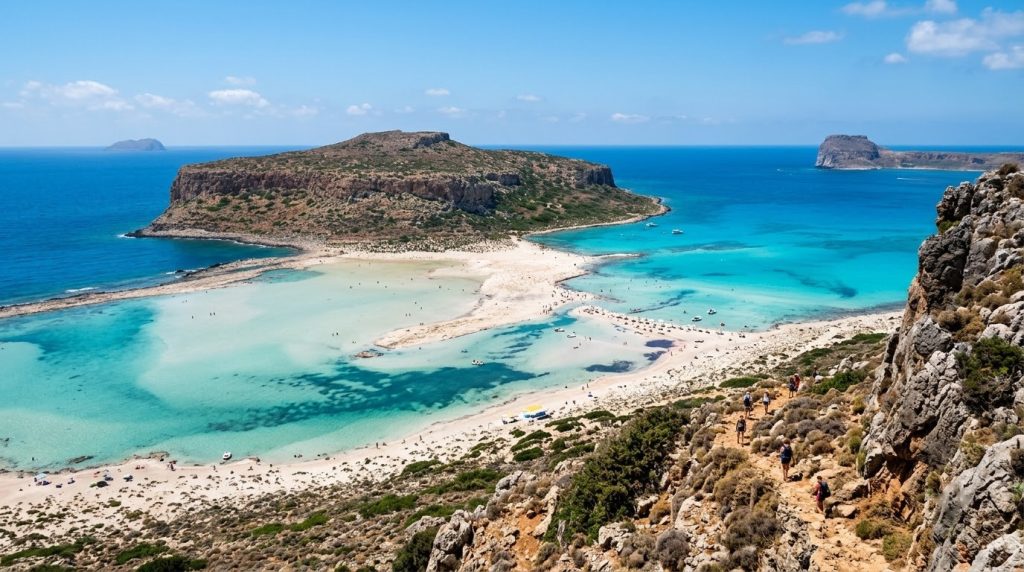
Pick Crete if you have 7 or more days, and pick Santorini if you have 3 nights: Crete is more than 90 times bigger, so it can’t be “done” in a weekend. Santorini wins on caldera views and short-trip romance. Crete wins on beaches, hiking, food, history and room to escape the crowds.
Hotel prices are closer than most people expect. If you can spare 10 days, do both. The fastest ferry between them takes 1 hour 35 minutes.
| Factor | Santorini | Crete |
|---|---|---|
| Size | About 91 sq km | About 8,300–8,450 sq km |
| Ideal stay | 3–4 nights | 7–14 nights |
| Best for | Caldera views, sunsets, couples | Beaches, hiking, families, road trips |
| Beaches | Dark volcanic sand | Pink sand, lagoons, long bays |
| Avg. 3-star hotel (Booking.com) | USD 177/night | USD 175/night |
| Cruise crowds | Daily cap of 8,000 passengers | Spread across a much bigger island |
| Need a car? | No | Yes, realistically |
Size and time: why 3 nights vs a full week
Santorini is the rim of an old volcano: about 91 sq km and 15,480 residents (2021 census). Fira, Oia, Pyrgos and the beach towns are all reachable by bus in a day. Crete stretches 260 km west to east, has about 624,000 people, multiple airports and mountains up to 2,456 m on Mount Ida.
That decides your trip. Santorini needs 3 nights, 2 at minimum. Crete needs 4 at minimum, and a week is far better. For a long weekend, Santorini is the right call, and our Santorini travel guide covers the logistics. Give Santorini alone a full week and you’ll run out of things to do.
Getting there from the US and between the islands
From the US you’ll connect through Athens or another European hub. Ferries from Piraeus take roughly 5 to 11+ hours to Santorini and 7.5 to 13 hours to Crete, so most Americans fly the last leg. On Crete, use Heraklion or Chania airport.
Between the islands, boats run Heraklion to Athinios, about 63 nautical miles (120 km). According to Ferryhopper’s route page, Seajets catamarans take about 1 hour 35 minutes and conventional Blue Star ferries about 3 hours.
Fares start around USD 17 (EUR 15) on the slow boat and around USD 104 (EUR 92.70) on the fast cat, converted at USD 1 = EUR 0.89. In peak season there are up to 3 crossings a day, but in winter only about 2 a week. Plan a combined trip for April through October.
The US State Department rates Greece at Level 1, “Exercise Normal Precautions” (updated 23 Oct 2025).
Beaches: Crete wins by a wide margin
Santorini’s beaches (Kamari, Perissa, Perivolos, Vlychada) are dark volcanic sand and pebbles that get hot underfoot by midday. Red Beach has been closed repeatedly after rockfalls, including in February 2025, so treat it as a photo stop from a boat.
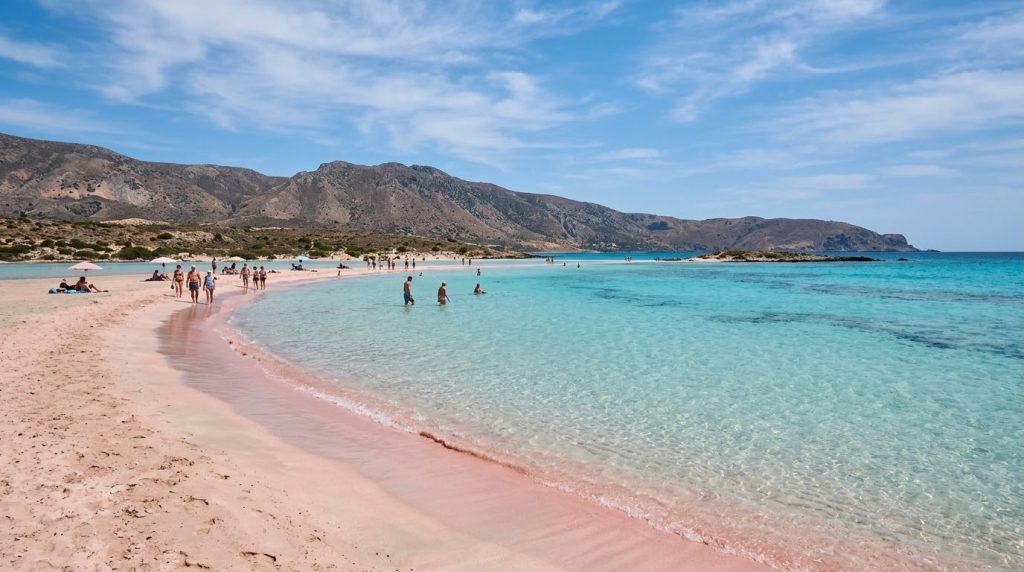
Crete plays in a different league. Elafonissi, a Natura 2000 reserve about 90 minutes by bus from Chania, has pink-tinged sand and a shallow lagoon kids can wade across. Balos Lagoon, Falassarna, Preveli and palm-backed Vai round out the list. If swimming matters, pick Crete.
Cost: the hotel gap is smaller than you think
Booking.com’s own averages undercut the “Santorini is far pricier” line. A 3-star hotel averages USD 177 a night on Santorini against USD 175 on Crete, and a 4-star USD 342 against USD 332. At 5-star, Crete averages higher (USD 619 vs USD 545), thanks to its big resorts.
The real Santorini premium is the sunset-facing caldera room in Oia, Imerovigli or Firostefani. Stay beach-side in Kamari or Perissa and prices drift toward Crete’s. Our Santorini budget guide breaks down where the money goes.
Both islands charge the same climate resilience fee: USD 6 (EUR 5) per night at a 3-star from April to October, USD 17 (EUR 15) at a 5-star. Knossos costs USD 23 (EUR 20). Crete’s hidden cost is the rental car you’ll need for Balos or the south coast. Santorini’s is the Fira cable car, USD 11 (EUR 10) each way.
Crowds and cruise ships
Santorini gets an estimated 2 million visitors a year, around 900,000 of them off cruise ships. Since July 1, 2025, cruise passengers pay USD 23 (EUR 20) each from June to September, as GTP reported. In 2026 the Thira port fund capped arrivals at 8,000 cruise passengers a day, down from peak days of over 15,000.
Oia at sunset and Fira in the afternoon are still packed. Walk the caldera path early and save midday for wineries or Akrotiri; our best things to do in Santorini list is built around those peaks. On Crete, crowds bunch at Knossos, Balos and Elafonissi, but a short drive inland and they’re gone.
Verdict by traveler type
– First-timers with 4–5 days: Santorini. You’ll see the postcard view without spending half your trip in a car. – Couples: Santorini for a 3-night honeymoon splurge; Crete for a slower week of tavernas and coves. – Families: Crete. Shallow lagoon beaches and space to run.
Santorini’s stair-filled cliff hotels are hard with a stroller. – Budget travelers: Crete. Star-for-star rooms cost about the same, but food and village stays away from resort strips are far cheaper. – Hikers: Crete. The Samaria Gorge runs 12.5 km, or 16 km to the sea at Agia Roumeli.
It opens May to October, weather permitting, according to Visit Greece. – 10 days total: Do both. Spend 3–4 nights on Santorini first, then 6–7 on Crete, using the 4-day Santorini itinerary for the first leg.
Things to do in Santorini beyond the caldera view
The sunset photo is only one part of a Santorini trip, and the island has enough beyond Oia’s walking path to fill three or four days without repeating yourself.
Akrotiri, a remarkably preserved Bronze Age settlement buried under volcanic ash, is often described as Greece’s own answer to Pompeii and sits under a large protective roof near the island’s southern tip.
Published entry prices vary by source, from about EUR 12 to EUR 20 (roughly USD 13 to USD 22), so check the current rate before you go, and budget about an hour for a quick visit or two for a slower walk through the covered excavation.
A volcano and hot springs boat tour is the other classic half-day out. Group boats to the Nea Kameni crater and the Palea Kameni hot springs run about USD 34 to USD 58 per person depending on the operator and whether lunch is included, and most trips run three to five hours round trip from Fira or Athinios.
Wineries built into the island’s volcanic soil add a different half day: tastings typically pair Assyrtiko whites with caldera views, and several are an easy taxi ride from Fira or Oia.
For a quieter alternative to the crowded caldera path, the inland village of Pyrgos and the Byzantine ruins of ancient Thera both draw far fewer visitors than Oia, and reward the short drive or hike with views that rival the famous sunset spots at a fraction of the crowd.
Fira itself is worth more time than most itineraries give it. The town’s Museum of Prehistoric Thera and the Archaeological Museum both hold finds from Akrotiri and are a sensible rainy-afternoon or midday-heat alternative to standing in the sun.
The cable car between the old port and Fira saves the steep donkey-path climb and is a reasonable splurge after a boat tour, when stairs are the last thing anyone wants after a day on the water.
Things to do in Crete beyond the beaches
Crete’s size means its best days out are not all beach days. Knossos, the Minoan palace complex near Heraklion, is the headline historical site and costs about EUR 20 (USD 23) to enter; pair it with the Heraklion Archaeological Museum for context on the artifacts actually found there.
Chania’s old town, with its Venetian harbour and lighthouse, and Rethymno’s smaller Venetian quarter both reward an evening of wandering rather than a rushed afternoon, and neither charges an entry fee to walk through.
Hikers have the Samaria Gorge, a 12.5 to 16 kilometre route depending on where you finish, open roughly May through October weather permitting. Shorter gorge walks near Chania suit travelers who want a taste of the scenery without a full-day commitment.
Cretan food is also worth building a day around on its own: the island’s cuisine leans on local olive oil, wild greens, cheeses such as graviera, and raki as a digestif, and several villages around Chania and Rethymno run hands-on cooking classes that double as a half-day activity.
Families and groups who want a break from driving can base a day around Elafonissi or Balos and simply stay for sunset, since both lagoons are quieter and the light softer once the tour buses leave in the late afternoon.
Crete’s size also means the weather and the crowd pattern can differ meaningfully between its north coast, south coast and mountain villages on the same day, so travelers who build in one flexible day can chase sun or shade rather than being locked into a single region’s forecast.
That flexibility is one of the clearest advantages Crete has over a compact island like Santorini, where there is nowhere else on the island to go if the weather or the crowds do not cooperate.
Best trip types: honeymoons, anniversaries and group celebrations
Santorini is built for a short, high-impact celebration. A caldera-view suite in Oia or Imerovigli, a private dinner reservation timed to sunset, and two or three nights are enough to make a honeymoon or anniversary feel like an event without needing a long stay.
Couples on a tighter budget can get a similar feel from a beach-side room in Kamari or Perissa paired with one splurge dinner up on the caldera rim.
Crete suits a longer, lower-key celebration or a multi-generational group trip better than Santorini does.
A villa with a private pool near Chania or along the south coast gives a family group space that a caldera hotel room cannot, and the island’s size means grandparents, teenagers and toddlers can each find a slower day or an active one without everyone doing the same activity.
A milestone birthday or a reunion week suits Crete’s mix of beaches, old towns and day trips better than three nights built around one viewpoint.
For a honeymoon that wants both, the combined itinerary mentioned above works well here too: front-load the romance in Santorini, then unwind in Crete, where the pace slows and the per-night room cost is close to identical at the same star rating.
Group celebrations with a wide age range, from grandparents down to young cousins, tend to go smoother on Crete for a practical reason beyond space: a rental car means nobody is stuck waiting on a bus schedule or a shared boat transfer to see the thing they specifically wanted to see.
On Santorini, where most visitors rely on buses, taxis or a single rented ATV, a large group celebrating together has noticeably fewer easy ways to split up for a few hours and regroup again later for dinner.
Where to stay
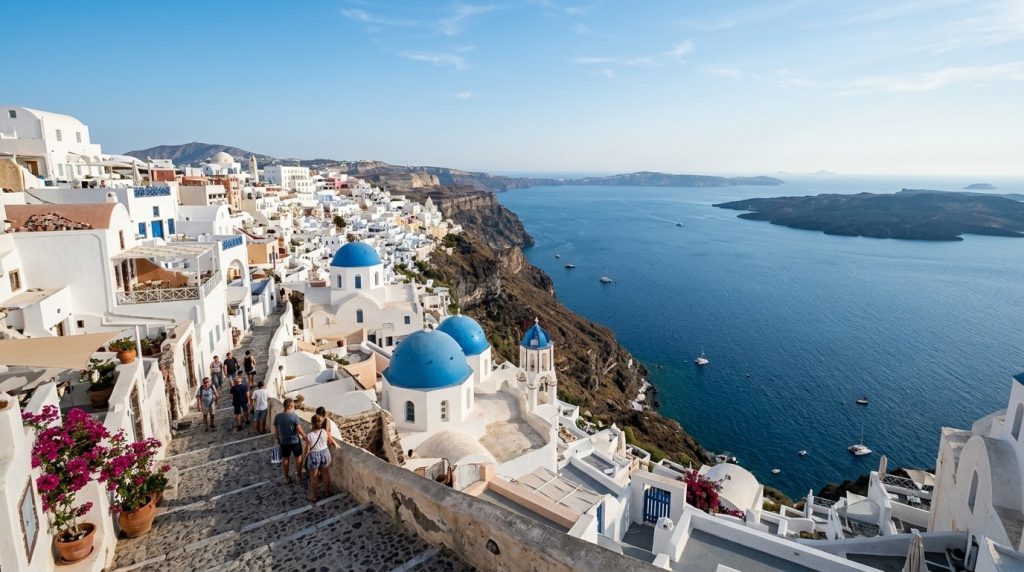
– Chania Old Town (Crete): Best first-timer base, with the Venetian harbor, great food and easy runs to Balos, Falassarna and Elafonissi. – Heraklion area (Crete): Practical for Knossos, the airport and the Santorini ferry. Better for one or two nights than a week. – Kamari or Perissa (Santorini): Beach-side and cheaper than the caldera, with buses to Fira. Couples who want the view should splurge on Firostefani or Imerovigli instead.
Find your Crete hotel on the map
Live prices from Booking, Airbnb and more — move the map or change dates to compare stays across Crete.
Frequently Asked Questions
Is Crete or Santorini better for a first trip to Greece?
For a short trip of 4–5 days, Santorini is better. It’s compact, you don’t need a car, and you’ll see the famous caldera view on day one. With a week or more, Crete gives first-timers more variety: beaches, Knossos, gorges and village food. The ideal first trip combines Athens, 3 nights on Santorini and a week on Crete.
Can you do a day trip from Crete to Santorini?
Technically yes, in peak season. Seajets catamarans cover the 120 km from Heraklion in about 1 hour 35 minutes, so a same-day return works on some summer schedules. But fast fares start around USD 104 each way and you get only a few hours ashore. Two nights is a far better use of the money.
Is Crete cheaper than Santorini?
For food, car-based travel and beach-side stays, usually yes. For hotels at the same star rating, the gap is small: Booking.com averages USD 175 a night for a 3-star on Crete and USD 177 on Santorini. The big Santorini markup is caldera-view rooms in Oia and Imerovigli. Skip the view and the two islands cost about the same per night.
How many days do you need in Crete vs Santorini?
Plan 3 nights for Santorini (2 at minimum) and at least 4 for Crete, with 7 being much better. Crete is 260 km long, so trying to see Chania, Heraklion and the south coast in under a week means long drives every day. For a 10-day combined trip, give Santorini 3–4 nights and Crete 6–7.
Which island has better beaches, Crete or Santorini?
Crete, clearly. Elafonissi, Balos, Falassarna and Vai offer pale or pink sand and shallow, clear water. Santorini’s beaches are dark volcanic sand and pebbles that heat up fast, and its Red Beach has been closed repeatedly because of rockfalls. Go to Santorini for the views and to Crete for swimming.