
Lake Como vs Amalfi Coast 2026: Which Is Better for Your Trip?
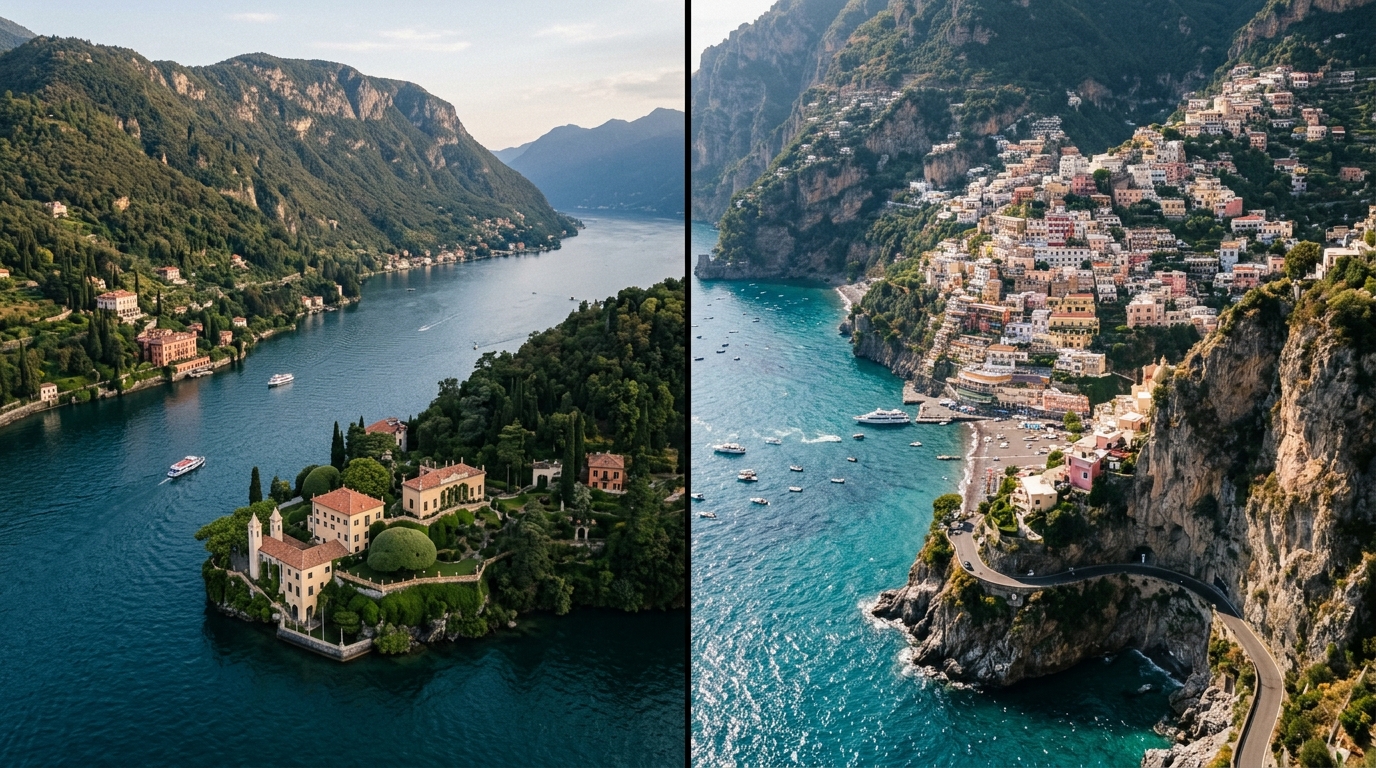
The short verdict: Lake Como wins for romance, easy travel logistics, and serene mountain scenery. The Amalfi Coast wins for dramatic sea views, Southern Italian food, and sheer visual drama. Cost is nearly identical at budget tier ($127 vs $132 per day), but luxury Amalfi runs almost double Como’s prices. Read on for the full comparison.
Key Takeaways
– Budget daily costs are nearly identical: $127/day (Como) vs $132/day (Amalfi) (GotripZI, 2026)
– Lake Como is easier to reach: 30-40 min from Milan by train vs Amalfi’s 1.5-2h bus/ferry from Naples
– Amalfi Coast logged 2.3 million overnight stays in 2024 — a record high, meaning crowds are intense
– Como suits families and mobility-limited travelers; Amalfi involves steep stairs and narrow roads
– You can visit both in one trip using an open-jaw flight: fly Milan in, fly Naples outAffiliate Disclosure: Some links in this guide are affiliate links. If you book through them, we earn a small commission at no extra cost to you. We only recommend services we genuinely trust. Learn more.
“complete Lake Como travel guide” → /lake como travel guide/
For full destination planning, start with our complete Lake Como travel guide before using this comparison to decide which Italian region fits your trip best.
Lake Como vs Amalfi Coast: Quick Comparison
| Category | Lake Como | Amalfi Coast | Winner |
|---|---|---|---|
| Scenery | Alpine lake, villas, mountains | Sea cliffs, colorful villages, Mediterranean | Tie (different moods) |
| Budget cost/day | $127/day (~€110) | $132/day (~€115) | Lake Como (slight edge) |
| Luxury cost/day | $567/day (~€490) | $1,090/day (~€950) | Lake Como (2x cheaper) |
| Crowds | Moderate (peak: July-Aug) | Intense (2.3M stays in 2024) | Lake Como |
| Getting there | 30-40 min from Milan by train | 1.5-2h from Naples by bus/ferry | Lake Como |
| Activities | Ferries, villas, kayaking, hiking | Boat tours, coastal hikes, Pompeii day trips | Amalfi (more variety) |
| Food | Northern Italian: risotto, lake fish | Southern Italian: seafood, pasta, limoncello | Amalfi (bolder flavors) |
| Families / mobility | Ferry-accessible, flat lakeside paths | Steep stairs, narrow switchback roads | Lake Como |
| Honeymoon | Intimate, peaceful, luxury villas | Dramatic, cinematic, romantic sunsets | Tie |
| Best months | May-Jun, Sep-Oct | May-Jun, Sep-Oct | Tie |
| Verdict | Easier, cheaper, calmer | More dramatic, better food, harder to reach | Depends on traveler type |
Source: GotripZI (2026); Amalfi Cruises / Statista (2025); Rome2Rio (2025); author research
Which Has Better Scenery and Atmosphere?
Both destinations are visually stunning, but they deliver completely different moods. Lake Como offers serene alpine grandeur: still blue-green water, snow-capped peaks reflected in the lake, and pastel-colored villas draped in wisteria. The Amalfi Coast gives you raw Mediterranean drama — cliffs plunging into turquoise sea, whitewashed villages clinging to rock faces, and fishing boats bobbing in impossibly blue coves.
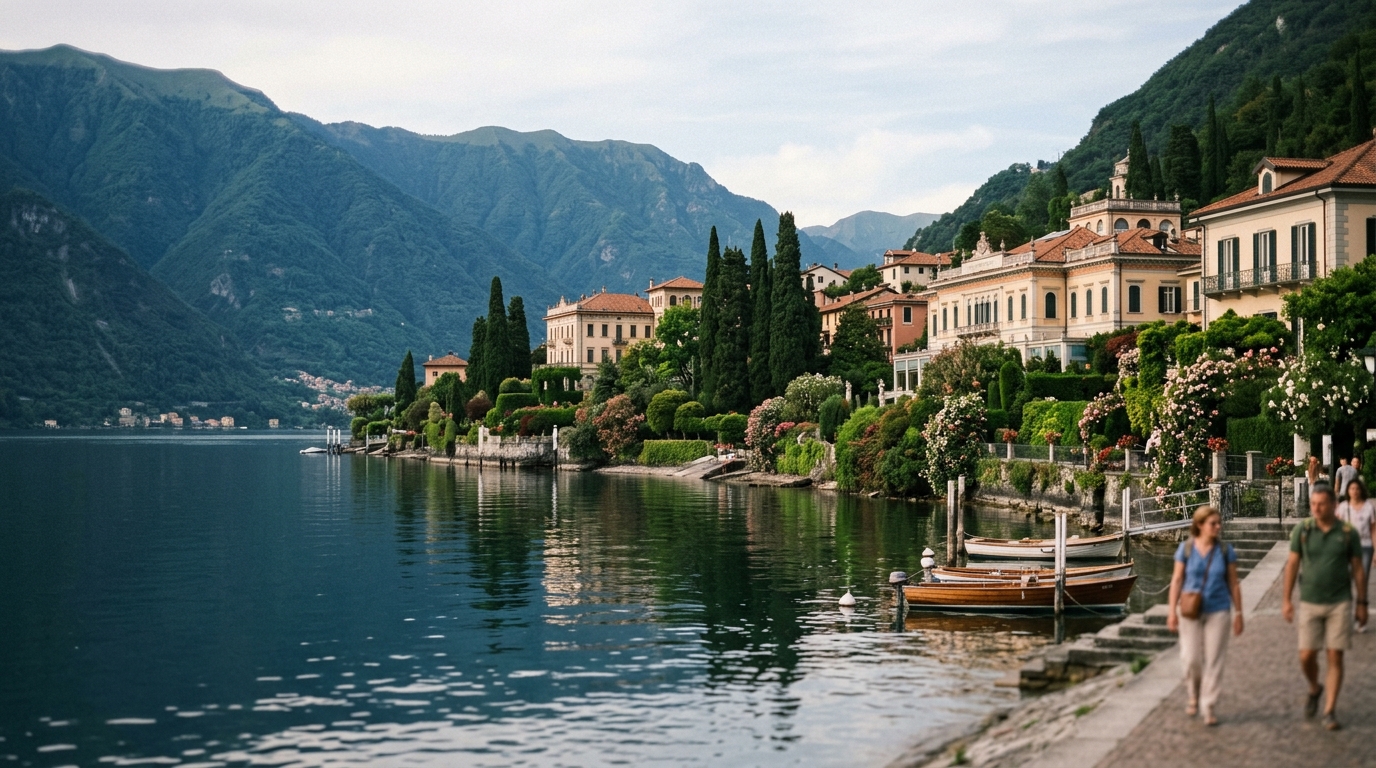
Como’s atmosphere is quieter and more refined. The lake towns of Bellagio, Varenna, and Menaggio feel like places where time slows down. You arrive by ferry, wander cobblestone lanes, and watch the light shift across the water all day. It suits travelers who want calm over spectacle.
Amalfi’s atmosphere is electric. Positano, Ravello, and Amalfi town pack intense color, noise, and energy into narrow streets. The coastline is frankly one of the most photographed in Europe. But that popularity comes with a cost: in summer, the SS163 coastal road can gridlock for hours, and terrace restaurants fill up by 12:30pm.
Verdict: Tie. Choose Como for alpine serenity. Choose Amalfi for cinematic Mediterranean drama.
“things to do in Lake Como” → /best things to do in lake como/
Which Is Easier to Reach?
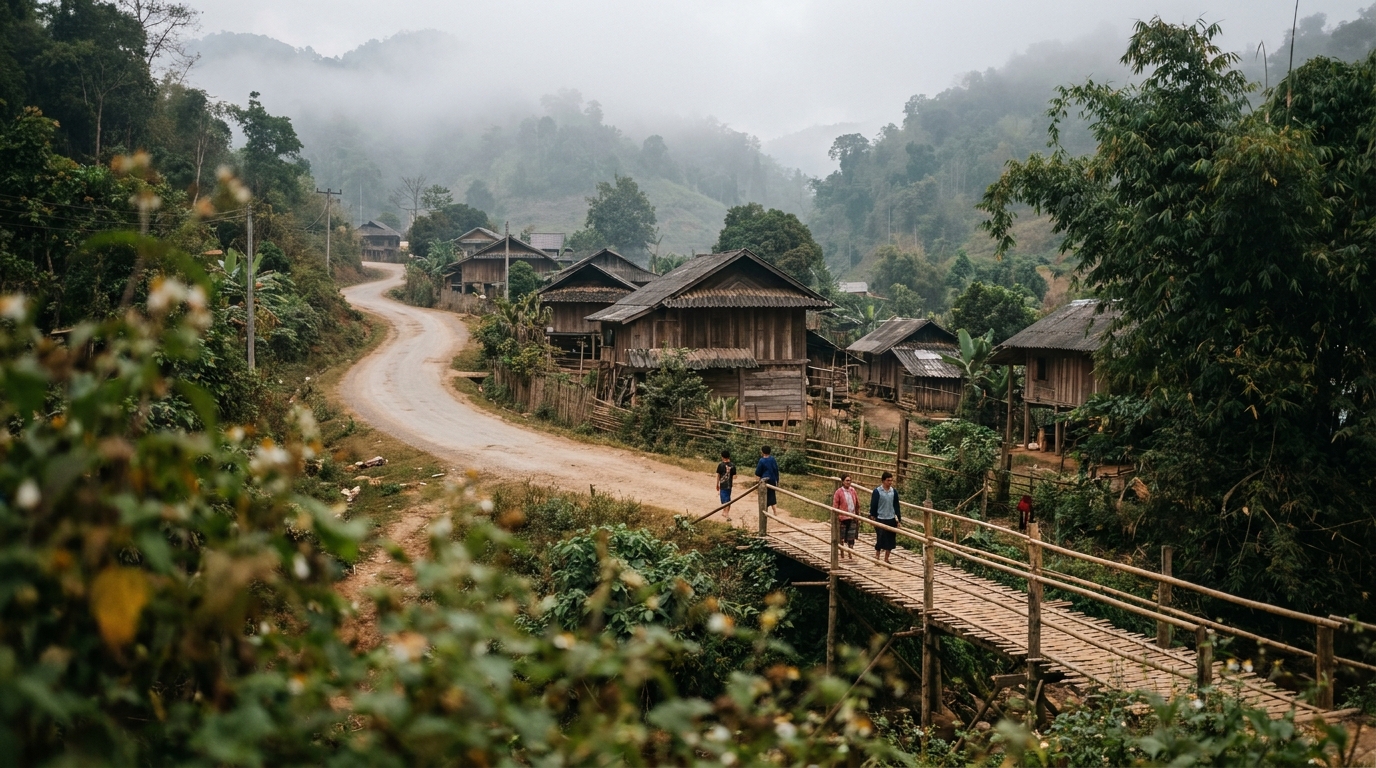
This is where Lake Como wins decisively. Milan Centrale station connects to Como San Giovanni in around 30-40 minutes by direct train, running multiple times per hour (LakeComo Travel, 2025). Malpensa Airport (MXP) to Como is roughly 1 hour 15 minutes by train or shuttle. For most European visitors, Como is a two-hop journey from their home city.
| Origin | To Lake Como | To Amalfi Coast |
|---|---|---|
| Milan Malpensa (MXP) | ~1h 15min (train + ferry) | ~4h+ (fly to Naples first) |
| Milan Centrale | ~30-40 min (direct train) | Not practical direct |
| Naples (NAP) | ~5h (train north) | ~1.5-2h (bus or ferry) |
| Rome (FCO) | ~3h+ (train to Milan, then Como) | ~3h (car/bus via A3 highway) |
Source: Rome2Rio (2025); LakeComo Travel (2025); author research
The Amalfi Coast is genuinely awkward to reach. There is no direct train to any Amalfi Coast town (Rome2Rio, 2025). Travelers fly into Naples, then take a 1.5-2 hour bus along the winding SS163 or a seasonal ferry from Salerno. The coastal road is notoriously slow in summer — a 35km stretch can take 2 hours in July traffic.
Verdict: Lake Como. Como’s rail access from Milan is one of Italy’s easiest resort transfers. Amalfi requires more planning, patience, and ideally a car rental.
“4 day itinerary” → /4 day lake como itinerary/
Compare Italy car rentals on Discover Cars → if you plan to self-drive the Amalfi Coast road.
Best Time to Visit — Month-by-Month Comparison

Italy’s summer travel demand rose 17.9% in 2025 versus 2024 (Tourist Italy, 2025), which means both destinations are more crowded than ever. Shoulder season — May-June and September-October — is the clear answer for both. But the month-by-month picture differs significantly between them.
| Month | Lake Como Rating | Amalfi Coast Rating | Notes |
|---|---|---|---|
| January | 2/5 — Off-season | 2/5 — Off-season | Many venues closed; Como quieter, Amalfi almost empty |
| February | 2/5 — Cold, quiet | 2/5 — Cool, quiet | Low prices; not beach weather; good for Como villa tours |
| March | 3/5 — Opening up | 3/5 — Warming up | Gardens bloom at Como; Amalfi lemons in season |
| April | 4/5 — Very good | 4/5 — Very good | Easter crowds spike both; best wildflowers at Como |
| May | 5/5 — Peak shoulder | 5/5 — Peak shoulder | Ideal weather, manageable crowds, full services open |
| June | 5/5 — Excellent | 4/5 — Good, warming | Como stays manageable; Amalfi crowds start building |
| July | 3/5 — Hot, crowded | 2/5 — Overtourism peak | 64% of Italy visitors report overtourism in summer (VisitItaly.eu, 2025) |
| August | 2/5 — Peak crowds | 2/5 — Worst crowds | Ferry queues 1h+; Amalfi road gridlock common |
| September | 5/5 — Best month | 5/5 — Best month | Crowds drop 30-40%; warm water; harvest season |
| October | 4/5 — Excellent | 4/5 — Very good | Fall colors at Como; shoulder prices return |
| November | 3/5 — Quiet | 3/5 — Quiet | Some lake towns wind down; Amalfi storms begin |
| December | 3/5 — Christmas charm | 2/5 — Limited access | Como has festive markets; Amalfi road conditions poor |
Source: Author research; VisitItaly.eu (2025); Tourist Italy (2025)
The Amalfi Coast’s crowd problem is more severe. It recorded 2.3 million overnight stays in 2024 — the highest figure on record (Amalfi Cruises / Statista, 2025). With roughly 5 million annual visitors passing through a coastline with very limited road capacity, July and August are genuinely unpleasant. Lake Como has crowds, but the ferry network and multiple lakeside towns spread visitors out more effectively.
Verdict: Both are best in May-June and September. Amalfi’s summer crowds are significantly worse.
Which Is Cheaper? Cost Comparison for 2026
Lake Como and Amalfi Coast cost nearly the same at budget tier, but diverge sharply at the top end. Budget travelers spend $127/day at Como versus $132/day on the Amalfi Coast (GotripZI, 2026). The real difference shows up in mid-range and luxury: Amalfi’s luxury daily cost of $1,090/day is nearly double Como’s $567/day.
| Spending Tier | Lake Como (per person/day) | Amalfi Coast (per person/day) |
|---|---|---|
| Budget | $127 (~€110) | $132 (~€115) |
| Mid-range | $274 (~€237) | $281 (~€245) |
| Luxury | $567 (~€490) | $1,090 (~€950) |
Source: GotripZI (2026)
[CHART: Bar chart – Daily budget comparison Lake Como vs Amalfi Coast across three tiers – Source: GotripZI 2026]
Accommodation is the biggest driver of that gap. A 3-star hotel on Lake Como averages around $134/night (GotripZI, 2026), while Positano 3-star hotels in summer run €250-€450/night (machupicchu.org, 2026). Even in shoulder season, Positano prices drop only 20-30%. Grand Hotel Tremezzo on Como is one of the priciest options at $1,678/night — still lower than Positano’s top-end summer rates.
| Hotel Type | Lake Como (avg/night) | Amalfi Coast (avg/night) |
|---|---|---|
| Budget guesthouse | $60-90 | $80-120 |
| 3-star hotel | ~$134 | €250-450 (~$270-490) |
| 4-star boutique | $200-350 | $350-600 |
| Luxury / top-end | From $567 (Grand Hotel Tremezzo: $1,678) | From $700 (peak season: $1,200+) |
Source: GotripZI (2026); machupicchu.org (2026); author research
Food costs also favor Como slightly. A lakeside trattoria meal runs €15-25 per person. Amalfi restaurants with sea views command €25-45 for a similar meal, with tourist-trap pricing common along the main promenade in Amalfi town.
Verdict: Lake Como is cheaper at every tier above budget, and significantly cheaper for luxury travel.
Browse Lake Como hotels → | Browse Amalfi Coast hotels →
“best hotels on Lake Como” → /lake como hotels/
See our full guide to the best hotels on Lake Como for curated picks across every budget tier.
What Are the Best Activities at Each Destination?
Activities are where Amalfi edges ahead in raw variety, though Como holds its own for lake-specific experiences. Both destinations attract roughly the same traveler profile — couples, honeymooners, and culture-focused tourists — but the activity menus differ considerably.
Lake Como Activities
The ferry network is Como’s defining feature. Ferries connect 30+ lakeside towns, meaning you can hop between Bellagio, Varenna, Menaggio, and Tremezzo without renting a car. Boats run from early morning through evening in peak season. A day pass costs around €15-25 depending on route length.
Villa gardens are a genuine Como highlight. Villa del Balbianello (made famous by James Bond and Star Wars scenes), Villa Carlotta, and Villa Melzi open to visitors from March through October. Garden entry runs €10-15. The villas are clustered along the lake’s western arm, easily reachable by ferry or water taxi.
Hiking options are underrated. The Greenway del Lago trail connects Colonno to Cadenabbia (10km) with lake views throughout. More serious hikers take the Cammino di San Jago route above Varenna. Water sports — kayaking, paddleboarding, sailing — are available from every major town.
Amalfi Coast Activities
Boat tours are the Amalfi equivalent of Como’s ferries. Private and shared boat tours depart Positano and Amalfi daily, covering the Grotta dello Smeraldo (Emerald Cave), Li Galli islands, and Capri. A shared boat tour to Capri runs €40-70; private charters start at €200 for a half-day.
The Path of the Gods (Sentiero degli Dei) is one of Italy’s most dramatic coastal hikes: a 7.8km route from Bomerano to Nocelle with panoramic views of the coast 400m below. The path takes 3-4 hours and is best walked west to east in the morning light.
Day trips expand the Amalfi experience significantly. Pompeii (1.5h by bus), Naples (1.5h), Paestum Greek temples (1h), and the island of Capri are all accessible. Como day trips are more limited in scope — Milan (30 min) and Bergamo are the main options.
Verdict: Amalfi Coast for variety, especially day trips. Como for relaxed, ferry-based exploration.
Where to Stay: Accommodation Guide
Lake Como: Best Areas to Stay
Bellagio is the most famous and most expensive village. It sits at the junction of Como’s three branches, giving ferry access to all parts of the lake. Expect premium prices: budget €100+ per night even for basic rooms in summer. The grand hotels here — Villa d’Este in Cernobbio, Grand Hotel Tremezzo in Tremezzina — define Italian luxury.
Varenna offers a quieter, less-polished alternative to Bellagio with similar ferry access and stunning views. Prices run 20-30% lower than Bellagio. It’s a better base for hikers and independent travelers who want fewer tour groups.
Menaggio and Bellagio both have ferry connections across to Varenna and Cadenabbia. Menaggio has more practical infrastructure for longer stays — supermarkets, pharmacies, affordable restaurants.
Amalfi Coast: Best Areas to Stay
Positano is the photogenic hub — the town of cascading pastel buildings and beach umbrellas that appears on every Amalfi Coast Instagram post. Staying here means paying a serious premium. Summer rates at 3-star properties start at €250/night; 4-star boutiques run €450+.
Praiano is the smart alternative. It sits 5km west of Positano on a quieter stretch of coast, with direct bus links to Amalfi and Positano. Prices run 30-40% lower than Positano for similar quality. The village’s terraced setting gives spectacular sunset views over the Tyrrhenian Sea.
Ravello perches 350m above the coast on a ridge above Amalfi town. It’s the quietest, most refined of the Amalfi options — no beach access, but cooler temperatures, far fewer tourists, and genuinely excellent restaurants.
Verdict: Como offers better value across all tiers. Amalfi’s Positano commands a heavy premium for peak-season stays.
Food: Northern Italy vs Southern Italy
Food is genuinely one of the most compelling reasons to choose Amalfi over Como. The culinary traditions are completely different, and both are excellent — but Southern Italian cuisine is bolder, more varied, and harder to replicate elsewhere.
Lake Como Food
Como’s food is Northern Italian: refined, cream and butter-based, and focused on lake produce. Missoltino (sun-dried lake fish preserved in oil) and lavarello (a freshwater whitefish) are local specialties you won’t find elsewhere in Italy. Risotto dishes — risotto with lake perch or saffron risotto Milanese — are staples in better restaurants. Polenta appears on every menu in colder months.
The restaurant scene in Bellagio and Varenna is solid but not adventurous. Expect competent regional cooking at fair prices in local trattorias, with tourist-aimed overpriced menus near the ferry docks. Lake fish dishes at a proper trattoria run €18-28 per plate.
“Lake Como’s food scene” → /best food in lake como/
Our guide to Lake Como’s food scene covers the best trattorias in Bellagio and Varenna with current menu prices.
Amalfi Coast Food
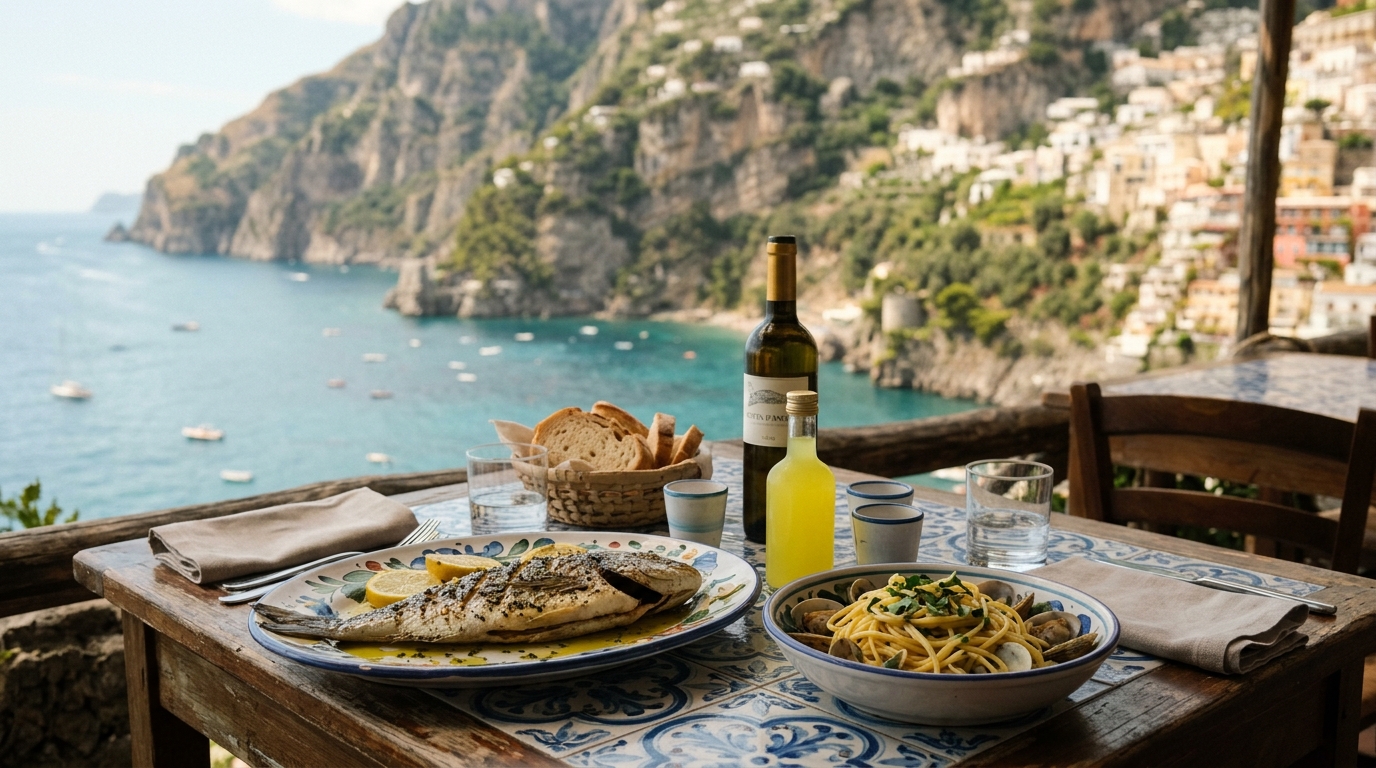
The Amalfi Coast’s culinary identity is built on lemons, seafood, and pasta. The local sfusato amalfitano lemon is a protected variety — larger, sweeter, and more aromatic than standard lemons. It appears in limoncello, granita, lemon pasta (pasta al limone), and the ceramic-handled lemon sorbet cups sold in every town.
Seafood is the main event: scialatielli ai frutti di mare (fresh pasta with mixed seafood) and totani con patate (squid and potatoes) are regional signatures. Pizza in Positano is Neapolitan-style, cooked in wood-fired ovens. A proper meal at a mid-range restaurant in Amalfi town costs €30-45 per person including wine.
Verdict: Amalfi Coast for food. The combination of Southern Italian seafood, artisan lemons, and Neapolitan pizza represents a more distinctive regional cuisine than Como’s Northern Italian cooking — good as that is.
Can You Visit Both? The Open-Jaw Italy Trip
This is the question most Italy planners don’t ask — and it has a very practical answer. Yes, you can visit both destinations in one trip, and an open-jaw flight routing makes it easy and cost-effective. No competitor article covers this routing in detail, so we’ll map it out precisely.
The recommended route:
Fly into Milan Malpensa (MXP) → transfer to Lake Como (1h 15min by train and ferry) → spend 3-4 nights on the lake → take the train from Milan Centrale to Rome (€30-50, ~3h, book on Trainline) → spend 1-2 nights in Rome as a transit base → take the train from Rome to Naples (€15-40, ~1h 10min on Frecciarossa, book on Trainline) → bus or ferry to your Amalfi Coast base → spend 4-5 nights → fly home from Naples (NAP).
Check Milan-Naples trains on Trainline →
This open-jaw routing avoids expensive return trains and cuts out significant backtracking. Flying into Milan and out of Naples costs similar to a return ticket to either city, and often less. The train legs are fast and scenic: the Rome-Naples Frecciarossa takes just over an hour.
Total trip: 10-12 days, 2 airports, 4-5 destinations, no car required for Como section.
If you want the Amalfi coastal drive experience — which is genuinely worthwhile in shoulder season when the road is clear — rent a car at Naples Airport and return it there before flying home.
Compare Italy car rentals on Discover Cars →
Practical notes:
– Book train tickets 2-4 weeks ahead for cheapest fares on Trenitalia/Frecciarossa
– Amalfi-to-Naples transfer: SITA bus (€3, 2h) or Travelmar ferry (€15-18, 1.5h, April-October only)
– Italy eSIM from Airalo keeps you connected across all regions without roaming charges
Verdict: Visiting both is 100% feasible in 10-12 days. The open-jaw Milan-in, Naples-out routing is the most efficient way to combine them.
Who Should Choose Lake Como (and Who Should Choose Amalfi)?
This is the section that matters most for trip planning. After comparing every category, the destination choice comes down to your travel style, group composition, and what kind of experience you’re after.
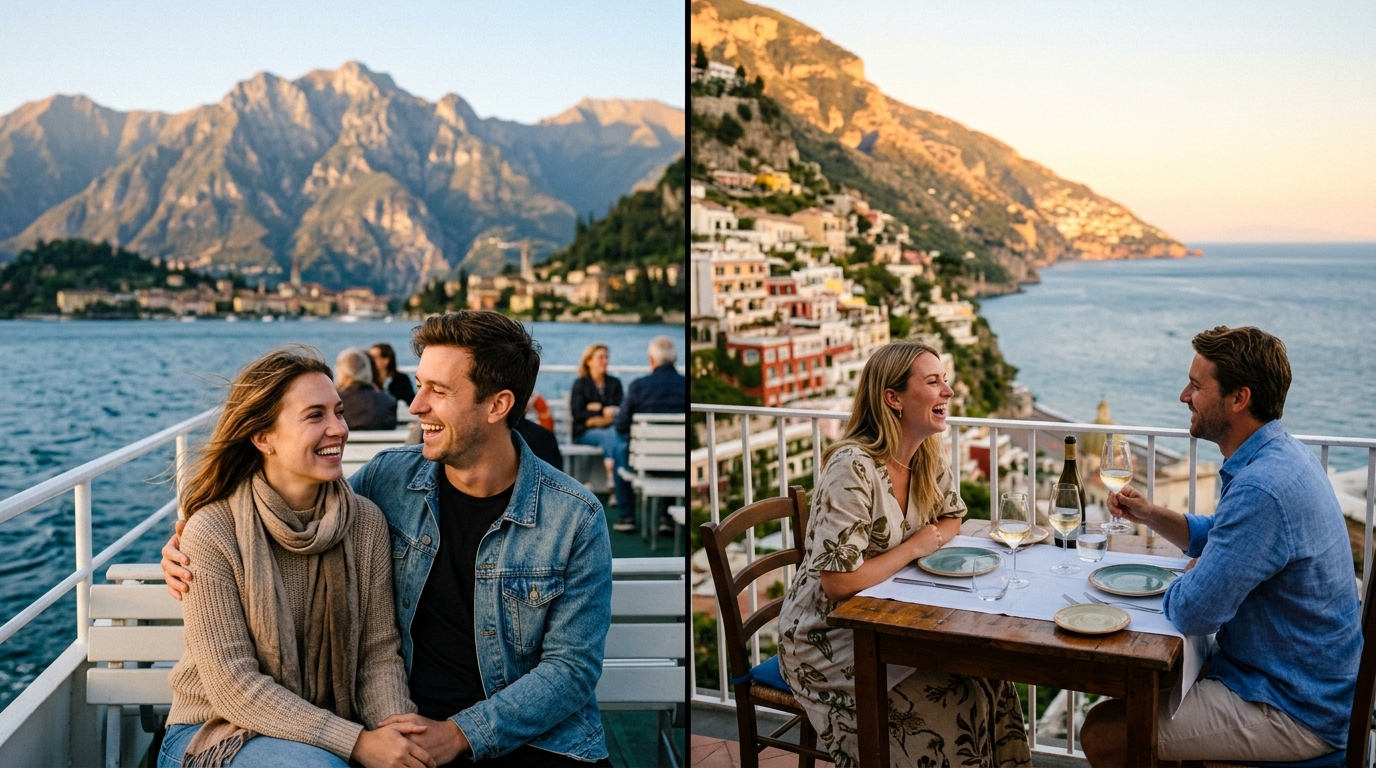
Choose Lake Como If You…
- Want easy, low-stress travel logistics. Train from Milan in 30-40 minutes, ferry network connecting all towns, no mountain roads required.
- Are traveling with family or have mobility limitations. Lake ferries are wheelchair-accessible. Flat lakeside promenades are pram-friendly. The Amalfi Coast’s hundreds of steps and narrow staircases make it genuinely difficult for anyone with mobility challenges.
- Have a tighter budget. Budget and mid-range spending runs nearly identical, but Como gives more value at luxury tier — and Como hotels are easier to find in all seasons.
- Want a slower, more contemplative trip. Como rewards doing less: sitting on a terrace watching the lake, taking the morning ferry, wandering villa gardens.
- Are based in Northern Europe. Countless direct flights land at Milan. Getting to Naples often requires a connection.
Choose Amalfi Coast If You…
- Want the most visually dramatic Italian scenery. Positano from the water, the cliff-face villages at dusk, the Path of the Gods — Amalfi Coast delivers iconic images that Como simply can’t match.
- Care deeply about food. Southern Italian cuisine — fresh seafood, sfusato lemons, Neapolitan pizza, handmade pasta — is a stronger culinary experience for most travelers.
- Want day trip options. Pompeii, Naples, Capri, Paestum — the Amalfi Coast sits within reach of some of Italy’s greatest historical and island destinations.
- Are visiting in shoulder season (May-June or September). The crowds thin out, the sea is warm enough, and the road is manageable. Amalfi in September is genuinely magnificent.
- Are on your honeymoon and want drama over serenity. Amalfi’s sunset views from Ravello or a private boat off Positano are genuinely hard to beat for romantic impact.
The honest summary: Lake Como is the smarter choice for first-time Italy visitors, families, and anyone who values ease over spectacle. Amalfi Coast is the better choice for food lovers, experienced Italy travelers, and anyone chasing that specific cliff-and-sea visual drama.
Frequently Asked Questions
Is Lake Como or Amalfi Coast better for a honeymoon?
Both work beautifully, but for different honeymoon styles. Lake Como suits couples who want peaceful luxury: private villa pools, sunrise ferry rides, and candlelit lakeside dinners. Amalfi Coast delivers dramatic romance: cliffside restaurants at sunset, private boat charters, and the visual spectacle of Positano. Amalfi costs significantly more in peak season — budget at least $1,090/day for a luxury Amalfi honeymoon versus $567/day at Como (GotripZI, 2026).
Is Lake Como more expensive than the Amalfi Coast?
At budget and mid-range tiers, costs are nearly identical: $127 vs $132 per person per day at budget level. Amalfi becomes substantially more expensive at the luxury end, with daily costs nearly double Como’s at $1,090 vs $567 (GotripZI, 2026). Positano’s 3-star hotels reach €250-450/night in summer, while Como’s 3-star average is around $134/night.
Which is easier to get to: Lake Como or Amalfi Coast?
Lake Como is significantly easier to reach. Milan Centrale connects to Como San Giovanni in 30-40 minutes by direct train (LakeComo Travel, 2025). The Amalfi Coast has no direct train access — travelers fly into Naples, then take a 1.5-2 hour bus or seasonal ferry along the coast (Rome2Rio, 2025). For travelers flying into Milan, Como is a 30-minute transfer. Amalfi from the same starting point takes the better part of a day.
What is the best time of year to visit each?
May-June and September-October are ideal for both destinations. Italy’s summer demand rose 17.9% in 2025 (Tourist Italy, 2025), making July and August increasingly uncomfortable at both sites. The Amalfi Coast is worse in peak summer: 2.3 million overnight stays in 2024 (a record) produce gridlocked roads and packed beaches. September is arguably the finest month at both — warm water, thinner crowds, and 20-30% lower accommodation rates.
Can you visit both Lake Como and Amalfi Coast in one trip?
Yes. The most practical routing is an open-jaw flight: fly into Milan Malpensa, spend 3-4 nights on Lake Como, take the train south through Rome to Naples (~€45-90 on Trainline), then base on the Amalfi Coast for 4-5 nights before flying home from Naples. Total trip of 10-12 days covers both destinations without backtracking. Book train tickets 2-4 weeks ahead for the best Frecciarossa fares.
Is Lake Como or Amalfi Coast better for families?
Lake Como is the clear family choice. The ferry network is accessible, lakeside paths are flat and pram-friendly, and towns like Menaggio have practical infrastructure (supermarkets, playgrounds). The Amalfi Coast’s steep staircases — hundreds of steps between terraces in Positano — make it genuinely difficult with young children or prams. Summer road traffic on the SS163 also means long, hot bus or car journeys between towns.
Which is more crowded?
The Amalfi Coast is more severely affected by overtourism. It recorded 5 million annual visitors and 2.3 million overnight stays in 2024 — its highest figure ever (Amalfi Cruises / Statista, 2025). A survey found 64% of Italy summer visitors experienced overtourism in 2025 (VisitItaly.eu, 2025). Lake Como has its own crowds — Bellagio ferry queues in August run 45-60 minutes — but the lake’s multiple towns and water routes spread visitors more effectively than the single coastal road can manage.
Which has better food?
The Amalfi Coast has the more distinctive regional cuisine. Southern Italian cooking — sfusato amalfitano lemons, fresh seafood pasta, Neapolitan pizza, handmade scialatielli — is bolder and more varied than Como’s Northern Italian menu of lake fish and risotto. Both are excellent regional cuisines, but the Amalfi Coast’s combination of seafood, artisan ingredients, and proximity to Naples gives it a clear edge for food-focused travelers.
The Bottom Line: Lake Como vs Amalfi Coast 2026
After comparing scenery, access, cost, crowds, activities, and food, neither destination is universally “better” — they are genuinely different experiences designed for different travelers.
Choose Lake Como if you prioritize easy travel logistics, value at every budget tier, family-friendly access, and serene Alpine lake scenery. The 30-minute Milan train connection makes it one of Italy’s most accessible resort destinations. Shoulder season (May-June and September) gives you full ferry service, open villa gardens, and manageable crowds.
Choose the Amalfi Coast if you want Italy’s most dramatic Mediterranean scenery, a stronger food culture, and access to major day-trip destinations like Pompeii and Capri. Go in May or September — the July-August crowd situation is genuinely difficult given 2.3 million annual overnight stays concentrated into a narrow coastal strip.
Want both? The open-jaw Milan-in, Naples-out routing makes a combined 10-12 day trip entirely practical. Book trains on Trainline 3-4 weeks ahead for best prices, and consider a rental car for the Amalfi coastal drive.
“complete Lake Como travel guide” → /lake como travel guide/
Start planning your Lake Como section with our complete Lake Como travel guide, then build the Amalfi itinerary around your train connections south.
Browse Lake Como hotels → | Browse Amalfi Coast hotels →
Check train routes on Trainline → | Compare Italy car rentals → | Get Italy eSIM on Airalo →
Citation Capsule
Lake Como and Amalfi Coast carry nearly identical budget daily costs in 2026 — $127 versus $132 per person — but diverge sharply at the luxury end, where Amalfi’s $1,090/day is nearly double Como’s $567/day. The Amalfi Coast recorded 2.3 million overnight stays in 2024, its highest figure on record, making it one of Italy’s most overtouristed coastal regions. (GotripZI, 2026; Amalfi Cruises / Statista, 2025)
Sources: GotripZI (2026) — daily budget figures; Rome2Rio (2025) — transit times; LakeComo Travel (2025) — Milan-Como rail times; Amalfi Cruises / Statista (2025) — overnight stay records; VisitItaly.eu (2025) — overtourism survey; Tourist Italy (2025) — demand growth data; machupicchu.org (2026) — Positano hotel pricing.