
Disclosure: Some links in this guide are affiliate links. If you book or buy through them, we may earn a small commission at no extra cost to you — it helps keep our guides free.
Ultimate Petra Travel Guide 2026: Tickets, Tips & Top Trails
Petra is one of those places that genuinely lives up to the hype — walking through the Siq canyon and watching the Treasury emerge from the rose-red rock is as breathtaking as every photograph suggests. We’ve put together the most complete, up-to-date guide so you arrive knowing exactly what to pay, where to go, and how to make the most of every hour inside the site.
Key Takeaways
– Petra’s entrance fee in 2026 is JOD 50 (approx. USD 70) for a one-day pass; a two-day pass is JOD 55 and three-day JOD 60 — dramatic value jump after day one. (Jordan Tourism Board, 2026)
– The site covers roughly 264 km2 with more than 800 individual monuments; most visitors only see about 5% of it. (UNESCO World Heritage List, 2025)
– Temperatures in June–August peak above 38°C (100°F) — visiting March–May or September–November is strongly recommended for comfort. (Jordan Meteorological Department, 2025)
– Over 1.1 million tourists visited Petra in 2024, a record high since the COVID dip. (Jordan Tourism Board, 2025)
– A Jordan eSIM from Airalo costs around USD 5–9 for 1 GB, keeping you connected for maps and offline guides without a physical SIM swap.
What Is Petra and Why Does It Still Deserve the Hype?
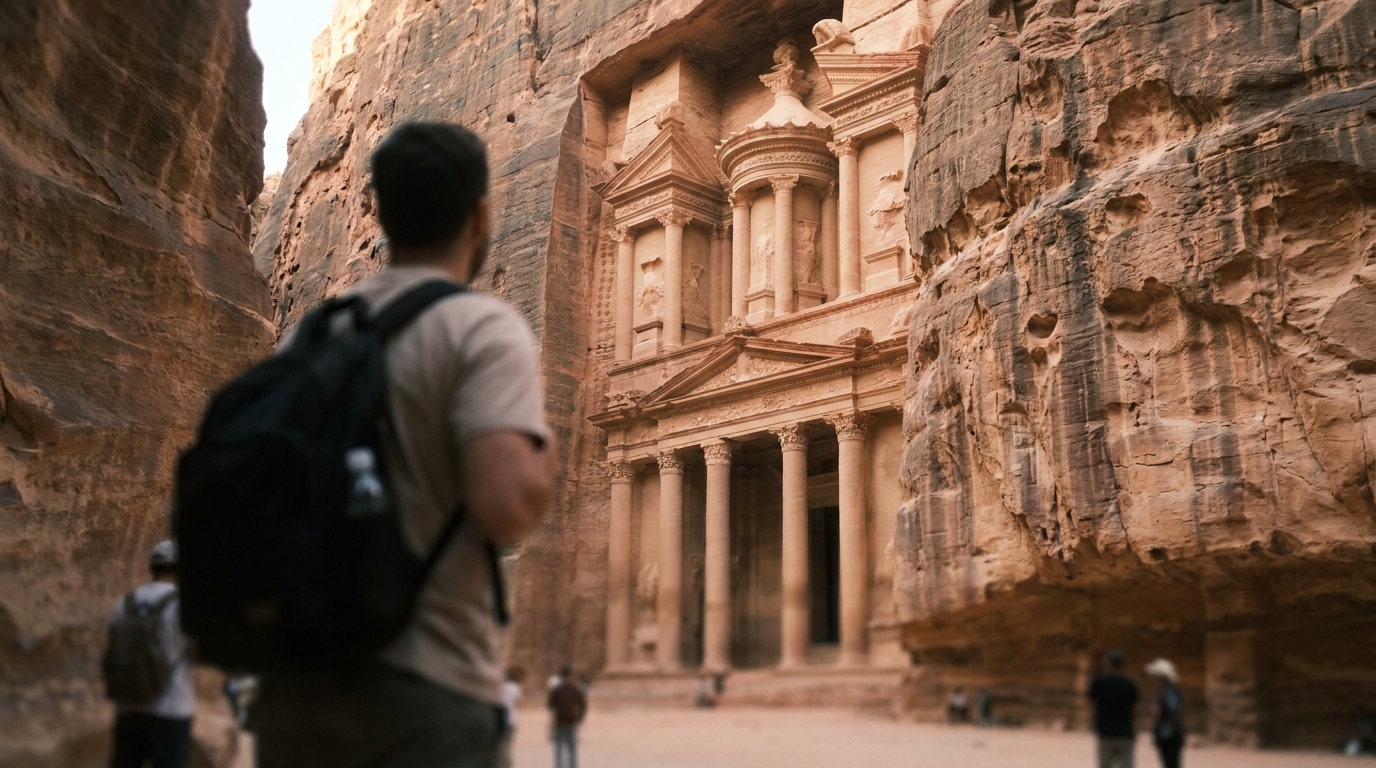
Petra earns its place on every serious traveler’s list because no photograph, however good, fully captures the scale and silence of the place. Carved almost entirely into sandstone cliffs by the Nabataean civilization around the 4th century BCE, the city reached its peak as a trade crossroads linking Arabia, Egypt, and the Mediterranean before it was absorbed into the Roman Empire in 106 CE. What remains is the largest archaeological site in the Middle East and one of the most visited UNESCO World Heritage Sites on the planet.
The famous Treasury — Al-Khazneh — is only the opening act. Beyond it, Petra unfolds over a vast desert valley with a colonnaded Roman street, dozens of royal tombs, an amphitheater that seated 8,500, a Byzantine church with remarkable floor mosaics, and the towering monastery Ad-Deir, perched at the top of 850 rock-cut steps. In short, you need more than one day.
What makes 2026 a particularly good year to visit: Jordan’s government has invested heavily in site infrastructure — new shade shelters, better wayfinding signage in English and Arabic, improved lighting along the Siq — following visitor-experience feedback. Crowd management is also tighter, with time-slotted entry for the Siq under trial at peak season.
For context on how Petra sits within a broader Jordan itinerary, read our Jordan travel guide and our breakdown of Wadi Rum tours and camps.
Petra Ticket Prices and Entry Rules in 2026
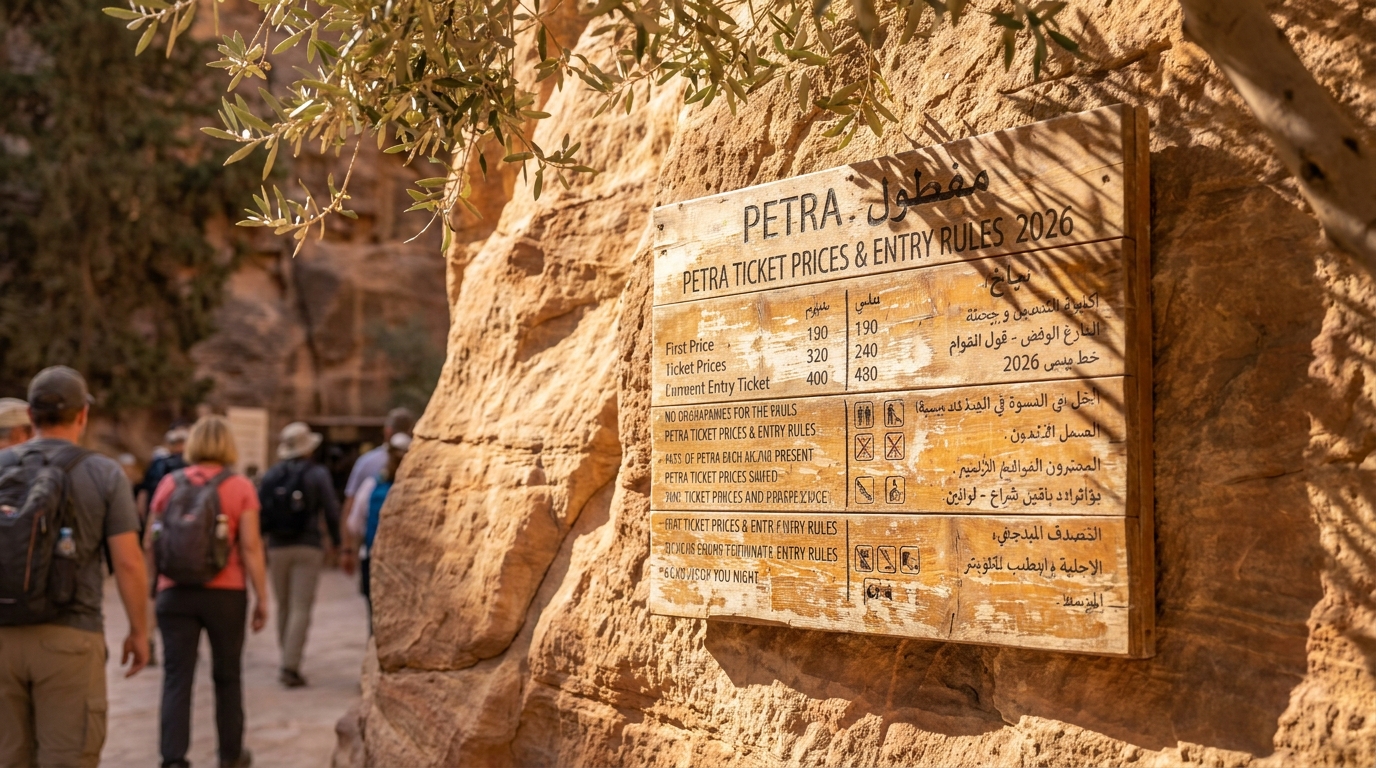
Tickets are non-negotiable, and 2026 prices are notably higher than 2023 levels — plan your budget accordingly. The Jordan Pass, which combines a Jordan visa fee waiver with multisite entry, remains the smartest option for most international visitors.
Standalone Petra Tickets (2026):
| Pass Type | Price (JOD) | Approx. USD |
|---|---|---|
| 1-Day | 50 | ~70 |
| 2-Day | 55 | ~77 |
| 3-Day | 60 | ~85 |
| Petra by Night (add-on) | 17 | ~24 |
| Children under 12 | Free | Free |
Jordan Pass (purchased online before arriving): starts at JOD 70 for a 1-night visa waiver + 1-day Petra entry, scaling to JOD 80 for a 3-day Petra entry. If you’re flying into Amman and spending at least three nights in the country, the Jordan Pass almost always works out cheaper than paying visa plus ticket separately. You buy it online at jordanpass.jo before you land. You can compare flights on Aviasales to find the cheapest dates and routes.
Practical entry rules:
- The main gate opens at 06:00 and closes at 18:00 (last entry 17:00 in practice).
- Tickets must be purchased at the Petra Visitor Center in Wadi Musa — no third-party resellers have authorised physical tickets, though some tour packages include entry.
- You can re-enter on the same ticket on the same day.
- Photography is unrestricted within the archaeological zone; drone permits require advance application through the Petra Development & Tourism Region Authority (PDTRA).
We recommend booking a guided tour through GetYourGuide or Klook if it’s your first visit — a knowledgeable Jordanian guide unlocks context that transforms a walk past rocks into a genuinely moving historical experience. Half-day and full-day guided Petra tours are widely available from USD 35–65 per person.
Getting to Petra: Flights, Buses, and Road Transfers
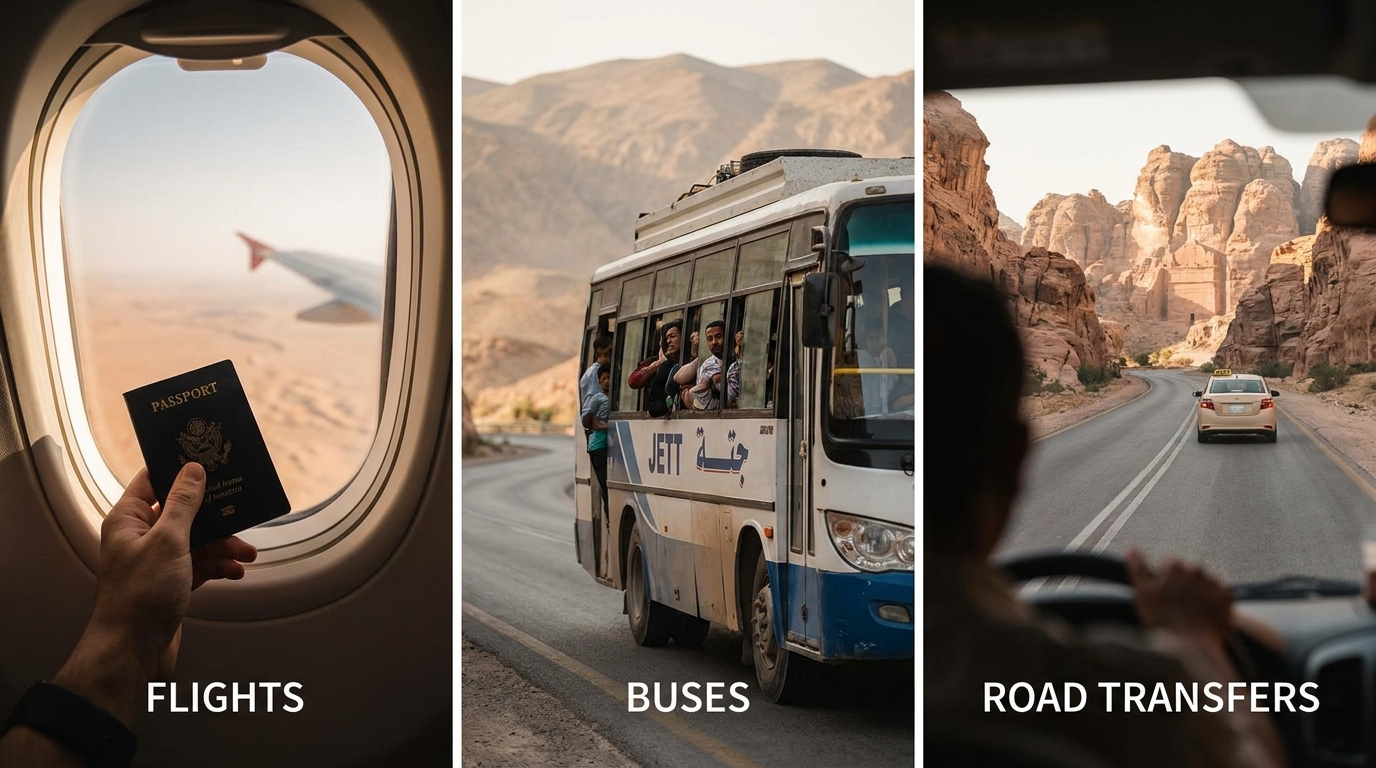
Petra is reached via the town of Wadi Musa, which sits adjacent to the visitor center. Most travelers fly into Queen Alia International Airport in Amman (AMM) or, less commonly, Aqaba’s King Hussein International Airport (AQJ) in the south.
From Amman: The JETT bus company runs a daily coach from Amman’s 7th Circle station directly to Wadi Musa for about JOD 10 each way — it departs at 06:30 and takes 3–3.5 hours. Private taxis and transfer services charge JOD 60–80 for the same journey. Renting a car via Discover Cars and driving the Desert Highway yourself takes about 3 hours and gives you freedom to stop at Wadi Rum en route; rates from around USD 30/day for a compact vehicle.
From Aqaba: Aqaba is only 120 km from Petra, making it the closest city. A shared minibus (servis) costs around JOD 5 but timings are inconsistent. A private taxi runs JOD 40–55. Renting a car in Aqaba via Discover Cars is also practical, especially if you’re crossing the border from Israel or arriving by Red Sea cruise.
From Amman by organized tour: Day trips from Amman are possible but we don’t recommend them — the 6-hour round trip eats your site time, and Petra genuinely needs at least two days. Overnight tours that include accommodation in Wadi Musa make far more sense and are bookable on GetYourGuide from USD 120 per person including transport and hotel.
Getting a local SIM: Before you leave Amman airport, pick up a Zain or Orange SIM (around JOD 5 with data). Alternatively, buy a Jordan eSIM through Airalo before you fly — plans start at USD 5 for 1 GB, and you can activate it the moment you land without queuing at a kiosk.
For cross-region connections, our Dead Sea Jordan guide and Amman city guide cover the wider itinerary.
Find your Petra hotel on the map
Live prices from Booking & Airbnb — tap a pin to compare stays around Wadi Musa and beyond.
Where to Stay in Wadi Musa and Petra
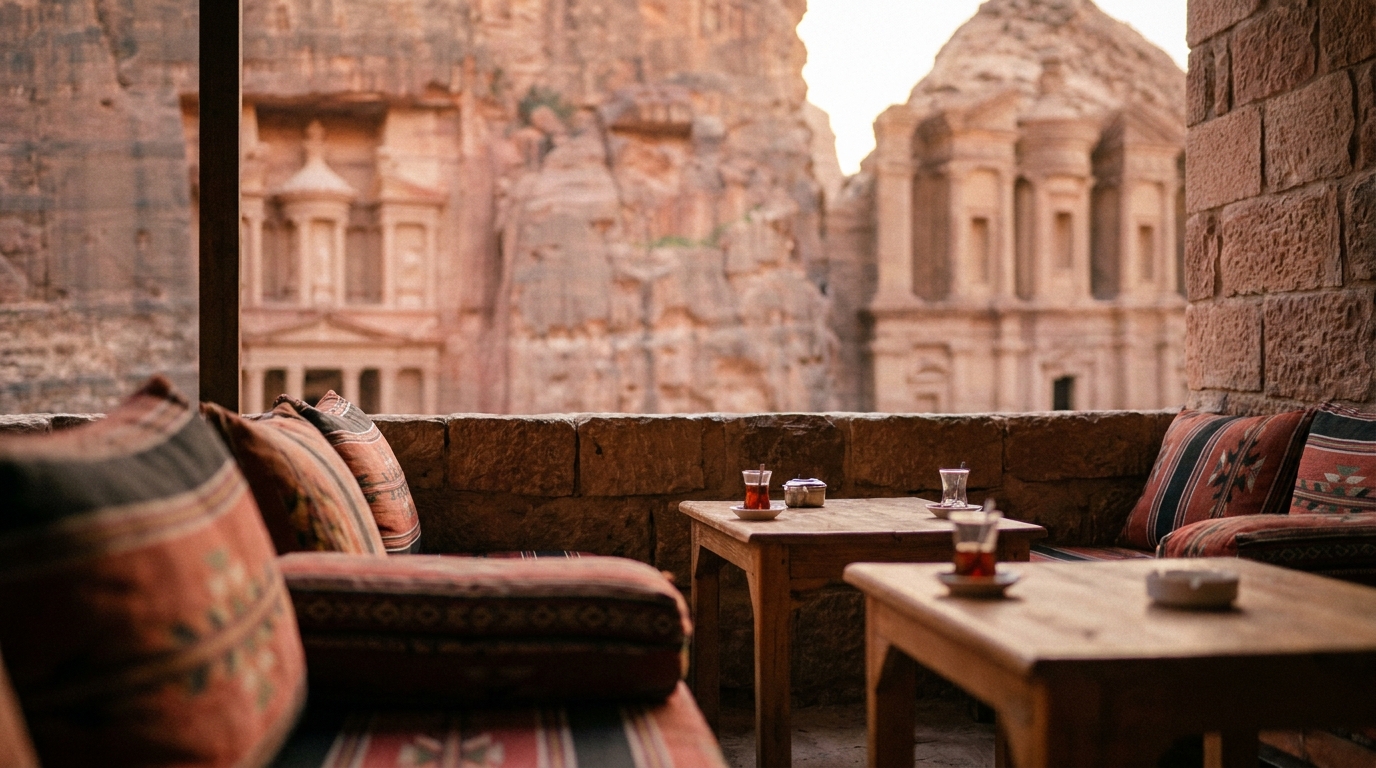
Wadi Musa is the only realistic base, and it has a surprisingly wide range of accommodation — from five-star infinity-pool hotels overlooking the valley to JOD 10/night guesthouses popular with backpackers. Booking well in advance matters in spring (March–May) and autumn (September–October), when rooms sell out weeks ahead.
Top tier: Mövenpick Resort Petra sits literally at the entrance to the archaeological park — you can walk to the gate in 90 seconds. Rooms start around USD 180–220/night in 2026 shoulder season. Petra Marriott has similar proximity with strong views from upper-floor rooms; rates from USD 160. Book both on Booking.com for the best flexible rate options.
Mid-range: Rocky Mountain Hotel and Petra Moon Hotel both offer clean, comfortable rooms with breakfast for USD 60–90/night. The rooftop restaurant at Petra Moon gives you a view over the valley that you’re not paying luxury prices for. Movenpick’s sister property, La Maison Hotel, is slightly cheaper at USD 100–130.
Budget: Cave Bar & Hostel is a genuine experience — a 2,000-year-old Nabataean cave converted into a bar and hostel, beds from around USD 20/night. Sella Hotel and Orient Gate Hotel are solid midrange-budget picks from USD 35–55/night.
Outside Wadi Musa: Some travelers stay in a Bedouin camp inside the park itself, accessed via Little Petra. These are basic setups — mattresses, shared facilities, fire pits — and entirely unlike a hotel, but the experience of waking up inside the archaeological zone is extraordinary. Ask at the visitor center or look on Booking.com under “Petra Bedouin camp.”
One logistical tip: rooms on the upper town side of Wadi Musa tend to be cheaper but add 15–20 minutes of walking to reach the visitor center. If you’re planning an early start — and you should, more on that below — proximity to the gate is worth paying for.
The Main Petra Trails: What to Do on Day One, Day Two, and Day Three
Most visitors spend one day and miss 95% of the site. Here’s how we’d structure each day if you have the time.
Day One — The Classic Route (10–12 km, 5–7 hours)
Start at the visitor center no later than 06:30 to beat tour groups. Walk the Siq (1.2 km of canyon corridor) as the morning sun begins to illuminate the walls — the light at 07:00–08:30 is exceptional. The Treasury appears at the end; spend time here before the masses arrive. Continue down the main colonnaded street past the Nymphaeum, Temenos Gateway, and the Great Temple. Climb to the Royal Tombs on the eastern cliff face for elevated views across the valley. Eat lunch at Basin Restaurant inside the park (full meals JOD 10–14, the hummus is worth it).
In the afternoon, tackle the High Place of Sacrifice trail: 45 minutes up, an exposed ridge with panoramic views, and ancient rock altars. Return via the Wadi Farasa gorge for canyon scenery most visitors never see.
Day Two — The Monastery (Ad-Deir) and Little Petra (8–10 km, 5–6 hours)
The Monastery is the other iconic monument and outranks the Treasury in terms of sheer scale — its facade is 47 meters wide and 48 meters tall. Reach it via 850 steps carved into the rock, about 50 minutes from the valley floor. Start by 07:00 to be there before the heat peaks. Bring plenty of water; this trail is exposed. The viewpoint above and to the left of Ad-Deir gives you the classic photograph with the monument framed against the desert valley.
In the afternoon, take a taxi or arrange a guided tour to Little Petra (Siq al-Barid) — a smaller, largely crowd-free Nabataean town 9 km north, included in the main Petra ticket. The painted dining room ceiling here is genuinely remarkable.
Day Three — Off-the-Beaten-Path Trails
If you have a third day, hire a local guide for the Wadi Muthlim canyon route (an alternative approach to the Treasury through a narrower, wilder canyon), the Jabal Haroun hike to the Tomb of Aaron (a full-day, 12 km round trip), or the Columbarium and Snake Monument area that most visitors walk straight past. These routes are not well-signed and a guide is genuinely necessary; GetYourGuide and Klook list certified local guides from USD 40–60 for a half day.
Petra by Night: Is It Worth It?
Petra by Night runs every Monday, Wednesday, and Thursday. You pay a JOD 17 add-on fee, enter the site at 20:30, and walk the Siq by the light of 1,800 candles to the Treasury, where Bedouin music plays in the dark. The experience lasts about 90 minutes.
Honest assessment: the atmospheric value is real — the Siq by candlelight is genuinely eerie and beautiful, and the Treasury lit from below looks completely different from the daytime version. However, the crowd management has been uneven in past seasons; you can end up shuffling through in a dense queue rather than experiencing a contemplative walk.
Our recommendation: go if you can book early tickets (limiting crowds) and if you’re staying multiple nights anyway. Don’t make it the centerpiece of a single-night visit.
Food, Drink, and Practical Tips Inside Petra
Eating inside the site is more manageable than most archaeological parks its size. The Basin Restaurant at the base of the Ad-Deir trail is the main option — sit-down meals, shade, reliable food. Smaller tea stalls dot the route every 20–30 minutes run by Bedouin vendors; the mint tea is excellent and stopping to chat is culturally appropriate (a small tip or purchase is polite). Avoid the overpriced souvenir stalls immediately around the Treasury.
Water: Bring at least 2 liters per person for a half day, 3+ liters for a full day in summer. Water bottles sold inside the park cost JOD 1–2; filling your own bottle at the visitor center fountain saves money and plastic.
Dress code: Petra is a Jordanian archaeological site, not a strictly religious space, so there’s no formal dress code. That said, covering shoulders and knees shows cultural respect and protects you from the sun. In summer, a wide-brim hat and UV-rated long-sleeve shirt are practical necessities, not niceties.
Hiring a horse, donkey, or camel: Short horse rides are included in the entry ticket from the gate to the start of the Siq — take advantage of this. Longer donkey rides up to the Monastery are optional and cost JOD 20–40. Be aware that animal welfare practices at Petra have been criticized by international organizations; choose carefully and don’t engage with aggressive touts.
ATMs and currency: There’s an ATM at the visitor center and in Wadi Musa town. US dollars and euros are widely accepted in hotels, but having Jordanian Dinar for smaller vendors, tea stalls, and transport is essential. Many card terminals work but connectivity inside the park is patchy; carry cash.
Photography timing: The Treasury faces east, meaning morning light (06:30–09:00) is ideal for front-lit photography. Afternoon light (15:00–17:00) illuminates the Royal Tombs beautifully. Avoid midday, which bleaches color and creates harsh shadows.
For a wider perspective on the region, our Israel and Jordan combined itinerary covers border crossings, visa strategy, and how to link both countries efficiently.
Health, Safety, and When to Visit Petra
Petra is one of the safest destinations in the Middle East for international travelers. Jordan has maintained political stability and a strong tourist infrastructure. Petty crime is rare inside the site; the main risk is hard-sell pressure from vendors, which is manageable with a polite but firm “la, shukran” (no, thank you).
Best time to visit:
| Month | Avg High Temp | Crowds | Notes |
|---|---|---|---|
| March–May | 20–28°C (68–82°F) | High | Best weather; book rooms early |
| June–August | 33–39°C (91–102°F) | Medium | Very hot; start by 06:30, rest midday |
| September–November | 22–32°C (72–90°F) | High | Excellent; October is peak quality month |
| December–February | 8–16°C (46–61°F) | Low | Cold, can rain or snow; quietest and cheapest |
Health:
- No vaccinations are specifically required for Jordan, but hepatitis A and typhoid are recommended by most travel health advisors.
- Travel insurance covering medical evacuation is strongly advised — the nearest major hospital is in Aqaba or Amman.
- Flash flooding can occur in the Siq during heavy rain (rare but serious). The visitor center will close the Siq if risk is assessed as high; follow staff instructions and don’t attempt to enter a flooding canyon.
- Sun and heat exhaustion are the most common health issues. Drink water consistently, not just when thirsty. If hiking to the Monastery in summer, early start is not optional — it’s a medical necessity.
Connectivity: Mobile signal in Petra is intermittent. Download offline maps (Maps.me and Google Maps both have Petra data) and consider saving a PDF of your tickets. The Airalo Jordan eSIM works on Zain’s network, which has better coverage in Wadi Musa than some competitors.
Frequently Asked Questions
How much does it cost to visit Petra in 2026?
A one-day entry ticket costs JOD 50 (around USD 70). A two-day pass is JOD 55 and a three-day pass JOD 60 — the marginal cost of extra days is tiny, so we strongly recommend buying at least two days. Children under 12 enter free. The Jordan Pass (from JOD 70) bundles Petra entry with a Jordan visa waiver and is better value for most international visitors staying three nights or more.
How many days do I need in Petra?
Two days is the realistic minimum to see the major monuments — the Treasury, Royal Tombs, Colonnaded Street, and Monastery. Three days lets you explore lesser-visited areas like the High Place of Sacrifice, Wadi Farasa, and Little Petra without rushing. One-day visitors see the highlights but leave with the nagging sense they’ve only scratched the surface, which is entirely accurate.
Is Petra safe for solo female travelers?
Petra is generally safe for solo female travelers. Jordan ranks among the more progressive countries in the region regarding tourist safety, and the site is well-staffed with PDTRA rangers. Verbal attention from vendors can be persistent but is rarely threatening. Dress conservatively, respond firmly to unwanted attention, and connect with other travelers at your guesthouse if you’d prefer company for evening walks in Wadi Musa. The main Petra trail during site hours is never isolated.
What should I wear to Petra?
Lightweight, breathable clothes that cover your shoulders and knees work best — practical sun protection that also fits the cultural context. Comfortable closed-toe walking shoes with ankle support are essential; the terrain is uneven rock and packed sand for 10+ km. A wide-brim hat, sunglasses with UV protection, and sunscreen (reapply every 90 minutes in summer) are non-negotiable. Bring a light layer for early mornings, which can be cool even in summer.
Can I visit Petra and Wadi Rum on the same trip?
Yes, and we’d argue you should — the combination is spectacular. Wadi Rum is roughly 100 km southeast of Petra via Aqaba or the Desert Highway. Most travelers do 2 nights in Wadi Musa for Petra, then transfer to Wadi Rum for 1–2 nights in a Bedouin desert camp. Discover Cars makes it easy to rent a car for this loop. Alternatively, guided combo tours from GetYourGuide cover Petra and Wadi Rum in a single 3-day package from Amman. See our full Wadi Rum guide for camp options and safari prices.
Is Petra by Night worth the extra cost?
For most visitors, yes. The JOD 17 add-on for 1,800-candle illumination of the Siq and Treasury is a unique experience you can’t replicate during daylight hours. The limitations are real — it runs only three nights a week, the crowd flow can be slow, and photography in low light is challenging. If you’re already staying multiple nights, add it. If you’re on a single-night visit, prioritize a very early morning start instead for the same sense of solitude and dramatic light.
Do I need a guide to visit Petra?
You don’t need a guide to enter Petra, but the site’s depth makes a guide enormously valuable for at least one day. A certified Jordanian guide explains Nabataean history, points out details invisible to the untrained eye, and navigates you efficiently to see more in less time. For the Monastery day, off-trail routes, or the alternative Wadi Muthlim canyon entry, a guide is strongly advisable.
Final Thoughts: Making Petra Yours in 2026
Petra rewards preparation and punishes rushing. The visitors who leave disappointed are almost always the ones who arrived on a single-day bus tour from Amman, caught the Treasury at noon surrounded by crowds, and left by 15:00. The visitors who leave transformed are the ones who watched the sunrise paint the Siq walls in gold, climbed to Ad-Deir before the heat built, and ate Bedouin bread with mint tea at a trail-side stall in total quiet.
Book your tickets through the Jordan Pass before you fly, secure accommodation close to the gate on Booking.com, grab a GetYourGuide day tour for your first morning with a local guide, and pick up a Jordan eSIM from Airalo so you’re never navigating blind. Then give yourself two days minimum — ideally three — and let the city reveal itself at its own pace.
For your complete Jordan planning, start with our Jordan itinerary 10 days guide and our Amman travel guide, then loop back here with your specific questions.
Petra is ready. The only question is whether you’ve given yourself enough time to do it justice.